
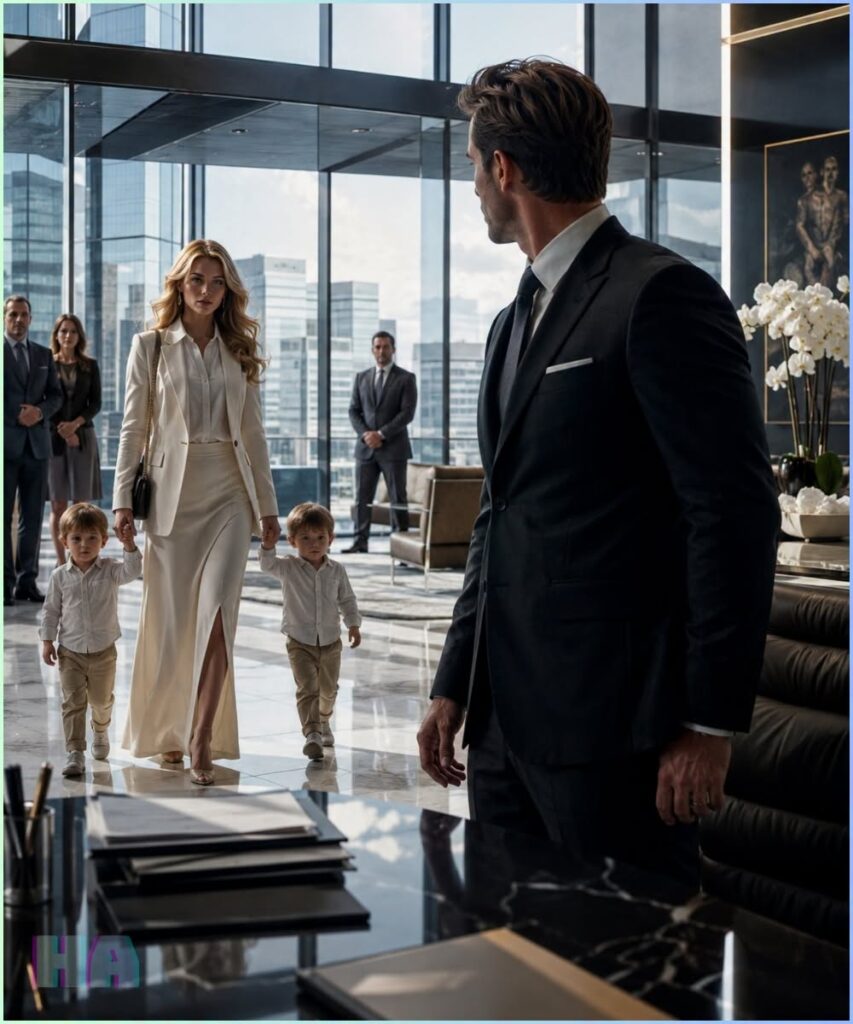
The Billionaire Boss Froze When His Ex Walked Past With Twins Who Had His Eyes, but the Birth Certificates Hid the Betrayal Inside His Own Empire
Miles Harrington had spent fifteen years teaching steel and glass how to touch the sky, but on New Year’s Eve, beneath the glittering towers that carried his name, one small boy looked across a frozen Manhattan street with Miles’s unmistakable gray eyes—and brought the billionaire boss’s entire empire crashing down inside him.
Miles had left two hundred guests in his Central Park penthouse without saying goodbye. Champagne was still flowing beneath crystal chandeliers, a jazz quartet was still playing for investors and celebrities, and his mother was probably smiling through clenched teeth while explaining that the founder of Harrington Urban Design had been delayed by an urgent international call.
There was no call.
Miles had simply walked out.
At forty-two, he owned more than most men could imagine and less than he had ever admitted needing. His firm had transformed abandoned waterfronts into thriving neighborhoods, raised towers in Chicago, Boston, Seattle, and New York, and made his signature as recognizable in business circles as the buildings themselves. Financial magazines called him the architect who had built a billion-dollar kingdom from a rented room and one borrowed drafting table.
Yet as he wandered through Lower Manhattan in a charcoal coat over his tuxedo, he felt like a trespasser in his own life.
Couples passed him laughing, arms linked against the cold. Parents carried sleepy children toward subway stations before midnight. Restaurant windows glowed with candlelight and warmth. Everywhere he looked, people seemed to be hurrying toward someone.
Miles had nowhere he wanted to go.
His phone buzzed again.
Rebecca Sloan, his executive assistant.
Where are you? Your mother is asking. The Hudson investors leave at twelve fifteen.
Miles silenced the phone and stopped in front of a narrow French restaurant tucked between two brownstones. The brass sign above the door read Colette.
He had not been there in two years.
Claire Bennett had loved the corner table near the kitchen because she could watch the pastry chef work through a small window in the swinging door. Miles had preferred the private table upstairs, where clients and photographers could not see him. Claire had teased him for treating dinner like a classified operation.
“You know,” she had once said, dipping a piece of bread into olive oil, “most people come to restaurants to enjoy themselves.”
“I enjoy privacy.”
“You enjoy control.”
“There’s a difference.”
“Not when you’re you.”
Then she had smiled, and Miles had forgotten what argument he had been preparing.
Claire had never been impressed by his money. When they met, she was a thirty-year-old freelance illustrator living in a cramped Brooklyn studio with exposed pipes, secondhand furniture, and enough plants to qualify the apartment as a greenhouse. She charged too little for her work, forgot to invoice clients, and sketched strangers on subway platforms because she believed every face contained a story.
Miles had fallen in love before he realized he was falling.
Four years later, she left him without slamming a door or throwing a glass.
That had made it worse.
“I don’t want your penthouse,” she had told him on their final evening. “I don’t want vacations you attend through video calls. I don’t want apologies delivered with jewelry. I want breakfast with someone who is actually at the table.”
“I’m building something that won’t come twice.”
“Neither will I.”
He had stared at her, wounded pride rising faster than honesty.
“You knew who I was.”
“I knew who you could be.”
“And now?”
“Now I know who you keep choosing to be.”
They had spent one final night together, not because either believed the relationship could be saved, but because love did not disappear merely because hope had failed. The next morning, Claire kissed him at the door, whispered that she hoped one day he would find something he could not bear to leave, and walked away.
For nearly two years, they had not spoken.
Standing outside Colette, Miles could still remember the warmth of her hand in his. He could also remember how quickly he had buried the loss beneath acquisitions, contracts, and eighteen-hour days.
He turned from the restaurant before memory could pull him inside.
That was when he saw her.
Across the street, Claire stepped out of a children’s boutique wearing a cream-colored coat and a dark green scarf. Her honey-blond hair, once usually twisted into a careless knot, fell in waves over her shoulders. She looked older, though not diminished—stronger around the mouth, more tired around the eyes, and somehow more beautiful because the softness he remembered had been joined by something unshakable.
She carried a child in each arm.
Twins.
They wore matching navy snowsuits and knitted caps with tiny white stars. The girl rested sleepily against Claire’s right shoulder. The boy on her left twisted around to stare at the traffic, his small face illuminated by a streetlamp.
Miles stopped breathing.
The child had his eyes.
Not merely the same color. The same intense, steady gaze. The same slight narrowing when trying to understand something unfamiliar. Even the shape of the brow resembled photographs of Miles as a toddler that his mother kept locked in an album no one was permitted to touch.
Claire adjusted the boy against her hip and began walking toward the crosswalk.
Miles’s mind rejected what his body already knew.
They appeared to be sixteen or seventeen months old.
He calculated backward.
Their final night.
The week afterward, when Claire had called once and hung up before he answered.
The months when Rebecca had filtered every personal message because Miles had told the entire office he did not want distractions.
The two years of silence.
Claire reached the opposite sidewalk. She looked down at the girl, who had begun to fuss, and murmured something tender. Then she raised her head.
Her eyes met Miles’s.
The color vanished from her face.
She did not look guilty. She looked like a woman watching a storm she had feared for nearly two years finally reach shore.
Miles crossed the remaining distance without remembering the movement.
“Claire.”
She drew the twins closer. “Miles.”
Fireworks began exploding over the East River, early bursts of gold and red scattering against the dark. People cheered from rooftops. A passing couple kissed beneath a shop awning.
Miles heard none of it.
He stared at the children. “How old are they?”
Claire swallowed. “Seventeen months.”
The answer struck him with physical force.
“Are they mine?”
“What did she say?”
“That you had received my package. That you believed contacting you through a pregnancy announcement was manipulative. She said you would provide financial support if paternity was confirmed, but that you did not want personal involvement.”
Miles’s coffee cup struck the saucer as his hand tightened around it.
“I never said any of that.”
Claire’s composure cracked. “I know that now.”
“How?”
“Because of your face when you saw them.”
For a moment, neither spoke. Miles could hear the faint hiss of the espresso machine and the distant roar of the city counting down the final minutes of the year.
“Why didn’t you confront me directly?” he asked.
“I came to your office.”
“When?”
“March fourth. Ten thirty in the morning. I was almost four months pregnant and barely showing. Security wouldn’t let me upstairs. Rebecca came to the lobby. She told me you were presenting to the Hudson board and threatened to have me removed if I created a scene.”
Miles remembered that day. The Hudson presentation had secured the largest contract of his career. His mother had attended. Rebecca had managed access to the executive floor. Miles had worked until midnight and celebrated by himself with a drink in his office.
Claire’s voice grew quieter. “Rebecca gave me an envelope containing a proposed confidentiality agreement and a blank check. I tore both in half and left.”
Miles felt sick. “Do you still have them?”
“The torn agreement, yes. I kept it because part of me knew I might need proof one day. The letter said the offer came from Harrington Urban Design’s executive office.”
“I didn’t authorize it.”
“I believed you had.”
“I would never have abandoned my children.”
“You abandoned me every day for four years, Miles.”
The truth silenced him.
Claire wiped a tear before it could reach her jaw. “I’m not saying what happened was fair to you. It wasn’t. But at the time, I thought you had made your decision. I refused the money, moved in with my mother for six months, and built a life that didn’t depend on you.”
Miles looked at Julian and Ivy. Seventeen months of first cries, first smiles, illnesses, sleepless nights, birthdays, and ordinary mornings he could never recover.
“Did you put my name on their birth certificates?”
Claire hesitated.
“No.”
Pain moved through him so sharply that he had to look away.
“You erased me.”
“I thought you had erased yourself.”
The countdown outside reached ten.
Customers near the front window began shouting the numbers.
Miles leaned closer. “I deserve a chance to know them.”
Claire’s eyes hardened with fear. “You deserve the truth. A chance is different.”
“They are my children.”
“They are children, Miles. Not a deal you can reclaim because you discovered someone mishandled the paperwork.”
“That isn’t what I’m doing.”
“Isn’t it? You’ve known about them for twenty minutes, and already you’re speaking as though wanting them gives you the right to enter their lives on your terms.”
“I lost seventeen months.”
“So did they. But they don’t understand loss yet. They understand routine. Safety. People who stay.”
The city erupted as midnight arrived. Fireworks filled the windows with color. Ivy startled and began to cry. Claire lifted her immediately, holding the girl against her chest while Julian watched with wide eyes.
Miles’s phone vibrated repeatedly inside his coat. He removed it, saw forty-three missed calls, then turned it off and placed it face down.
Claire noticed.
“I want to meet them,” he said. “Slowly. However you decide is safest.”
Her gaze remained guarded. “And your company?”
“It can survive one day without me.”
“That wasn’t my question.”
Miles looked at the twins, then at the woman he had loved and failed. “I don’t know how to fix two years in one night.”
“You can’t.”
“Then let me begin tomorrow.”
Claire was silent for a long time. Finally, she wrote an address on a napkin.
“Two o’clock. They nap until around two thirty. Don’t arrive with photographers, lawyers, or a fleet of black cars.”
“I won’t.”
“And don’t bring a truckload of expensive toys.”
Miles glanced away.
“You already planned to.”
“I was considering a reasonable number.”
“They need a father, not a department store.”
He almost smiled, then remembered how much pain stood between them.
Claire gathered the twins and left the café. Through the window, Miles watched her disappear into the first morning of the new year with his son and daughter.
Only after she was gone did he turn on his phone.
The first message was from his mother.
Your behavior tonight was unacceptable. Come home immediately.
The second came from Rebecca.
The Hudson investors are furious. I told them you had a medical emergency.
Miles typed one question.
Did Claire Bennett send me a letter two years ago?
The typing indicator appeared, vanished, and appeared again.
Then Rebecca’s reply came.
I don’t know what you’re talking about.
Miles looked through the café window toward the street where Claire had disappeared.
For the first time in his career, he recognized a lie before he had gathered the evidence to prove it.
The next afternoon, Miles stood outside Claire’s Park Slope brownstone holding one modest paper bag. Inside were two board books, a wooden train, and a stuffed fox. He had spent nearly an hour in the children’s store before asking a sales clerk what a seventeen-month-old might actually enjoy.
Claire opened the door before he rang.
“Were you planning to stand there until they graduated?”
“I was preparing.”
“You run meetings with governors and billionaires.”
“None of them have my nose.”
A reluctant softness touched her face. “Come in.”
The apartment was small, warm, and full of evidence that life had continued without him. Children’s drawings covered the refrigerator. Colorful bins lined one wall. A worn couch faced a low bookshelf packed with picture books. Framed photographs showed Claire pregnant, Claire holding two newborns in a hospital bed, the twins smashing cake on their first birthday.
Miles paused before the hospital photograph.
Claire stood beside him. “They came five weeks early. Julian spent nine days under observation. Ivy spent twelve.”
“Were they in danger?”
“For a while.”
“Who was with you?”
“My mother. My friend Natalie. No one who had promised me anything.”
The words were not spoken cruelly. That made them hurt more.
Crying came from the small nursery.
Claire entered first. Miles followed and stopped in the doorway.
Julian stood gripping the crib rail, face red with distress. Ivy bounced in the second crib, calling, “Mama, Mama,” until Claire lifted her.
Julian saw Miles and retreated to the far corner.
“He doesn’t like strangers,” Claire said.
“I’m not—” Miles stopped himself. To Julian, he was exactly that. “May I stay here?”
Claire nodded. “Don’t reach for him. Let him decide.”
Miles lowered himself to the rug beside the crib.
“Hello, Julian. I’m Miles.”
The boy stared at him suspiciously.
Miles picked up the wooden train he had brought and rolled it slowly across the floor. Julian’s crying weakened. His eyes followed the wheels.
“I’m told trains are interesting.”
Julian looked at Claire.
“It’s okay,” she said. “You can look.”
Miles rolled the train again. After several minutes, Julian approached the rail. He extended one hand through the bars.
Miles placed the train within reach.
Julian took it, examined it, then held it back toward Miles.
“You want me to do it again?”
Julian nodded.
For the next ten minutes, the founder of one of America’s most powerful design firms rolled a wooden train beneath a crib while his son watched. When Claire finally lifted Julian out, the boy remained stiff in her arms but did not cry.
Miles held out his hand.
Julian touched one finger, then another. His curiosity overcame caution, and he leaned toward Miles’s face. Tiny fingertips pressed against Miles’s cheek and moved upward until they found his nose.
Julian squeezed.
Claire laughed.
The sound struck Miles with the force of memory.
“What?” he asked.
“He’s obsessed with noses.”
Julian squeezed again. Miles made a ridiculous honking sound. The boy’s eyes widened, then he giggled.
Ivy laughed because Julian did.
Miles laughed because both of them did.
For one impossible second, the room contained no betrayal, no lost years, and no fear. It held only four people connected by something fragile enough to break and strong enough to have survived silence.
Then Julian reached urgently for Claire.
“Mama.”
Miles handed him back at once.
The ache of rejection surprised him.
Claire saw it. “He came closer than he does with most people.”
“I’m his father.”
“Biology doesn’t create familiarity. Time does.”
“Then I’ll give him time.”
Claire studied him. “How much?”
“All of it.”
The first test came less than an hour later.
Miles was cutting strawberries while Claire strapped the twins into their high chairs. His phone buzzed repeatedly.
Rebecca.
Urgent. Singapore consortium withdrawing. Conference call in ten minutes.
Claire glanced at the screen.
“You should answer.”
“No.”
“Miles, losing a major client to prove a point is not responsible.”
“I’m not proving a point.”
“Then what are you doing?”
He switched off the phone. “Having lunch with my children.”
The Singapore consortium withdrew that afternoon.
Within three weeks, Miles had missed fourteen meetings, canceled a trip to California, and delegated three presentations he once would have considered impossible to entrust to anyone else. His chief operating officer, Robert Chen, adjusted faster than expected. The board did not.
Miles kept returning to Brooklyn.
He learned that Ivy refused green vegetables unless they were mixed with applesauce. Julian needed the same stuffed elephant for every nap. Both twins loved Miles’s deep reading voice, even when he turned simple picture books into dramatic performances with accents Claire called terrible.
He learned to change diapers, install car seats, prepare bottles, and distinguish the cry of hunger from the cry of exhaustion. He learned that parenthood did not resemble a grand decision. It was a thousand tiny choices made while tired.
Some evenings, Claire watched him with cautious hope.
Other evenings, she watched the clock, waiting for him to leave.
One night, after Miles had spent twenty minutes persuading Ivy to sleep, he found Claire in the kitchen staring at the torn confidentiality agreement she had retrieved from a locked box.
He read it twice.
The document had been drafted on Harrington letterhead. It offered Claire a seven-figure payment in exchange for permanently surrendering any claim, public or private, against Miles or the company. It also required that any child resulting from their relationship never use the Harrington name.
At the bottom was an electronic authorization code assigned to the executive office.
“This code can be traced,” Miles said.
Claire folded her arms. “To Rebecca?”
“Possibly. Or someone above her.”
“Your mother.”
Miles looked up.
Claire’s expression held no triumph. Only exhaustion. “Rebecca never made a decision involving you without Margaret’s approval.”
“You believe my mother knew?”
“I believe your mother knew everything that entered your office.”
Miles photographed the document and sent it to his private attorney, Daniel Reeves, with instructions to examine the authorization code discreetly.
He did not confront Margaret yet.
He wanted evidence, not rage.
Two nights later, Claire called at eleven forty-three.
“Miles, I need help.”
He was standing before a wall of financial projections in his penthouse, trying to understand how quickly the company’s recent losses could be stabilized.
The papers fell from his hand.
“What happened?”
“They’re both sick. Julian’s fever is over one hundred three. Ivy won’t drink. The pediatric nurse said to take them to the emergency room, but I can’t carry both down three flights and drive safely.”
“I’m coming.”
He reached the apartment in twenty-two minutes.
Claire sat in the nursery rocking Ivy, tears running freely down her face. Julian lay curled in his crib, flushed and whimpering.
Miles lifted his son. The child’s skin felt frighteningly hot.
“We’re going now.”
At the hospital, doctors diagnosed Julian with a severe ear infection and Ivy with strep throat. Both were dehydrated. Nurses started fluids while the twins screamed and reached desperately for the adults they trusted.
Julian reached for Miles.
Not Claire.
Miles froze only a second before gathering the boy against his chest.
“I’m here,” he whispered while the nurse secured the line. “You can be angry. You can scream. I’m still here.”
Julian clutched his shirt and cried until exhaustion pulled him to sleep.
Hours later, both children rested beneath thin hospital blankets. Claire sat between their beds, shoulders bent beneath a burden she had carried too long.
“I thought I could do everything,” she whispered. “I thought needing help meant I had made the wrong choice.”
“You kept them alive, loved, and safe for seventeen months. Needing another person doesn’t erase that.”
“I was so tired tonight I couldn’t remember which one I had given medicine to first.” Her voice broke. “What kind of mother does that?”
“A human one.”
She looked at him with red-rimmed eyes. “And what kind of father loses fifty million dollars because he refuses to answer a phone?”
“One who finally understands that some losses are cheaper than others.”
Claire lowered her head.
Miles took her hands. “You don’t have to do this alone anymore.”
“For how long?”
“As long as they need me.”
“That’s forever.”
“Then forever.”
Her tears fell onto their joined hands. “I’m sorry I believed the letter.”
“I’m sorry I built a life where the letter sounded believable.”
For the first time in two years, Claire leaned into him. Miles held her while dawn gradually softened the darkness beyond the hospital windows.
At seven fifteen, the door opened.
Margaret Harrington entered wearing a slate-gray suit and an expression more appropriate for a merger than a pediatric ward.
She was sixty-one, elegant, disciplined, and feared by half the executives in Manhattan. After Miles’s father died when he was fourteen, Margaret had transformed grief into relentless ambition. She had taught her son that weakness invited control and that love, unless carefully managed, became a liability.
Her gaze moved from Miles to Claire, then to the sleeping twins.
“So,” she said quietly. “It is true.”
Miles stood. “These are Julian and Ivy. Your grandchildren.”
Margaret’s eyes rested on Julian’s face. Something flickered there before she buried it.
“How long have you known?”
“Three weeks.”
“And you have already jeopardized two major contracts.”
Claire stiffened. Miles stepped between them.
“This is not the place.”
“Your decisions affect thousands of employees.”
“My children are sick.”
“And now they are receiving excellent treatment. Standing here all morning will not improve their medical care.”
Miles had heard his mother dismiss emotion his entire life. For the first time, he recognized how cruel practicality could sound when used against someone defenseless.
“You need to leave.”
Margaret’s expression sharpened. “The board has scheduled a meeting for tomorrow. Your recent behavior has raised concerns about your stability.”
“My stability?”
“You disappeared from your own event. You have missed meetings, ignored investors, and reorganized your life around children you did not know existed a month ago.”
“They are not a disruption. They are my family.”
Margaret looked at Claire. “A family conveniently revealed when Miles was at the height of his success.”
Claire rose slowly. “I did not reveal anything. He saw us on the street.”
“How fortunate.”
“Mother,” Miles warned.
Margaret turned toward him. “You are reacting from guilt. It is understandable, but guilt is not a sound foundation for leadership or parenthood. Establish financial support. Create trusts. Hire whatever assistance is necessary. But do not destroy fifteen years of work to play father in a Brooklyn apartment.”
Julian stirred at the sound of raised voices.
Miles lowered his tone. “Get out.”
Margaret’s face went still. “You will regret speaking to me that way.”
“No. I regret not doing it sooner.”
She left with controlled steps, but Miles saw her hand tremble as she opened the door.
The board meeting was worse than he expected.
Robert Chen spoke first, describing declining client confidence. Patricia Whitmore, the firm’s senior design director, listed missed obligations without exaggeration. Others spoke about employees, investors, and commitments that could not simply be abandoned because Miles’s personal priorities had changed.
They were not villains. That made the decision harder.
“We need the old Miles,” one board member said.
“The old Miles was successful because he was available every hour of every day,” Miles replied. “That is not sustainable leadership. It is dependency.”
Margaret sat at the opposite end of the table. “Call it whatever you like. The company was built around you.”
“Then I built it badly.”
A murmur moved through the room.
Miles continued. “Promote Robert. Expand Patricia’s authority. Create regional leadership teams. No organization employing thousands should depend on one man never having a personal life.”
Patricia leaned forward. “Are you proposing to step back?”
“Yes.”
Margaret’s fingers tightened around her pen. “Because Claire Bennett demanded it?”
“Claire asked me to protect the company because she is afraid I will resent our children if I sacrifice too much.”
“And will you?”
The question landed cleanly.
Miles hesitated.
Margaret saw it and pressed. “You have known these children for three weeks. You are making permanent decisions while emotionally overwhelmed. The board has a duty to consider whether you remain fit to lead.”
“I am not having a breakdown.”
“Then demonstrate judgment. Return full-time for ninety days. Establish a structured visitation schedule. After the quarter closes, reassess.”
“You are asking me to become a scheduled visitor in my children’s lives.”
“We are asking you to behave like an adult responsible for more than his immediate feelings.”
Miles looked around the table. Fifteen years of loyalty, sacrifice, and obsession sat inside that room. Beyond its windows rose buildings he had drawn on napkins before convincing anyone they were possible.
He could not simply pretend none of it mattered.
“I need forty-eight hours,” he said.
When he returned to Brooklyn, Claire already knew about the meeting.
A business site had published a story titled Billionaire Architect’s Secret Family Triggers Leadership Crisis. The article included a photograph of Miles carrying Julian outside the hospital.
Claire held up her phone. “A photographer followed me to the grocery store.”
“I’ll handle it.”
“You can’t unpublish photographs.”
“I can obtain an injunction.”
“And the next one? And the one after that?” She wrapped her arms around herself. “This is what I feared. Your life consumes privacy.”
“I did not leak the story.”
“Your mother did.”
Miles did not deny it.
Claire’s eyes filled with tears. “The twins called you Dada today.”
Joy and fear collided inside him. “They did?”
“Julian stood at the door for twenty minutes after you left. Ivy pointed at your photograph and said it over and over.”
Miles moved toward the living room, but Claire caught his sleeve.
“We need to finish this conversation before you pick them up.”
“They want me.”
“That is exactly why this matters.”
He turned back.
Claire’s voice trembled. “You haven’t told the board no because you still want both lives.”
“Of course I do. The company is not a hobby. I created it.”
“And these children are not a rescue project.”
“I know.”
“Do you? Because you are trying to split yourself into two perfect men, and neither one exists. The CEO misses meetings because he is thinking about his children. The father checks his phone because he is worried about the company. Everyone gets half of you.”
“I’m learning.”
“Parenthood will always demand something you planned to give elsewhere.”
“What are you asking me to do?”
“I’m asking you to decide without using us to make yourself feel like a better man.”
The accusation hurt because it contained truth. Miles had spent weeks measuring his sacrifices as proof of transformation.
Claire wiped her cheeks. “Go save your company.”
His face hardened. “You want me to leave.”
“I want you to be certain before they trust you completely.”
“They already call me Dada.”
“And if you disappear after that, it will hurt more than never knowing you.”
From the living room, Ivy called, “Dada?”
Miles closed his eyes.
Claire whispered, “I love you enough to refuse half of you again.”
He looked at her.
She seemed startled by her own confession, but she did not take it back.
Miles touched her face. “What if I choose you?”
“Then don’t say it in my kitchen. Prove it where the choice costs you something.”
His phone rang.
Daniel Reeves.
Miles answered. “Tell me.”
“We traced the authorization code on Claire’s agreement.”
Claire went still.
Daniel continued. “The document was approved through the chairman’s private administrative account.”
Margaret’s account.
Miles’s grip tightened.
“There’s more,” Daniel said. “The courier record shows Claire’s original letter was received by Rebecca Sloan, scanned, and forwarded to Margaret. Internal archive logs indicate the digital copy was deleted twelve minutes later.”
“Can you recover it?”
“We already did.”
Miles placed the call on speaker.
Daniel’s voice filled the room. “The letter explicitly states Claire was pregnant, that she wanted to discuss the child’s future, and that she was not asking for money. The attached ultrasound is time-stamped.”
Claire covered her mouth.
Miles felt the past rearrange itself around a darker truth.
His mother had not merely suspected. She had known.
“What about Rebecca?” he asked.
“She signed a sworn statement this morning. Margaret instructed her to intercept all communication from Claire. Rebecca claims she was told the pregnancy was a manipulation attempt and that protecting you protected the company.”
Claire sank onto a chair.
Miles ended the call after instructing Daniel to secure every record.
“I tried to tell you,” she whispered.
“I know.”
“No, I need you to understand. I did not just decide you were unworthy. I went to your office. I wrote. I called. Someone kept closing every door.”
Miles knelt before her. “I believe you.”
“For nearly two years, I hated myself for not trying harder.”
“You should never have had to fight an entire corporation to tell me I was going to be a father.”
Anger surged through him, but beneath it lay a deeper grief. Margaret had stolen time from all four of them to preserve an empire Miles no longer recognized as his own.
He stood.
“Where are you going?”
“To make the choice cost me something.”
At eight the next morning, every board member sat around the Harrington conference table. Margaret occupied the chair beside Miles’s place as though she had already inherited it.
Miles entered with Daniel Reeves and placed a thick file before each director.
Margaret’s face changed when she saw the recovered letter.
“Miles,” she began.
“Do not speak until I finish.”
The room fell silent.
“Two years ago, Claire Bennett notified my office that she was pregnant. Her letter was intercepted, copied, and deleted. A fraudulent confidentiality agreement was then sent in my name. The authorization came from the chairman’s administrative account.”
Board members began turning pages.
Robert stared at Margaret. “Is this accurate?”
Margaret’s voice remained controlled. “I acted to protect Miles during a vulnerable period.”
“You told the mother of my children that I wanted nothing to do with them.”
“You had just secured the Hudson project. Claire had left you. You were emotionally unstable and working toward the most important expansion of your career.”
“You stole my right to know my children.”
“I postponed a complication you were not prepared to handle.”
“Seventeen months is not a postponement.”
Margaret looked around the table as if expecting reason to rescue her. “Every person here benefited from that decision. The Hudson contract doubled our valuation. Thousands of jobs were created. Had Miles become distracted by a pregnancy from a failed relationship, none of that growth was guaranteed.”
Patricia Whitmore closed the file. “You committed fraud.”
“I protected the company.”
“You used the company to impersonate its founder.”
Margaret turned to Miles. “You would have gone back to her out of obligation.”
“Maybe.”
The admission startled everyone.
Miles continued. “Maybe I would have proposed because I thought responsibility was the same as love. Maybe I would have failed Claire again. But that failure would have been mine to make. You did not protect me from a mistake. You made yourself the author of my life.”
His mother’s composure finally fractured. “Everything I did was for you.”
“No. Everything you did was to keep me useful.”
Miles looked at the board.
“I am resigning as chief executive, effective immediately.”
Robert stood. “Miles, given this new information, no one expects you to decide today.”
“I decided last night.”
Margaret shook her head. “You are emotional.”
“I am clear. Those are not the same thing.”
He slid a signed letter across the table.
“I will remain available for a six-month transition in a limited consulting capacity. Robert and Patricia have the experience to serve as interim co-chief executives. My controlling shares will be placed in a voting trust that excludes Margaret pending an independent investigation of document fraud and misuse of corporate authority.”
Margaret went pale. “You cannot do this to me.”
“I learned from you that sometimes difficult choices protect the greater good.”
The irony silenced her.
Miles left the boardroom before anyone could stop him.
Outside, dozens of reporters crowded the lobby because someone had leaked news of the emergency meeting. Cameras flashed as security opened a path.
“Mr. Harrington, are you stepping down because of your secret children?”
“Are reports of a breakdown true?”
“Did Claire Bennett demand control of your fortune?”
Miles stopped.
Daniel touched his arm. “You don’t have to answer.”
“Yes,” Miles said. “I do.”
He faced the cameras.
“I am stepping down because I spent fifteen years believing success required sacrificing every relationship that could not be measured on a balance sheet. I was wrong. My children were concealed from me through actions taken inside my own company. Their mother tried to contact me and was deliberately blocked.”
Questions exploded.
Miles raised one hand.
“Claire Bennett did not ask for money. She did not engineer a scandal. She raised our children alone because she was falsely told I had rejected them. Any story suggesting otherwise is a lie.”
“Are you abandoning Harrington Urban Design?”
“I am leaving daily leadership. The company contains thousands of talented people and should never have been dependent on my constant presence.”
“What will you do now?”
Miles thought of Julian squeezing his nose. Ivy falling asleep against his chest. Claire standing in her kitchen, demanding not to receive half a man.
“I’m going home.”
The story dominated the news for days.
Margaret was removed as chair pending an independent investigation. Rebecca resigned and agreed to cooperate in exchange for protection from civil action. The board accepted Miles’s transition plan unanimously.
Claire’s name, however, became public property.
Photographers appeared outside the brownstone. Strangers searched her social media accounts and republished old photographs. Commentators debated whether she had been noble, manipulative, reckless, or calculating, as though she were a character created for their entertainment rather than a mother trying to buy diapers without being followed.
Then came the anonymous child-welfare complaint.
Claire received the call at work.
Someone alleged that Miles was experiencing a psychological crisis and that his sudden access to the twins placed them in danger. The complaint claimed Claire was exploiting an unstable billionaire while exposing the children to unpredictable behavior.
By the time Miles reached her office, Claire sat in a conference room with two attorneys, shaking with rage.
“They’re sending an investigator to the apartment,” she said. “They can interview the daycare workers, the pediatrician, my mother—everyone.”
“We have nothing to hide.”
“That doesn’t mean there is nothing to fear.”
Miles sat beside her. “My mother filed it.”
“We cannot prove that yet.”
“I will.”
Claire looked at him with terror he could not soothe. “They can recommend temporary removal during an investigation.”
“They won’t.”
“You don’t know that.”
“No,” he admitted. “But I know I will not let you face it alone.”
The investigator arrived that afternoon. Her name was Lisa Torres, a composed woman in her forties who carried a notepad but watched more than she wrote.
She found toys scattered across the floor, laundry folded imperfectly on the couch, and two toddlers arguing over the same red block. She watched Miles prepare dinner while Claire answered questions about medical appointments. She observed Julian bring his elephant to Miles after becoming upset and Ivy climb into Claire’s lap when tired.
“Mr. Harrington,” Lisa said, “the complaint alleges erratic decision-making. You resigned from a major corporation less than a month after learning these children existed.”
“That is true.”
“Do you consider that impulsive?”
“I consider remaining in a job that required me to neglect them more irrational.”
“You lost significant power.”
“I still have more money than I could spend in several lifetimes.”
“This is not about money.”
“I know. That is why I left.”
Lisa turned to Claire. “Why did you keep the children from their father?”
Claire’s eyes moved briefly toward Miles.
“Because I was told he had rejected them. I should have found another way to reach him, and I will live with that regret. But I did not hide them to punish him or gain leverage. I was trying to protect them from being unwanted.”
“And now?”
“Now I know they are wanted.”
Julian toddled toward Miles holding a board book.
“Dada read.”
Miles lifted him. “We’re talking right now, buddy.”
Julian pushed the book against his chest. “Read now.”
Lisa’s mouth twitched.
Miles opened the book. “Apparently, this meeting has been overruled.”
He read while Lisa watched Julian settle against him and Ivy climb up on his other side. Claire sat close enough to turn the pages when Miles’s hands were full.
The investigator left three hours later without revealing her conclusion.
That night, Claire stood by the nursery window after the twins fell asleep.
“What happens if this never stops?” she asked.
“It will.”
“How can you promise that?”
“I can’t promise the world will stop being cruel. I can promise you won’t face it by yourself.”
She turned. “I am still angry with you.”
“You should be.”
“I’m angry that you made neglect look so normal that I believed a forged rejection.”
“I know.”
“I’m angry that part of me still loves you enough to be terrified.”
Miles crossed the room slowly. “I love you enough not to demand forgiveness on my schedule.”
Claire’s expression softened, but before she could answer, Miles’s phone rang.
Daniel.
“We traced the complaint,” the attorney said. “It was filed through a private family advocacy consultant retained by Margaret’s personal office.”
Miles closed his eyes.
Claire had heard through the speaker.
“She used our children against us again,” she whispered.
Daniel continued. “We also recovered an audio recording from Rebecca. She recorded her last meeting with Margaret to protect herself.”
“What’s on it?”
“Margaret instructing her to create concern around your mental fitness. She specifically says the investigation will frighten Claire into removing the children from your life.”
Claire sat heavily on the edge of the bed.
Miles’s anger turned cold.
“Send it to the board, the investigator, and my attorney.”
“Do you want it released publicly?”
Miles looked at Claire.
She shook her head. “Not yet. Once it is public, it belongs to everyone.”
Miles told Daniel to keep it sealed.
The next morning, the child-welfare case was closed. Lisa’s report stated that Julian and Ivy were healthy, securely attached, developmentally thriving, and surrounded by appropriate care. She also referred evidence of the malicious complaint for further review.
Claire cried when she read the decision.
Miles held her in the kitchen while the twins covered the floor with cereal.
“It’s over,” he whispered.
“No,” she said against his chest. “The investigation is over. Your mother is still your mother.”
That afternoon, Margaret arrived at the brownstone.
Miles met her on the front steps and did not allow her inside.
“You recorded me,” she said.
“Rebecca recorded you.”
“She was protecting herself after following my instructions for years.”
“She was afraid of you.”
“She should be more afraid of what will happen when the company collapses without us.”
“The company has not collapsed.”
“It will lose its identity.”
“Then it will have to build a healthier one.”
Margaret looked toward the upstairs windows. A small hand pressed against the glass. Ivy waved.
For a second, Margaret’s face softened.
Then pride returned.
“You are destroying your legacy for people who may one day leave you.”
Miles stepped closer. “Buildings can be sold. Companies can be renamed. Children remember who came when they were sick.”
“I did what I thought was best.”
“You knew I wanted children someday.”
“You said you did. Men say many things before they understand the cost.”
“You did not trust me to become a better man.”
“I knew the man you were.”
“And you made sure I stayed him.”
The words struck her harder than shouting would have.
Margaret looked away. “Your father dreamed of building something lasting.”
“My father died at forty-six after missing half my childhood to work. I barely remember his voice without a telephone between us.”
“He sacrificed for you.”
“No. He sacrificed us and called it providing. You taught me to do the same.”
Margaret’s eyes shone, but she refused to let the tears fall.
“What do you want from me?”
“Nothing right now.”
“I am your mother.”
“And they are my children.”
Miles opened the door, then paused.
“If you ever want to know them, you will have to earn access through honesty, therapy, and consistent respect for boundaries. You will not buy forgiveness. You will not use the company. You will not speak to the press. One violation, and the door closes permanently.”
Margaret’s lips parted, offended by conditions she could not control.
Miles went inside.
Three months later, he no longer spent most nights in the penthouse.
He slept on Claire’s worn couch often enough that Julian began leaving a pillow there for him. He took on two residential design projects, both within subway distance of Brooklyn. For the first time since his twenties, he drew homes instead of corporate monuments.
Claire continued working at a marketing agency and gradually allowed herself to accept help. The twins attended daycare three mornings a week. Miles learned the pickup routine and never arrived late.
One rainy afternoon, Julian stood inside the classroom doorway gripping his elephant.
“You come back?” he asked.
Miles knelt. The question still carried the child’s earliest uncertainty.
“Always.”
“Promise?”
Miles placed a hand over his heart. “Promise.”
The teacher later told Claire that Julian had watched the clock for ten minutes before pickup, then shouted, “My dada keeps promises,” when Miles appeared.
That evening, Claire found Miles washing spaghetti sauce from Ivy’s hair.
“She put the bowl on her head,” he explained.
“I can see that.”
“I believe it was a creative decision.”
Claire laughed, and something between them shifted.
After the twins were asleep, they sat on the couch with two glasses of wine. No emergencies waited. No board demanded an answer.
Miles took her hand.
“I want to ask you something, and you can say no.”
“That introduction inspires confidence.”
“Would you go to dinner with me?”
“We eat dinner together almost every night.”
“A real date.”
Claire studied him. “Why?”
“Because I loved you before I knew how to stay. I want to discover whether I can love you now without asking you to carry the relationship alone.”
“What about the children?”
“My mother will not babysit, if that is what you’re thinking.”
Despite herself, Claire smiled.
“Natalie can watch them,” Miles continued. “Two hours. A restaurant without photographers. I will leave my phone in the car.”
“That sounds dangerous. The international economy may collapse.”
“Then Robert will finally earn his salary.”
Claire’s smile faded into something more vulnerable. “I’m scared.”
“So am I.”
“What if loving each other again hurts them?”
“Then we move carefully and tell the truth. But fear already cost us two years.”
She looked toward the nursery.
“One date,” she said.
Miles took her to Colette.
They sat at the corner table near the kitchen.
When he reached automatically for his phone, he remembered it was in the car. Claire noticed and raised one eyebrow.
“Withdrawal symptoms?”
“Severe.”
“Would you like me to describe quarterly earnings?”
“I would rather hear about your day.”
She looked surprised.
Then she told him.
Months passed.
The company survived. Under Robert and Patricia, it became less dependent on celebrity leadership and more respected for collaborative work. Miles’s name remained on the original buildings, but his days belonged increasingly to smaller spaces: kitchens designed so parents could cook while watching children, bedrooms with window seats, accessible homes for grandparents aging near family.
Margaret resigned before the board could remove her. For six months, she honored Miles’s demand for distance. Then she began therapy.
Her first letter contained no excuses.
I confused control with love. I believed protecting the future justified stealing the present. It did not. I am sorry.
Miles did not answer for three weeks.
When he finally allowed Margaret to meet the twins, the visit lasted thirty minutes in a public park. She arrived without gifts.
Julian hid behind Miles’s leg. Ivy stared boldly.
Margaret lowered herself onto a bench and waited.
Eventually, Ivy handed her a yellow leaf.
“Pretty,” Ivy said.
Margaret accepted it as though it were something priceless. “Very pretty.”
The reconciliation did not happen in one scene. It happened through months of appointments kept, boundaries respected, apologies repeated without expectation, and Sundays when Margaret learned to sit on the floor even though her knees hurt.
Nearly a year after Miles saw Claire with the twins, he finished renovating a three-bedroom Craftsman house in Park Slope. It had a small backyard, a bright kitchen, an office near the playroom, and a reading nook built beneath the stairs.
He invited Claire to see it after the final inspection.
The twins ran from room to room, shouting over each discovery.
“Dada, two sinks!”
“Dada, stairs!”
“Dada, yard!”
Claire stood in the empty kitchen, touching the wide wooden counter.
“You designed this for us.”
“I designed it for a family.”
“Our family?”
“If you want it to be.”
She turned slowly.
Miles removed a small velvet box from his coat, but he did not kneel yet.
Claire stared at it. “Miles.”
“This is not because we have children. It is not because I left the company, and it is not a reward for surviving what happened.”
“You practiced that speech.”
“For several weeks.”
“I can tell.”
He smiled nervously. “I spent most of my life believing love was something that waited until the important work was finished. You taught me love is the important work.”
Tears filled her eyes.
“I cannot promise never to fail you,” Miles continued. “I can promise never to hide inside work when I do. I cannot promise our life will be easy. I can promise you will never carry it alone again.”
He dropped to one knee.
“Claire Bennett, will you marry me?”
She laughed through her tears—the same laugh that started softly and grew until it filled the room.
“Yes.”
Miles rose and slipped the ring onto her finger.
A small voice came from the hallway.
“We have cake now?” Julian asked.
Claire wiped her cheeks. “Why would we have cake?”
“Happy people have cake.”
Ivy nodded solemnly. “Big cake.”
Miles lifted both twins, one in each arm.
“Your argument is persuasive.”
They drove to a neighborhood bakery and bought a chocolate cake far too large for four people. Julian ate the frosting first. Ivy pressed her hand into the center and declared the resulting destruction beautiful.
Miles looked across the table at Claire.
Once, he had believed an empire was proof that a man mattered.
Now his wool coat was stained with frosting, his daughter was feeding cake to his son with her fingers, and the woman he loved wore a simple ring that meant more to him than every tower bearing his name.
Five years later, the Park Slope house was louder.
Julian and Ivy were seven. Their younger sister, Sophie, was three and believed rules existed mainly to improve the excitement of breaking them. Claire ran a successful illustration studio from the converted garage. Miles consulted on a handful of major projects each year, but only when deadlines respected school plays, pediatric appointments, family dinners, and the ordinary moments he had once considered interruptions.
One late summer afternoon, Miles sat on the porch watching Julian teach Sophie to kick a soccer ball while Ivy read in the treehouse and shouted corrections.
“You’re moving your foot wrong,” Ivy called.
“I am demonstrating professional technique,” Julian argued.
“You are seven.”
“So are you.”
“That is how I know.”
Sophie picked up the ball and ran away with it.
Claire came outside carrying lemonade. She wore paint-splattered jeans and the expression of a woman who had finally learned that happiness did not require constant vigilance.
“Your mother called,” she said. “She wants to know whether Sophie still refuses vegetables on Sundays.”
“She eats broccoli when Julian calls it dinosaur food.”
“I’ll warn Margaret.”
The relationship with Margaret remained imperfect, but it was real. She had never again crossed a boundary. She attended therapy, apologized without demanding absolution, and accepted that love did not erase consequences. The twins knew her as a grandmother who baked cookies and sometimes became strangely emotional while watching them sleep.
Miles’s phone buzzed.
Robert had sent details about a waterfront library project.
Claire glanced at the screen. “Interested?”
“Maybe. The first design workshop conflicts with Ivy’s school exhibit.”
“We could adjust.”
“We could,” Miles said. “But the library will still need an architect next month. Ivy will only present her first chapter book once.”
Claire leaned against his shoulder. “Who are you, and what have you done with the billionaire boss who used to schedule romance through an assistant?”
“He was extremely efficient.”
“He was miserable.”
“He was.”
The children’s argument grew louder. Sophie had created her own soccer team and declared the family dog its captain.
Miles watched them with a fullness he still could not take for granted.
“Do you ever regret it?” Claire asked.
“Leaving the company?”
“Losing control of the empire you built.”
Miles considered the question honestly.
“I miss designing at that scale sometimes. I miss the moment a building rises and becomes real. But I don’t miss believing everything would collapse if I went home.”
Claire placed a hand over her stomach.
Miles looked down.
Her smile trembled.
“Are you telling me what I think you’re telling me?”
“Seven weeks.”
He stared, speechless.
“You have designed towers taller than clouds,” she teased. “Surely you can respond to a pregnancy announcement.”
Miles laughed, then pulled her into his arms.
“Four children.”
“Surprised?”
“Terrified.”
“Good. You’re paying attention.”
He kissed her forehead.
Across the yard, Julian shouted that Sophie had violated every known rule of soccer. Ivy announced that rules could be revised by democratic vote. The dog escaped with the ball.
The house was noisy, cluttered, and alive.
Miles thought of the frozen New Year’s Eve sidewalk where he had first seen two children with his eyes. He remembered believing he had discovered a secret created by Claire’s silence. In truth, the deeper betrayal had come from an empire so powerful it had intercepted love before it could reach him.
Yet the empire had not won.
The missing letter had been recovered. The stolen years had not returned, but they had taught Miles to stop wasting the years still ahead. Claire had learned that protection could become another kind of prison when fear made every decision. Margaret had learned that love without respect was merely control wearing a respectable face.
And Julian and Ivy had learned something simpler.
Their father came back when he promised.
That evening, after dinner, Miles tucked Sophie into bed while Claire helped the twins with reading. Before he turned off the light, Sophie wrapped both arms around his neck.
“Dada?”
“Yes, sweetheart?”
“You important?”
The question made him smile. “What makes you ask?”
“Grandma says you made big buildings and everybody knew you.”
“I used to make very big buildings.”
“Are you important now?”
Miles looked toward the hallway, where Claire’s laughter mixed with Julian and Ivy arguing over who had skipped a page.
He kissed Sophie’s forehead.
“More than ever.”
“To who?”
“To you.”
Sophie considered that, then nodded as though he had finally given the correct answer.
Miles turned off the lamp and left the door cracked. In the hallway, Claire waited for him.
“Everything okay?” she asked.
“Everything is exactly right.”
They stood together listening to their children settle into sleep.
Miles had once believed success meant becoming indispensable to the world. He had built towers, commanded boardrooms, and watched his name appear above doors strangers dreamed of entering.
But the world had continued without him.
His children would have continued without him, too.
That was the truth that humbled him most. Claire had proved she could raise them alone. They had not needed his fortune to survive. They had needed him to choose them—not once in front of cameras, not through a dramatic resignation, but every morning afterward when breakfast burned, deadlines moved, fevers rose, promises became inconvenient, and love required work no one applauded.
Miles had lost an empire made of concrete, contracts, and control.
In return, he had gained something no board could remove, no headline could define, and no fortune could purchase.
A home where he was known without his title.
A wife who loved him enough to demand his whole heart.
Children who did not care how many skylines carried his signature, only whether he would be there when they opened their eyes.
And this time, whenever they called for him, Miles Harrington answered.
THE END
