
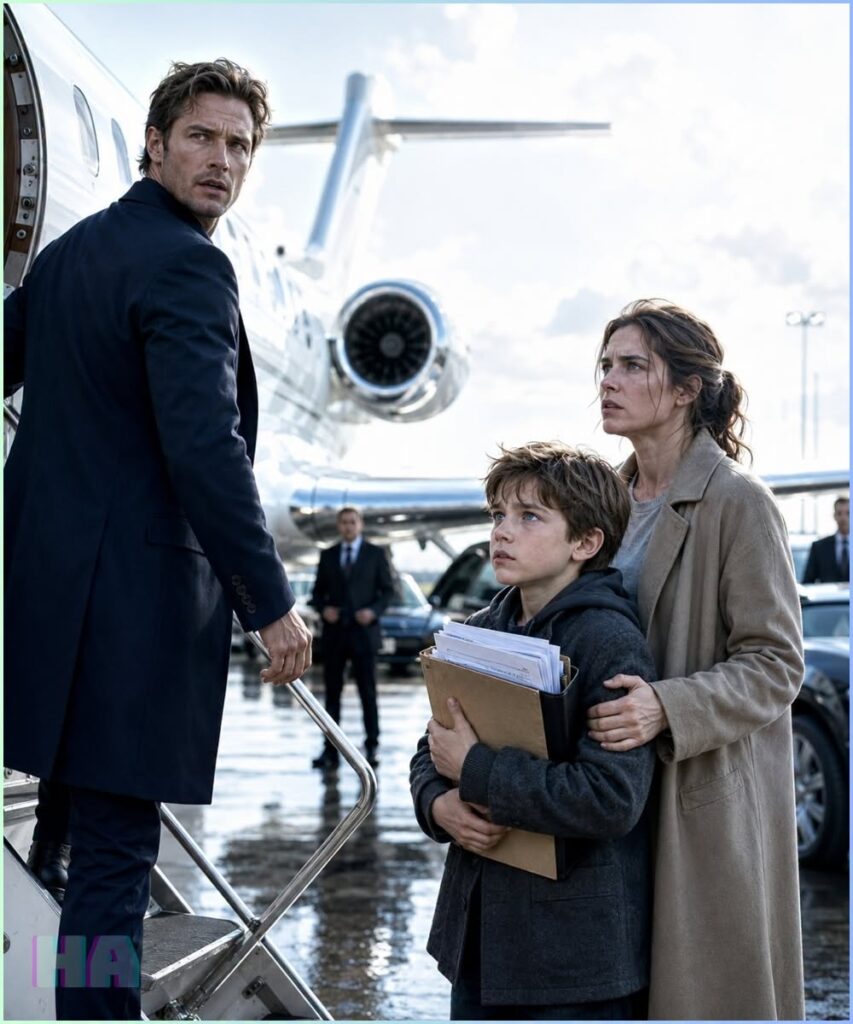
The Billionaire Boss Boarded a Plane to Escape His Past, but the Boy with His Eyes Was Carrying the File His Own Empire Had Nearly Killed His Mother to Hide
The little boy in seat 12B had Beckett Langston’s gray eyes, Beckett Langston’s crooked smile, and a silver moon hanging from his backpack that three powerful men had already tried to kill his mother to find.
Beckett did not know any of that when the child climbed into the seat beside him.
All he knew was that thirty thousand feet above New York, while he was trying to disappear from the wreckage of his own life, his past had taken the shape of a five-year-old boy and quietly said, “Hi. My name is Eli.”
Less than an hour earlier, Beckett had been standing inside his Manhattan penthouse, watching reporters gather behind the police barriers below.
The city looked small from the sixty-second floor. Human beings became dots. Traffic became veins of red and white light. Problems became abstractions that could be measured, priced, delegated, or buried beneath glass and steel.
That illusion had helped Beckett build Langston Sentinel into one of the largest cybersecurity companies in the country.
It had not helped him sleep.
At thirty-seven, he was worth more money than he could reasonably spend in several lifetimes. His company protected hospitals, financial networks, universities, and municipal systems. His face appeared on business magazines beside phrases such as visionary founder, digital guardian, and the billionaire who made privacy profitable.
That morning, his own privacy had become entertainment.
Someone had leaked photographs from inside his penthouse, copies of unfinished messages, private medical appointments, grocery receipts, and screenshots from dating applications he had opened and closed without ever meeting anyone.
The headlines were merciless.
The Man Who Protects Everyone’s Secrets Has None Left.
Inside the Lonely Life of America’s Cybersecurity Boss.
Billionaire Beckett Langston’s Empty Refrigerator Says More Than His Interviews Ever Did.
The refrigerator photograph hurt more than it should have. One bottle of water. Mustard. Half a lemon hardened at the edges. Three expensive meal-delivery containers he had never opened.
Strangers had turned his loneliness into a punch line.
His board wanted him to make a statement. His public-relations team wanted him to appear wounded but controlled. His legal department wanted authorization to begin litigation against every publication that had touched the data.
Beckett wanted silence.
His phone vibrated across the marble counter.
Graham Vale, his chief operating officer and oldest business partner, appeared on the screen.
Beckett let it ring until the call ended.
Graham called again.
This time Beckett answered.
“Tell me you’re still in the apartment,” Graham said without greeting.
“I’m still in the apartment.”
“Good. Security is coming upstairs. We’ll move you to the corporate residence until we identify the source.”
“I’m not moving to another glass box.”
“This isn’t the time to be difficult.”
Beckett stared at his reflection in the window. Dark hair he had not combed. A white shirt wrinkled from being slept in. Gray eyes that looked almost colorless in the morning light.
“I’m leaving town.”
A pause followed.
“Where?”
“I haven’t decided.”
“Beckett, someone penetrated the private network of the most protected man in America. You cannot simply wander into an airport.”
“That sentence is exactly why I need to wander into an airport.”
“You have a board vote next week.”
“You can postpone it.”
“It’s the vote on the Sentinel Health acquisition. We have spent fourteen months preparing for it.”
“Then you can survive forty-eight hours without me.”
Graham exhaled slowly. He had perfected the sound over twenty years, a controlled release of disappointment designed to make other people feel childish.
“At least take the company jet.”
“No.”
“Why?”
“Because whoever did this knows where the company jet goes.”
“That’s paranoia.”
“That’s cybersecurity.”
Beckett ended the call.
He stood in the center of the silent apartment, surrounded by furniture selected by designers and artwork selected by consultants. Nothing in the room carried a memory he wanted to keep.
Then he opened the hall closet and reached past three tailored coats for an old brown leather jacket.
Callie Hart had bought it for him at a thrift store in Brooklyn seven years earlier. The leather was cracked at the elbows, and one pocket had been repaired with uneven stitching after Callie had insisted she could sew.
“It makes you look human,” she had told him, laughing as she fixed the collar. “Rich men should be required to wear one imperfect thing.”
He had not worn it since she left.
Her name still struck him with the force of something thrown.
Callie had possessed none of the qualities his advisers considered safe. She asked questions no one wanted answered. She laughed loudly in quiet restaurants. She wrote investigative stories about landlords, hospital contractors, fraudulent charities, and corporations that hid cruelty behind complicated paperwork.
She had loved him before the magazine covers, before the private elevators, before Graham started referring to their relationship as a reputational vulnerability.
She had also been the last person who had asked Beckett to choose something that could not be measured in market value.
Six years ago, on a rainy Thursday night, Callie had stood in his office and told him she could no longer compete with his fear.
“I’m not asking you to abandon your company,” she had said. “I’m asking you to stop using it as a place to hide.”
“I’m building something that matters.”
“So am I.”
“What does that mean?
“I haven’t traveled yet,” Eli pointed out. “So we don’t know.”
The attendant laughed and helped him secure his backpack beneath the seat.
That was when Beckett noticed the silver moon attached to the zipper. It was scratched and ordinary-looking, slightly larger than a quarter.
Eli caught him staring.
“My mom gave me that.”
“It’s nice.”
“She said I have to keep it safe because it holds sunshine.”
Beckett’s attention sharpened.
“What does that mean?”
“I don’t know. Mom says grown-up things that sound pretty when she doesn’t want me asking questions.”
The flight attendant told Eli she would check on him after takeoff, then moved down the aisle.
Eli climbed into his seat and carefully buckled himself in.
“I’m Beckett,” Beckett said.
“That’s a funny name.”
“I’ve been told.”
“My mom says all names mean something.”
“What does Eli mean?”
“My God answers.”
He recited it proudly, as if he had practiced.
“Your mother looked it up?”
“She looks up everything. She’s a reporter.”
Beckett’s heart began striking his ribs.
“What kind of reporter?”
“She writes about people who do bad things and think nobody will find out.”
The plane started moving away from the gate.
Eli leaned toward the window, his small shoulder brushing Beckett’s arm.
“I’ve never been on an airplane before. Mom said it’s like riding on a cloud, except clouds don’t charge forty dollars for a suitcase.”
Beckett almost laughed. The sentence sounded exactly like Callie.
“What’s your mother’s name?”
Eli looked at him.
“Callie.”
The cabin noise seemed to disappear.
“Callie what?”
“Callie Hart. Do you know her?”
Beckett stared into the face of the child he had trained himself not to imagine.
The years aligned with brutal simplicity.
Callie had called six years ago.
Eli was five and three quarters.
He had Beckett’s eyes, Beckett’s smile, Beckett’s nervous expression, and the small dimple that appeared in Beckett’s left cheek whenever he concentrated.
“I knew someone named Callie Hart,” Beckett said.
“Was she nice?”
“She was the bravest person I had ever met.”
“She’s still brave,” Eli said seriously. “But she hasn’t been sleeping very much.”
The engines grew louder.
As the aircraft accelerated, Eli’s hand shot out and closed around Beckett’s wrist.
“I’m not scared,” he said.
“I know.”
“Mom says brave people can still have scared stomachs.”
“She’s right.”
The wheels left the ground.
Eli’s grip tightened.
A sensation Beckett had spent his entire adult life avoiding broke through him without permission. It was not simply affection. It was recognition so deep that it felt physical, as if some locked part of his body understood the child before his mind could accept the truth.
Eli released him once the plane leveled.
“Sorry.”
“You don’t have to apologize.”
“Some people don’t like being touched.”
“I don’t mind when you do it.”
Eli smiled again.
The nervous twitch appeared at the corner of his left eye.
Beckett turned toward the window because his vision had blurred.
For the next twenty minutes, Eli talked while Beckett tried to survive each revelation.
Callie lived in a small house on Maple Street.
She drank vanilla coffee.
She worked late after Eli went to sleep.
She had won an award for a story about a medical charity that stole donations from sick children.
She still kept an old photograph in the back of a kitchen drawer, though Eli had never seen the man’s face because it was folded in half.
“She gets sad when she finds me looking at it,” Eli said. “So I don’t anymore.”
“What does she tell you about your father?”
“That he lives far away.”
“Anything else?”
Eli hesitated.
“She says he was scared.”
Beckett’s throat closed.
“Scared of what?”
“Being someone’s family.”
The answer carried no anger. That made it worse.
Eli opened his backpack and removed a tablet, a stuffed fox with one missing button eye, and a small plastic container of crackers.
The silver moon clicked softly against the zipper.
“Did your mother send you to Portland because she’s working?” Beckett asked.
“She has to finish her big story.”
“What is it about?”
“I’m not supposed to say.”
“That’s smart.”
“It’s about a company that protects secrets but also steals them.”
Beckett became very still.
“Did she tell you the company’s name?”
Eli shook his head.
“She said names can be dangerous before you have proof.”
Callie had said the same thing years earlier when Beckett questioned why she waited so long to publish an investigation.
Allegations are noise, she had told him. Evidence is a voice people cannot pretend not to hear.
“Has anything happened to your mother?” Beckett asked.
Eli looked down at the stuffed fox.
“She got hit by a car.”
The air left Beckett’s lungs.
“When?”
“Three weeks ago. She said it was an accident, but Grandma Nora said accidents don’t usually follow people home first.”
“What does that mean?”
“I wasn’t supposed to hear that.”
Eli’s voice became smaller.
“A black car was outside our house for two nights. Mom told me it was probably someone visiting the neighbors. Then she got hurt.”
“How badly?”
“She had stitches here.”
Eli touched his temple.
“And her arm was in a sling. She’s better now.”
Beckett looked at the silver moon again.
“What did she mean when she said that holds sunshine?”
“I don’t know. She told me to give it to Grandma Nora and not take it off my backpack.”
The moon was not decorative.
Beckett knew hardware. He had spent his life recognizing technology designed to look like something else.
The narrow groove around the edge, the almost invisible connector beneath the clasp, and the faint serial marking told him the charm was an encrypted storage device.
Callie had sent evidence out of Portland with their son.
The plane shook as it entered rough air.
Eli caught Beckett’s hand again.
This time Beckett turned his palm upward and held on.
“Can I ask you something?” Eli said.
“Anything.”
“Do you have kids?”
Beckett looked at their joined hands.
“I don’t know.”
Eli frowned. “How can you not know?”
“Sometimes adults make their lives more complicated than they should.”
“My mom says complicated is often a word people use when they’re afraid to tell the truth.”
Beckett let out a broken laugh.
“That also sounds like her.”
Eli studied him.
“You really do know my mom.”
“Yes.”
“Were you friends?”
Beckett could not lie completely, but he was not prepared to transform the child’s life in seat 12B.
“I loved her.”
Eli’s eyes widened.
“Like best friends?”
“More than that.”
“Did she love you?”
“Once.”
“What happened?”
“I made a mistake.”
“A big one?”
“The biggest.”
Eli considered this with the seriousness only children could bring to an adult confession.
“My mom says mistakes aren’t the end of a story unless you refuse to fix them.”
“What if the person you hurt doesn’t want you to fix it?”
“Then you say sorry anyway, and you don’t make them take care of your feelings.”
Beckett turned toward him.
“Did your mother teach you that?”
“No. Grandma Nora did after I broke Mom’s coffee cup.”
For the first time that day, Beckett laughed without pain.
The sound startled him.
Eli grinned.
“You laugh like me.”
“No,” Beckett whispered. “You laugh like me.”
A drink cart reached their row. Eli accepted apple juice and pretzels, then opened both with the same methodical care Beckett used when examining a contract.
After several minutes, he asked, “Do you think my dad ever thinks about me?”
The question landed more violently than any accusation could have.
Beckett had missed the first cry, first smile, first word, first day of school, first scraped knee, first nightmare, and every bedtime question about a father who had chosen fear over love.
He could not reclaim those moments.
He could only decide what he did with the next one.
“I think he would think about you every day if he knew you.”
“But he doesn’t know me?”
“I don’t think he understood what he was losing.”
Eli’s mouth tightened.
“That sounds like a nice way of saying he left.”
“Yes,” Beckett said, forcing himself not to hide. “It does.”
“Mom never says he’s bad.”
“She doesn’t?”
“She says good people can do terrible things when they let fear make their choices.”
Beckett looked at the boy beside him and understood that Callie had protected him even in absence. She had given their son an explanation that preserved hope without erasing harm.
He did not deserve that mercy.
“Your mother is a remarkable woman.”
“I know.”
Eli ate a pretzel.
“Do you think my dad would like me?”
Beckett’s voice failed on the first attempt.
“He would be the luckiest man alive.”
Eli smiled at the window.
“I’d like to play catch with him. I’m not very good, but I’m learning.”
“I think he’d like that too.”
The remainder of the flight passed with Eli drawing pictures on his tablet and Beckett studying the child’s face when he thought he would not be noticed.
Every detail became a record of what he had missed.
The tiny scar beneath Eli’s chin.
The loose front tooth.
The way he hummed while concentrating.
The tenderness with which he tucked the stuffed fox beneath his arm.
As the plane descended over Portland, Eli pressed his forehead to the window.
“Grandma Nora is down there somewhere.”
Beckett’s pulse quickened.
He had met Nora Hart three times. She was a retired school librarian with Callie’s green eyes and none of her patience for arrogant men.
“Grandma has pictures of everybody,” Eli continued. “She even has pictures of Mom’s old boyfriend.”
Beckett almost stopped breathing.
“What does he look like?”
“She won’t show me. She says that story belongs to Mom.”
The landing gear lowered.
Eli became quiet.
Then he asked, “Beckett, if somebody makes one really big mistake, do you think they should get another chance?”
Beckett looked at the city rising beneath them.
“Not automatically.”
“What does that mean?”
“It means being sorry doesn’t erase what you did. A second chance is something the person you hurt may choose to give you after you prove you have changed.”
“How do you prove it?”
“You stay.”
Eli nodded as though storing the answer for later.
When the plane stopped at the gate, a flight attendant arrived to escort him.
Eli shouldered his backpack and held out his hand.
“I’m glad I sat by you.”
Beckett took it.
“So am I.”
“Maybe you can meet my mom again.”
“I hope so.”
Eli walked toward the exit, then turned around.
“Don’t forget what you said.”
“About what?”
“Staying.”
Before Beckett could respond, the child disappeared into the jet bridge.
He remained in his seat while the cabin emptied.
A cleaning employee finally touched his shoulder.
“Sir, you need to leave the aircraft.”
Beckett rose mechanically and entered the terminal.
He found Eli near baggage claim, wrapped in Nora Hart’s arms.
Nora looked older than he remembered. Her silver hair was pulled into a neat knot, and the lines around her mouth had deepened, but her posture remained straight and formidable.
Eli spoke excitedly.
“I made a friend. His name is Beckett, and he knew Mom when she was younger.”
Nora’s face changed.
She raised her head.
Across the terminal, her eyes found Beckett immediately.
Recognition appeared first.
Then anger.
Then fear.
Nora pulled Eli closer and looked directly at the silver moon on his backpack.
Beckett saw the moment she realized he might understand what it was.
She whispered something to Eli and guided him toward the exit.
Beckett took one step after them, then stopped.
He had no right to chase a child through an airport demanding a place in his life.
His phone rang.
Graham Vale’s name appeared again.
Beckett answered.
“Where are you?” Graham demanded.
“Portland.”
The silence on the line lasted half a second too long.
“Why Portland?”
“I told you about the hospital consultation.”
“That meeting was moved online.”
“I wanted to come anyway.”
“Are you alone?”
Beckett watched Nora and Eli disappear through the sliding doors.
“Why are you asking?”
“Because whoever leaked your information may be tracking you.”
“Or perhaps the person calling me is.”
Graham gave a short, humorless laugh.
“You’re exhausted.”
“Did Langston Sentinel ever conduct an internal investigation involving a journalist named Callie Hart?”
Another pause.
“No.”
“You’re sure?”
“I would remember.”
“You remembered her six years ago.”
“That was different.”
“How?”
“She was destabilizing you. I helped you see that.”
“No, Graham. You helped me justify what I already wanted to do.”
“Beckett, come back to New York. We need to contain this crisis before you make decisions you regret.”
“I’ve already made those.”
Beckett ended the call.
Twenty minutes later, while he sat on an airport bench searching public records connected to Callie’s reporting, his phone displayed an unfamiliar local number.
He answered.
“Mr. Langston,” Nora said. “You saw the moon.”
It was not a question.
“Yes.”
“Do you know what it is?”
“I know it is not jewelry.”
“Then listen carefully. Do not open it. Do not copy it. Do not contact your company. Come alone tomorrow morning to a coffee shop on Hawthorne Boulevard called Brood Awakening.”
“I need to know if Callie is safe.”
“You lost the right to need things from my daughter six years ago.”
“Nora—”
“Ten o’clock. Come prepared to answer questions before you ask any.”
She disconnected.
Beckett spent the night in a hotel room with the lights on.
He read every article Callie had published in the previous five years. She had exposed predatory housing contracts, falsified medical bills, and a foundation that diverted donations from children’s cancer treatment into luxury properties.
Her most recent published piece was seven months old.
After that, silence.
At 3:00 a.m., his assistant, Mara Ellison, called from New York.
Unlike Graham, Mara did not waste time pretending nothing was wrong.
“You triggered a restricted search on Callie Hart from your corporate device,” she said.
“I used my personal phone.”
“Your personal phone routes through Sentinel protection. Someone flagged the search within ninety seconds.”
“Who?”
“I’m still trying to find out. Graham ordered the query logs deleted.”
Beckett sat upright.
“Can you recover them?”
“I already did.”
“Mara, I need you to examine every internal access event connected to my apartment leak, the Sentinel Health acquisition, and Callie Hart.”
“That is a wide net.”
“Cast it.”
“Does this have anything to do with why you flew to Portland?”
“Yes.”
“Is someone in danger?”
Beckett looked toward the dark window.
“My family may be.”
Mara did not ask what he meant.
“I’ll send anything important through the offline channel we built during the Cavanaugh breach.”
“Trust no one on the executive floor.”
“Not even Graham?”
“Especially Graham.”
At ten the next morning, Nora was waiting in the back corner of the coffee shop.
She did not offer her hand.
“Sit.”
Beckett obeyed.
Nora studied the old leather jacket.
“She bought you that.”
“Yes.”
“She cried when she found it missing from her apartment. Thought she had lost the last stupid thing she bought for you.”
“I took it the night she left.”
“You took the jacket and abandoned everything inside it.”
Beckett accepted the blow.
“How badly was she injured?”
Nora’s expression hardened.
“Eleven stitches in her scalp. Two fractured ribs. A torn ligament in her shoulder. The driver never stopped.”
“Was Eli with her?”
“No. Thank God.”
“Why didn’t she contact me?”
Nora stared at him in disbelief.
“Which part of your six years of silence suggested you would be useful?”
“He is my son.”
“Yes.”
The confirmation was quiet, absolute, and devastating.
Beckett closed his eyes.
Hearing it spoken was different from knowing.
When he opened them, Nora’s anger had not softened.
“Callie called you nine times during the first week after she left,” Nora said. “She sent emails. She went to your office twice. Your security team turned her away.”
“I heard one voicemail.”
“One?”
“The first one. The night she told me she was pregnant.”
Nora’s face went pale with fury.
“You heard her.”
“Yes.”
“And you did nothing.”
“Yes.”
There was no explanation large enough to hide behind.
Nora leaned back, tears gathering in her eyes despite the rigid control of her voice.
“She spent years believing perhaps you never heard it. I let her believe that because the alternative seemed crueler.”
“I’m not going to excuse myself.”
“Good, because I did not come here to help you feel redeemed.”
“Why did you come?”
Nora placed both hands around her coffee cup.
“Because my daughter is investigating your company, and someone connected to it tried to kill her.”
Beckett did not move.
“What did she find?”
“Sentinel Health was created to protect hospital data. Callie discovered that patient information from clinics using your software was being copied before encryption and sold through subcontractors. Medical histories. Home addresses. Insurance records. Shelter locations. Information about children.”
“That is impossible.”
Nora’s eyes flashed.
“Powerful men say impossible when they mean expensive to admit.”
“The architecture would require a privileged internal key.”
“She found one.”
“Whose?”
“That is inside the moon.”
“Why send it with Eli?”
“Callie’s apartment was searched while she was in the hospital after the collision. Nothing valuable was taken. Only papers and storage devices. She knew they would come back. The moon contains an encrypted duplicate of everything she found. She asked me to keep it outside her house.”
“She put it on a five-year-old’s backpack.”
“She put it on an airline-supervised child traveling under a reservation made from a public library terminal. No one was supposed to connect him to the investigation.”
Nora’s gaze sharpened.
“Then he was seated beside you.”
“I booked my flight less than two hours before departure.”
“I know.”
“You checked?”
“I am protective, not helpless.”
“Where is Callie now?”
“At home.”
“I need to see her.”
“You need to understand what seeing her means.”
“I understand.”
“No, you understand urgency. Men like you are very good at urgency. It lets you feel heroic. What my daughter needs is consistency.”
“I will stay.”
“You said nothing for six years.”
“I know.”
“You built an empire while she worked overnight editing jobs with Eli sleeping beneath her desk because childcare cost more than she earned.”
Beckett’s voice dropped.
“I know what I did.”
“No. You know the outline. You do not know what it cost.”
Nora removed a folded piece of paper from her purse.
“Callie’s address. I am giving it to you because she deserves to decide what happens next. You will not threaten custody. You will not send lawyers. You will not buy the house next door, fund his school, or use money to force gratitude.”
“I wouldn’t.”
“You solve everything with money.”
“Not this.”
“If you harm that boy, I will spend the rest of my life making certain the world knows exactly what kind of man you are.”
Beckett took the paper.
“I believe you.”
Nora stood.
“One more thing. Callie received a message after the collision. It said, ‘You should have accepted Mr. Langston’s first warning.’”
“I never warned her.”
“Then someone did it in your name.”
The house on Maple Street was a small blue bungalow with chipped paint, wind chimes on the porch, and a garden that had been tended by someone who loved it more than she understood it.
A bicycle with training wheels leaned against the steps.
Beckett remained in his rental car for twenty-three minutes.
Then the front door opened.
Callie stepped outside carrying a canvas bag and a stack of folders.
Her auburn hair was shorter. A faint scar crossed her right temple. Her left arm moved stiffly when she adjusted the bag.
She noticed the unfamiliar car immediately.
Her gaze examined the plate, the windows, and the driver.
The folders fell from her hands.
For several seconds, neither moved.
Then Beckett opened the door.
“Callie.”
She crossed the yard and stopped six feet from him.
“What are you doing here?”
“I met Eli.”
Every trace of color left her face.
“Where?”
“On the flight from New York.”
Her hand rose to the scar at her temple.
“No.”
“He was in seat 12B.”
“No, no, that wasn’t supposed to—”
“He has my eyes.”
Callie’s fear became anger.
“You do not get to stand on my street and say that as though you discovered something that belongs to you.”
“I know.”
“He is not a missing asset. He is not a piece of your life that was misplaced.”
“I know.”
“Stop saying that.”
“I don’t know what else to say.”
“You could begin with why you ignored me.”
Beckett looked at the woman whose pain he had spent six years converting into a vague private tragedy.
“I was a coward.”
Callie laughed once, without humor.
“That is accurate but incomplete.”
“I heard your first voicemail. I told myself I needed time. Then every hour I waited made the next one harder. I chose fear because fear asked nothing of me.”
“You heard me tell you I was pregnant.”
“Yes.”
“And you slept.”
“No. I haven’t slept properly since.”
“That is not the same as being there.”
“I know.”
She flinched at the repeated phrase.
Beckett lowered his voice.
“Nora told me about the collision.”
Callie’s eyes narrowed.
“She had no right.”
“She believes someone inside my company ordered it.”
“She believes correctly.”
“Show me what you found.”
“Why? So you can bury it more efficiently?”
“I want to stop whoever did this.”
“You have spent your entire life sitting beside men who do terrible things in clean offices. You do not get to act surprised because one of them finally dirtied your carpet.”
“Callie, someone threatened you using my name.”
“And six years ago, someone sent me a message from your private account telling me not to contact you again.”
Beckett froze.
“What message?”
Her expression changed.
“You sent it.”
“I didn’t.”
“Do not lie to me now.”
“I never sent you anything.”
Callie stared at him.
Three days after her voicemail, she explained, she had received an email from an address only Beckett and two people in his office knew. It said that further contact would be considered harassment. It said any paternity claim would be handled through counsel. It included details from private conversations she and Beckett had shared.
“I thought you wanted me frightened enough to disappear,” she said.
“I did not send it.”
“You expect me to believe someone invented it?”
“I expect nothing from you. But I am telling you the truth.”
“Who else had access?”
“Graham.”
The name changed the air between them.
Callie looked toward the house.
“My source named him.”
“Graham Vale?”
“He authorized the subcontractor that diverted the data. Every shell company eventually leads back to a trust controlled by his brother-in-law.”
Beckett remembered Graham’s pauses on the phone, the deleted search logs, and the insistence that he return to New York.
“Let me help you.”
“I do not trust you.”
“Then use me.”
“For what?”
“To get inside the system.”
“You could take the evidence and destroy it.”
“I could.”
Callie’s jaw tightened.
“But I won’t.”
“Why should I believe that?”
“Because Eli asked me whether his father would like him.”
Pain crossed her face.
Beckett continued before courage failed.
“He told me he stopped asking questions because they made you sad. He told me he pretends his father is a superhero so you won’t think he abandoned both of you.”
Callie turned away.
“He should never have had to invent kindness for me.”
“No.”
“You left me to answer questions that belonged to you.”
“I did.”
She wiped her eyes angrily.
“Do not confuse admitting what you did with repairing it.”
“I won’t.”
“What do you want, Beckett?”
“My son.”
Her entire body went rigid.
He corrected himself immediately.
“I want the chance to know him. I want to earn whatever place you decide is safe. I am not asking you to forgive me.”
“And me?”
“I love you.”
“Don’t.”
“I never stopped.”
“That makes it worse.”
“I know.”
“Stop saying that.”
She drew a breath and looked toward the house again.
“He is with my mother until tomorrow. You will not meet him as his father yet.”
“All right.”
“You will not tell him anything without me.”
“All right.”
“You will not threaten me with your money or your lawyers.”
“Never.”
“If you disappear after he begins trusting you, I will never forgive you.”
Beckett met her eyes.
“If I disappear, it will be because I am dead.”
Callie’s face tightened.
“Do not make promises that sound dramatic. Make ones that survive ordinary days.”
She gathered the fallen folders.
“There is a park two blocks away. Meet me there in twenty minutes. I will show you what I found. After that, we decide whether you are part of the solution or another problem I have to survive.”
At the park, Callie opened a battered laptop and showed him a map of data transfers originating from hospitals protected by Langston Sentinel.
The transfers occurred before encryption, making them invisible to normal monitoring. Someone had inserted a hidden administrative pathway during a software update eighteen months earlier.
Beckett recognized the coding structure.
“This was built by our internal Red Harbor team.”
“Who controls that team?”
“Graham.”
Callie clicked through invoices, shell companies, and payment records.
“They sold patient profiles to debt collectors, private investigators, insurance brokers, and companies that target vulnerable families. My source estimated forty million records.”
Beckett felt physically ill.
“Why acquire Sentinel Health if they were already inside the system?”
“To erase the subcontractor and absorb the infrastructure before an audit. Once the acquisition closes, the records disappear inside your company.”
“My signature authorizes the final merger.”
“That is why someone leaked your private life. They needed you ashamed, distracted, and desperate to prove control. Graham expected you to rush back, sign everything, and let him manage the crisis.”
“He knew exactly how I would react.”
“He has known you for twenty years.”
Beckett’s phone vibrated.
A message from Mara appeared through their offline channel.
Internal audit logs confirm apartment leak originated from executive access token GV-01. Additional hidden traffic detected in Sentinel Health build. Do not use standard communications. Graham has convened an emergency board session and is recommending temporary removal of your authority.
Callie read the message over his shoulder.
“GV.”
“Graham Vale.”
“He leaked your life.”
“And tried to remove me before I could stop the acquisition.”
Another file arrived.
Mara had recovered an archived email record from six years earlier.
A message had been sent to Callie from Beckett’s private address at 4:41 a.m., three days after her voicemail.
The login originated from Graham’s office.
Beckett stared at the record.
Callie did not speak.
The revelation did not erase his silence. It could not restore the call he had chosen not to make. But someone had taken his cowardice and sharpened it into a weapon.
“Why?” Callie whispered.
“Graham believed you would pull me away from the company.”
“He was right.”
“No. He believed I belonged to him.”
Callie shut the laptop.
“I need the moon.”
“Nora has it.”
“We should copy it before Graham realizes Eli carried it.”
Beckett looked around the park.
“If he compromised airline reservations, he may already know.”
Callie’s face went white.
They called Nora.
She answered on the second ring.
Before Callie could speak, Nora said, “A man is outside.”
“What man?”
“He says he is from the airline and needs to verify something from Eli’s flight.”
“Lock the doors,” Beckett ordered. “Do not give him anything.”
“I was not planning to invite him for cookies.”
A crash sounded through the phone.
Nora inhaled sharply.
“Mom?” Callie shouted.
The line went dead.
Beckett and Callie reached Nora’s house in twelve minutes.
The front door had been forced open.
A lamp lay shattered in the hallway. A chair had been overturned. One kitchen drawer had been pulled entirely from its frame.
“Nora!” Callie ran inside.
They found her in the pantry with Eli behind her, gripping a cast-iron skillet in both hands.
Nora lowered it when she saw them.
“The man left through the back when a neighbor came outside,” she said. “He searched the living room and asked where the boy’s backpack was.”
Eli’s face brightened when he saw Beckett.
“Airplane friend!”
He ran forward, then stopped when he noticed the adults’ expressions.
“Did I do something wrong?”
“No,” Callie said, kneeling and pulling him close. “You did everything right.”
“The moon,” Beckett said.
Nora nodded toward the pantry shelf.
“I removed it last night.”
She reached inside an empty flour container and produced the silver charm.
Beckett connected it to a laptop that had never touched the internet. The drive requested a twenty-four-character encryption key.
Callie typed a sentence.
The truth is sunlight, but courage opens the blinds.
The files appeared.
Transaction records. Internal messages. Hidden source code. Payment authorizations. Recordings from a whistleblower who had worked under Graham.
There was also a folder labeled HART.
Inside were surveillance photographs of Callie and Eli, copies of Eli’s school registration, Callie’s medical report from the collision, and an invoice paid to a security contractor two days before she was struck.
Eli stood near the table, unable to understand the documents but old enough to recognize his own photograph.
“Why does that man have pictures of me?”
Callie closed the laptop.
“Because he was trying to scare me.”
“Did he hurt you?”
She hesitated.
“Yes.”
Eli’s lower lip trembled.
Beckett crouched beside him.
“Listen to me. None of this happened because of you.”
“Is he coming back?”
“No,” Beckett said.
Callie looked at him sharply.
“You cannot know that.”
“No,” Beckett agreed. “But I can make certain he never reaches this house again.”
For the first time, Callie allowed him to take control of something.
Beckett moved Nora and Eli to a small hotel under different names. He hired two security professionals who had worked with him before Langston Sentinel became an empire and who owed Graham nothing.
Then he called his board.
The emergency session appeared on his laptop at seven that evening.
Graham sat at the center of the conference room in Manhattan, wearing a charcoal suit and the calm expression of a man who believed he had already won.
“Beckett,” he said. “We have been trying to reach you.”
“I know.”
“The board is concerned about your judgment. Your disappearance during a major security event has damaged confidence.”
“My disappearance exposed the event.”
Several board members shifted.
Graham smiled faintly.
“You are exhausted. We can continue this conversation after you return.”
“I’m not returning until the authorities have secured the building.”
The smile vanished.
“What authorities?”
“The state prosecutors receiving evidence of forty million stolen medical records.”
Silence filled the room.
Graham leaned back.
“I have no idea what you are talking about.”
“I am also sending them evidence that you ordered surveillance of a journalist and paid the contractor who struck her with a vehicle.”
“That is an outrageous accusation.”
“It is documented.”
“By whom? Callie Hart?”
The casual way he spoke her name confirmed more than denial would have.
Beckett watched the board members turn toward Graham.
“You told me you did not know her investigation.”
“I know who she is because you destroyed six years of your life over her.”
“No. I destroyed those years. You exploited the damage.”
Graham’s expression hardened.
“You were unstable when she left. I protected you.”
“You impersonated me.”
“I prevented a woman with no understanding of your responsibilities from trapping you with a child.”
Beckett’s hands curled beneath the table.
Across the hotel room, Callie stood beside Nora. Eli was asleep in the next room.
“Say that again,” Beckett said.
Graham realized too late that the meeting was being recorded on an independent system.
He tried to recover.
“I am referring to the allegations she made at the time.”
“She told me she was pregnant. I failed to answer. You sent a message threatening her from my account.”
“I stopped a crisis.”
“You created a fatherless child.”
“No. You did that when you refused to call her. Do not place your weakness on me.”
The words were cruel.
They were also true.
Beckett did not look away.
“You’re right. My cowardice created the opening. But you turned it into a business model.”
Graham stood.
“You are about to destroy a company employing eleven thousand people because a former girlfriend gave you a collection of fabricated files.”
“I am preserving the parts that deserve to survive.”
“You cannot remove me without a vote.”
“I am not removing you.”
Beckett uploaded the evidence packet to every board member and three independent legal offices.
“I am suspending the Sentinel Health network, notifying every affected institution, and resigning as chief executive immediately after the emergency protocols are complete.”
The board erupted.
Graham’s face lost all color.
“You resign, and the acquisition fails.”
“Yes.”
“The company’s value could collapse.”
“Yes.”
“You will lose billions.”
Beckett looked toward the closed door behind which his son slept.
“I already lost the only things that mattered. Money is the part I can afford to lose.”
Graham closed his laptop.
Before his image disappeared, he said, “You think choosing them now makes you a good man?”
“No,” Beckett answered. “It makes me a man who finally understands the cost of not choosing them.”
The next forty-eight hours became a war fought through cables, code, legal orders, and sleepless rooms.
Mara coordinated trustworthy engineers in New York. Beckett disabled the hidden administrative keys and sent emergency patches to every hospital connected to the compromised system.
Callie worked beside him, organizing evidence and contacting editors through secure channels.
Nora watched Eli, who believed the adults were preparing an important story.
At 2:16 on the second morning, several hospital networks began losing access to patient files.
Graham had triggered a destructive program designed to erase the evidence and punish institutions that disconnected from his servers.
One of those hospitals was Portland Children’s Medical Center.
At 3:04, Callie rushed into the hotel room where Beckett was working.
“Eli can’t breathe.”
He was burning with fever.
By 3:30, they were in a pediatric emergency room crowded with frightened parents while nurses recorded information on paper because the digital system had failed.
A physician diagnosed Eli with pneumonia. His oxygen level had dropped dangerously low, and he needed immediate medication.
The hospital pharmacy could not access its verification system.
Beckett stood beside his son’s bed and watched the consequences of his company’s corruption become terrifyingly personal.
Eli’s small chest rose and fell too quickly.
Callie held the oxygen mask against his face.
“Mom,” he whispered, “am I going to die?”
“No.” Her voice broke. “No, baby.”
Beckett turned to the nurse.
“What do you need?”
“Medication history, allergy verification, dosage authorization. Everything is locked.”
“I can restore local access.”
“The hospital network is isolated.”
“Good. Keep it isolated.”
Beckett borrowed a maintenance laptop and connected directly to the hospital’s internal emergency terminal. The malicious code recognized his executive credentials and attempted to erase the local database.
He stopped it seconds before deletion.
For forty-three minutes, he worked beside hospital technicians while Callie stayed with Eli.
He rebuilt access from an offline backup, restored the pharmacy records, and discovered the destructive program contained an authorization certificate issued to Graham’s private key.
The evidence that could convict Graham was now embedded in the attack he had launched.
Medication reached Eli.
His breathing slowly steadied.
Near dawn, Beckett entered room 314.
Eli lay beneath a dinosaur blanket with a thin oxygen tube under his nose. Callie sat beside him, one hand wrapped around his fingers.
Eli opened his eyes.
“Beckett.”
“I’m here.”
“I knew you would come.”
Beckett sat on the other side of the bed.
“I’m not going anywhere.”
A nurse entered to check the monitors.
She looked from Callie to Beckett and smiled.
“You must be his father.”
The room went silent.
Beckett looked at Callie.
She was exhausted, frightened, and out of places to hide.
Eli watched them both.
Callie swallowed.
“Yes,” she said. “He is.”
Eli’s eyes widened.
The nurse, unaware that the world had shifted, adjusted the oxygen line and left.
For several seconds, only the monitors spoke.
“You’re my dad?” Eli whispered.
Beckett moved closer.
“Yes.”
“Since when?”
“Since the day you were born.”
“But you didn’t know me.”
“No.”
“Why?”
Callie brushed his hair from his forehead.
“Your dad and I made mistakes before you were born.”
Eli looked at Beckett.
“Did you leave because you didn’t want me?”
The question was quiet, direct, and unbearable.
“No.” Beckett’s voice trembled. “I left because I was afraid before I understood who you were. That was wrong. It was never because you were not wanted.”
“But you knew Mom had a baby.”
“I knew she was going to have one. I was too frightened and ashamed to call her back. Then another man sent her a message pretending to be me, and I did not find out the truth because I did not look.”
Eli frowned.
“That sounds like two mistakes.”
“It was many mistakes.”
“Are you sorry?”
“Every day.”
“Does Mom have to forgive you?”
“No.”
Callie’s eyes filled.
Beckett continued.
“Your mother never has to forgive me. You don’t either. I will still do everything I can to be someone you can trust.”
“Are you going back to New York?”
“Not unless you and your mother know where I am and why.”
“Will you come to my soccer games?”
“Yes.”
“Even if I don’t score?”
“Especially then.”
“Will you read the dragon story again?”
“As many times as you want.”
Eli studied him with the solemn concentration Beckett had noticed on the plane.
“Can I still call you Beckett?”
“You can call me anything that feels right.”
Eli thought for another moment.
“Maybe Beckett-Dad at first.”
A laugh escaped Callie through her tears.
Beckett bowed his head, overwhelmed.
“I would be honored.”
Eli lifted one weak arm.
Beckett leaned forward, and the boy wrapped it around his neck.
“You have to stay,” Eli whispered. “You said that’s how people prove things.”
Beckett held his son carefully.
“I remember.”
By noon, Eli’s fever began to fall.
By evening, Callie’s investigation was published simultaneously by three independent newspapers.
The evidence from the moon drive, the hospital attack, and Graham’s statements during the board meeting were impossible to dismiss.
Graham attempted to leave the country but was detained before boarding his flight. Several executives were charged with conspiracy, data theft, fraud, and arranging violence against a witness.
The Langston Sentinel stock price collapsed.
For once, Beckett did not watch it.
He sat in Eli’s hospital room, reading a story about a dragon that guarded a castle because it was afraid no one would love it if it stopped being useful.
“That dragon is kind of silly,” Eli said sleepily.
“Why?”
“People can love you when you’re not doing anything.”
Beckett looked across the bed at Callie.
She held his gaze.
“Some people take a long time to learn that,” he said.
When Eli returned home, Beckett did not move into the Maple Street house.
Callie had not invited him, and he had learned that love could not be repaired by occupying space before it was offered.
He rented a modest apartment six blocks away.
He attended soccer practice.
He learned which cereal Eli liked and which socks made his shoes uncomfortable.
He discovered that five-year-olds asked questions during movies, changed their minds about food after it was prepared, and considered bedtime a negotiable concept.
He was present for a parent-teacher meeting where Eli’s teacher explained that the boy was compassionate but sometimes became anxious when adults left without saying goodbye.
Beckett sat in the parking lot afterward and cried where Eli could not see him.
He did not announce it.
He did not ask Callie to comfort him.
He simply began saying goodbye clearly every time he left.
“I’ll be back at eight tomorrow morning.”
“I’m going to New York for one night, and I’ll call before bedtime.”
“I am leaving the room, not the house.”
The first time Eli ran after him and asked, “Promise?” Beckett knelt and said, “Promise.”
Then he kept it.
The company’s board asked Beckett to return after independent directors removed the remaining compromised executives.
He refused the chief executive position.
Instead, he spent three months helping separate the legitimate security systems from the criminal operation. He sold most of his ownership and used a substantial portion of the proceeds to compensate affected hospitals, shelters, and patients.
Some commentators called it an act of redemption.
Callie did not.
She called it restitution.
The distinction mattered.
One evening, six months after the flight, Beckett arrived at Maple Street carrying groceries.
He found Callie on the porch, reading a printed copy of her completed investigation.
The scar at her temple had faded.
“You’re late,” she said.
“Four minutes.”
“Eli counted.”
“I know. He sent me three messages.”
Beckett set down the bags.
“Did you read the editor’s final version?”
“Yes.”
“And?”
“You made me sound more noble than I was.”
“I wrote what you did.”
“You also wrote what I lost.”
“That was part of the truth.”
He sat beside her, leaving the small distance she still sometimes needed.
Through the window, Eli could be seen constructing a fort from couch cushions.
“He asked whether I could stay overnight after the campout next weekend,” Beckett said.
Callie nodded.
“He has been planning that question for three days.”
“What did you tell him?”
“That he should ask you.”
“He said you would say that.”
A smile touched her mouth.
“He knows us.”
Beckett looked at his hands.
“I love you.”
Callie did not flinch anymore, but she did not immediately answer.
“I’m not saying it to make you responsible for what I feel,” he continued. “I’m saying it because hiding love was how I destroyed us the first time.”
She closed the pages in her lap.
“I loved you when you had nothing but a rented office and terrible coffee.”
“I remember.”
“I loved you when you became successful, even when success made you harder to reach.”
“I remember.”
“I hated you for a while.”
“You had the right.”
“I still become angry when I think about the years you missed.”
“So do I.”
“You do not get to use that anger to make me forgive you faster.”
“I won’t.”
Callie looked through the window at their son.
“He trusts you.”
“I know how serious that is.”
“I am beginning to trust you too.”
Beckett’s breath caught.
Callie reached for his hand.
“Beginning is not the same as finished.”
“It’s more than I deserve.”
“Stop deciding what you deserve. Just decide what you will do.”
“All right.”
“What will you do?”
“Stay.”
A crash came from inside the house.
Then Eli shouted, “Nothing broke, but the castle has experienced a structural emergency!”
Callie laughed.
The sound carried no grief.
“Come on,” she said, pulling Beckett to his feet. “Your son needs an engineer.”
“Our son,” he whispered.
Callie paused.
“Yes.”
Our son.
The words became the foundation of everything that followed.
Two years later, the house on Maple Street had warm green paint, a repaired porch, and a tire swing hanging from the oak tree.
Beckett had founded a smaller cybersecurity firm with a charter that prevented the sale of personal data and required independent oversight. Its first clients were children’s hospitals, community clinics, and shelters that could not afford the prices his former company had charged.
Callie published a book about corporate surveillance and the human cost hidden inside digital systems.
They married in Nora’s backyard with no reporters, no business executives, and no contracts beyond the promises they spoke aloud.
Eli carried the rings.
When asked whether he understood the importance of the job, he replied, “I’m the reason they finally learned how to stay.”
A year after the wedding, Lily Hart Langston was born with auburn curls, green eyes, and a cry strong enough to command the entire maternity floor.
On an early autumn afternoon, Beckett stood in the backyard watching seven-year-old Eli teach his little sister how to kick a soccer ball.
“Use the inside of your foot,” Eli instructed. “Dad taught me.”
The words still stopped Beckett sometimes.
Dad taught me.
Dad came to my game.
Dad is making pancakes.
Dad said he will be home at six.
Each ordinary sentence returned a piece of the life Beckett had once thrown away.
Callie stepped onto the porch holding two cups of vanilla coffee.
“You’re staring again,” she said.
“I’m watching.”
“There’s a difference?”
“Staring is what I did when I thought happiness belonged to other people. Watching is what I do now because I know it can disappear if you stop paying attention.”
She handed him a cup.
“You have a meeting in forty minutes.”
“They can wait.”
“Your new investors?”
“My daughter is about to kick a ball.”
Lily swung her leg and missed completely. The momentum turned her in a circle, and she sat down on the grass with an astonished expression.
Eli immediately knelt beside her.
“You did good,” he said. “Falling is part of learning.”
Lily considered this, then raised both arms toward Beckett.
“Daddy, up.”
He crossed the yard and lifted her.
She pressed a wet kiss against his cheek.
Eli retrieved the ball.
“Dad, do you ever think about the airplane?”
“Every day.”
“Were you really running away?”
“Yes.”
“From us?”
“I didn’t know I was running from you. I thought I was running from who I used to be.”
Eli frowned thoughtfully.
“But you found us instead.”
“You found me.”
“That was lucky.”
“It was more than luck.”
“What was it?”
Beckett looked toward Callie.
She stood on the porch in the afternoon light, the woman he had failed, the woman who had survived, the woman who had refused to let his guilt become another burden she had to carry.
Then he looked at Eli, the child who had boarded a plane carrying his father’s eyes and the truth that would bring an empire down.
“A second chance,” Beckett said. “The kind you spend the rest of your life earning.”
Eli nodded.
“That sounds right.”
He kicked the ball toward Lily.
She missed again and laughed so hard that everyone else began laughing with her.
Years earlier, Beckett had believed a meaningful life would arrive after the next contract, the next acquisition, or the next victory. He had built towers, protected networks, and accumulated enough wealth to remove almost every ordinary inconvenience.
Yet nothing he had purchased had ever felt as valuable as standing barefoot in a small Portland yard while his daughter tangled her fingers in his collar and his son argued that hugs were more important than winning soccer games.
Later that night, after the children were asleep, Beckett found Callie beside the kitchen window.
The glass reflected the room behind them.
A stack of Eli’s school papers.
Lily’s plastic cup beside the sink.
A grocery list held to the refrigerator by the silver moon that had once contained enough evidence to destroy Langston Sentinel.
The drive itself was locked in an evidence vault. The empty casing remained because Eli insisted the moon had brought his father home.
“Do you ever wonder what would have happened if I had answered your call?” Beckett asked.
Callie leaned against him.
“Sometimes.”
“I do too.”
“We might have avoided a great deal of pain.”
“Yes.”
“But wondering does not change the life we have.”
“No.”
She looked at their reflection.
“The man who ignored that call would not have known how to build this.”
“He should have.”
“He should have,” she agreed. “But he didn’t.”
Beckett rested his forehead against hers.
“I’m sorry.”
“I know.”
“Do you forgive me?”
Callie was quiet.
Then she answered with the honesty that had first made him love her.
“I forgave the man you were a long time ago. I trust the man you are because he keeps showing up.”
From upstairs came the sound of a door opening.
Small feet crossed the hallway.
Eli appeared at the kitchen entrance holding his stuffed fox.
“I had a bad dream.”
Beckett opened his arms.
Eli walked into them without hesitation.
“What happened?” Beckett asked.
“I dreamed I was on the airplane again, but nobody was in seat 12A.”
Beckett held him tighter.
“I’m here.”
“I know.”
Eli rested his head against Beckett’s chest.
“That’s why it was only a dream.”
Callie turned off the kitchen light.
Together, they walked upstairs through the imperfect house where nothing matched, the floorboards creaked, and the refrigerator was never empty.
Beckett tucked Eli into bed, pulled the blanket to his shoulders, and remained beside him until his breathing became slow and peaceful.
Before sleep took him, Eli opened his gray eyes.
“Good night, Dad.”
“Good night, son.”
“See you in the morning?”
Beckett smiled.
“Every morning I’m lucky enough to have.”
Outside, rain began tapping softly against the roof.
Inside, a father stayed.
THE END
