
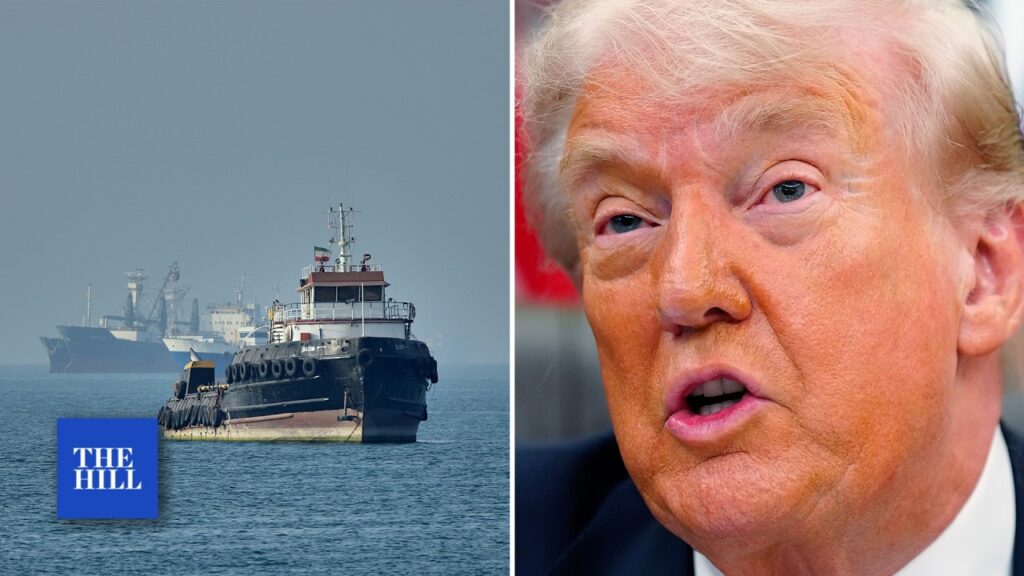
In a startling twist of rhetoric, former President Donald Trump has asserted that Iran has not violated the ceasefire agreement, despite reports of missile launches targeting U.S. ships in the precarious Strait of Hormuz. His declarations, mixed with a barrage of personal views on Iran’s military and economic situation, stir a potential diplomatic powder keg.
During a recent address, delivered with his characteristic bravado, Trump described Iran’s military capabilities as diminished, suggesting that they resorted to using light weaponry against U.S. naval vessels. This latest eruption of tensions in the strategically vital waterway raises serious questions about the fragility of peace in the region amid diplomatic negotiations which seem to teeter on the edge.
The former president’s comments came amidst rising tensions, showcasing a deep divide in how global powers assess Iran’s compliance with international agreements. Trump emphasized his belief that the Iranian regime is desperate for a deal, claiming that their financial woes—marked by staggering inflation—render them vulnerable. He pointed out that their military, described as a shadow of its former self, could no longer mount a significant offensive against U.S. interests.
While Trump expressed a desire to avoid military confrontation, his rhetoric hinted at a willingness to let Iran’s financial system collapse altogether, suggesting that a failure of their economy might be the best path to securing peace. “I hope it fails,” he declared, raising concerns about the implications of such a stance, particularly regarding humanitarian conditions within Iran.
The pulse of world markets reacts to Trump’s commentary, with oil prices being prominently affected. Trump predicted a potential spike in oil prices due to escalating tensions and the precarious nature of diplomatic relations. As of now, prices hover around $102, amidst fears they could soar to levels of $200 to $300 per barrel if conflict escalates—liner effects that could ripple across global economies and impact everyday consumers.
Going further, Trump took aim at previous administrations, particularly criticizing Barack Obama for what he characterized as financial appeasement. He recounted claims that vast sums of cash were airlifted to Iran under the nuclear agreement, asserting that such actions only undermined U.S. interests and empowered Tehran. “After giving them tens of billions, they screwed Obama,” Trump said, reiterating a theme of victimhood for U.S. policy.
As the conversation intensifies, the strategic implications of Trump’s statements cannot be understated. Observers note that rhetoric suggesting Iranian capitulation could erode trust and embolden hardliners within the Iranian regime, potentially dismantling any small progress made through diplomacy. The specter of military engagement looms if provocations continue unchecked in the Strait of Hormuz.
Statements from other global leaders reflecting either support or concern about Trump’s views have already begun to emerge. Allies closely watching this developing story are left to ponder the ramifications of an American foreign policy approach that seems increasingly confrontational, juxtaposed against a backdrop of urgent need for diplomatic solutions to long-standing issues.
As tensions rise and economic instability permeates the region, the world awaits Iran’s next move. Observers speculate whether Tehran will be emboldened to further assert its dominance or if the mounting pressures from both domestic and international fronts might push them towards negotiation. The potential for miscalculation on either side adds an alarming unpredictability to an already volatile scenario.
Moreover, this fraught environment has serious implications for U.S. military strategy in the region, where naval assets are already strained by ongoing commitments. The renewed focus on Iran challenges policy makers to navigate a complex landscape where military might and diplomatic overtures must be balanced. In this high-stakes game, failure to tread carefully could result in dire consequences not only for U.S. interests but for global stability.
With eyes firmly fixed on both Washington and Tehran, it’s clear that the unfolding dynamics will require swift and deliberate responses from leaders. As Trump’s comments reverberate through political channels, the narrative will likely shape discussions in both domestic and international forums. The world watches closely, as one misstep could ignite a conflict far beyond rhetoric, changing the geopolitical landscape for years to come.
In the coming days, expect hearings on military readiness and diplomatic strategy within Congress as lawmakers confront the realities of Trump’s provocative statements. The urgency of the situation compels leaders to act, reformulating approaches to engage Iran between a tightening economic grip and the specter of escalating aggression.
With multiple layers of complexities entwined in the fabric of Iranian-U.S. relations, the need for strategic foresight becomes essential. The message is crystal clear: the situation is fluid, and the stakes have never been higher. The possibility for diplomacy remains, but it is fraught with challenges that could easily spiral into open conflict if left unchecked.
