
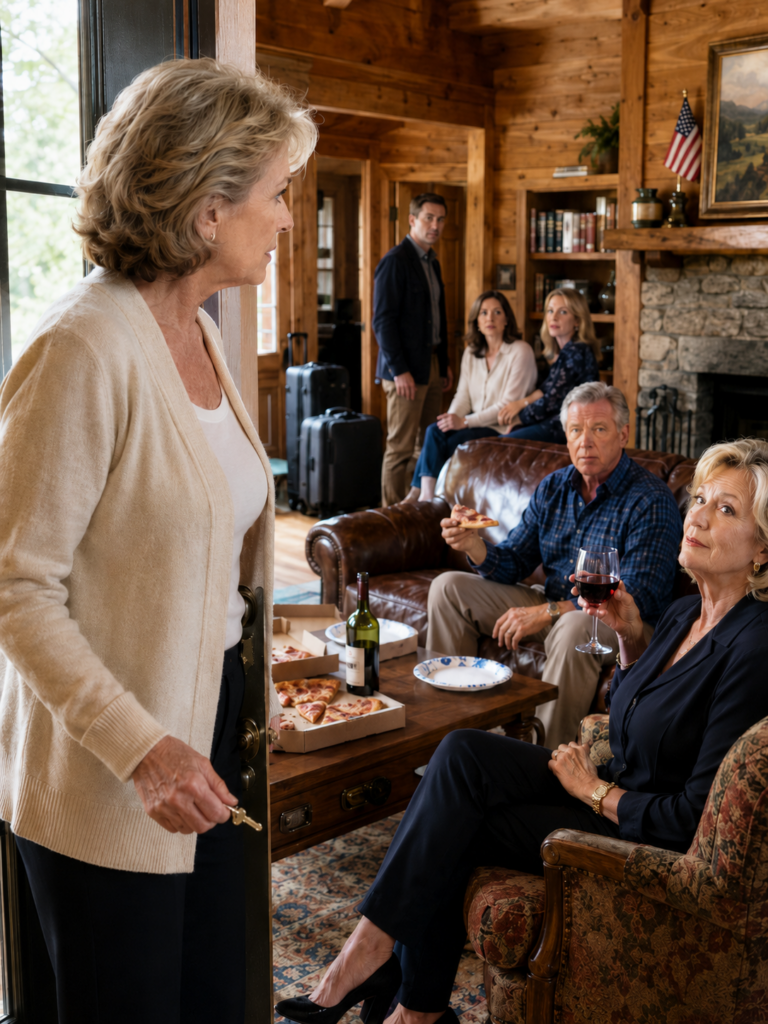
I drove to my Blue Ridge cabin to get it ready for renters and found my daughter-in-law’s parents inside with suitcases by the stairs, drinking my wine like they had already inherited the place. Brenda laughed and said Sarah told them the cabin would be hers someday anyway. I didn’t raise my voice — I only opened the rental folder in my hand, because buried inside it was the one detail that could turn Sarah’s little vacation plan into the biggest mistake of her life.
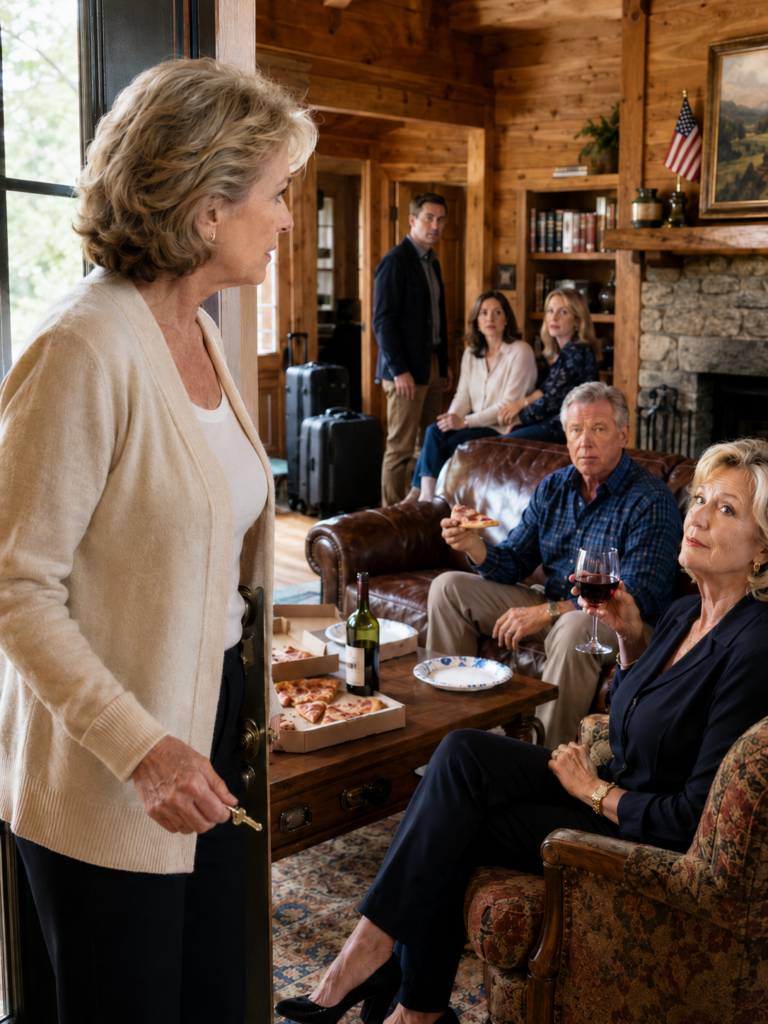
I went to my mountain cabin to meet a rental agent and found my daughter-in-law’s parents drinking my wine in the living room with three relatives, laughing as if they had already inherited the place. When her mother smiled from my favorite chair and said, “Sarah said it’ll be hers anyway,” I finally understood that some people do not steal from you all at once. They move in quietly, one assumption at a time, until the day you come home and find them holding your keys.
I drove up from Charlotte that Thursday with a thermos of coffee, a folder of rental papers, and one clean plan for my retirement.
Nothing dramatic.
Nothing cruel.
Just practical.
My second home, a small cabin tucked into the Blue Ridge Mountains, had been sitting empty for too long. It was not a mansion. It was not some glossy vacation house from a magazine. It was a sturdy place with pine floors, a stone fireplace, a porch that caught the morning fog, and the kind of quiet that makes you breathe differently the moment you step out of the car.
My late husband, Mark, and I had bought it twenty-two years earlier, back when our son Jason was still in high school and we were both working more hours than we admitted. We had scraped together the down payment, fixed the kitchen ourselves, painted the bedrooms over one long weekend, and spent years turning that house into a family refuge.
But memories, no matter how precious, do not pay taxes.
They do not pay insurance.
They do not replace a roof or refill a retirement account after medical bills, inflation, and one long season of pretending everything is fine.
So at sixty-eight, I had decided to rent the cabin out long-term.
Responsible tenants. A reputable management company. Clean paperwork. No family confusion. No informal favors. No more leaving a valuable property empty because I was afraid someone might say I was being selfish.
The rental agent was scheduled to meet me there Friday morning. I wanted Thursday to myself first. I planned to air out the rooms, check the linen closet, bring home a few personal things, and make sure the pantry was cleared before strangers walked through.
I left Charlotte after breakfast, passed the last wide grocery store parking lots, watched the road narrow and rise, and felt some of the pressure in my chest loosen as the mountains came into view. By the time I reached the gravel drive, the sky had turned that soft gray-blue color that makes the ridges look layered like folded cloth.
I expected silence.
That was what I loved about the cabin.
Silence in the pines.
Silence on the porch.
Silence deep enough to hear your own thoughts without somebody else’s opinion stepping on them.
Instead, I heard music.
Not the radio accidentally left on.
Music with a beat.
Then laughter.
Loud laughter.
Then the sharp clink of glasses.
I sat in the car for a few seconds with my hand still on the steering wheel, looking at the warm light glowing through my own living-room windows.
My first thought was that maybe the rental agent had come early with someone.
My second thought was that no professional woman would bring pizza, wine, and what sounded like half a party into a client’s property.
I took my spare key from my purse and walked up the porch steps.
The porch boards creaked under my shoes, familiar as an old voice. The brass lock stuck for half a second, the way it always did in damp weather. I turned the key, pushed the door open, and stepped inside.
The smell hit me first.
Wine.
Grease.
Cheap perfume.
A vanilla candle I had never bought.
Then I saw them.
My daughter-in-law Sarah’s parents, Brenda and Larry Collins, were in my living room with three of their relatives, acting as if they had booked the place for a family weekend.
Brenda was sitting in my favorite chair.
Not perched.
Not awkward.
Settled.
She had one leg crossed over the other, a glass of red wine in her hand, and her elbow resting on the arm of the chair like she had been waiting for room service.
Larry was stretched out on my leather sofa, shoes inches from the handwoven rug I had bought in Asheville the first spring after Mark died. Two women I vaguely recognized as Brenda’s cousins were laughing at something on television. A younger man sat near the fireplace scrolling through his phone, his paper plate balanced on his knee.
On my mother’s cherrywood coffee table sat two open pizza boxes.
Grease had soaked through one corner and left a dark stain on the cardboard. A half-empty bottle of my best Cabernet stood beside a pile of napkins. Someone had put a paper cup directly on the wood without a coaster.
That table had belonged to my mother.
Before that, to her mother.
Four generations of women had polished it with lemon oil and old cotton rags. My husband used to joke that if our house ever caught fire, I would save Jason, the photo albums, and that table in that order.
Now Brenda Collins was eating pepperoni over it like she was at a tailgate.
For a moment, no one moved.
Then Brenda looked up.
The first thing I noticed was that she did not look embarrassed.
Not even slightly.
She did not stand.
She did not put down the wine.
She did not say, “Diane, I can explain.”
She smiled.
A small, polished, cutting smile.
“Diane,” she said. “What are you doing here?”
The question was so absurd I almost laughed.
What was I doing there?
In my house.
With my key.
On my land.
Standing in my own doorway while people who had never paid a dime toward the place sat around eating, drinking, and spreading themselves across my furniture.
I looked around the room again, hoping Jason was somewhere nearby. My son. Sarah’s husband. If he had been there, guilty and uncomfortable, maybe I could have understood the chain of choices faster.
But Jason was not there.
Only Brenda.
Larry.
The relatives.
The wine.
The pizza.
And then I saw the suitcases.
One by the staircase.
Two more near the hall.
My chest tightened.
“How did you get in?” I asked.
Brenda lifted one shoulder in a careless little shrug.
“Sarah told us we could crash here for a few weeks,” she said. “The place was just sitting empty.”
A few weeks.
She said it as if she had asked to borrow a casserole dish.
One of the cousins gave a nervous laugh and reached for her wineglass. Larry suddenly became fascinated by the television.
I looked at the bottle again. It was from the small wine rack under the stairs. A bottle Mark and I had bought on one of our last anniversary trips. I had never opened it because some things, after a person dies, become too tender to use and too painful to throw away.
Brenda had opened it without hesitation.
“Sarah told you that?” I asked.
Brenda nodded.
“She said you wouldn’t mind. Family is family.”
Family is family.
People use that sentence for all kinds of things.
Sometimes it means comfort.
Sometimes it means forgiveness.
Sometimes it means sitting beside a hospital bed at two in the morning, or driving across town with soup, or paying for a child’s braces without making a speech about it.
But sometimes, in the wrong mouth, it means, “I want what is yours, and I expect you to feel guilty if you notice.”
That was what it meant in my cabin.
I stepped farther inside and closed the door behind me.
The room seemed smaller than usual. Not physically, but emotionally, as if their entitlement had taken up all the air.
“This house is being prepared for rental,” I said.
Brenda laughed.
Not warmly.
Not nervously.
A short little laugh with teeth in it.
“Oh, Diane,” she said, “don’t get worked up. Sarah said the house is basically going to be hers and Jason’s eventually anyway.”
There it was.
The sentence that turned something inside me cold and clear.
Eventually.
Anyway.
As if my life had already been moved into somebody else’s future.
As if I were not a woman standing in her own home, but an inconvenience between Sarah and the things she had decided she deserved.
Larry shifted on the sofa.
“Brenda,” he murmured.
But he did not correct her.
No one did.
Brenda took another sip of wine.
“We’re just getting a head start on enjoying the inheritance,” she said.
A head start.
On my inheritance.
I was sixty-eight years old. I had buried a husband, raised a son, survived layoffs, paid mortgages, handled hospital bills, sat in probate offices, and learned how quickly people become interested in your assets once your hair turns gray.
For years, I had tried to be graceful about it.
I had tried to keep peace.
I had smiled through Sarah’s little comments.
“This table is kind of dated, Diane.”
“Do you really need such a big cabin at your age?”
“Jason and I would make much better use of that place someday.”
I had watched Jason laugh awkwardly and change the subject because conflict exhausted him. I had watched Sarah rearrange drawers in my kitchen without asking. I had watched Brenda arrive at holidays with opinions, leave with leftovers, and still manage to make me feel as if I had not done enough.
I had measured every word.
That is what quiet women do.
People mistake it for weakness, but it is often math. We measure the cost of speaking. We measure the cost of silence. We measure who will be hurt, who will explode, who will sulk, who will say we ruined Christmas, who will accuse us of being difficult.
Standing in that cabin, looking at Brenda in my chair with my wine in her hand, I stopped measuring.
“I’m going to check the kitchen,” I said.
Brenda looked amused.
“Suit yourself.”
The kitchen was worse.
The sink was full of dishes. Plates with sauce drying on them. Forks tossed in every direction. Crumbs across the counters. A cabinet door hanging open. A grocery bag tipped on its side near the pantry. My husband’s cast-iron skillet sat in soapy water.
That skillet had been with us since our first apartment.
Mark used to make cornbread in it on Sunday afternoons while Jason sat at the table pretending to do homework. It had survived three houses, two floods in the basement, and my grief.
It had never been left to soak.
Not once.
Until Brenda’s family arrived.
I stared at it a moment longer than I should have.
Brenda followed me, swirling wine in her glass like she was touring a resort property.
“Don’t get your feathers ruffled,” she said. “We’ll clean before we leave.”
“When were you planning to leave?”
She leaned her hip against my counter.
“A few weeks. Maybe a month. Larry needed a break, and Sarah said this would be fine.”
“A month,” I repeated.
Brenda tilted her head.
“You make it sound like we broke in.”
“Did you ask me?”
Her smile thinned.
“Jason is your son.”
“That is not what I asked.”
Her face changed then. The politeness stayed on, but the warmth disappeared.
“Diane, really. Sarah said you weren’t using the place. And like I said, it’ll be hers someday. You can’t expect everyone to tiptoe around your feelings forever.”
My feelings.
That phrase had done a lot of work in my family.
When I objected to Sarah inviting friends to my house without asking, I was “sensitive.”
When I said I did not want to pay for Brenda’s cruise deposit after Larry’s hours were cut, I was “making things awkward.”
When I asked Jason why his wife had been telling people the cabin would be theirs soon, he said, “Mom, she didn’t mean it like that.”
People love to call it your feelings when they do not want to discuss your rights.
I took out my phone.
Brenda watched me photograph the sink, the skillet, the open cabinets, the wine bottle, the pizza boxes, the luggage, the chair, the cousins, the stains.
“What are you doing?” she asked.
“Documenting the condition of my property.”
Her smile disappeared.
Larry appeared in the kitchen doorway.
“Now hold on,” he said. “There’s no need to make this official.”
I looked at him.
“If you wanted unofficial, you should have asked permission before moving in.”
The room went still.
For the first time, I saw their surprise. They had expected the old Diane. Polite Diane. Soft Diane. The Diane who would say, “Well, this is uncomfortable,” then drive home and cry privately before calling Jason to ask what had happened.
They did not know this Diane.
To be honest, I was meeting her myself.
Brenda recovered first.
“You’re overreacting,” she said. “Sarah will be very upset when she hears how you treated her family.”
That sentence might have worked on me a year earlier.
It might have worked when I was still trying to earn Sarah’s approval, still hoping that if I was patient enough, generous enough, and quiet enough, she might one day see me as more than a future estate with a pulse.
But not that day.
I put my phone in my purse and walked to the front door.
Brenda followed.
“So you’re just leaving?” she demanded.
“Yes.”
“You’re not even going to talk this through?”
I turned around.
“There is nothing to talk through with people who are drinking my wine in my house without my permission.”
One cousin muttered something under her breath.
Brenda lifted her chin.
“Could you at least take the trash out when you go?”
The room went silent.
Even Larry looked uncomfortable.
That was the moment I understood how far it had gone.
They did not only believe they had a right to use me.
They expected me to clean up after being insulted.
I looked at Brenda for a long second.
Then I smiled.
Not because anything was funny.
Because I had finally recognized the kind of lesson this situation required.
“No,” I said.
I opened the door and stepped into the cold mountain air.
Behind me, Brenda called my name, sharper now.
I kept walking.
By the time I reached my car, Jason was calling.
His name lit up my phone.
I let it ring.
He called again as I backed down the driveway.
I let it ring.
He called a third time when I reached the highway.
I let it ring.
My son is not a bad man. I need that understood.
Jason has a good heart. He works hard. He loves his children. He still kisses my cheek when he sees me and brings my trash cans up from the curb when he visits. But somewhere inside his marriage, he had learned to survive by avoiding discomfort.
Sarah pushed.
Jason yielded.
I paid.
That had become the family arrangement, even though none of us had ever put it into words.
On the drive back to Charlotte, the mountains faded behind me, and my mind became strangely calm.
Not peaceful.
Not yet.
Orderly.
Bank accounts.
Utility accounts.
Insurance.
Keys.
Rental agency.
Cleaning service.
Legal documents.
Every authorization I had ever signed.
Every favor I had disguised as love because I was afraid of sounding selfish.
Every boundary I had let blur because I did not want my son to feel caught in the middle.
By the time I reached my townhouse, I was not shaking.
I was awake.
My home in Charlotte was small, quiet, and mine. I locked the door behind me, set my purse on the hall table, and made tea I did not drink.
Then I sat at my desk and opened my laptop.
The first account I checked was the joint savings account I had opened years earlier for Jason and the grandchildren. It held sixty thousand dollars. My money. Money I had put aside to help Jason and Sarah eventually buy a house in a better school district.
Jason had access to the account for emergencies, because I had trusted him.
But the principal was mine.
Legally.
Practically.
Morally.
Mine.
I stared at the balance for a long moment.
Sixty thousand dollars.
I had pictured it becoming stability. A yard for the children. A safer neighborhood. A kitchen where Emma could do homework while Ben left his soccer cleats by the back door. I had wanted that for them.
But generosity without respect becomes a leak in the ceiling.
At first, it is one drop.
Then one day, the whole room smells like rot.
I transferred every cent back into my private account.
Not angrily.
Carefully.
Then I printed the confirmation page.
Next, I canceled the upcoming cleaning service at the cabin. If Brenda and her family wanted a free mountain retreat, they could learn where the mop was.
Then I logged into the utility accounts.
Electricity.
Water.
Gas.
Internet.
I removed my automatic payments and scheduled service changes according to the required notice periods. Nothing illegal. Nothing reckless. I was not interested in revenge that could harm me later.
I simply stopped funding other people’s entitlement.
After that, I forwarded the photos to the rental agent and explained that unauthorized occupants were currently in the house, but I intended to have it cleared before the walkthrough.
She replied within an hour.
“Oh my goodness. Document everything. Do not hand out any keys. We’ll proceed once the property is empty.”
Document everything.
There is something about a professional woman saying those words that makes your backbone feel less lonely.
I printed her email too.
By the time I closed my laptop, the tea beside me had gone cold.
The hardest part was not the money.
It was not the mess.
It was not even Brenda’s laugh.
The hardest part was admitting that my son had allowed someone else to treat me as if I had already become an inheritance.
The next morning, Sarah came to my door without calling first.
That was typical.
Sarah did not visit so much as arrive.
She knocked once and pushed the door open before I reached the hallway.
Her face was flushed. Her blond hair was pulled back tight, her phone clutched in one hand like evidence in a trial.
“Diane, what was that yesterday?” she demanded.
I was watering African violets near the kitchen window.
I kept watering.
“Good morning, Sarah.”
“Don’t good morning me. My mother is devastated.”
I looked at the violets.
“They’re delicate plants,” I said. “Too much water, and the roots suffer.”
Sarah stared.
“What?”
I set down the watering can.
“Your parents are not welcome in my cabin.”
She laughed once, sharp and disbelieving.
“They’re family.”
“They are trespassers I happen to know.”
Her mouth opened, then closed.
“Jason and I agreed they could stay there,” she said.
“No. You and Jason agreed to give away something you do not own.”
Her eyes hardened.
“You’re being selfish.”
There it was.
The old word.
Selfish.
The word people use for women when they stop being convenient.
I walked to the kitchen table and sat down. Sarah remained standing, arms crossed, as if standing gave her the higher ground.
“That house is going to be ours anyway,” she said. “Why are you making a huge drama out of it?”
I looked at her directly.
“Later is not now.”
Her jaw tightened.
“And whether it will ever be yours,” I added, “is a decision I make every day.”
For the first time since she entered, Sarah had no immediate answer.
I saw her recalculating.
The old Diane would have softened it. Added a nervous little laugh. Said, “I don’t mean it that way.” Offered coffee. Offered comfort. Offered money.
I did none of those things.
Sarah’s voice dropped.
“Jason saw the savings account.”
“I assumed he would.”
“It’s empty.”
“Yes.”
“We were supposed to sign paperwork on the new house next week.”
“I know.”
“What did you do?”
“I moved my money.”
Her eyes flashed.
“That money was for us.”
“That money was intended as a gift,” I said. “A gift with one condition.”
“What condition?”
“Respect.”
She looked away, then back at me.
“You can’t punish your grandchildren because you’re upset with me.”
I folded my hands on the table.
“I am not punishing anyone. I am refusing to fund a household that gives away my property without permission and then lectures me for noticing.”
Sarah leaned forward.
“My parents needed a place to stay.”
“Then you should have hosted them.”
“Our apartment is too small.”
“Then you should have paid for a hotel.”
“We don’t have that kind of money right now.”
“But you believed you had authority to give them my house.”
Silence.
Not shame.
Not yet.
Anger.
Sarah’s anger had always been polished for public use. Raised voice in private. Tears on command. A wounded tone that made Jason start apologizing before he even knew what he had done.
But I simply watched her.
That unsettled her more than anything.
“You’re going to regret this,” she said.
“No,” I replied. “I regret letting it get this far.”
She stood there waiting for me to blink.
I did not.
Finally, she grabbed her purse.
“Jason is going to be furious.”
“Jason is welcome to come speak with me.”
She left hard, closing the door with enough force to rattle the glass.
A few hours later, Jason arrived.
He looked exhausted.
My son has always carried stress in his shoulders. Even as a boy, if he had a spelling test or a baseball game he was nervous about, he would hunch slightly, as if trying to make himself smaller than the problem.
That afternoon, he looked twelve years old and forty-five at the same time.
“Mom,” he said from the porch.
“Come in.”
He sat at my kitchen table in the same chair where he used to do homework while I made dinner after work. For one soft moment, the sight nearly undid me.
Then I remembered the pizza boxes on my mother’s coffee table.
“Does it have to be like this?” he asked.
“Yes.”
He rubbed his face.
“Sarah is losing it. Her parents won’t leave the cabin. Brenda says you embarrassed them.”
“I walked into my own house and found them using it without permission.”
“They thought it was okay.”
“Because you let them think that.”
He looked down.
There it was.
Not denial.
Silence.
“Jason,” I said, “did you give Sarah the spare key?”
He swallowed.
“She knew where it was.”
“That is not what I asked.”
He closed his eyes briefly.
“Yes.”
“And did you tell her she could offer the cabin to her parents?”
“Sarah said it would be fine. She said you weren’t using it.”
“Did you ask me?”
“No.”
“Did you tell them the cabin was being prepared for rental?”
“I didn’t know the agent was coming so soon.”
“You knew I was renting it.”
He said nothing.
The kitchen clock ticked between us.
I pushed a plate of cookies toward him. He did not take one.
“I love you,” I said. “That has never been the question.”
His eyes watered, and for a moment I wanted to reach across the table and make it all easier. Mothers are trained by love and habit to soothe. Even when our children are grown. Even when they have helped hurt us.
But love is not a deed transfer.
Love is not a blank check.
Love is not a spare key passed around until your own home no longer feels like yours.
“I’ve hired a rental agent,” I continued. “There will be a professional walkthrough next week. Sarah’s parents and their relatives need to be out by Sunday night.”
Jason looked up sharply.
“Sunday? Mom, they can’t do that.”
“They can.”
“They already unpacked.”
“They can pack.”
“Brenda says they planned on staying three weeks.”
“She planned incorrectly.”
He stared at me.
“You sound cold.”
“No,” I said. “I sound like a woman who is finished paying for warmth she never receives.”
He flinched.
I did not apologize.
Then I told him about the utilities, the cleaning service, the account, and the rental management plan.
His face changed with each item.
“You can’t just cut everything off.”
“I can stop paying for things I did not authorize.”
“But they’re there now.”
“They should not be.”
“What if they have nowhere to go?”
“Then the adults who invited them can help them find somewhere.”
He stood and paced toward the window.
“This is going to make everything worse.”
“No, Jason. It is going to make everything honest.”
He turned back.
“Sarah says you’re trying to control us.”
“I am controlling myself. That is what she dislikes.”
His shoulders dropped.
“I don’t want to be in the middle.”
“You placed me underneath the middle,” I said. “I am simply stepping out.”
That ended the conversation.
He left quietly.
That night, I slept better than I had in years.
Not because the problem was solved.
It was not.
But because for once, I was not lying awake wondering how to keep everybody else comfortable while I disappeared one inch at a time.
Peace built on surrender is not peace.
It is resentment with a tablecloth over it.
On Sunday evening, I drove back to the mountains.
This time, I was not alone.
Mr. Miller, a locksmith from a small town twenty minutes away, met me at the gravel driveway. He was a calm man in his fifties with a gray beard, a work van, and the patient expression of someone who had seen every kind of property dispute decent people get themselves into.
The cabin lights were blazing when we arrived.
Music drifted through the windows.
So they had not left.
Of course they had not left.
They thought I was bluffing because bluffing had been the family language for too long. People threatened change, then backed down the second discomfort arrived.
I had done that myself.
Not anymore.
I got out of the car. The air smelled like pine and cold dirt. The porch light cast a yellow circle over the steps. Inside, someone laughed.
I walked up and knocked.
Brenda opened the door wearing a robe over leggings, wineglass in hand.
When she saw me, her expression tightened.
“Diane,” she said. “Back again.”
“Yes.”
Her eyes moved to Mr. Miller.
“Who is that?”
“This is Mr. Miller. He is here to change the deadbolts on the front and back doors.”
Her mouth fell open.
“You cannot be serious.”
“I am.”
Larry appeared behind her, red-faced and untucked.
“What’s going on?”
“You have thirty minutes to pack,” I said.
Brenda laughed once.
Not a real laugh.
“We told you we’re staying through the month.”
“No,” I said. “You told yourselves that.”
Larry stepped forward.
“You can’t throw people out on a Sunday night.”
I looked at my watch.
“It is 7:54. You have thirty minutes.”
Brenda’s voice rose.
“This is family.”
“This is my property.”
“You’re being cruel.”
“I am being precise.”
Mr. Miller stood quietly behind me with his toolbox. He did not speak. He did not need to. His presence made the boundary visible.
Brenda grabbed her phone.
“I’m calling Sarah.”
“Please do.”
She put the call on speaker, perhaps believing Sarah’s voice would restore the old order.
Sarah answered on the second ring.
“Mom? What’s happening?”
Brenda spoke loudly.
“Your mother-in-law is here with some man trying to change the locks.”
Sarah’s voice sharpened instantly.
“Diane, have you lost your mind?”
I took the phone gently from Brenda’s hand.
“Sarah, your parents have thirty minutes to gather their belongings. Anything left behind will be handled by the rental agency.”
“You can’t do this,” Sarah snapped.
“I can.”
“My mother is crying.”
Brenda was not crying.
She was glaring.
“That is unfortunate,” I said.
Jason’s voice appeared faintly in the background.
“Mom, please—”
I ended the call and handed the phone back to Brenda.
The silence afterward was different from the silence on Thursday.
On Thursday, they had been comfortable in it.
Now it exposed them.
Mr. Miller began removing the front lock. The metallic sound of his drill filled the hall.
That sound did more than any speech could have done.
It announced that the house was returning to its owner.
The next thirty minutes were chaos.
Brenda stormed from room to room, stuffing clothes into plastic bags because she had not brought enough luggage for everything she had spread through the house. Larry searched for his shoes and blamed everyone within reach. One cousin gathered toiletries from the bathroom. Another wrapped leftover pizza in foil as if she still had the right to carry away dinner from my refrigerator. The younger man asked if I was “seriously making them drive at night.”
“Yes,” I said.
No explanation.
No debate.
Just yes.
Brenda kept muttering about humiliation.
I stood in the hallway with my hands in my coat pockets.
At one point, Larry looked at me and said, “You used to be nicer.”
I looked back at him.
“I used to be easier.”
He had no answer.
When the back door lock was changed, Mr. Miller handed me the new keys.
The five of them stood in the driveway under the porch light with bags at their feet and outrage on their faces. The mountain night had turned cold enough that their breath showed faintly in the air.
Brenda looked at me like she needed one final line sharp enough to leave a scar.
“This will damage your relationship with your son,” she said.
“No,” I replied. “The damage began when my son learned he could give away my home and expect me to thank him for including me afterward.”
Her face hardened.
I stepped inside, closed the door, and locked it with the new key.
Then I turned off the porch light.
Through the front window, I watched them stand in the darkness for several stunned seconds before they finally loaded their cars and drove away.
When the taillights disappeared down the gravel road, the cabin became quiet again.
Real quiet.
I stood in the living room and breathed.
The house was a mess. The coffee table needed careful cleaning. The kitchen needed more than an ordinary wipe-down. The trash smelled terrible. Someone had spilled wine on a throw pillow. The guest bathroom looked like a roadside motel after a holiday weekend.
But the house was mine again.
That mattered more than the mess.
On Monday morning, I met the rental agent.
Her name was Melissa. She was brisk, kind, and wonderfully practical. She walked through the cabin with me, took notes, photographed the deck and the view, and assured me the location was strong and the right tenants would pay well.
“This place has character,” she said.
I looked at the cherrywood coffee table, now cleared and polished again.
“Yes,” I said. “It does.”
I hired a professional cleaning crew. I scheduled minor repairs. I had the wine storage locked. Melissa recommended a property management company that handled tenant screening, maintenance calls, payments, and inspections.
I signed the preliminary paperwork that afternoon.
By the time I drove back to Charlotte, I felt tired but steady.
Jason was waiting outside my townhouse when I arrived.
He looked worse than before.
Unshaven.
Pale.
Eyes shadowed.
“Mom,” he said. “What did you do?”
I unlocked my door.
“I protected my property.”
He followed me inside.
“Brenda and the others had to check into a motel.”
“That was their choice.”
“Sarah has been crying for hours. She says you humiliated them.”
“I did not humiliate anyone. I stopped hosting people who were never invited.”
He sat at the kitchen table.
“We don’t have money for a motel and the down payment. Closing costs are due. If we don’t pay soon, we lose the house.”
I sat across from him.
“I’m sorry to hear that.”
He looked stunned.
“That’s all?”
“What would you like me to say?”
“I thought you cared.”
There it was.
The sentence designed to turn a mother’s spine into water.
I looked at my son, my only child, the boy whose fevers I had slept beside, whose college essays I had proofread, whose first heartbreak I had soothed with grilled cheese sandwiches and silence.
“I care very much,” I said. “That is why this has to change.”
His eyes filled.
“Mom.”
“No, Jason. Listen.”
He closed his mouth.
I went to my desk and brought back a folder.
Inside was a plain-language agreement. Not a final legal contract, though I intended to have an attorney review anything formal. It was a list of terms. Clear expectations. No emotion hidden in the margins.
I placed it on the table between us.
“I am willing to help with housing,” I said. “But under new conditions.”
He stared at the paper.
“The cabin will be managed by a rental agency. Neither you nor Sarah will have a key. No one stays there without a written agreement through the agency.”
He swallowed.
“The savings for the grandchildren will remain protected, but I will be the sole trustee. There will be no withdrawals for emergencies created by Sarah’s relatives.”
His eyes moved down the page.
“If I help with a home, the money goes directly where it is supposed to go. Lender. School. Repairs. Closing costs. Not cash in anyone’s hand.”
He looked up.
“And Sarah?”
“Sarah owes me a written apology.”
He leaned back as if I had asked him to move the mountains.
“Mom.”
“No.”
“She won’t do that.”
“Then the account stays closed.”
He rubbed his forehead.
“She thinks you’re trying to dominate her.”
“Sarah has mistaken access for respect. I am correcting that.”
He stared at the paper for a long time.
For a moment, he seemed angry.
Then tired.
Then smaller.
“I don’t know how to fix this,” he said.
“You start by telling the truth.”
“To Sarah?”
“To yourself.”
He did not answer.
For two weeks, there was no real conversation.
Not silence exactly.
Sarah knew how to make noise without speaking directly.
She sent photos of the children.
Emma holding a drawing.
Ben in his soccer jersey.
The baby asleep in a car seat with one sock missing.
Each message came with a sentence sharp enough to look innocent.
“They miss their Nana.”
“Emma asked why you don’t visit anymore.”
“Ben says family should forgive.”
It hurt.
Of course it hurt.
Anyone who says boundaries do not hurt has never drawn one around grandchildren.
I missed them terribly. I missed the smell of their hair after bath time, the way Ben told stories with his whole body, the way Emma pressed stickers on my wrist and declared them jewelry.
But I had learned something in that cabin.
People who use love as a lever will keep pulling until something breaks.
I refused to let the broken thing be me.
So I replied simply.
“I miss them too. When the cabin matter is settled respectfully, I would love to see them.”
No argument.
No defense.
No open door for manipulation.
Then came the day their option on the new house expired.
Jason called that evening.
His voice shook.
“Mom.”
I closed my book.
“Jason?”
“Sarah won’t apologize,” he said. “She says you’re acting like a tyrant. The sellers moved on. We lost the house.”
The sadness hit me harder than I expected.
Not for Sarah.
Not even for the house.
For Jason.
For the version of my son who had wanted something stable and had not understood that stability cannot be built on money borrowed from someone you allow others to disrespect.
“I’m sorry,” I said.
“Are you?”
“Yes. But I am not responsible for Sarah’s pride.”
He breathed unevenly.
“She blames me.”
“For what?”
“For not making you fix it.”
I let that sit between us.
Then I said, “Jason, pride does not pay a mortgage. Neither does avoidance.”
He did not argue.
Shortly after that, the tone shifted inside Sarah’s household.
Brenda and Larry ran out of money for the motel. The relatives who had enjoyed my cabin suddenly had their own problems, their own schedules, their own reasons they could not help. Brenda and Larry ended up in Jason and Sarah’s two-bedroom apartment, which had already been tight with two adults and three children.
Now it became unbearable.
Jason told me later that Brenda criticized Sarah’s cooking. Larry watched television too loudly. The children had nowhere quiet to sleep. Every conversation turned into a complaint about me.
Sarah’s perfect image began to crack under the weight of her own invitation.
Brenda called me once from a number I did not recognize.
I answered.
“Diane,” she said, sweet as syrup. “I think this has gotten out of hand.”
“Yes,” I replied. “It did.”
“We should talk like adults.”
“We had that opportunity in my kitchen.”
She sighed dramatically.
“I may have said some things.”
“You said enough.”
“I was joking.”
“You were not.”
Her voice sharpened.
“You know, people are saying you threw a family into the street.”
“I changed locks on my own property after giving unauthorized guests a deadline.”
“You are a cold woman.”
“No,” I said. “I am a clear one.”
Then I ended the call and blocked the number.
That small action felt better than it should have.
Not because I enjoy shutting people out.
Because I finally understood that access to me is not a public utility.
A few evenings later, Jason came to my townhouse alone.
He had a suitcase.
The sight nearly broke my heart.
Not because I was surprised, but because some part of me had been expecting it.
He stood on my porch with his shoulders slumped.
“I can’t do it, Mom,” he said.
I stepped aside.
He came in.
The suitcase wheels bumped softly over the threshold.
“The apartment is full of her relatives,” he said. “Everyone is fighting about money. Sarah says it’s my fault. Brenda says I ruined everything by not handling you. The kids are upset. I can’t think.”
“You can stay in the guest room,” I said.
His face filled with relief.
“But one condition.”
He tensed.
“We do not negotiate about money in this house. We do not use my home as a war room against Sarah. We do not invite chaos through my door. This is my sanctuary.”
He nodded.
“I understand.”
For three days, Jason stayed with me.
He slept more than I had seen him sleep in years. He ate toast at my kitchen table. He drank coffee on the patio while morning light moved across my garden. He watched me go about my life, and I think he saw something he had forgotten existed.
Peace.
Not wealth.
Not perfection.
Not loneliness.
Peace.
Bills paid on time.
Meals planned.
Friends calling without drama.
A neighbor dropping off tomatoes from her garden.
A book club reminder written on the calendar beside the refrigerator.
A life where no one had to raise her voice to prove she mattered.
On the second night, he helped me make pasta.
He chopped onions while I stirred sauce.
“I didn’t realize how tired I was,” he said.
“I know.”
“Sarah says I’m weak.”
I turned down the stove.
“Are you?”
He looked at me.
“I don’t know anymore.”
“That means you are ready to find out.”
He gave a sad little laugh.
“You sound like Dad.”
That one landed in a tender place.
Mark had been gone eight years. He had not been perfect, but he had been steady. He believed a person’s word should have weight and a person’s home should have a door that could close.
“He would have changed the locks faster than I did,” I said.
Jason smiled for the first time in days.
On the fourth morning, Sarah came over.
She knocked.
That alone told me the world had shifted.
When I opened the door, she stood on the porch looking worn down. Her hair was loose, her makeup light, her expression drained of its usual polish.
She was still a beautiful woman.
But the sharpness had dulled.
Exhaustion makes everyone more honest.
“Is Jason here?” she asked.
“He is asleep.”
She started to step forward.
I stayed in the doorway.
She stopped.
“What do you want, Sarah?”
Her eyes flicked past me, then back.
“My parents moved out.”
I said nothing.
“They drove up to stay with my brother in Virginia.”
Still I said nothing.
“It was a nightmare,” she added.
I waited.
Silence had become my best tool. Not the silence of surrender. The silence that requires the other person to carry her own words.
Sarah swallowed.
“I’m sorry,” she said.
It sounded forced.
It sounded painful.
It sounded like something pulled from her with pliers.
But it was there.
“I’m sorry about the cabin,” she continued. “I shouldn’t have let my parents stay there. I shouldn’t have acted like it was mine to offer. And my mother should never have said what she said.”
I looked at her for a long moment.
“That is a start.”
Her jaw tightened at the word start, but she did not argue.
“An apology without changed behavior,” I said, “is just noise.”
She looked down.
“I know.”
I stepped aside.
She entered quietly.
The three of us sat at my kitchen table after Jason woke. It was strange seeing them together there, my son and his wife, no children, no holiday meal, no birthday cake, no noise to soften the edges.
Just the table.
The truth.
And me with the keys.
I laid out the terms again.
The cabin would remain under rental management. No family keys. No informal stays. No last-minute favors disguised as emergencies.
The savings for the grandchildren would remain, but I would be the sole trustee.
If I helped with housing, I would do it in a way that protected the money and the family from impulsive decisions. No cash transfers. Payments would go directly to lenders, schools, or vendors. If they found another house and needed help, my name would be attached in a way that protected my investment for the first five years.
Sarah started to protest.
“This makes us look like children,” she said.
Jason looked at her.
For once, he did not rush to soften her discomfort.
“We acted like children,” he said.
Sarah stared at him.
He held her gaze.
“We blew it.”
Those three words changed the room.
Not loudly.
Not dramatically.
But I saw it happen.
Sarah had expected him to bend toward her as he always had. To translate her anger into my guilt. To ask me privately to let things go for the sake of peace.
Instead, he sat beside her and told the truth.
She looked down at her hands.
I almost felt sorry for her.
Almost.
The months that followed were not magical.
Real change rarely is.
Sarah did not become warm overnight. Brenda did not send flowers. Jason did not transform into a perfectly confident man after one conversation at my kitchen table.
But the pattern changed.
That was enough.
The cabin was leased to a retired couple from Atlanta. Melissa’s agency handled everything. The tenants paid on time, sent polite maintenance requests, and once emailed me a photo of the porch after a snowfall because they thought I would like to see how beautiful it looked.
I did.
The rental income went straight into my account.
For the first time in years, retirement felt less like careful breathing and more like actual air. I could repair things before they became emergencies. I could say yes to lunch with friends without calculating groceries in my head. I could donate to the church pantry, buy good shoes, and stop treating every unexpected bill like a personal failure.
The cabin was no longer a symbol of what my family might inherit.
It was part of the life I was still living.
Jason moved back home after a week, but something in him had shifted. He started making decisions again. Small ones at first. He enrolled in a certification course Sarah had once dismissed as a waste of time. When he told me, I offered to help pay for it.
He hesitated.
“Are you sure?”
“Yes,” I said. “Send me the school’s payment link.”
He smiled faintly.
“Directly to the school?”
“Directly to the school.”
He understood.
That was how help worked now.
It built something, or it did not leave my account.
A few months later, I organized a family dinner at a local bistro in Charlotte. Nothing flashy. Just a quiet place with cloth napkins, warm bread, and a server who knew when to refill water without interrupting.
Jason came.
Sarah came.
The children came.
Brenda and Larry were not invited.
Sarah did not ask why.
That was progress.
During dinner, Emma showed me a drawing of a purple horse. Ben told me about soccer practice. The baby dropped a piece of bread on the floor and laughed like he had invented comedy.
Jason looked lighter.
Sarah looked careful.
Careful was acceptable.
Not every relationship needs to become soft. Some simply need to become respectful.
At one point, the check arrived, and Sarah reached for it.
I placed my hand gently over the folder.
“I invited everyone,” I said. “This one is mine.”
She nodded.
“Thank you, Diane.”
No edge.
No performance.
Just the words.
Another afternoon, Sarah came to my townhouse alone.
She brought flowers.
Not expensive flowers. Grocery-store tulips wrapped in brown paper. But they were my favorite color, and somehow she had remembered.
“I wanted to say thank you,” she said.
I took them.
“For what?”
“For taking Jason in when things were bad at our place.”
I looked at her.
“I love my son.”
“I know.”
“But I also love myself,” I said. “That is the difference between now and then.”
She absorbed that.
There was a time she would have rolled her eyes.
That day, she did not.
Instead, she asked, “How did you do it?”
“Do what?”
“Stay so calm when all of us were pushing you.”
I trimmed the tulip stems at the sink.
“I was not calm at first.”
“You looked calm.”
“That is different.”
She leaned against the counter.
“I thought you were being cold.”
“I was being clear.”
Sarah watched me place the flowers in a vase.
“When you know what belongs to you,” I said, “and you know what you are worth, you do not need to burn the room down to defend yourself. Sometimes all you need is to turn on the light.”
She was quiet.
Then she said, “My mother still talks about that night.”
“I’m sure she does.”
“She says you embarrassed her.”
“Your mother embarrassed herself. I simply changed the locks.”
Sarah almost smiled.
Not fully.
But almost.
That was when I knew we had reached a new level.
Not friendship exactly.
Not mother and daughter.
Something more practical, and perhaps more durable.
Recognition of territory.
She knew where I stood. I knew where she stood. We both knew the old game was over.
Today, I am sixty-nine years old.
I am sitting on my patio as I write this, looking out at the hydrangeas behind my townhouse. My phone is beside me, but it no longer feels like a device that can ruin my day. If it rings, I decide whether to answer. If a message comes in, I decide whether it deserves my energy.
That may sound small to some people.
It is not small.
It is freedom.
The cabin in the Blue Ridge Mountains is in good hands. The tenants keep the porch swept. They ask permission before hanging anything on the walls. They oil the butcher-block counter because they noticed it needed care.
They understand something my own extended family forgot.
A home belongs to the person who carries its responsibility.
Not the person who imagines inheriting it.
Jason and Sarah eventually found another house. Not the first one. Not the showy one Sarah had wanted. A smaller place, with a reasonable mortgage, a fenced yard, and a kitchen that gets good morning light.
I helped.
But I helped under the terms we discussed.
The money went where it was supposed to go. The paperwork was clean. My contribution was protected. Nobody received cash to “handle things.” Nobody got to turn my generosity into their emergency fund.
Some people would call that harsh.
Those people are welcome to fund chaos with their own retirement.
I am done doing it with mine.
The grandchildren come over often. We bake oatmeal cookies. We plant herbs in little pots. We watch old movies on rainy afternoons. They know my house is a place of love, but also a place where shoes go by the door, sticky hands get washed, and nobody opens drawers that are not theirs.
Boundaries are not the opposite of love.
They are the structure that lets love stay healthy.
I have not heard directly from Brenda since the Sunday night at the cabin. Through the family grapevine, I hear she still tells people I threw her out into the cold. She leaves out the wine, the pizza boxes, the luggage, the weeks she planned to stay, and the sentence about getting a head start on my inheritance.
People like Brenda always edit the story until they can survive their own role in it.
That is no longer my concern.
The echo does not reach me here.
Sometimes, when the rental calendar is open, I drive up to the mountains for a day. I sit on the porch with coffee in the morning or a glass of wine at sunset. The air smells like pine and damp earth. The old cherry furniture sits where it belongs. The cast-iron skillet is dry, seasoned, and safe.
The house is quiet again.
But the quiet is different now.
Before, it was the quiet of a woman trying not to cause trouble.
Now it is the quiet of a woman who knows she can handle trouble when it walks through her door wearing a polite smile.
I think often about the moment Brenda laughed and said Sarah told her the cabin would be hers someday.
For a while, that sentence hurt.
Now I almost appreciate it.
Not because it was kind.
It was not.
Because it woke me.
It showed me the future they had planned if I did nothing. More assumptions. More access. More decisions made around me, over me, and eventually without me. It showed me how easily love can be converted into expectation when no one is required to say thank you.
I realized something that day.
You may have to risk the approval of people you love to save the truth of who you are.
You may have to let your only child be disappointed in you.
You may have to let your daughter-in-law call you selfish.
You may have to let relatives tell a version of the story where you are the villain because the honest version does not flatter them.
Let them.
A person who needs you powerless will always describe your boundaries as cruelty.
That does not make it true.
Jason respects me more now than he did when I was paying, yielding, and smoothing everything over. He may not say it in those exact words, but I see it. He calls before coming by. He asks instead of assumes. He has begun to stand straighter in his own life.
That is the unexpected gift.
By taking back my keys, I gave my son a picture of what a backbone looks like.
My name is Diane.
I am sixty-nine years old.
I own my home, my cabin, my accounts, my time, my silence, and my yes.
And I am never giving away my keys again.
