
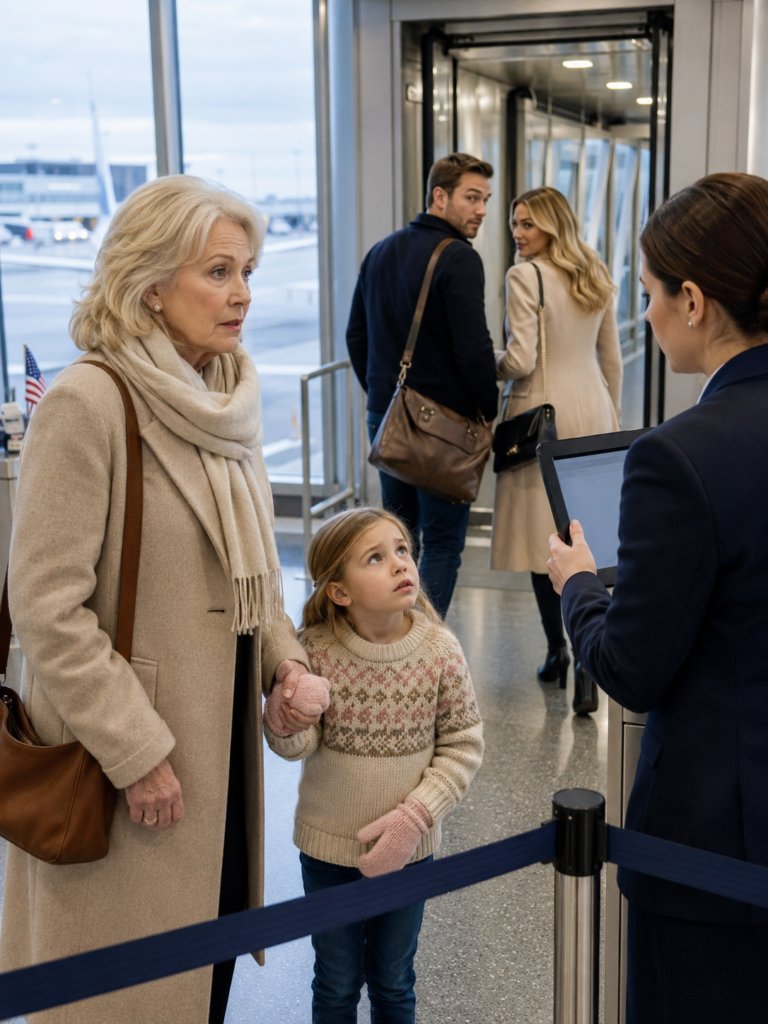
At Chicago O’Hare, my son and daughter-in-law boarded their flight to Canada while my ticket quietly disappeared from the reservation. I was still holding my six-year-old granddaughter’s hand when the gate agent said, ‘Ma’am, your seat is no longer in the system.’ Then my granddaughter looked up at me and whispered, ‘Grandma, aren’t we going too?’ That one little question changed what I was willing to keep paying for.
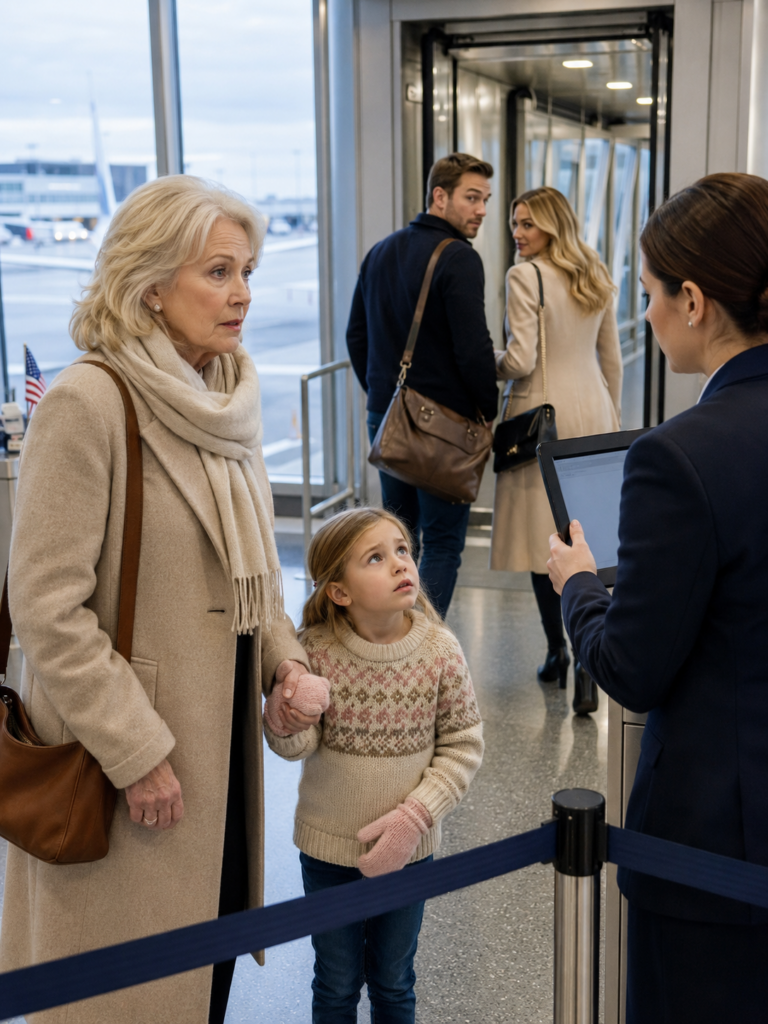
The gate agent did not say my family had abandoned me.
She did not have to.
All she did was scan my boarding pass, frown at the screen, and ask me to step aside while the line kept moving around me at Chicago O’Hare.
Behind her, the jet bridge door stood open. Ahead of me, my son and daughter-in-law were already walking toward the plane with their winter coats over their arms, their carry-ons rolling behind them, and no intention of looking back.
My six-year-old granddaughter Sophie stood beside me in pink mittens, holding a stuffed fox under one arm and waving at her father with the innocent confidence of a child who still believed adults came back when they saw you waiting.
Ryan glanced over his shoulder once.
Just once.
His eyes landed on me, then on Sophie.
Then he turned away.
Brooke touched his sleeve, leaned in close, and said something I could not hear. Whatever it was, it made him walk faster.
The gate agent lowered her voice.
“Mrs. Haron, I’m sorry, but this seat isn’t active anymore.”
I stared at her.
“What do you mean, not active?”
She turned the monitor slightly, shielding it from the impatient passengers behind me.
“It looks like the traveler was removed from the reservation.”
For a moment, the whole airport seemed to shrink down to the red letters on that screen.
Removed.
Not delayed.
Not accidentally misplaced.
Removed.
The overhead speakers announced final boarding for our flight to Calgary. A child somewhere behind me cried because his backpack zipper was stuck. Suitcase wheels clicked over tile. A man in a Bears sweatshirt muttered about weather delays. The smell of burnt coffee drifted from a kiosk near the gate.
And my son kept walking.
Sophie’s mitten slipped from my hand.
“Grandma?” she whispered.
I looked down at her. Her cheeks were pink from excitement. Brooke had curled her hair that morning and put her in a cream sweater with tiny silver snowflakes across the front because, as she said, “It’ll look adorable in the cabin pictures.”
Sophie looked from me to the gate, confused.
“Aren’t we going too?”
The agent’s face changed when she heard that. It was small, almost professional, but I saw it.
People always think humiliation is loud.
Sometimes it is very quiet.
Sometimes it sounds like an airline scanner beeping red while your own child boards a plane without you.
My name is Renee Haron.
I am sixty-four years old, a widow, a grandmother, and the owner of a brick duplex on a quiet street west of Chicago where the snowplows come late and everybody knows whose garbage cans belong to whom.
For most of my life, I believed family meant you helped before anyone had to ask.
I believed you paid the overdue bill if your son was short.
You watched the child if the babysitter canceled.
You brought soup when someone had a cold.
You kept an extra key under the flowerpot, even in winter.
You said, “Don’t worry about it,” until people stopped worrying altogether.
That afternoon at O’Hare, with my granddaughter staring up at me and my son disappearing into the jet bridge, I understood something I should have understood years earlier.
Some people do not see your help as love.
They see it as infrastructure.
They count on you the way they count on heat coming through the vents.
Useful.
Quiet.
Expected.
And when you finally stop, they call it cruelty.
The gate agent touched the edge of the counter.
“Ma’am, I can check whether another seat is available, but the flight is full. I’m very sorry.”
I looked through the glass one last time.
Ryan and Brooke were gone.
The jet bridge door began to close.
Sophie squeezed the stuffed fox so hard its little orange ear folded over.
“Did Daddy forget us?”
That sentence did something no insult from Brooke had ever managed to do.
It did not break me.
It organized me.
I bent down, zipped Sophie’s coat to her chin, and brushed a curl away from her cheek.
“No, sweetheart,” I said softly. “We’re not getting on that plane today.”
Her eyes filled.
“But the lights.”
She had spent weeks talking about the northern lights, though Brooke had told her at least ten times not to “build it up too much.” Sophie had drawn green and purple skies on construction paper and taped them to my refrigerator. She had packed a little notebook to write down “Canada things.” She had practiced saying bonjour, even though we were not going to that part of Canada.
I took her hand again.
“We’ll make our own lights,” I said. “And this New Year’s will still be one we remember.”
The agent offered to call airport police, then customer service, then someone from the airline office.
I thanked her and declined.
There are moments when making a scene only gives careless people a performance to complain about later.
I had all the evidence I needed.
The canceled boarding pass.
The unanswered wave.
The child left standing at the gate.
I bought Sophie a soft pretzel and a bottle of apple juice because she looked like she might cry if anyone spoke kindly to her. Then I called a taxi from the lower level, where the air smelled like exhaust and cold pavement.
Chicago slid past the window in gray and orange streaks.
Sophie fell asleep against my coat before we reached the Kennedy Expressway. Her mittened hand stayed curled in my lap, still gripping the corner of her stuffed fox.
I did not call Ryan.
I did not call Brooke.
I did not send a paragraph asking how they could do this.
A younger version of me would have done that. She would have begged for the shape of the knife after already feeling it.
At sixty-four, I had no interest in begging a person to explain why they hurt me.
By the time the taxi pulled onto our street, the porch lights were already glowing. My side of the duplex looked the same as always: a brick path, two winter planters, a wreath I had bought at Costco, and the upstairs window where Sophie liked to tape paper snowflakes.
Ryan and Brooke lived in the other half.
My late husband, Frank, and I bought the building thirty-one years earlier. Back then, the neighborhood still had a corner bakery, a hardware store with handwritten receipts, and a little diner where Frank ordered the same Denver omelet every Saturday. We lived in one unit and rented the other to schoolteachers, nurses, and once a retired postal worker who always left tomatoes on our porch in August.
When Ryan married Brooke, they were struggling. Their rent in the city had gone up. Sophie was a toddler. Brooke cried at my kitchen table one Sunday after church and said they just needed “a little breathing room.”
So I gave them breathing room.
A family rate.
Shared internet.
My basement for their extra furniture.
My name on the property portal because Brooke hated “dealing with old-fashioned websites.”
My bank card connected to the utility account because Ryan always forgot passwords.
My Saturday mornings when they wanted “couple time.”
My Sunday afternoons when Brooke needed “just one hour” that somehow became five.
That was how a little help became a second job I never applied for.
That night, I made Sophie grilled cheese and tomato soup in the blue pot Frank used to love.
She sat at the kitchen table, swinging her feet under the chair, still in the snowflake sweater meant for cabin photographs.
“Are Mommy and Daddy mad at us?” she asked.
I placed the bowl in front of her and sat down.
“No, honey. Grown-ups make choices. Sometimes they make poor ones.”
She looked at the soup.
“Did I do something?”
That was the second sentence that changed me.
I reached across the table and covered her small hand with mine.
“No. You did nothing wrong. Nothing.”
She nodded, but children do not always believe words the first time. Especially when the people who were supposed to protect them had just walked onto an airplane.
After I tucked her into my bed, because she asked not to sleep alone, I sat at the kitchen table with my laptop open and the house silent around me.
At 9:43 p.m., Brooke texted.
You should get used to us needing our space. Don’t be so sensitive.
I read it once.
Then again.
There was no apology. No lie about an airline mistake. No panic over Sophie. No “Is she okay?”
Just a neat little sentence polished to sound reasonable.
That was Brooke’s specialty.
She never raised her voice if a smaller cruelty would do.
I typed back one line.
Don’t worry. Your New Year’s is going to be unforgettable.
Then I opened the folder on my laptop marked FAMILY HOUSE.
Frank had created that folder years ago when online bills first became common. He was a machinist, not a computer person, but he believed in order. Every receipt had a home. Every repair had a date. Every agreement, even with family, belonged in writing.
I had ignored that last part too often after he died.
The first file I opened was the Canada trip.
Wire transfer.
October 15.
Amount: $1,800.
Memo: Renee + Sophie travel share.
Brooke had insisted on handling everything because, in her words, “I’m better with apps than you are, Renee.”
She said it with a smile at my kitchen island while drinking the coffee I had made and eating the banana bread Sophie and I had baked.
I had transferred the money that same afternoon.
The next file was not about travel.
It was about the duplex.
Property taxes.
Homeowners insurance.
Water.
Gas.
Trash.
Internet.
Furnace service.
Snow removal.
The shared cleaning woman Brooke had wanted because “it’s weird if only your side gets cleaned.”
I had not noticed how much of Ryan and Brooke’s comfort still passed through my accounts because I had trained myself not to notice.
That is how resentment grows in older women.
Not from one grand betrayal.
From a thousand little swallowed moments.
A grocery receipt here.
A Venmo request ignored there.
A child dropped off twenty minutes early and picked up two hours late.
A daughter-in-law saying, “You’re so lucky you get all this time with Sophie,” as if unpaid childcare were a vacation package.
A son kissing your cheek and saying, “Thanks, Mom, you’re the best,” while never asking what it cost you to be available.
I opened the property portal first.
For years, Brooke had logged in under my account. That ended at 10:17 p.m.
I changed the password.
Then I transferred renter access to Ryan’s email.
Next, the utilities.
I removed my bank card from every account that belonged to their unit or benefited them directly. I left anything required for the building itself, because I was not foolish and I was not cruel. Heat, water, safety, insurance—those stayed properly handled.
But convenience?
Convenience was over.
The shared internet had been my mistake. The provider had run one line into the building before Ryan moved in, and I had shrugged when he asked to use it. “Why pay twice?” he had said.
Because boundaries cost less than resentment, that was why.
I ordered a separate router for my side and changed the network name by midnight.
Then I wrote a calm email.
No emotion.
No accusation.
No mention of the airport.
Ryan and Brooke,
Beginning January 1, all utilities and services connected to your unit will need to be paid from your own accounts. I have transferred portal access to Ryan’s email. Please update billing information directly.
The basement storage space on my side of the property was temporary and is no longer available. Your items will be boxed and placed under the covered patio by January 3. Please collect them by January 15.
Going forward, communication about property matters should be in writing.
Renee
I read it twice before sending.
It sounded cold.
Good.
Warmth had been very expensive.
The next morning, Sophie woke early and asked if planes could turn around.
I told her sometimes they could, but ours would not.
She sat at my kitchen table in Frank’s old flannel shirt over her pajamas, eating Cheerios and watching the snow dust the back steps.
At 8:12 a.m., Brooke posted the first photograph from Canada.
A rented cabin with big windows.
A stone fireplace.
Two mugs on a wooden table.
Her caption read: Finally just us. New year, new peace.
Sophie saw it because Brooke had tagged Ryan and my phone lit up while Sophie was leaning against me.
Her spoon stopped halfway to her mouth.
“Just them?” she said.
I closed the app.
Then I did something I should have done the moment we left the airport.
I put the phone in a drawer.
“Go get your coat,” I said. “We’re going skating.”
The park district rink was small, nothing like Canada. It sat between the library and a row of leafless trees wrapped in white lights. The ice was scratched. The cocoa came from a machine that made it too sweet. A teenage employee in a red hat helped Sophie lace her skates because my fingers were stiff from the cold.
It was perfect.
Sophie wobbled, laughed, fell twice, and stood up each time.
I held the rail more than I wanted to admit.
At one point, she looked at me and said, “Grandma, are you sad?”
“Yes,” I said.
Children deserve the truth when the truth is not their fault.
She nodded.
“Me too.”
We stood there under the lights, two abandoned travelers making a holiday out of a county rink and paper cups.
Then she took my hand.
“Can we make grilled cheese again tonight?”
That was the kind of mercy children give without knowing it.
“Yes,” I said. “We can.”
By late afternoon, the first notifications started.
Nothing dramatic.
Just ordinary life walking to the correct doorstep.
The cleaning service asked for updated payment.
The grocery delivery account requested a new card.
The property portal sent Ryan a notice to complete renter setup.
The internet company confirmed equipment changes.
At 6:03 p.m., Brooke called.
I let it ring twice before answering.
“Hello, Brooke.”
“What did you do to the portal?”
No hello.
No how is Sophie.
No apology.
Her voice had that smooth, clipped edge she used with waiters, front desk clerks, and me.
“I transferred access to Ryan,” I said. “You’ll need to add your own billing.”
“We’re in Canada.”
“I know.”
“We can’t deal with this right now.”
“Then deal with it when you can.”
There was a pause.
“Renee, don’t be petty.”
I looked toward the living room, where Sophie was coloring northern lights over my old Chicago Tribune.
“Petty is taking a grandmother’s money and removing her from a reservation,” I said. “This is bookkeeping.”
Brooke inhaled sharply.
“I don’t know what you think happened, but we needed space.”
“You left your daughter at an airport.”
“She was with you.”
That sentence told me everything.
Not that they had forgotten Sophie.
Not that it was a mistake.
They had counted on me.
They had made me the safety net and then complained when I noticed the fall.
I kept my voice even.
“Enjoy your trip, Brooke.”
“Renee—”
I hung up.
My hands were steady.
That surprised me a little.
Ryan called an hour later.
I almost did not answer, but he was still my son, and the curse of motherhood is that love does not shut off just because respect disappears.
“Mom,” he said.
He sounded tired already.
Not sorry.
Tired.
“Ryan.”
“Can you just cover this month? We’ll sort it out when we’re back.”
I closed my eyes.
That was my boy.
Forty years old and still thinking “sort it out” meant “Mom will absorb it.”
“No,” I said. “I’m reorganizing my budget.”
“Come on. We’re out of the country.”
“You knew that when you changed the reservation.”
Silence.
Then, quieter, “Brooke handled that.”
A familiar sentence.
Brooke handled it.
Brooke wanted it.
Brooke thought it would be better.
Brooke said you wouldn’t mind.
For years, Ryan had hidden inside his wife’s sharper edges because it was easier than standing up straight.
“Ryan,” I said, “you walked onto the plane.”
He did not answer.
That silence was the first honest thing he had given me all day.
New Year’s Eve came with a thin crust of ice over the sidewalks and a sky the color of pewter.
Sophie and I made our own celebration.
Sparkling cider in plastic champagne flutes.
Cheese and crackers on Frank’s old cutting board.
A bowl of clementines.
A frozen pizza we ate on paper plates while wearing pajamas.
At nine o’clock, because midnight was too late for a six-year-old who had cried twice in the bathroom where she thought I could not hear her, I pulled two chairs by the kitchen window and found a livestream of fireworks from downtown Chicago.
Sophie made paper crowns from construction paper.
Mine was purple and crooked.
Hers had green crayon streaks across it for the northern lights.
At “midnight,” which was actually 9:27, we clinked our cider glasses.
“To us,” she said.
I swallowed around the ache in my throat.
“To us.”
After she went to sleep, I posted one photograph.
Not a speech.
Not a fight.
Just Sophie and me by the kitchen window, wearing paper crowns, our cider glasses touching.
Happy New Year. We’re enjoying the quiet.
By morning, Brooke had stopped posting.
That told me the trip was no longer smooth.
I did not gloat.
Gloating is for people who are not already tired.
Instead, I went to the bank.
The branch on Roosevelt Road still had a bowl of peppermint candies at the teller window and a manager named Mrs. Patel who had known me since Frank was alive. She did not ask personal questions. She simply helped me separate what should have been separated years ago.
A new account for household expenses.
Automatic deposits adjusted.
Old family transfers canceled.
A note on my profile that no one but me could make changes.
From there, I stopped at the post office and sent two certified letters.
One to Ryan and Brooke’s unit.
One to Brooke’s email address in printed form, because Brooke loved claiming she “never saw” things that did not benefit her.
Then I called an attorney Frank and I had used years before when a tenant broke a lease and left a motorcycle in the backyard.
Mr. Alvarez was older now. So was I.
He listened without interrupting while I explained the duplex, the family rent, the basement, the accounts, and the airport.
When I finished, he said, “Mrs. Haron, you are wise not to change locks on their living space or interfere with essential services. But you are also not required to subsidize adults who mistreat you.”
The relief of hearing that nearly made me cry.
Not because I needed permission to stop paying.
Because I needed someone outside the family to confirm that boundaries were not revenge.
He helped me draft a formal rental agreement.
Month-to-month.
Below market, still generous, but no longer insulting.
Separate utilities.
No shared internet.
No storage on my side.
No unannounced entry through my basement.
No using my address, accounts, or name for services without written permission.
Property matters through email.
Childcare arranged by request, not assumption.
“If they refuse?” I asked.
“Then you follow the legal process,” he said. “Calmly. Properly. In writing.”
Frank would have liked him.
On January 2, while Sophie built a blanket fort in my living room, a grocery order appeared on my phone.
Brooke’s account.
Two bottles of wine.
Organic strawberries.
Imported cheese.
A party-size bag of chips.
Delivery address: cabin.
Payment declined.
I stared at it, not because I cared about the food, but because I realized how much of their comfort had been attached to me in invisible ways.
I did not update the card.
Five minutes later, Brooke texted.
Are you seriously embarrassing us over groceries?
I texted back:
No. I’m letting you buy your own.
She did not respond.
Ryan did.
Mom, please. Sophie doesn’t need all this tension.
That one made me laugh, but not kindly.
I looked over at Sophie, who had placed her stuffed fox on a pillow and was pretending it had “airport feelings.”
Then I typed:
Sophie needed parents who did not leave her at O’Hare.
There was no answer.
For the rest of their trip, my phone buzzed like a trapped bee.
A streaming account.
A cleaning service.
A cabin deposit question.
A ride-share charge Brooke tried to put through the family card she had used “just for convenience.”
Every time, I did the same thing.
Nothing.
Silence is not always weakness.
Sometimes silence is a locked door.
On January 3, I packed their things from my basement.
I did it carefully.
That mattered to me.
Brooke’s wreath boxes.
Ryan’s golf clubs.
A broken lamp they had promised to fix.
Three bins of baby clothes Brooke said she was “saving for memories” but had not opened in four years.
An artificial Christmas tree they used once before deciding mine looked better.
I labeled every box, photographed everything, and placed the items under the covered patio between the units, wrapped in plastic tarps.
My neighbor, Mrs. Donnelly, watched from her kitchen window and came out with a scarf pulled over her hair.
“You finally cleaning house?” she asked.
Mrs. Donnelly was seventy-two, widowed, Catholic, and so sharp she could slice ham with a glance.
“Something like that,” I said.
She looked at the boxes, then at me.
“Good.”
That was all.
Older women know when not to ask.
By January 4, Ryan and Brooke were due home.
The weather turned ugly that afternoon. Rain instead of snow. A cold, steady drizzle that made the streetlights blur and left everyone’s garbage bins shining at the curb.
Their rideshare pulled up at 3:18 p.m.
I knew because Sophie had been watching from behind my curtains, though she pretended she was not.
Ryan got out first, wearing the expensive parka I had given him two Christmases earlier. Brooke followed in white boots completely wrong for Chicago slush. Their suitcases hit the pavement with heavy, wet thuds.
Neither of them looked like people returning from peace.
Brooke looked toward the patio and saw the boxes.
Her mouth opened.
Ryan rubbed his face.
Sophie stepped back from the window.
“Do I have to go over there?” she asked.
“No,” I said. “Not until you want to.”
“Will they be mad?”
“Probably.”
“At me?”
I knelt in front of her.
“No. And if they act that way, I will handle it.”
The knock came less than ten minutes later.
Not a polite knock.
Three hard hits.
I opened the door with the chain still on.
Ryan stood on the porch, rain beading on his hair.
Brooke hovered behind him, eyes already scanning past my shoulder as if she owned whatever she could see.
“Mom,” Ryan said, “why isn’t the Wi-Fi working?”
That was the first thing he asked.
Not how Sophie was.
Not whether she had cried.
Not whether I had made it home safely from the airport.
The Wi-Fi.
I looked at my son and felt the last tender excuse I had been saving for him fall quietly to the floor.
“The Wi-Fi is private now,” I said. “You’ll need to set up your own service.”
Brooke stepped forward.
“That is ridiculous. We live in the same building.”
“A duplex,” I said. “Two homes. That is how duplexes work.”
Ryan glanced toward the patio.
“And why are our things outside?”
“They are under cover. Labeled and photographed. You received notice.”
“We were away.”
“Yes,” I said. “I remember.”
Brooke’s eyes narrowed.
“This is because of the trip.”
I opened the door a few more inches, keeping the chain on.
“No. This is because of the pattern. The trip just made it impossible to pretend I did not see it.”
Ryan’s face flushed.
“Mom, can we not do this on the porch?”
“Property matters in writing,” I said.
Brooke laughed once. It was small and mean.
“Oh my God, Renee. Are you pretending to be some landlord now?”
I looked at her.
“I am not pretending.”
That quieted her more than anger would have.
I removed the chain and opened the door fully, but I did not invite them in.
Sophie stayed in the hallway behind me, half-hidden, holding her stuffed fox.
Ryan saw her.
His face changed.
For the first time since O’Hare, he looked ashamed.
“Soph,” he said.
She did not move.
Brooke looked at Sophie, then quickly away, because some people can handle conflict better than innocence.
Ryan swallowed.
“Hey, baby.”
Sophie’s voice was barely there.
“You didn’t wave back.”
Rain tapped the porch railing.
Ryan closed his eyes.
Brooke stepped in before he could answer.
“Sweetheart, Grandma is making this very dramatic. Mommy and Daddy needed a little grown-up trip, and you were safe here.”
I felt Sophie stiffen behind me.
There it was.
Not remorse.
Rebranding.
I turned to Brooke.
“Do not put your choice on me.”
Brooke’s cheeks went red.
“You love watching her.”
“I love Sophie,” I said. “That is not the same as being used as a drop box.”
Ryan looked at me then.
Maybe he heard Frank in my voice. Maybe he heard the woman I had been before grief softened all my edges. Or maybe he finally understood that I was not going to smooth this over for him.
“Mom,” he said quietly, “we messed up.”
Brooke snapped her head toward him.
“Ryan.”
He ignored her.
“We should have told you.”
I almost laughed at the smallness of that sentence.
Told me.
As if the problem were poor communication.
As if a canceled ticket and a child left at a gate were a scheduling misunderstanding.
“You should not have done it,” I said.
He looked down.
Brooke folded her arms.
“This is absurd. We pay rent.”
“You pay less than half of what that unit is worth,” I said. “And often late.”
Ryan flinched.
Brooke’s mouth tightened.
“We are family.”
I stepped inside, picked up the folder from the side table, and came back.
The folder was plain manila.
Nothing dramatic.
No red stamp.
No cinematic reveal.
Just paper.
Paper has a way of frightening people who prefer fog.
I handed Ryan the first envelope.
“This is your new rental agreement. You have until January 20 to sign it or provide written notice that you intend to leave. Everything is proper. Everything is legal. Mr. Alvarez copied you by email.”
Brooke snatched the papers before Ryan could open them.
“An attorney?” she said.
“Yes.”
“You called an attorney on your own son?”
“No,” I said. “I called an attorney about my property.”
Her eyes flashed.
“You are unbelievable.”
I looked at Sophie.
Then at Brooke.
“No. What is unbelievable is using a grandmother’s money to book a family trip, removing her seat, leaving your child with her at an airport, posting ‘finally just us,’ and then coming home to ask about Wi-Fi.”
Ryan’s face went pale.
Brooke stared at me as if I had slapped her.
I had not raised my voice.
That made it worse for her.
Quiet truth often does.
Mrs. Donnelly’s curtain moved next door. I pretended not to notice.
Ryan took the papers from Brooke.
“What does this mean?” he asked.
“It means you are adults,” I said. “You pay your own bills. You manage your own accounts. You ask before leaving Sophie with me. You do not use my basement, my card, my passwords, or my silence.”
Brooke shook her head.
“You are punishing Sophie.”
Sophie stepped out from behind me before I could answer.
“No, she isn’t.”
All three of us looked at her.
Her little voice trembled, but she kept going.
“You left me.”
Ryan covered his mouth.
Brooke looked embarrassed, which is not the same as sorry.
Sophie held the stuffed fox tighter.
“Grandma took me skating.”
That broke something in Ryan.
He stepped back as if the porch had shifted beneath him.
“I’m sorry, Soph,” he said.
Sophie did not run to him.
Children are forgiving, but they are not stupid.
Brooke made a frustrated sound.
“She is six. She doesn’t understand adult decisions.”
I smiled then.
Not because anything was funny.
Because Brooke had finally said the sentence every selfish adult eventually says when a child tells the truth.
“Brooke,” I said, “she understands who stayed.”
That was the moment the porch went completely quiet.
Even the rain seemed softer.
Ryan looked at his wife, and for the first time in years, I saw him see her without my excuses standing in the way.
Brooke must have noticed too, because her expression changed from anger to calculation.
“Ryan,” she said carefully, “we should go inside.”
But Ryan did not move toward their door.
He looked at me.
“Mom, can Sophie stay here tonight?”
Sophie stepped behind my leg.
I looked at my granddaughter first.
“Do you want to?”
She nodded.
Ryan’s shoulders sank.
“Okay,” he whispered.
Brooke turned on him.
“Are you serious?”
He looked at her, tired and wet and finally cornered by his own choices.
“Yes.”
That one word did more damage to Brooke’s control than any speech I could have made.
She grabbed one suitcase handle and dragged it toward their unit, the wheels bumping hard over the brick path.
Ryan stayed on the porch.
“I’m sorry,” he said to me.
I wanted to say, You should be.
I wanted to say, Frank would be ashamed of you.
I wanted to say, Do you know how many times I defended you when people said Brooke ran your life?
But motherhood is a complicated country.
So I said the only thing that mattered.
“Apologize to your daughter. Then prove it.”
He nodded.
After he left, I closed the door and locked it.
Sophie stood in the hallway, very still.
“Grandma?”
“Yes, honey?”
“Are we in trouble?”
I knelt and opened my arms.
She came to me so fast she nearly knocked me backward.
“No,” I said into her hair. “We are not in trouble.”
She cried then.
Not loudly.
Just the tired, broken little cry of a child who had been brave too long.
I held her until the hallway light buzzed overhead and the rain tapped against the glass.
For dinner, we had pancakes.
Sometimes healing begins with breakfast at the wrong hour.
The next two weeks were not peaceful, but they were honest.
Brooke tried every door before accepting they were locked.
First anger.
Then guilt.
Then charm.
Then the kind of apology that contains no apology at all.
I’m sorry you felt hurt.
I’m sorry things got confusing.
I’m sorry this became such a big deal.
I did not respond to those.
Ryan came over twice to see Sophie, both times awkward and red-eyed. The first evening, he sat on my couch and told his daughter he was sorry without adding excuses.
Sophie listened with her stuffed fox in her lap.
“Why did you go?” she asked.
Ryan looked at me, then back at her.
“Because I was selfish,” he said.
That answer was ugly.
It was also true.
Sophie nodded slowly.
“Don’t do that again.”
“I won’t,” he said.
Children cannot demand contracts.
But sometimes they make vows sound simple enough for adults to understand.
On January 14, Ryan signed the rental agreement.
Brooke did not come with him.
He stood in my kitchen, the same place where I had made his birthday cakes, packed his school lunches, and helped him fill out college financial aid forms. He looked around like he was noticing the room as mine for the first time.
“I should have done more after Dad died,” he said.
I poured coffee into two mugs.
“Yes,” I said.
He gave a small, painful laugh.
“You’re not going to soften that?”
“No.”
He nodded.
“I guess I earned that.”
I sat across from him.
“Ryan, I love you. That is why you have mistaken me for an endless resource. I made that easy for you. But I am done making it easy.”
He looked down at the lease.
“Brooke says you’re trying to control us.”
“No,” I said. “Control is canceling someone’s ticket and not telling her. A boundary is removing your card from accounts that are not yours.”
He rubbed his forehead.
“She didn’t think you’d really stop.”
“I know.”
“I didn’t either.”
That hurt more than Brooke’s cruelty.
Because Brooke had always tested people.
Ryan had simply trusted my pain would be smaller than his inconvenience.
He signed the last page.
Then he slid a check across the table.
It covered the overdue rent, the current month, and the $1,800 from the Canada trip.
“I know it doesn’t fix it,” he said.
“No,” I said. “But it pays what was owed.”
He winced, but he did not argue.
That was growth.
Not redemption.
Growth.
Brooke moved out in March.
Not permanently at first. She called it “staying with my sister until your mother calms down.”
By then, I had stopped being offended by inaccurate descriptions of my peace.
Ryan did not beg me to call her.
He did not ask me to apologize so things could “go back.”
He started taking Sophie to school on his mornings.
He set up his own internet.
He learned the property portal password and wrote it down like a man discovering fire.
He paid late once and paid the late fee without asking me to waive it.
I did not celebrate that.
Adults meeting minimum obligations do not deserve parades.
But I noticed.
Sophie still spent Wednesdays with me.
Not because Ryan and Brooke needed coverage.
Because she asked.
We made soup.
We skated until the rink closed for the season.
We planted basil in paper cups by the kitchen window.
Some nights she still asked about Canada, but less often.
One evening in April, when the snow was finally gone and the maple trees along our block had little red buds, Sophie looked at the paper crown still sitting on my bookshelf.
“Grandma,” she said, “that was a bad New Year’s, but also kind of a good one.”
I smiled.
“How do you figure?”
She shrugged with the wisdom only children can deliver without warning.
“Because we found out.”
I looked at her.
Out the window, Ryan was carrying groceries into his own unit. Not mine. His. He had Sophie’s backpack over one shoulder and a bag of dog food under his arm, though they did not own a dog. He had bought the wrong thing again. He would return it himself.
Across the duplex, the porch light clicked on.
Mine stayed steady.
For years, I had thought keeping family close meant removing every obstacle from their path.
I know better now.
Sometimes love is soup.
Sometimes love is a warm coat at an airport.
Sometimes love is taking a child skating when her heart has been bruised.
And sometimes love is a locked basement door, a separate Wi-Fi bill, and a manila folder that says: I am still your mother, but I am no longer your floor.
The canceled ticket was supposed to erase me from a family vacation.
Instead, it gave me back my name.
Not Grandma the babysitter.
Not Mom the backup plan.
Not Renee who will cover it.
Just Renee Haron.
Widow.
Homeowner.
Grandmother.
Woman with keys to her own house.
And when the next New Year’s came around, Sophie and I did not try Canada again.
We did something better.
We stood in my kitchen under paper stars she had cut from silver wrapping paper, clinked our cider glasses beside the same old window, and watched snow begin to fall over our little street west of Chicago.
Ryan came over before midnight with a grocery-store pie and an apology he did not try to decorate.
Brooke was not with him.
Sophie opened the door, looked up at her father, and said, “Did you bring your own whipped cream?”
Ryan laughed.
Then he held up the bag.
“Yes, ma’am.”
It was a small thing.
But life is mostly small things.
The right card on the right account.
The right key in the right lock.
The right person staying when a child looks back.
At midnight, Sophie leaned against my side and whispered, “Grandma, this one is better.”
I kissed the top of her head.
“Yes,” I said. “This one is ours.”
