
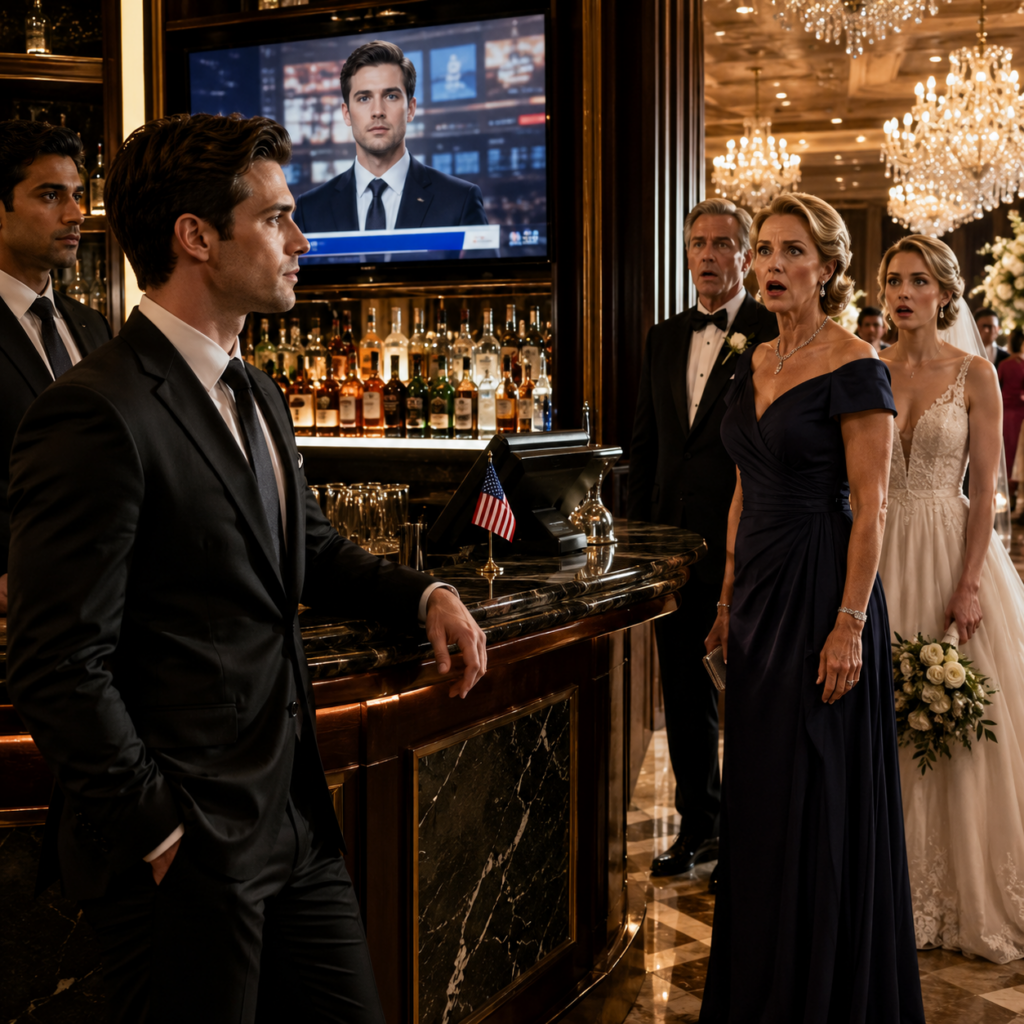
At my cousin’s luxury wedding, my mother told me my “situation” would make the room uncomfortable, so I put the invitation back on the table and said, “Understood.” By the reception, a red Breaking News banner flashed above the hotel bar — and my mother’s smile disappeared before the anchor finished my name.
The call came while my coffee was still warm.
I was in my office, watching market numbers crawl across one monitor while an unopened folder from Goldman sat on the corner of my desk. My mother did not start with hello. She started with my name in that careful tone she used whenever she had already decided something and wanted me to accept it politely.
“Ethan, it’s about Jessica’s wedding.”
Jessica was my cousin — polished, photogenic, and reliable in all the ways my family admired. She knew how to smile in family Christmas photos, how to talk about charity committees, how to choose the right dress for a country club brunch. She had never once embarrassed the Morrisons by changing direction, taking risks, or refusing the path already laid out for her.
I had done all three.
“What about it?” I asked.
My mother sighed softly, as if the problem had become painful only because I was making her say it out loud.
“The seating chart has become complicated.”
I looked through the glass wall of my office at the rows of engineers working under warm lights, half of them hunched over laptops, the other half pacing with phones pressed to their ears. On the far wall, a large dashboard showed client activity in real time. Green numbers, moving fast.
“Complicated how?”
“Well,” she said, lowering her voice, “Jessica is marrying Marcus Wellington. You know the Wellingtons. They’re a very established family. Marcus manages a major portfolio, his father knows half the people in Washington, and there will be senators, investors, CEOs… people who matter.”
People who matter.
She said it smoothly, but not smoothly enough.
“And?”
“And given your situation, your father and I think it may be better if you don’t attend.”
My hand stayed around the coffee mug, but I did not lift it.
“My situation?”
“Ethan, don’t make this difficult.”
“I’m just asking what you mean.”
“You know what I mean.” Her patience thinned. “You’re still doing that coding thing. You live quietly. You never bring anyone around. You don’t have the kind of career people at that wedding will understand. Jessica wants everything to be elegant and comfortable, and I don’t want you to feel out of place.”
It was amazing how neatly she could wrap humiliation in concern.
I leaned back in my chair and looked at the skyline beyond the window. Morning light flashed against the glass towers downtown. Somewhere below, delivery trucks were double-parked, office workers were buying burnt coffee from carts, and everyone was rushing toward something they hoped would matter by the end of the day.
“I see,” I said.
“I knew you would.” She sounded relieved too quickly. “It’s not personal.”
It was always personal when someone said that.
“Jessica is just nervous,” my mother continued. “Marcus’s family has certain expectations. And between us, she’s a little sensitive about… different levels of success in the family.”
Different levels of success.
I almost laughed.
Five years earlier, when I left business school to build a software company out of a cramped apartment with bad plumbing and worse heating, my father called it “a quarter-life tantrum.” My mother told her friends I was “exploring tech” the same way other families said someone was “between jobs.” My sister Amanda stopped asking what I was working on because she said she didn’t understand computers.
None of them had cared enough to learn.
“I understand,” I said.
“I’m glad you’re being mature about it. We’ll tell everyone you had a work conflict.”
I glanced at the folder on my desk.
Goldman’s final valuation documents were inside.
Two hundred eighty million dollars.
“Sure,” I said. “Work conflict.”
After I hung up, I sat very still.
Not because I was shocked. That was the worst part. I was not shocked at all.
My family had been telling me who they were for years. I had simply kept hoping they would surprise me.
A knock came at the open door.
Raj Patel, my co-founder and the only person in the world who knew how much that phone call would hurt, leaned against the frame with a paper cup in his hand.
“You look like someone just read you a bad obituary,” he said.
“Family.”
He winced. “Ah. Worse.”
Raj and I had met in college, back when neither of us slept much and our biggest asset was a secondhand espresso machine that sounded like it was about to explode. We had written the first version of our trading software in a dorm room during a week when both of us should have been studying for finals. The code barely worked. The idea did.
Now Fintech Solutions occupied three floors of a downtown office building, served institutional clients across the country, and had more people trying to buy into the company than we had conference rooms to put them in.
But to my family, I was still the son who had “walked away from a real future.”
“They uninvited me from Jessica’s wedding,” I said.
Raj blinked. “Your cousin Jessica?”
“Apparently my situation would make the room uncomfortable.”
He stared at me for one full second.
Then he started laughing.
I knew him well enough to know he was not laughing at me. He was laughing because the truth was too absurd to handle politely.
“Your situation,” he repeated. “As in the company valued at almost three hundred million dollars?”
“Apparently coding is awkward around hedge fund people.”
Raj came in and dropped into the chair across from me.
“Tell them.”
“No.”
“Ethan.”
“No.”
He rubbed his forehead. “You have turned quiet revenge into an entire lifestyle.”
“It’s not revenge.”
“It is absolutely revenge. Very elegant revenge, but still.”
I looked back toward the dashboard. A new client trade request flickered across the screen. Somewhere three doors down, our CFO was probably on the phone with Goldman’s legal team, asking them to stop changing commas in the press release.
“It’s not about punishing them,” I said. “I just wanted to know. That’s all.”
“Know what?”
“If they’d ever be proud of me without proof they could show off.”
Raj’s face softened.
For all his jokes, he understood. He had watched me take calls from my mother in that first year, when the company barely had revenue but already had promise. He had heard my father tell me over speakerphone that business school would still take me back if I “came to my senses.” He had sat beside me after family dinners where relatives asked if I had considered getting a stable job in IT.
“They had five years,” Raj said quietly.
“I know.”
“And you kept giving them chances.”
“I know.”
He leaned forward. “Then maybe stop giving them quiet chances. Let life handle the announcement.”
“That announcement is Monday.”
“Exactly.”
The Goldman deal was supposed to go public the Monday after Jessica’s wedding. We had spent weeks preparing. There would be interviews, a carefully timed press release, maybe a Bloomberg segment if the producer’s schedule held.
By then, my family would know. Everyone would.
But the wedding would be over. Jessica would have had her perfect day, complete with the absence of her embarrassing cousin.
I told myself that was fine.
For the next two weeks, I worked like nothing had happened.
That had always been my method. When my father refused to attend the small launch party for our first office because he said he had a dinner with “serious business people,” I worked. When my mother introduced me at Thanksgiving as “our creative one,” I worked. When Amanda joked that I probably got paid in energy drinks, I went home and fixed a bug that later saved one of our clients seven million dollars.
Work had become a room where no one could belittle me without results answering back.
The week before the wedding, our CFO, Margaret Chin, walked into my office with the final documents pressed against her chest. Margaret had spent twenty-five years in finance and possessed the terrifying calm of a woman who had survived three IPOs, two market crashes, and one CEO who tried to hide a yacht purchase as “research travel.”
“Goldman signed off,” she said. “Valuation holds at two-eighty.”
“Good.”
“Press release Monday at six Eastern. They want you and Raj in studio by seven-thirty. CNBC may ask for a remote later that morning. Bloomberg confirmed.”
“Sounds like a normal Monday.”
Margaret gave me a look over the top of her reading glasses.
“Your family still doesn’t know, do they?”
“No.”
“You realize this is going to be messy.”
“I’m familiar with messy.”
“No, Ethan. I mean public messy. Once the press gets a human-interest angle, they bite down.”
“There’s no angle.”
She raised an eyebrow. “A twenty-eight-year-old founder builds a major fintech company after dropping out of business school against his family’s wishes? That is already an angle. If anyone finds out they thought you were broke, it becomes a headline.”
“They won’t find out from me.”
Margaret studied me for a moment. “Families can be funny about money.”
“That’s one word for it.”
“I grew up with relatives who ignored my mother until she bought her first house,” she said. “After that, suddenly everyone remembered her birthday.”
I looked at her.
“She forgive them?”
“Some,” Margaret said. “Not all. Forgiveness is not a coupon everyone gets to redeem just because they feel embarrassed later.”
Then she placed the folder on my desk and left.
Saturday came bright and clear, the kind of spring day that makes hotel gardens look expensive without effort.
Jessica’s wedding was at the Fairmont Grand, a historic hotel with marble floors, brass railings, and floral arrangements so large they looked like they required permits. I knew the schedule because my mother had posted about it for weeks. Ceremony at two. Cocktail hour at four. Reception at five. Black tie. No children. Valet only.
I spent most of the morning in the office, pretending I was there because of deadlines.
At noon, Raj appeared holding two garment bags.
“No,” I said.
“You don’t know what I’m about to suggest.”
“You’re holding suits.”
“I am holding options.”
“Raj.”
He hung one garment bag on the back of my door. “We are not crashing the wedding.”
“Good.”
“We are merely going to have a drink at the hotel bar.”
“That hotel?”
“It has an excellent bar.”
“It has many bars in this city.”
“None of those bars are beside the ballroom where your mother will be busy pretending you don’t exist.”
I stared at him.
He lifted both hands. “Look, we can stay here and let them enjoy their little hierarchy in peace. Or we can sit in public, fully invited by the laws of commerce, dressed like men who belong wherever they decide to buy overpriced scotch.”
“It’s petty.”
“Yes.”
“I’m too old for petty.”
“You are twenty-eight.”
“I’m too tired for petty.”
“That is more believable.”
I looked at the garment bag.
Raj grinned.
“You know you want the Tom Ford.”
The worst thing about having a best friend is that sometimes he knows exactly which bad idea will make you feel better.
An hour later, we walked into the Fairmont Grand looking like we had not been hurt by anyone.
That was the first lie.
I wore the dark suit I had bought for the Goldman pitch meeting, the one Margaret called “quietly expensive.” Raj wore navy and looked like he had never doubted himself once in his life. The lobby smelled faintly of lilies, perfume, and polished wood. Guests moved in clusters, women in jewel-toned gowns, men tugging at bow ties, all of them speaking in that low formal voice people use at weddings and funerals.
From the garden entrance, I caught a glimpse of white chairs in perfect rows. A string quartet was playing somewhere out of sight.
“There’s your mother,” Raj murmured.
She stood near the doors in a navy dress, smiling with her whole social face. My father was beside her in a tuxedo, shoulders stiff, expression careful. He looked like a man trying to remember the names of richer people.
My mother laughed at something a woman in cream silk said. The laugh was light, practiced, and nothing like the one she used at home.
“She looks happy,” I said.
“She looks busy performing happy.”
Raj was right, but I did not say it.
We took a table in the hotel bar just off the main lobby. It was dimmer than the rest of the hotel, all leather chairs and brass fixtures, with shelves of bottles glowing behind the counter. A flat-screen television above the bar played cable news on mute, captions scrolling beneath stock footage and political panels.
We ordered scotch because Raj said beer would ruin the symbolism.
For a while, nothing happened.
That was when the hurt had room to breathe.
From where I sat, I could see guests passing the bar entrance on their way to the ceremony. My aunt in pale pink. My uncle with his hand on her back. Cousins I had not seen since Christmas. Amanda in a bridesmaid dress the color of champagne, walking quickly while checking something on her phone.
Every few minutes, someone laughed. Someone hugged. Someone said, “You look beautiful,” or “Can you believe this place?”
I should have been one of them.
Not because I cared about the flowers or the champagne tower or the hedge fund groom. I should have been there because family is supposed to hold a place for you before the world decides what you are worth.
Raj watched me without pretending not to.
“You okay?”
“Mostly.”
“That means no.”
“It means mostly.”
He nodded toward the garden. “You know what’s strange? Even after everything, you still wanted to be included.”
“That is usually how being excluded works.”
“Fair.”
The ceremony lasted less than an hour.
We could not hear the vows, but we saw the crowd rise when Jessica came down the aisle. She looked beautiful. I had no trouble admitting that. Her dress was simple in a way that only very expensive dresses can be simple, and Marcus stood waiting under the flowers with the calm posture of a man trained since childhood to be watched.
When the ceremony ended, guests spilled back toward the lobby and ballroom. Champagne appeared on silver trays. A photographer moved backward through the crowd, calling for smiles.
Raj finished his drink and looked at me.
“Walk?”
“No.”
“Tiny walk.”
“No.”
“Just to stretch our legs.”
I should have said no again.
Instead, I stood.
We moved down the corridor toward the ballroom, two men with no place to be and every right to be there. The ballroom doors were open. Inside, tables glittered under chandeliers. Tall centerpieces dripped white flowers over gold-rimmed plates. The band played something soft and old-fashioned.
“Ethan?”
I turned.
Amanda stood a few feet away, frozen with her clutch in both hands.
For a moment, she looked almost like the little sister who used to sneak into my room and ask me to fix her laptop because she had downloaded something suspicious from the internet. Then the years came back into her face.
“What are you doing here?” she asked.
“Having a drink.”
“At Jessica’s wedding?”
“At the hotel bar.”
“You weren’t invited.”
“That was made clear.”
Her cheeks flushed. “I didn’t mean it like that.”
“No?”
She looked toward the ballroom, then back at me. “Mom said you had work.”
“I do.”
“And you came anyway?”
“I’m not in the ballroom, Amanda.”
Raj stepped forward smoothly. “Raj Patel. Ethan’s business partner.”
Amanda shook his hand automatically. “Business partner?”
“Unfortunately,” Raj said. “He makes me do math before coffee.”
Amanda gave a confused little smile, then looked back at me.
“What business?”
“Software,” I said.
“Right.” She shifted her weight. “The coding thing.”
There it was again. Not cruel exactly. Just small. Small enough to deny later.
I smiled because I had learned how.
“Yeah. The coding thing.”
She glanced down the hall, where our mother had appeared near the ballroom entrance, speaking to a server.
“Mom shouldn’t have done that,” Amanda said suddenly.
I looked at her.
“She shouldn’t have told you not to come,” Amanda continued. “I didn’t know until this morning. I thought you really had a conflict.”
“You don’t have to explain.”
“I’m not explaining. I’m apologizing.” She swallowed. “You should have been invited.”
For the first time that day, something in me shifted.
Amanda had gone along with the family for years, but she had never enjoyed cruelty the way some people did. She was impressionable, not malicious. There is a difference, though the difference can still hurt.
“Thank you,” I said.
She looked relieved. “Do you want me to talk to Jessica?”
“No. It’s her wedding. Let her have it.”
Amanda nodded, then stepped closer and hugged me quickly, like she was afraid someone might catch her doing it.
“You look good,” she said when she pulled away. “Very… serious.”
Raj coughed. “That’s the nicest anyone has ever made rich look.”
Amanda blinked. “What?”
“Nothing,” I said. “Go enjoy the reception.”
She hesitated, then went back toward the ballroom.
Raj watched her leave. “That was almost healthy.”
“Don’t sound so disappointed.”
“I was hoping for more drama before dinner.”
We returned to the bar.
By then, the reception had begun. Through the corridor, I could hear the muffled swell of applause, then music. Someone announced the couple. People cheered. The bartender turned the television to a market segment with captions running across the bottom.
I checked my phone out of habit.
Three emails from Goldman’s communications team.
One missed call from Margaret.
Then another email.
Subject: MEDIA EMBARGO CHANGE.
I opened it.
My stomach dropped.
“What?” Raj asked.
“Goldman moved the announcement.”
“To when?”
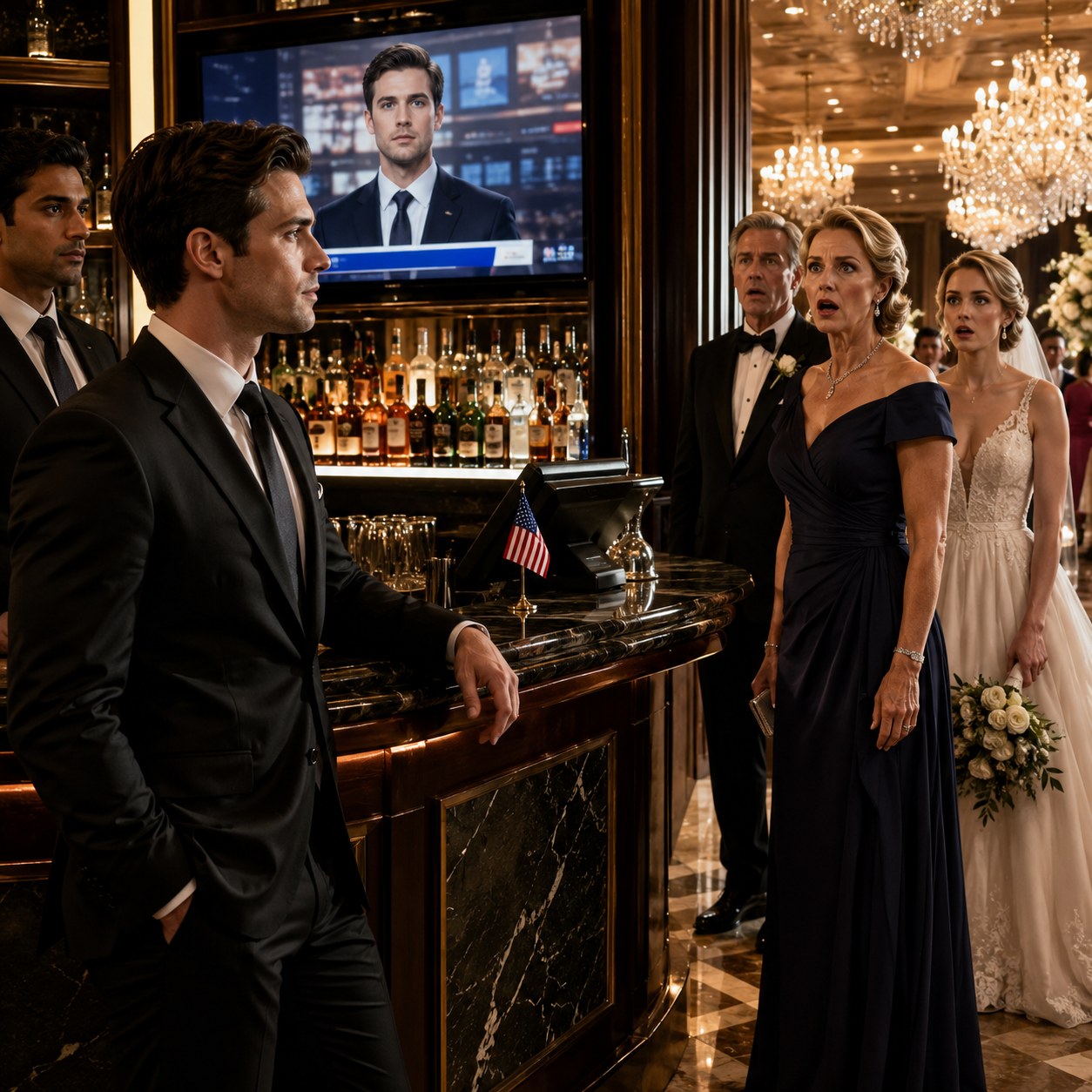
Before I could answer, the television above the bar changed.
A red Breaking News banner slid across the screen.
Fintech startup valued at $280 million in major Goldman-led investment.
My photo appeared beneath the headline.
Not a casual photo. The official one. Dark suit, clean background, confident expression. The kind of photo that looks like it belongs beside phrases like “market disruption” and “rising founder.”
Raj slowly turned toward the television.
“Well,” he said. “That answers my question.”
The bartender looked up, then looked at me, then looked back at the screen.
The sound was still muted, but the captions were enough.
Ethan Morrison, founder and CEO of Fintech Solutions, has built one of the fastest-growing machine-learning platforms in institutional trading. The company, founded five years ago after Morrison left business school, is now valued at approximately $280 million.
My mouth went dry.
“They weren’t supposed to do this until Monday,” I said.
Raj pulled out his phone. “Margaret just texted. Another outlet got part of the story. Goldman pushed early to control the release.”
“During the wedding.”
“During the wedding.”
For a moment, the bar stayed quiet except for the low clink of glassware and the muffled music from the ballroom.
Then my mother walked in.
She must have been coming to speak with the bartender or check on something for the reception. She stopped just inside the entrance, one hand still lifted slightly, her smile half-formed for a conversation she never started.
Her eyes went to the television.
Then to me.
Then back to the television.
The color drained from her face so quickly I almost stood to catch her.
My father came up behind her, annoyed. “Claire, the planner is looking for—”
He stopped too.
On the screen, my photo had shifted to footage of our office building. The captions continued.
The company currently serves more than sixty institutional clients and processes large-scale trading data across multiple markets. Analysts say the Goldman-led investment positions Fintech Solutions as a significant player in the future of financial technology.
My father’s jaw tightened.
Not anger. Not yet.
Recognition.
A few more people gathered behind them, drawn by the strange stillness. My aunt. My uncle. Two groomsmen. A woman in a silver dress holding a champagne flute.
The bartender, either helpful or wildly entertained, turned up the volume.
The anchor’s voice filled the bar.
“Ethan Morrison’s rise is especially notable given that he left a traditional business school track to pursue the company, reportedly building its first platform from a small apartment with co-founder Raj Patel…”
Raj lifted his glass slightly. “That’s me.”
No one laughed.
My mother finally spoke.
“Ethan?”
It was barely my name. More like a question she had no right to ask.
“Yes,” I said.
“That’s… you?”
I looked at the television, then back at her.
“Yes.”
“But your company…”
“My company,” I said.
My aunt pushed closer, squinting at the screen. “Fintech Solutions? Marcus was talking about that company at the rehearsal dinner.”
My father looked at me as if I had changed shape in front of him.
“You founded this?”
“With Raj.”
Raj gave a small nod. “Good evening.”
Nobody greeted him.
The ballroom doors had opened wider now. Guests were drifting out, curious about the interruption. I heard someone whisper, “Isn’t that Jessica’s cousin?” Another voice said, “The one they said couldn’t come?”
Then Jessica appeared in her wedding dress, Marcus beside her.
The bouquet hung from her hand, forgotten.
She stared at the television.
Then at me.
“Oh my God,” she said softly. “You’re that Ethan Morrison?”
“That depends how many there are.”
Marcus stepped forward. For the first time all day, his perfect confidence cracked into open astonishment.
“Your platform saved our fund a fortune last quarter,” he said. “We’ve been trying to get a meeting with your team for months.”
Raj murmured, “Amazing how small the world becomes when there’s money in the room.”
My mother heard him. Her face tightened, but she did not defend herself.
The anchor continued, cheerful and oblivious.
“Goldman described Morrison’s work as one of the most promising fintech developments of the decade…”
People were staring now. Not glancing. Staring.
The same guests who had been invited because they mattered. The same elegant room my presence might have made uncomfortable.
My mother took one step toward me.
“Why didn’t you tell us?”
There were so many answers, and none of them were short.
“I tried.”
“No,” she said quickly. “No, you never said it was this.”
“I told you I was building a company.”
“You said software.”
“That is what the company makes.”
My father’s voice came out rough. “You let us think you were struggling.”
I looked at him then.
Really looked at him.
The man who once told me I had embarrassed him at a Rotary dinner because someone asked where I was going to school and he had to explain I had left. The man who stopped inviting me to business lunches because, in his words, “you wouldn’t be able to contribute.” The man who called Raj and me “boys playing with code” at Christmas while we were already negotiating our first seven-figure contract.
“I did not let you think anything,” I said. “You chose what to think. Every time.”
My mother’s mouth opened, then closed.
Behind her, Amanda had arrived. She stood near the edge of the crowd, one hand over her mouth.
The television moved to another segment, but the headline remained in the lower corner. My name stayed on the screen like a thing no one could shove back into the dark.
Jessica turned slowly toward her mother, my aunt.
“You didn’t invite him because you thought he’d embarrass us.”
My aunt stiffened. “Jessica, not now.”
“No,” Jessica said, her voice shaky. “At my wedding, I heard people talking about how Ethan was still ‘figuring himself out.’ I let them. I didn’t correct anyone.”
Marcus looked uncomfortable now, which was fair. No man wants his wedding reception to become a moral audit with cable news as evidence.
My mother stepped closer.
“Ethan, I’m sorry if the call hurt you.”
If.
That tiny word did more damage than the apology repaired.
“You told me my life would make the room awkward,” I said. “That doesn’t become less ugly because you didn’t know I had money.”
Her eyes filled suddenly, and for one weak second, I wanted to comfort her.
Old habits are stubborn.
But Raj shifted beside me, just enough to remind me I was not alone.
My father cleared his throat. “Son, we need to discuss this privately.”
“Do we?”
“This isn’t the place.”
“No,” I said. “The place would have been a family dinner sometime in the last five years. Or a phone call where you asked what I was building and stayed on the line long enough to hear the answer.”
Several people looked away.
There is a special kind of silence that arrives when polite people witness something true. It is heavier than shouting.
Marcus tried to recover the situation.
“Ethan,” he said, extending a hand slightly, “I’d be very interested in sitting down with you after all this. Professionally, I mean. Your work is exactly the kind of innovation our firm—”
“No,” I said.
He blinked.
“No?”
“No.”
The word landed cleanly.
Raj looked proud enough to be unbearable later.
Marcus lowered his hand. “I understand.”
I doubted that, but I appreciated the effort.
Jessica stepped toward me, her face pale under the careful bridal makeup.
“I’m sorry,” she said. “Not because of the company. Because you should have been there. You should have been in that room as my cousin, not as someone we suddenly recognized from television.”
That apology was not perfect.
But it was the first honest thing anyone had said.
“Thank you,” I told her. “I hope you have a good marriage, Jessica. Truly.”
Her eyes shone, and she nodded.
My mother reached for my arm.
“Ethan, wait.”
I moved back before she touched me.
Not sharply. Just enough.
“I’m going to leave now.”
“You can’t just walk away from your family.”
I almost smiled.
“That’s funny,” I said. “I was told not to come.”
Then I took out my wallet, paid the tab, and left enough cash on the bar to make the bartender’s eyes widen.
Raj and I walked toward the lobby.
The crowd parted.
I do not know whether it was respect, embarrassment, or simple shock. Maybe all three. The marble floor reflected the chandeliers above us, and our footsteps sounded too loud in the sudden hush.
We were almost at the front doors when Amanda came running after us, holding up the hem of her bridesmaid dress.
“Ethan!”
I stopped.
She reached me out of breath.
“I meant what I said earlier,” she said. “You should have been invited.”
“I know.”
“No, I need to say all of it.” She pressed a hand to her chest. “I went along with them. For years. I made jokes. I acted like your work was some hobby because Mom and Dad did. I didn’t ask questions because it was easier not to know I might be wrong.”
Her voice cracked.
“I’m proud of you. And I’m sorry I waited until a television screen told me I should be.”
That one got through.
I hugged her.
Not long, not dramatically. Just enough for both of us to remember there had been a time before all the measuring began.
“Call me next week,” I said. “Not about the company.”
She nodded quickly. “Okay.”
Outside, the evening air felt cool and clean. Valets moved under the hotel awning. A couple of guests stood smoking near a large planter, pretending they were not watching us.
Raj exhaled.
“Well,” he said. “On a scale from one to Greek tragedy, that was somewhere around Thanksgiving with lawyers.”
I laughed despite myself.
“It wasn’t supposed to happen like that.”
“Big moments rarely check your calendar.”
We walked toward the parking garage.
Behind us, the Fairmont glowed with golden windows and wedding music. Jessica’s reception would continue. People would dance. The cake would be cut. Someone’s aunt would drink too much champagne. Photos would be taken from careful angles that did not show the bar where everything shifted.
My phone buzzed before we reached the elevator.
Mom.
We need to talk. You embarrassed us tonight.
I stared at the words.
For a moment, the old Ethan — the son still hoping to be understood — wanted to answer carefully. Wanted to explain. Wanted to soften the evening so she would not have to sit with what she had done.
Instead, I deleted the message.
Another buzz.
Dad.
Call me.
Deleted.
Then Amanda.
That was insane. Also, for what it’s worth, you looked annoyingly impressive on TV.
I smiled.
Raj glanced over. “Good text?”
“Better one.”
Monday morning arrived anyway.
By six-fifteen, the story was everywhere. Goldman’s announcement hit the wires. Bloomberg picked it up. CNBC ran a segment before breakfast. The Wall Street Journal requested an interview. Our office lobby filled with flowers from clients, investors, and one venture capitalist who had ignored our first three emails five years earlier.
Success, I learned that morning, has a smell.
Coffee, printer ink, expensive flowers, and fear from people who had underestimated you.
By eight, Raj and I were in a studio answering questions under bright lights.
“How does it feel,” the interviewer asked, “to go from a small apartment startup to a company valued at more than a quarter billion dollars?”
Raj looked at me.
I said, “It feels like a lot of work people didn’t see.”
The interviewer smiled, thinking I had given a humble answer.
I had not.
By nine-thirty, my phone had forty-three missed calls from my mother.
At ten, the Journal published a profile.
The headline was not gentle.
The Dropout His Family Dismissed Is Now Building Wall Street’s Next Big Machine.
The article mentioned the wedding.
Not cruelly, but clearly. Someone had talked. Maybe a guest. Maybe hotel staff. Maybe Marcus, though I doubted he would volunteer embarrassment unless there was profit in it. The details were sharp enough to hurt: a cousin’s wedding, an uninvited founder, a breaking news segment playing above a hotel bar.
By noon, my mother stopped calling and sent one text.
Please. I didn’t know how bad it looked until I read it.
That was not an apology either.
Still, I called her.
She answered on the first ring.
“Ethan.” Her voice was hoarse. “Have you seen what they’re saying?”
“Yes.”
“They make us sound awful.”
I stood by my office window. Below, traffic moved in tight silver lines.
“Do they?”
She was quiet.
“We made a mistake,” she said finally.
“Yes.”
“We didn’t understand what you were doing.”
“You didn’t try.”
“That’s not fair.”
“Mom, you asked me not to attend a family wedding because you thought successful strangers might feel uncomfortable around me.”
I heard her breath catch.
“You’re my son,” she said.
“I was your son before the headline.”
The silence after that was long.
When she spoke again, her voice was smaller.
“I don’t know how to fix this.”
“For once,” I said, “I’m not going to tell you.”
“What does that mean?”
“It means I am done auditioning for my own family. If you want a relationship with me, you have to build one with the person I actually am. Not the son you wanted. Not the failure you invented. Not the CEO you can mention at dinner parties. Me.”
She started crying then.
I did not feel victorious.
That surprised me.
For five years, I had imagined some version of this conversation. I thought the truth would feel clean. Sharp. Satisfying. Instead, it felt like standing in a house after a storm, looking at all the water damage no one wanted to admit had been there before the rain.
“I have meetings,” I said.
“Ethan, please don’t shut me out.”
“I’m not shutting you out. I’m opening the door from my side. What you do from yours is up to you.”
Then I hung up.
Raj was waiting outside my office with two coffees.
“You look like you just fought a ghost.”
“Family ghosts are persistent.”
He handed me a cup. “Drink. Capitalism needs you functional.”
For months, life moved too fast for grief to catch me standing still.
We hired more engineers. Signed new clients. Took another floor in the building. I gave interviews, attended investor dinners, and learned that some people can flatter you with the same mouth they once used to dismiss you. Former classmates reached out. Distant relatives sent messages beginning with “Not sure if you remember me.”
I remembered all of them.
I answered very few.
Jessica sent a real apology two weeks after the wedding. Not a performance. Not an excuse. A message long enough to show she had sat with it.
She wrote that she had cared too much about appearances. That she had let her wedding become a stage for the kind of status game she used to pretend she was above. That she was ashamed she had only recognized my value when it came stamped with a valuation.
I replied with three sentences.
Thank you for saying that. I appreciate the honesty. I hope you and Marcus are well.
It was not forgiveness.
But it was not nothing.
Amanda called the next Sunday.
Not about the company.
She told me about a terrible date, her new apartment, and a pottery class she had signed up for because she said she needed a hobby that did not involve checking other people’s opinions. I told her I did not have hobbies anymore. She said that was depressing and exactly why I should come with her.
So I did.
For two hours, my sister and I sat in a bright little studio between a bakery and a pharmacy, trying to make bowls that looked like evidence of a minor earthquake. Clay stuck under my fingernails. Amanda laughed so hard she had to wipe her eyes with her wrist.
For the first time in years, she did not ask me whether I was busy.
She assumed I had made time because I wanted to.
That mattered.
My parents moved more slowly.
At first, my mother sent articles about me with messages like, We’re so proud, as though pride could be attached to a link and forwarded. I did not respond to those.
Then, one afternoon, she sent a photo.
It was an old one. Me at nine years old, sitting at the kitchen table with a screwdriver in my hand and a broken radio in pieces around me. My hair stuck up. My face was serious.
Under it, she wrote:
You always wanted to know how things worked. I should have remembered that.
I stared at that message for a long time.
Then I wrote back:
Yes. You should have.
She answered:
I know.
That was the first time she did not defend herself.
In October, Forbes put me on its 30 Under 30 cover.
The photo shoot happened at our new headquarters. They wanted me in the server room, surrounded by black towers and blinking lights, as if innovation always needed dramatic lighting and expensive hardware to look real. The photographer kept asking me to smile less, then more, then “like you know something the market doesn’t.”
Raj stood behind him making faces until I almost ruined every shot.
During the interview, the reporter asked, “What has been the hardest part of building this company?”
I considered giving the expected answer. Hiring. Scaling. Regulation. Competition. Sleep.
Instead, I told the truth.
“Learning that success doesn’t heal everything it proves.”
The reporter paused. “What do you mean?”
“I mean some people think proving them wrong will make the wound disappear. It doesn’t. It just changes the conversation around it.”
That quote made the article.
My mother called the day the issue came out.
“Ethan,” she said, “I read it.”
“I figured.”
“The part about success not healing everything.”
I waited.
“I’m sorry,” she said.
This time, there was no if. No but. No explanation waiting behind it.
“I’m sorry for the wedding call. I’m sorry for the jokes I let people make. I’m sorry for treating your life like something temporary until you came back to what we understood.”
My throat tightened.
“I waited a long time to hear that.”
“I know.”
“You hurt me.”
“I know.”
“And the money doesn’t erase that.”
“No,” she said. “It doesn’t.”
That was when I believed she might actually mean it.
Thanksgiving came a month later.
The invitation arrived not through a formal family group text, not through my mother’s usual campaign of logistics, but in a voicemail from my father.
“Ethan,” he said, sounding uncomfortable in the way men of his generation often do when trying to be honest, “your mother and I would like you to come for Thanksgiving. Not because of the articles. Not because of the company. Because you’re our son. If you’re not ready, I understand.”
I played the message twice.
Then I walked into Raj’s office.
“My parents invited me to Thanksgiving.”
He looked up. “Do you want to go?”
“I don’t know.”
“That means part of you does.”
“Or part of me enjoys bad decisions.”
“Also possible.”
I sat across from him. “What would you do?”
Raj leaned back. “I’d go once.”
“Once?”
“Not as surrender. As data.”
I laughed. “You would turn Thanksgiving into analytics.”
“You built a predictive trading company. Don’t judge me.”
He grew serious.
“You don’t owe them closeness. But you might owe yourself the chance to find out whether they can do better.”
So I went.
My parents’ house looked the same from the outside. Brick, black shutters, two pumpkins still sitting by the front steps even though Halloween was long past. The maple tree in the yard had dropped leaves across the driveway. Through the front window, I could see warm light and movement in the kitchen.
For years, that house had made me feel seventeen again.
That day, it simply looked like a house.
My mother opened the door before I knocked.
She did not say, “Look at you.” She did not mention Forbes. She did not say, “Everyone is so excited.”
She said, “I’m glad you came.”
That was better.
Dinner was awkward in the way repaired things are awkward at first. Everyone was careful. My aunt complimented the sweet potatoes twice. Jessica apologized once more, and when I told her we did not need to keep repeating it, she nodded and let the subject rest.
Marcus lasted forty-three minutes before asking one question about market structure.
Jessica kicked him under the table.
I pretended not to see it.
Amanda sat beside me and whispered, “Pottery bowl update: mine cracked.”
“Mine looked cracked before firing.”
She laughed into her napkin.
After dinner, my father asked if we could talk in the den.
I followed him past the family photos on the wall. There I was at twelve in a soccer uniform, at sixteen beside Amanda at the lake, at eighteen in a suit for senior prom. Then the photos thinned. After I left business school, I appeared mostly in group shots, slightly off to the side, like someone not fully edited out.
My father noticed me noticing.
“I did that,” he said.
I looked at him.
“In my head,” he continued. “I moved you to the side because you didn’t make sense to me anymore.”
The honesty was so blunt I had no answer.
He stood near the bookshelf with his hands in his pockets.
“I was wrong,” he said. “About school. About your company. About what kind of man you were becoming.”
I stayed quiet.
“I thought success had a shape,” he said. “Degree. Firm. Title. House. Wife. Children. A clean path people could recognize. You chose something I didn’t understand, and instead of admitting I didn’t understand it, I called it foolish.”
His voice roughened.
“That was pride. Not wisdom.”
For most of my life, my father had spoken in conclusions. That night, he spoke like a man still working through the sentence as he said it.
“I can’t undo it,” he said. “But I can stop pretending it was anything other than what it was. I was embarrassed because you didn’t reflect the version of success I wanted people to see. And that was my failure, not yours.”
The room went very still.
I looked at the shelves behind him, at the old law books he never read and the framed golf photo from a tournament he never won.
“Thank you,” I said.
He nodded once.
It was not a hug. Not yet.
But it was something.
A year after the wedding, Fintech Solutions went public.
IPO day felt less like a finish line than a storm with photographers.
We stood on the floor of the New York Stock Exchange surrounded by employees, investors, advisors, and cameras. Margaret wore red lipstick and the expression of someone who had personally wrestled chaos into compliance. Raj kept pretending he was calm, which fooled absolutely no one.
The opening bell rang.
Our symbol flashed across the screens.
The first trade printed higher than expected. Then higher again.
People cheered.
Someone handed me champagne before noon, which felt illegal but apparently was tradition if enough bankers were present.
By the closing bell, the company had crossed a market cap I could barely make myself say out loud. Reporters wanted quotes about disruption, leadership, and the future of finance. Investors wanted meetings. Employees hugged each other with the exhausted joy of people who had survived something together.
In the middle of it all, my phone buzzed.
My mother:
Watching from home. We love you. Proud of the work, proud of the man.
My father:
Well done, son.
Amanda:
You’re on TV again. Try not to look so emotionally unavailable.
Jessica:
Cheering for you today. You earned this.
I read each message slowly.
Raj appeared beside me with two glasses of champagne.
“To the dropout,” he said.
“To the roommate who paid rent when I couldn’t,” I answered.
He smiled. “You paid me back.”
“Not the point.”
We clinked glasses.
Around us, the room roared. Screens flashed. People celebrated numbers that would be analyzed, traded, praised, doubted, and rewritten by morning.
But for one quiet second, I thought about the hotel bar.
The red banner. My mother’s face. The crowded doorway. The strange ache of being seen only after the world put a price beside my name.
Then I thought about the pottery studio with Amanda, my mother’s old photo of the broken radio, my father standing in the den and naming his pride without dressing it up.
Not everything had healed.
Maybe not everything would.
But my life no longer waited for their approval to become real.
My phone buzzed once more.
Unknown number.
Mr. Morrison, this is Marcus Wellington. Congratulations on the IPO. If your board ever considers adding—
I deleted it before finishing.
Raj saw my face. “Marcus?”
“Marcus.”
He laughed. “Some men are nothing if not consistent.”
I slipped the phone back into my pocket and looked around at the people who had built the company with me. Engineers who had slept under desks. Analysts who had caught errors at midnight. Margaret, who had taken a risk when we were still more promise than proof. Raj, who had believed before belief was convenient.
Success was not the television segment.
It was not the valuation.
It was not the wedding guests whispering in the doorway or my mother finally realizing what she had dismissed.
Success was standing in a room full of people who had seen the work before the world saw the reward.
For years, I had wanted my family to tell me I was enough.
In the end, I had to build a life that told me first.
And when the noise settled, when the cameras moved on and the market closed and the headlines began turning into yesterday’s news, that was the only victory that stayed.
I was not the awkward situation.
I was not the son they had to explain away.
I was not a mistake waiting to be corrected.
I was Ethan Morrison.
And finally, that was enough.
