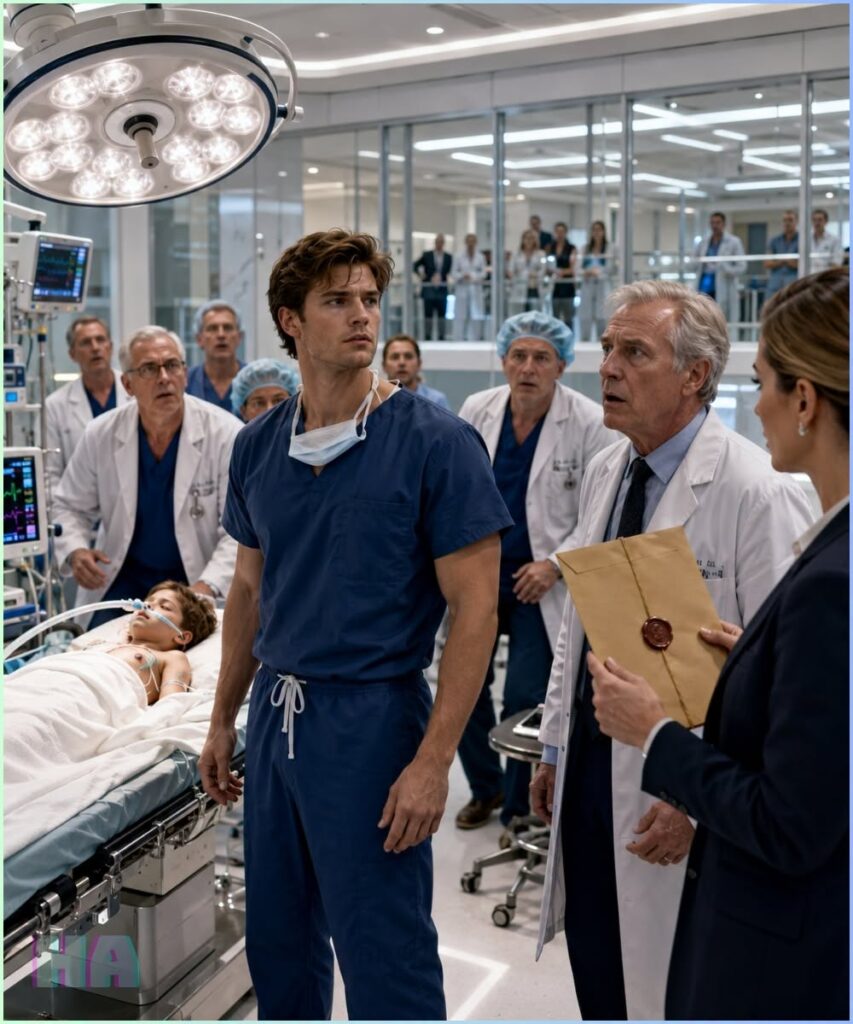
The Hospital Boss Called Him a Reckless Resident in Front of a Dying Child, but After the Impossible Surgery a Sealed File Made Every Surgeon in the Room Stand Up
At 11:51 p.m., Chief of Surgery David Cole ordered the quiet resident to take his bloody hands off a dying nine-year-old girl.
At 12:08 a.m., that same resident finished an operation most senior surgeons would not have attempted without a full specialty team.
Seventy-two hours later, a sealed file arrived at the hospital and revealed why Dr. Marcus Whitfield had not hesitated when everyone else had—and why he had spent eight months allowing people to believe he was nothing more than an ordinary resident.
The clock above Operating Room Four showed 11:51 when Dr. Elena Marsh pushed through the double doors and knew something was wrong before anyone explained the case.
It was not merely the blood.
Blood was expected in a trauma operating room. It stained the suction tubing, darkened the gauze, pooled in the channels of the table, and marked the gloved hands of everyone fighting to keep a patient alive.
This wrongness lived in the silence.
Veteran nurses were avoiding one another’s eyes. The anesthesiologist was staring at the monitor as if concentration alone might stop the numbers from falling. Two residents stood near the wall, motionless and pale, while a third leaned over the open chest of a child whose body looked impossibly small beneath the blue surgical drapes.
“Talk to me,” Elena said.
She tied her mask, pulled on a gown, and approached the table.
“Patient is Lily Hart, nine years old,” said charge nurse Nora Bell. “Passenger in a rollover collision forty-seven minutes ago. Seat belt injury, multiple rib fractures, left lung contusion, severe internal bleeding. She deteriorated during imaging.”
The monitor sounded again.
Heart rate, seventy-nine.
Oxygen saturation, thirty-six percent and falling.
Blood pressure barely detectable.
“Source?”
“Aortic tear,” said the resident standing over Lily.
Dr. Marcus Whitfield’s voice was calm, but his gown was soaked to the elbow. “Blunt-force injury near the descending thoracic aorta. She’s bleeding into the chest faster than we can replace it.”
Elena looked at the surgical field.
The incision had already been made. Marcus had entered the chest before a cardiothoracic attending had arrived, a decision that could save Lily’s life or end his career.
Possibly both.
“How long has she been open?”
“Three minutes.”
“Dr. Chen?”
“Forty minutes away,” Nora replied. “She was at a conference dinner across the county.”
Elena’s gaze shifted to Marcus.
He was thirty-seven, older than most third-year residents, though almost nobody at St. Catherine Medical Center knew why. He spoke little during rounds, accepted undesirable shifts without complaint, and never competed for praise. Attendings often forgot he was in the room until he quietly pointed out something important—a medication interaction, a subtle change in a scan, a lab result everyone else had dismissed.
Chief Cole had once described him as dependable but unremarkable.
Elena had never agreed with the second word.
Marcus’s hands hovered over the wound, not trembling, not rushing. His fingers moved through the blood with deliberate precision, as though the chaos inside Lily’s chest had formed a map only he could read.
“Her pressure is collapsing,” the anesthesiologist warned.
“I know,” Marcus said. “Prepare another unit and reduce the ventilator pressure. Her left lung is trapping.”
The anesthesiologist hesitated. “That may drop her oxygen even faster.”
“If you don’t reduce it, the pressure will obstruct venous return and she’ll arrest.”
Before the man could respond, the operating-room doors flew open.
Chief David Cole entered wearing a white coat over his dress shirt, his face drained of color. He was sixty-one, broad-shouldered, silver-haired, and accustomed to having his orders followed before he finished giving them.
“What happened?” he demanded.
“Suspected traumatic aortic rupture,” Elena said. “We had no time to wait.”
Cole looked at the open chest, then at Marcus.
“Whitfield, step back.”
Marcus did not move.
The command sharpened.
“I said step back.”
“Her aorta is tearing farther with every heartbeat,” Marcus replied. “If I release this field, she dies.”
“You are a third-year resident. This requires a cardiothoracic attending, not someone playing hero outside his scope.”
“There’s no attending here.”
“Then we stabilize her until one arrives.”
“We can’t.”
Cole’s jaw tightened. “That is not your decision.”
Marcus finally looked up.
His eyes were gray, exhausted, and startlingly steady.
“She has less than ten minutes,” he said. “Dr. Chen is at least thirty-five minutes away even if she breaks every speed limit between here and the hospital. The transport helicopter cannot fly in this storm. If we close her and pretend stabilization is possible, she will bleed to death before anyone qualified by your definition enters this room.”
The monitor screamed.
Oxygen saturation, thirty-three.
Blood pressure disappearing.
A nurse adjusted the transfusion line. Another looked toward Cole, waiting for permission to follow the resident or obey the chief.
Elena had seen these moments before. Medicine liked to imagine itself ruled by science, but hospitals were also governed by hierarchy, fear, reputation, and liability. Sometimes the greatest danger in an operating room was not uncertainty.
It was the number of powerful people afraid to make the wrong decision.
Marcus lowered his gaze to Lily’s chest.
“I can repair it,” he said.
Cole stared at him. “Based on what?”
“Based on the location, the tear pattern, and the fact that I have done this before.”
“How many times?”
Marcus said nothing.
“Whitfield, how many?”
“Enough.”
Cole moved toward the table. “You are done.”
Elena stepped between them.
“Chief, let him work.”
Everyone in the room froze.
Cole looked at her as though she had struck him.
“You are asking me to permit a resident to perform an emergency aortic repair on a child.”
“I am asking you to look at the patient instead of his title.”
“I am looking at both.”
“Then look harder.”
Elena pointed toward the monitor.
“Lily does not have thirty-five minutes. She may not have five. You can take over, but pediatric thoracic trauma is not your specialty either. I can take over, but he has already identified the tear and positioned the field. Every interruption costs blood she no longer has.”
Cole lowered his voice. “If this child dies, the hospital will ask why I allowed an unsupervised resident to continue.”
“And if she dies because you stopped the only person in the room who knows what to do?”
Cole looked at Lily’s face. Only a narrow strip was visible beneath the drapes, pale skin, closed eyes, a small purple bruise near her temple. Someone had tied her brown hair away from the surgical field with a strip of gauze.
She was not a risk calculation.
She was a child whose mother was waiting two floors below, unaware that her daughter’s life had narrowed to the space between one heartbeat and the next.
Cole stepped back.
“You have ten minutes,” he said. “If she arrests, I take over.”
Marcus did not answer.
He was already moving.
“Long vascular clamp.”
Nora placed it in his hand.
“Temporary bypass tubing ready.”
“We don’t have the pediatric size opened,” a nurse said.
“Use the smallest adult line, trim six centimeters, and bring me a connector.”
“That isn’t standard.”
“Neither is letting a nine-year-old bleed out while we read the packaging.”
The nurse obeyed.
Marcus’s hands entered the wound.
Elena positioned herself opposite him and followed his lead. She had assisted in hundreds of operations. She had watched inexperienced surgeons fumble and experienced surgeons become arrogant. She had seen brilliant physicians freeze when a routine procedure turned chaotic, and average physicians become extraordinary when disaster left no room for ego.
What she saw in Marcus was different.
There was no performance in him.
No hunger to impress.
No reckless speed.
He worked as if every unnecessary movement had been trained out of his body years ago.
“Suction lower,” he said.
The nurse adjusted it.
“Not there. Two centimeters left. If you pull directly over the tear, you’ll extend it.”
The suction shifted.
For one brief instant, the blood cleared enough for Elena to see the damage.
The aortic wall had split along a jagged line near the ligamentum arteriosum. Each beat forced more blood through the tear. The surrounding tissue was bruised and fragile, making every clamp placement dangerous.
Elena’s stomach tightened.
This was worse than she had expected.
Marcus did not react.
“Pressure?”
“Forty-eight over twenty-six,” the anesthesiologist said. “Heart rate sixty-eight.”
“She’s slowing.”
“I know.”
“Do you want epinephrine?”
“Not yet. Increase norepinephrine by point-zero-two. Give calcium now, not after the next blood gas.”
The anesthesiologist looked toward Elena.
She nodded.
“Do it.”
Marcus reached deeper.
“Proximal control is difficult,” Elena said. “The tissue is shredding.”
“I can feel it.”
“If the clamp slips—”
“It won’t.”
“How do you know?”
“How do you know?”
“Because I won’t place it until it can’t.”
arrow_forward_iosRead more
His fingers moved behind the vessel, separating damaged tissue by touch. The monitor continued its uneven rhythm.
Beep.
Beep.
Discover more
People & Society
Drama Films
Men’s Interests
A pause too long.
Beep.
Nora glanced at the clock.
Two minutes had passed.
Marcus extended his hand.
“Clamp.”
Before the instrument touched his palm, the monitor tone changed.
“Pressure is dropping,” the anesthesiologist said.
“Thirty-eight systolic.”
Marcus did not look up.
Discover more
Wedding
Movies
Language Resources
“It’ll fall to thirty-two, then stabilize.”
Three seconds later, the man read the screen.
“Thirty-two.”
A strange expression crossed his face.
“How did you—”
“Because her chest is filling faster than the venous return. Increase the transfusion rate by twenty percent, then reduce it when I clamp.”
“You can’t know the exact moment—”
“Now.”
Marcus placed the clamp.
The blood pouring into the field slowed.
“Reduce transfusion.”
The anesthesiologist obeyed.
Marcus placed a second clamp distal to the tear, preserving as much blood flow as he could. His shoulders remained still, but sweat gathered beneath the edge of his cap.
“Temporary bypass.”
Elena handed him the tubing.
He inserted the first end, secured it, then the second.
“Flow.”
Discover more
Divorce
Family
Internet & Telecom
The pump began.
The saturation stopped falling at thirty-one percent.
For several seconds, no one breathed.
Then the number rose.
Thirty-two.
Thirty-four.
Thirty-seven.
The anesthesiologist stared at the monitor.
“I have pressure. Fifty-two over thirty.”
“Keep it there,” Marcus said. “Too high and the repair tears. Too low and we lose spinal perfusion.”
Cole remained near the wall, his arms crossed. The anger had disappeared from his face. In its place was the wary concentration of a man watching something that did not fit his understanding of the world.
Elena noticed, but she did not have time to wonder about it.
“What do you need?”
Discover more
Cleaning Services
Men
Web Browsers
“Patch material.”
“We haven’t prepared one.”
“Use the bovine pericardial patch from the vascular tray. Cut it narrow and curved. The lower edge must follow the vessel or it’ll fold.”
Nora opened the tray.
Marcus examined the tear again.
“The tissue around the superior margin is too damaged for a primary closure,” he said. “We’ll reinforce with interrupted sutures, then run the patch.”
Elena’s eyes narrowed.
That was not merely the correct choice. It was the choice of someone who had performed the repair under pressure before and remembered exactly how injured tissue behaved after the blood flow returned.
She leaned closer.
“Who taught you this?”
Marcus’s hands did not pause.
“Later.”
“That wasn’t an accusation.”
“I know.”
“Then answer me.”
“Not while she’s bleeding.”
Nora handed over the patch.
Marcus shaped it with three quick cuts, studied it for less than a second, and placed it precisely over the damaged section.
“Suture.”
The needle holder landed in his palm.
His hands began to move.
The room changed with him.
The nurses stopped looking toward Cole. The anesthesiologist stopped questioning every instruction. Elena anticipated the next instrument and placed it in Marcus’s hand before he asked. Even the residents by the wall stepped closer, their fear replaced by stunned attention.
Marcus was not improvising.
He was returning to something.
That realization unsettled Elena more than the blood.
A person could learn technique from textbooks and repetition. But Marcus possessed a familiarity with catastrophe that could not be taught in a controlled hospital. He knew how quickly blood pressure would fall. He knew which equipment could be altered when the correct size was unavailable. He knew how injured tissue felt before it tore.
Most disturbing of all, he knew exactly how fear moved through a room, and he knew how to make it obey him.
“First line secure,” he said. “Check the distal flow.”
“Present,” Elena replied.
“Temperature in the left foot?”
A nurse checked.
“Cool but improving.”
“Good. Second line.”
He continued.
The oxygen saturation reached fifty-two.
Then sixty.
Lily’s heart rate steadied at eighty-eight.
The clock showed 12:02.
Cole’s ten minutes had passed, but he said nothing.
Marcus tied another suture. The tissue held.
“Prepare to restore full flow.”
Elena watched the patch.
“If it leaks?”
“We repair it.”
“And if it ruptures?”
“We don’t let it.”
He glanced at the anesthesiologist.
“Bring the pressure down five points.”
“Done.”
Marcus loosened the distal clamp first.
A thin red line appeared along the patch, then disappeared as the sutures settled.
“Proximal release slowly.”
Elena controlled the clamp.
“Quarter turn.”
She moved it.
“Another.”
Blood entered the repaired section.
The patch expanded.
No rupture.
No sudden flood.
No alarm.
“Full release,” Marcus said.
Elena opened the clamp.
For one terrible second, the operating room was silent except for the ventilator.
Then the monitor found a steady rhythm.
Beep.
Beep.
Beep.
Oxygen saturation climbed through seventy.
Blood pressure reached seventy-six over forty-two.
Nora let out a breath that sounded almost like a sob.
Marcus examined the repair.
“Small leak at the lower edge.”
Elena could barely see it.
“I’ve got it,” she said.
“No. The angle is narrow.”
He placed one additional suture and tied it.
The leak stopped.
At 12:08 a.m., seventeen minutes after Elena had entered the room, Marcus Whitfield stepped back from the operating table.
The impossible repair was complete.
His shoulders dropped for the first time, as if a wire inside him had been pulled tight throughout the surgery and had finally been released.
“Chest tube,” he said. “Then we close.”
Elena looked at him.
“You should do it.”
Marcus shook his head.
“You finish.”
“Why?”
“Because my hands are starting to shake.”
Only then did she see it.
The tremor was slight, almost invisible, but it traveled from his fingers into his wrists. During the most dangerous part of the operation, he had been steady enough to place sutures through tissue no thicker than wet paper. Now that Lily was safe, his body was collecting the debt.
Marcus peeled off his outer gloves and turned away from the table.
Chief Cole moved into his path.
“Where did you learn that repair?”
Marcus removed his mask.
His face was pale beneath the harsh operating lights.
“Training.”
“That was not residency training.”
“No.”
“I have watched cardiothoracic attendings with twenty years of experience hesitate over less complicated tears. You identified the lesion without full imaging, modified a bypass line, predicted every hemodynamic shift, and finished the repair before our attending reached the parking lot.”
Marcus’s expression closed.
“The patient needed surgery. She received it.”
“That is not an answer.”
“It’s the only one that matters tonight.”
Cole stepped closer.
“Your credentials did not say you were qualified for this.”
“My credentials listed prior trauma experience.”
“They listed humanitarian medical work. They did not list independent pediatric aortic repairs.”
Marcus looked past him toward Lily.
Nurses were preparing to close her chest. Her numbers remained stable.
“I didn’t apply here to be treated differently.”
“That choice was not yours to make.”
Marcus’s jaw tightened.
“No, Chief. The choice that mattered was whether that child would still be alive when Dr. Chen arrived. Everything else can wait until morning.”
He walked toward the scrub room.
Elena watched him disappear through the door.
For eight months, Marcus had moved through St. Catherine like a shadow. He never joined the residents arguing over fellowships. He never mentioned family. He never displayed awards, photographs, or certificates in his locker. When other doctors told stories about difficult cases, he listened without adding his own.
Elena had mistaken silence for privacy.
Now she wondered whether it was closer to hiding.
The closing took another forty minutes. Dr. Vivian Chen arrived in time to inspect the repair and stood speechless over the operating field.
“Who did this?” she asked.
Elena removed her gloves.
“Marcus Whitfield.”
“The resident?”
“Yes.”
Chen studied the patch.
“I would have needed a perfusion team, pediatric tubing, and at least an hour.”
“He had seventeen minutes.”
Chen looked toward the door through which Marcus had left.
“Where is he?”
“I don’t know.”
Marcus was sitting on the floor of an empty supply corridor two levels below.
His back rested against the wall. His scrub cap lay beside him. He had washed Lily’s blood from his arms, but a thin red line remained beneath one fingernail.
He stared at it.
The hallway lights were dimmer there, and the mechanical hum from the ventilation system muffled the sounds of the hospital. It was the kind of place employees used when they did not want to be found crying.
Marcus was not crying.
He wished he could.
Instead, he heard sounds that did not belong in St. Catherine.
Canvas snapping in hard wind.
A generator coughing beneath a cloud of dust.
Metal screaming as a temporary hospital collapsed.
Someone shouting his name from under concrete.
Someone else begging him not to leave.
Nine names moved through his mind in the order he had learned they were dead.
Laura Mendel.
Peter Vaughn.
Owen Hart.
Marisol Grant.
Aaron Pike.
Derek Wells.
Tessa Boone.
Samuel Reed.
Jonah Ellis.
He closed his eyes.
For six years, Marcus had trained himself not to hear them.
Tonight, a nine-year-old girl’s torn aorta had pulled every voice out of the grave.
Footsteps approached.
Marcus straightened, expecting Cole.
Elena appeared instead.
She stopped several feet away.
“I looked in the scrub room.”
“I needed somewhere quiet.”
“So you chose a hallway beside the linen incinerator.”
“It was available.”
She leaned against the opposite wall.
“Lily is stable. Dr. Chen inspected the repair. She said it was exceptional.”
Marcus nodded without looking up.
“Her mother is waiting downstairs,” Elena continued. “She doesn’t know who performed the operation.”
“That’s probably better.”
“Why?”
“Because parents need to trust that a hospital saved their child, not wonder why a resident was doing an attending’s job.”
“A resident did save her child.”
Marcus finally looked at Elena.
“And tomorrow, the hospital will decide whether that resident endangered her.”
“You know Cole.”
“I know institutions.”
“He was frightened.”
“He called me reckless.”
“He was wrong.”
Marcus gave a humorless smile.
“Maybe.”
Elena crossed the hallway and crouched in front of him.
During the surgery, she had seen no fear in his eyes. Now it was everywhere, held behind discipline so rigid that most people might have mistaken it for calm.
“Who are you?” she asked.
His gaze shifted to the red line beneath his fingernail.
“Marcus Whitfield.”
“That is your name. It isn’t the answer.”
“What answer are you looking for?”
“The one that explains how you knew exactly when Lily’s pressure would collapse. The one that explains why your hands moved like they had performed that repair in rooms without proper equipment. The one that explains why you looked relieved when she survived and devastated at the same time.”
Marcus’s face changed.
Only slightly, but enough.
Elena had found the wound.
“I’m just a resident,” he said.
“No, you aren’t.”
“That’s what my badge says.”
“Badges tell people where you work. They don’t tell them what you survived.”
He stood too quickly.
For a moment, the hallway tilted beneath him. Elena reached for his arm, but he stepped away.
“Don’t,” he said.
She lowered her hand.
“I’m not trying to expose you.”
“Everyone says that before they decide a story belongs to them.”
“I’m asking because I watched you save a child, and afterward you looked like somebody had died.”
Marcus picked up his cap.
“Somebody did.”
“Tonight?”
“No.”
The word came out almost soundless.
He walked away before Elena could ask anything else.
At 1:26 a.m., Rachel Hart sat alone in a surgical-family waiting room with her daughter’s pink backpack pressed against her chest.
The zipper had broken during the collision. A math worksheet, a library book, and a crushed package of fruit snacks had spilled onto the floor when a paramedic handed it to her.
Rachel had put everything back except a silver friendship bracelet.
Lily had made it at school. The beads spelled BRAVE in uneven blue letters.
Rachel held it so tightly that the metal clasp marked her palm.
When Dr. Chen and Elena entered, Rachel stood.
The backpack fell.
“Is she alive?”
The question struck Elena with its simplicity.
Not Is she going to be all right?
Not What happened?
Only Is she alive?
Elena crossed the room.
“Yes.”
Rachel’s knees weakened. Dr. Chen caught one arm while Elena held the other.
“She is alive,” Elena repeated. “The tear in her aorta was repaired. Her condition is still serious, but her heart is beating normally and her oxygen level has improved. We’re moving her to pediatric intensive care.”
Rachel pressed both hands over her mouth.
A sound escaped between them—half sob, half prayer.
“Can I see her?”
“As soon as the intensive-care team finishes settling her.”
“Who operated?”
Dr. Chen glanced at Elena.
“One of our surgical physicians began the emergency repair before I arrived.”
“A physician?”
“A resident,” Elena said.
Rachel stared at her.
“A resident saved her?”
“Yes.”
“Was he supposed to do that?”
The question held no accusation. Only confusion.
Elena chose her words carefully.
“He did what was necessary because waiting would have killed her.”
Rachel looked down at the bracelet in her hand.
“What’s his name?”
“Dr. Marcus Whitfield.”
Something moved across Rachel’s face.
“Whitfield?”
“Yes.”
“Marcus Whitfield?”
Elena noticed the change.
“Do you know him?”
Rachel’s eyes filled again, but this time the emotion was different.
“I don’t know. My husband knew someone with that name years ago.”
“Where?”
Rachel looked toward the dark window.
“Overseas. Owen worked with a disaster-relief organization after a major earthquake. He was an engineer. He helped reinforce temporary clinics.”
Elena felt a cold line travel down her back.
“What happened to your husband?”
“He died when one of the field hospitals collapsed during an aftershock.”
Rachel looked at the bracelet.
“Lily was four. Owen had been gone for six weeks. A man called me afterward and stayed on the phone for almost an hour even though he barely spoke. He said he had tried to save Owen. He said he was sorry.”
“Was his name Marcus?”
“I think so.”
Rachel closed her eyes.
“I hated him for calling.”
Elena remained silent.
“For months, I replayed his words and wondered why he had survived when Owen hadn’t. I knew it was cruel. I knew he had probably done everything he could, but grief does not care what is fair.”
She opened her eyes.
“Then one day I listened to the voicemail again. He wasn’t asking me to forgive him. He was making sure Owen’s last words reached us.”
“What were they?”
“Tell Lily her daddy built something strong enough to protect people.”
Rachel’s voice broke.
“She doesn’t remember his voice anymore. But she remembers that sentence because I’ve told it to her every birthday.”
Elena looked toward the hallway through which Marcus had disappeared.
“Did you ever meet him?”
“Once, before the deployment. There were dozens of people at a fundraising dinner. I barely remember his face.”
Rachel tightened her fingers around the bracelet.
“Could it be the same man?”
Elena thought of Marcus sitting beside the linen incinerator, repeating nine names no one else could hear.
“I don’t know,” she said. “But I think it might be.”
By seven the next morning, the story of Operating Room Four had spread through St. Catherine.
Some called Marcus courageous.
Others called him reckless.
A few claimed he had been lucky.
The most confident opinions came from people who had not been in the room.
In the surgical lounge, two residents stopped speaking when Marcus entered. An attending who had ignored him for months suddenly asked how he was feeling. A nurse from another floor stared at him as though he might perform another miracle beside the coffee machine.
Marcus filled a paper cup with water and left without drinking it.
By nine, he had been removed from operative duty pending review.
At ten, Chief Cole summoned him to his office.
The incident report lay open on the desk. Beside it sat Marcus’s personnel file, a thick stack of paperwork that somehow contained years of education without explaining the man himself.
Cole remained standing.
“Close the door.”
Marcus did.
“Sit.”
“I’d rather stand.”
“That was not a request.”
Marcus sat.
Cole opened the file.
“Medical degree from the University of Michigan. General surgical training interrupted after the fourth year. Six-year gap listed as international humanitarian service. Re-entry assessment completed through the state medical board. Advanced placement denied because too much time had passed without verified domestic supervision. You accepted a third-year position here rather than appeal.”
“That is correct.”
“You did not disclose that you had performed more than two hundred independent emergency operations.”
“The application asked for accredited training and verified appointments. Much of my work took place in temporary facilities that no longer exist.”
“You could have provided references.”
“I provided the references required.”
“You provided enough information to be accepted and nothing more.”
“Yes.”
Cole sat slowly.
“Why?”
“Because I wanted to complete residency.”
“That explains what you did. It does not explain why you concealed your experience.”
“I didn’t conceal it. I summarized it.”
“You reduced six years of field surgery to three lines.”
“Three accurate lines.”
Cole’s patience thinned.
“You performed a highly specialized procedure on a pediatric patient without authorization.”
“I performed the only procedure that could keep her alive.”
“You could lose your license.”
“I know.”
“The hospital could face litigation.”
“I know.”
“And you still refuse to explain why you possessed skills far beyond your documented level.”
Marcus leaned forward.
“Would the explanation change the condition of the patient when she arrived?”
“No.”
“Would it make Dr. Chen appear sooner?”
“No.”
“Would it place a qualified pediatric cardiothoracic surgeon inside that room before Lily bled to death?”
Cole’s mouth tightened.
“No.”
“Then it does not change the decision.”
“It changes whether I can trust you.”
Marcus stood.
“You trusted the badge on my chest enough to give me overnight trauma duty. You trusted me to assess patients, assist in operations, manage complications, and answer when families asked whether their loved ones would live. You only stopped trusting me when I did something you did not believe a person at my level could do.”
“That is not fair.”
“No. It isn’t.”
Marcus looked at the file.
“For eight months, I followed every rule. I took every shift. I never demanded special treatment. Last night, a child had minutes to live, and I used the skills I had. I would make the same decision again.”
Cole rose.
“That answer may cost you your position.”
Marcus’s expression did not change.
“Then I will leave knowing Lily Hart is alive.”
He turned toward the door.
“Whitfield.”
Marcus stopped.
Cole’s voice had lost some of its authority.
“Did you know her father?”
The room seemed to narrow.
Marcus looked back.
“Who told you?”
“Dr. Marsh spoke with the mother.”
Marcus’s face went pale.
“So it is true.”
“Yes.”
“Owen Hart died in the same incident that ended your humanitarian work.”
Marcus’s hand remained on the doorknob.
“Do not use his name to investigate me.”
“I’m trying to understand.”
“No. You’re trying to decide whether understanding me reduces the hospital’s liability.”
“That is part of my responsibility.”
“And that is why I told you nothing.”
He opened the door.
Cole spoke before Marcus could leave.
“Did you fail to save him?”
Marcus stood motionless.
When he answered, his voice was no longer calm.
“I chose someone else.”
Cole said nothing.
“There were fourteen people trapped after the field hospital collapsed,” Marcus continued. “I had limited oxygen, two functional monitors, and enough blood for perhaps four patients. Owen was conscious. The woman beside him was not. Her injuries looked survivable. His did not.”
“You made a triage decision.”
“I made a calculation.”
“That is what trauma surgeons must do.”
“Tell that to his daughter.”
Marcus turned.
“Tell Lily I measured the time it would take to reach her father and decided someone else had a better chance. Tell her I heard Owen calling while I operated twenty feet away. Tell her that when the second section of roof came down, I was still holding another patient’s heart in my hands.”
His eyes were bright now, but he refused to let the tears fall.
“Nine people from our team died that day. Five survived. For years, everyone called the five survivors proof that I had made the right decisions. Nobody wanted to understand that survival can still feel like evidence against you.”
Cole slowly lowered himself into his chair.
Marcus left.
That afternoon, he entered the pediatric intensive-care unit only because Nora told him Lily’s blood pressure had changed.
He reviewed the chart, adjusted one medication, and checked the drainage from her chest tube. Lily remained sedated, surrounded by machines that made her appear smaller than she was.
Rachel sat beside the bed.
Marcus saw her only after he had finished examining the monitors.
For several seconds, neither of them spoke.
Age had changed her face, but he remembered her from the relief organization’s farewell dinner. Owen had kept a photograph of Rachel and Lily folded inside his wallet. The corners had softened from being opened so often.
“Marcus?” she whispered.
He stepped back from the bed.
“Mrs. Hart.”
“You’re the one who called me.”
“Yes.”
“And you operated on Lily.”
“Yes.”
Rachel stood.
Marcus’s body became rigid, as though preparing for a blow.
She moved toward him.
“I need you to tell me the truth.”
He nodded.
“Did you know who she was before the surgery?”
“No. I saw her name on the chart, but I did not connect it to Owen until after the repair. Hart is common, and Lily was only four in the picture he carried.”
Rachel looked at her daughter.
“Would you have done anything differently if you had known?”
“No.”
The answer came without hesitation.
“I would have been more afraid,” he added. “But I would have done the same operation.”
Rachel folded her arms across her chest.
“Why did you leave?”
Marcus understood she was not asking about the intensive-care unit.
“I could no longer walk into an operating room without hearing the collapse.”
“You never answered my letters.”
“I read every one.”
“I sent five.”
“I know.”
“You told me Owen’s last words, then disappeared.”
“I thought my presence would make your grief worse.”
“It did.”
Marcus closed his eyes.
Rachel’s voice trembled.
“But your absence made it worse too. You left me with a question I could not answer.”
“What question?”
“Whether my husband died because you abandoned him.”
Marcus absorbed the words without defending himself.
Rachel took one step closer.
“Did you?”
“No.”
“What happened?”
He looked at Lily.
For nine years, he had protected Rachel from details he believed would only hurt her. Now he understood that silence had created its own cruelty.
“Owen was reinforcing the western wall when the aftershock hit,” Marcus said. “The first section collapsed over the recovery ward. He and four others went back inside before we could stop them because patients were trapped.”
Rachel pressed a fist against her mouth.
“He carried two children out. Then the roof shifted. A steel beam pinned him through the pelvis. He was conscious, but the bleeding was severe. I could see him. I could hear him.”
“Why didn’t you go to him?”
“A nurse named Marisol was trapped closer to me. She had a punctured lung and cardiac compression. She had minutes. Owen had minutes too.”
“So you chose her.”
“Yes.”
“Did she live?”
“For six years.”
Rachel stared at him.
“What?”
“She survived the collapse. She returned home, married, and had a son. She died last winter from cancer.”
Marcus swallowed.
“She wrote to me every year on the anniversary. She said Owen had shouted for me to help her first.”
Rachel’s arms fell to her sides.
“He said that?”
“Yes.”
“Why didn’t you tell me?”
“Because I did not want his last act to sound like an excuse for my choice.”
Marcus’s voice cracked.
“I still chose. I still heard him. When I reached him after Marisol was stabilized, the second collapse had taken away the chance.”
Rachel looked at him for a long time.
Then she struck him.
The sound was sharp in the quiet room.
Marcus did not move.
Rachel covered her face and began to sob.
“I am sorry,” he said.
“Stop saying that.”
“I don’t know what else to say.”
“You saved my daughter.”
His eyes shifted toward Lily.
“That does not erase your husband.”
“I know.”
“You think that’s what I’m asking you to believe?”
“No.”
“Then look at me.”
Marcus raised his eyes.
Rachel’s cheeks were wet.
“I blamed you because I needed Owen’s death to belong to someone. An earthquake was too large. A collapsing building was too empty. But a man had called me, and I could put my anger in his voice.”
“You had every right.”
“No. I had grief. That is not the same as a right.”
She looked at Lily again.
“For five years, I taught my daughter that her father died building something strong enough to protect people. Last night, the man he told to save someone else saved her.”
Marcus turned away.
His shoulders shook once.
Rachel stepped closer, but she did not touch him.
“You did not replace Owen,” she said. “You did not repay a debt. You saved Lily because she needed you.”
Marcus wiped his face with the heel of his hand.
“I almost stopped.”
“During the operation?”
“Years ago.”
He forced the words out.
“After the collapse, I finished several more deployments. Everyone said I was functioning. I operated, taught, organized teams. Then I began waking up with blood on my hands that wasn’t there. I started hearing alarms in quiet rooms. One day, I froze during a routine procedure because the ceiling light flickered.”
Rachel listened.
“I resigned the next morning. I let my certification lapse. When I applied to return, the state board required supervised training. I could have fought the decision, but I wanted someone else to decide whether I was safe.”
“And were you?”
“I thought I was until last night.”
Rachel looked toward the repaired heart beating on Lily’s monitor.
“What do you think now?”
Marcus watched the green line rise and fall.
“I don’t know.”
Three days after the surgery, Chief Cole sat alone in his office reviewing the incident report for the seventh time.
The language was clinical.
Emergency thoracotomy.
Traumatic aortic rupture.
Immediate threat to life.
No attending specialist available.
Successful repair.
Stable postoperative condition.
Nothing in those phrases described the operating room as Cole remembered it. They did not capture Lily’s color, the blood on Marcus’s gown, or the moment Cole realized the resident he had dismissed was giving orders with the certainty of someone who had lived through disasters.
His desk phone rang.
The caller identification read PRIVATE.
Cole nearly let it go to voicemail.
He answered.
“Chief Cole.”
“My name is Dr. Grant Ashford,” said a man on the other end. His voice was calm, older, and unhurried. “I direct Northstar International Medical Relief. I understand you had an emergency involving Dr. Marcus Whitfield three nights ago.”
Cole straightened.
“How did you learn about that?”
“One of your staff requested verification of his overseas service.”
Cole looked toward the personnel file. Human resources had sent the request that morning.
“You know him?”
“I trained him.”
“As a volunteer?”
The silence that followed carried something close to offense.
“Dr. Whitfield was never merely a volunteer.”
Cole reached for a pen.
“Then perhaps you can explain why his record contains almost no detail.”
“Because he requested that it contain almost no detail.”
“That does not answer my question.”
“No, Chief. It answers Marcus’s fear.”
Ashford paused.
“Before he came to St. Catherine, Marcus served as Northstar’s lead trauma surgeon in six major disaster zones. He operated after earthquakes, industrial collapses, floods, transportation disasters, and outbreaks that overwhelmed local hospitals. When permanent operating rooms were unavailable, he worked in tents, school buildings, cargo terminals, and once inside a damaged ferry.”
Cole said nothing.
“He performed more than two hundred emergency surgeries under conditions your hospital cannot reproduce in simulation. He trained physicians from twelve regional systems. He developed field protocols for major vascular trauma when standard equipment was unavailable.”
Cole’s hand tightened around the pen.
“Why was none of that verified?”
“It could have been. He asked us not to submit anything beyond basic service dates.”
“And you agreed?”
“Eventually.”
“Why?”
“Because the last time people treated Marcus like a hero, it nearly destroyed him.”
Cole leaned back.
Ashford continued.
“Our teams called him Highwire. He could operate under conditions where one mistake meant losing the patient and sometimes the entire medical post. He had extraordinary hands, but that was never his greatest gift. He made frightened people believe they could still function.”
Cole remembered the operating room settling around Marcus.
“What happened at the end of his service?”
“A field hospital collapsed during an aftershock. Fourteen members of our team were trapped. Marcus coordinated the rescue while operating with limited supplies. Five survived.”
“And nine died.”
“Yes.”
“Including Owen Hart.”
Ashford’s voice softened.
“You know the name.”
“His daughter was the patient.”
For the first time, Ashford lost his composure.
“Lily?”
“Yes.”
The line went silent.
When Ashford spoke again, his voice was rougher.
“Does Marcus know?”
“He does now.”
“Dear God.”
Cole looked at the rain sliding down his office window.
“Dr. Ashford, I need to determine whether Marcus exceeded his authority.”
“He did.”
The blunt answer surprised him.
“You agree?”
“Of course. Rules matter. Supervision matters. Credentialing matters. But rules also exist within reality. The reality that night was that a child had minutes to live, a specialist was unavailable, and the only surgeon in the room capable of repairing the injury happened to be wearing a resident’s badge.”
“That will not satisfy the review board.”
“Then ask the board whether they prefer a defensible death to a difficult survival.”
Cole set down the pen.
“Why did Marcus return as a resident?”
“He did not trust himself to return as anything else. After the collapse, he began experiencing severe trauma responses. He left clinical practice and allowed his certification to lapse. When he decided to return, he could have pursued an accelerated pathway. He chose the most supervised route available.”
“He wanted to start over.”
“He wanted to be ordinary.”
Ashford sighed.
“For years, strangers needed Marcus to be fearless. Patients needed him to make impossible choices. Teams needed him to remain calm when buildings were shaking. Reporters called him a miracle surgeon. Donors put his face in brochures. None of them asked what happened to him after the lights went out.”
Cole looked at Marcus’s application photograph.
An unremarkable headshot. Neutral expression. No trace of the life behind it.
“He asked us never to reveal his history unless patient safety required it,” Ashford said. “I believe patient safety now requires your hospital to understand who is walking its halls. But do not turn him into a spectacle. If you use his past to sell the hospital’s reputation, he will disappear again.”
Cole felt the warning.
“What do you suggest?”
“See him accurately.”
“That sounds simple.”
“It is not. You saw a resident and assumed inexperience. Others may see a celebrated field surgeon and assume invulnerability. Both assumptions erase the man.”
Before ending the call, Ashford said one final thing.
“Chief Cole, Marcus will accept punishment more easily than gratitude. Do not mistake that for humility. It is grief.”
That evening, Marcus received an email ordering him to attend an emergency surgical-staff meeting.
He assumed it was a disciplinary hearing.
He packed his locker before going.
The hand-drawn schedule taped inside the door came down first. Then two textbooks, three clean shirts, a worn stethoscope, and the small tin containing letters he had never answered.
At the bottom of the locker lay an old photograph.
Fourteen people stood in front of a temporary clinic, squinting in the sunlight. Owen Hart was in the back row with one arm lifted as if he had been making a joke when the picture was taken.
Marcus placed it in the box.
Nora Bell found him there.
“You’re leaving.”
“I’m preparing.”
“For what?”
“The probable outcome.”
“You saved a child.”
“I violated protocol.”
“You say that like both facts cannot be true.”
“They are both true.”
Nora crossed her arms.
“I’ve been a surgical nurse for twenty-eight years. I have seen doctors hide mistakes, alter notes, blame residents, blame nurses, blame patients, and blame equipment that worked perfectly. You recorded every decision you made that night before anyone asked you to.”
“That was required.”
“You also stayed awake for twenty-six hours monitoring Lily after you were removed from operative duty.”
“I was not prohibited from reviewing her chart.”
“You corrected a medication dose that would have damaged her kidneys.”
“Anyone could have caught that.”
“But you did.”
Marcus closed the box.
Nora lowered her voice.
“You think accepting that you saved her means pretending nobody else died.”
He stared at her.
“I didn’t say that.”
“You didn’t need to.”
She touched the photograph.
“Take this with you. But leave the rest until after the meeting.”
At six o’clock, Marcus entered the boardroom carrying the photograph in his coat pocket.
Every surgical attending was present. So were the senior residents, charge nurses, administrators, risk-management officers, and the hospital’s board chairman, Preston Vale, a billionaire real-estate developer whose donations had placed his family name on half the medical campus.
Marcus recognized the arrangement immediately.
This was not merely a review.
It was a performance.
Chief Cole stood near the windows. Elena was beside him. Dr. Chen occupied the first chair. Rachel Hart sat near the far wall, holding Lily’s BRAVE bracelet.
And beside her stood Grant Ashford.
He wore a dark suit, not a uniform, and time had added more gray to his hair. Marcus had not seen him in four years.
For the first time since anyone at St. Catherine had known him, Marcus stopped walking as though he had forgotten how.
“No,” he said.
Ashford stepped forward.
“Marcus.”
“I told you never to do this.”
“The hospital requested verification.”
“You could have verified the dates.”
“Those dates would not explain the operation.”
“They didn’t need to.”
Board chairman Preston Vale rose with a practiced smile.
“Dr. Whitfield, this is an extraordinary moment for St. Catherine. We have only just learned of your remarkable background, and I believe the public will be deeply inspired—”
Marcus turned toward Cole.
“You invited him?”
Cole’s expression hardened.
“Chairman Vale requested to attend.”
Vale continued as if Marcus had not spoken.
“A resident with a secret history as an internationally celebrated surgeon performs an impossible operation on the daughter of a fallen colleague. It is a story of courage, redemption, and the exceptional medical talent found within our institution.”
Elena’s face tightened.
Marcus looked around the room.
“Is that what this is?”
“No,” Cole said.
Vale smiled again.
“We are prepared to suspend the disciplinary review, reinstate you immediately, and arrange a press conference tomorrow morning. Naturally, we would want legal approval for the details, but the story has enormous value.”
“Value to whom?” Marcus asked.
“To the hospital, to future patients, and to your career.”
“My career was not your concern three days ago.”
“We did not have all the information.”
“You had a dying child.”
Vale’s smile faded.
“You should be careful, Doctor. The board is offering you protection from serious professional consequences.”
“In exchange for turning the worst day of my life into a fundraising campaign.”
“That is an unfair characterization.”
“It is an accurate one.”
Vale looked toward Cole.
“I was told he was cooperative.”
Cole’s eyes narrowed.
“No. You were told he was quiet.”
The chairman’s face changed.
Cole moved to the center of the room.
“This meeting was called to address three truths. First, Dr. Whitfield performed a procedure beyond the formal authority of his current position. Second, that procedure was medically necessary and saved Lily Hart’s life. Third, this hospital failed to understand the physician it assigned to its trauma service.”
He turned toward Marcus.
“The third failure begins with me.”
The room became still.
Cole was famous for defending his decisions. He had survived budget crises, malpractice investigations, and conflicts with powerful donors without once apologizing in public.
Now he faced the resident he had nearly removed from Operating Room Four.
“I judged your ability by your title,” Cole said. “I dismissed your prior service because it was not described in language I valued. I spoke to you as though quietness were evidence of incompetence. Then, when your actions exposed my mistake, I treated your history as information I was owed.”
Marcus’s face remained guarded.
Cole continued.
“You were right about Lily. You were right that delay would have killed her. You were also right that understanding your past does not erase the authority you exceeded. Both facts must be addressed honestly.”
Vale interrupted.
“David, this is not the time for institutional self-criticism.”
“It is exactly the time.”
“You answer to this board.”
“I answer to my patients first.”
Vale stared at him.
Cole looked around the room.
“The review committee has determined that Dr. Whitfield acted under an immediate-life exception. Dr. Chen has confirmed that the chosen repair was technically appropriate and that no safer alternative existed. No disciplinary action will be taken.”
A breath moved through the room.
Marcus did not relax.
“And the press conference?” he asked.
“There will not be one unless you request it.”
Vale stood.
“That decision is not yours alone.”
Cole turned toward him.
“Patient information cannot be released without consent. Dr. Whitfield’s history cannot be used without his consent. Mrs. Hart has declined media contact. There is no story for you to sell.”
Vale looked at Rachel.
She met his gaze without flinching.
“My daughter nearly died,” she said. “She is not an advertisement.”
The chairman gathered his papers.
“You are allowing emotion to interfere with an extraordinary opportunity.”
“No,” Elena said. “We are allowing humanity to interfere with exploitation.”
Vale left the boardroom.
The door closed behind him.
No one spoke for several seconds.
Ashford faced Marcus.
“I am sorry.”
Marcus laughed once, bitterly.
“You revealed everything.”
“I revealed enough to keep them from treating your skill as an accident.”
“You promised me.”
“I know.”
“That promise was one of the reasons I trusted you.”
Ashford absorbed the accusation.
“I thought keeping your secret protected you,” he said. “Then I realized it had also allowed people to place you in situations where they did not understand what you carried.”
“So you decided everyone should know?”
“No. I decided the people responsible for your training and patient assignments needed the truth. The rest is yours.”
Marcus looked toward the staff.
Some appeared ashamed. Others looked awed. Both reactions made him uncomfortable.
Dr. Chen rose.
“I would like to say something.”
Marcus gave no response.
She approached him.
“I inspected Lily’s repair. It was one of the cleanest emergency vascular patches I have seen. That does not mean you should be left alone with that burden again.”
Marcus frowned.
Chen continued.
“You had no perfusion specialist, no pediatric equipment prepared, and no attending with your experience. You succeeded, but success does not make the situation acceptable. The hospital failed you too.”
“How?”
“By placing you on an overnight trauma team without asking what support you needed. By assuming that because you could manage disaster, you should.”
The words struck more deeply than praise would have.
Elena stepped closer.
“You told me your hands were shaking.”
Marcus looked away.
“No one else saw.”
“I did.”
“We had finished.”
“That does not mean you were fine.”
Rachel stood and walked toward him.
She held out the bracelet.
Marcus stared at the blue beads.
“Lily asked me to bring this,” she said. “She woke up for a few minutes this afternoon.”
“She’s awake?”
“She tried to pull out her breathing tube, so I believe the nurses consider that encouraging.”
A quiet laugh moved through the room.
Rachel placed the bracelet in Marcus’s palm.
“She remembers a man telling her she had to stay with him in the emergency room.”
Marcus searched his memory.
Before the surgery, while blood filled Lily’s chest and the trauma team prepared to move her, he had leaned near her ear.
Stay with me, Lily. I know you’re tired, but you do not get to leave yet.
He had not known she could hear him.
“She wants you to give that back when she can walk out of the hospital,” Rachel said.
Marcus closed his hand around the bracelet.
“I don’t deserve this.”
Rachel’s eyes hardened.
“Do not make my daughter responsible for your guilt.”
The room went silent.
Marcus looked at her.
“She is thanking the doctor who saved her,” Rachel said. “You do not have the right to turn her gratitude into another punishment for yourself.”
His throat tightened.
Ashford nodded slowly.
“She always was Owen’s daughter.”
Rachel almost smiled.
Marcus looked down at the bracelet.
For years, people had praised him in ways that felt unbearable. They had called him fearless when he had been terrified. They had called him heroic when he had been choosing which life to save. They had called his survival miraculous when it had felt random and cruel.
But Lily’s bracelet made no claim about courage.
It contained one word.
BRAVE.
Not fearless.
Bravery required fear.
For the first time, Marcus allowed himself to consider that perhaps fear did not disqualify him from being a surgeon. Perhaps shaking afterward did not erase steadiness when it mattered. Perhaps needing help did not mean he had become dangerous.
“I don’t want to be Highwire here,” he said.
Ashford’s expression softened.
“Then don’t.”
“I don’t want residents treating me like a legend.”
One of the residents near the wall lowered his eyes.
Cole nodded.
“Then they will treat you like a colleague.”
“I need supervision.”
“You will have it.”
“I need time away from emergency cases when the memories become too strong.”
“You will have that too.”
Marcus looked at Elena.
“And I need someone who will tell me when I am lying about being fine.”
“That position has already been filled,” she said.
A small smile appeared at the corner of his mouth.
Cole extended his hand.
Three nights earlier, it had been the hand of a chief prepared to pull Marcus away from a child. Now it was simply the hand of a man admitting he had been wrong.
“I owe you an apology,” Cole said.
Marcus looked at the hand but did not take it immediately.
“An apology does not change how you treated me.”
“No.”
“It does not change how many residents you may have dismissed because they were quiet.”
“No.”
“It does not fix the culture that made everyone in that room wait for your permission while Lily was dying.”
Cole’s face tightened, but he nodded.
“No.”
Marcus finally shook his hand.
“Then change those things.”
“I will.”
The following morning, St. Catherine announced no miracle surgeon and released no dramatic press statement.
Instead, Chief Cole issued an internal directive reviewing emergency authority, resident escalation procedures, and the way prior clinical experience was evaluated. He required attendings to hold monthly conferences where residents could discuss not only errors but the emotional consequences of impossible cases.
Some surgeons complained.
Cole made the meetings mandatory.
He also created a policy allowing any operating-room professional—nurse, technician, resident, or attending—to call for a thirty-second clinical reassessment when hierarchy was interfering with patient care.
The staff began calling it the Lily Pause.
Marcus remained a resident.
He did not receive an honorary title, a private office, or a sudden promotion. He repeated rotations he had technically surpassed years before because the structure helped him rebuild the parts of medicine that disaster had distorted.
Dr. Chen supervised his cardiothoracic cases. She challenged his shortcuts, even when they were brilliant, and reminded him that a permanent hospital had resources a field clinic did not.
“Stop cutting tubing,” she told him during one routine procedure.
“The standard length creates unnecessary slack.”
“We have the correct size now.”
“I could improve it.”
“You are not repairing civilization every Tuesday morning, Whitfield.”
He looked at the tubing, then at her.
“Fine.”
Elena became the person who noticed when he went silent after difficult trauma cases.
Sometimes she asked whether he wanted coffee.
Sometimes she sat beside him without speaking.
Once, after a teenager died despite four hours of surgery, Marcus tried to remain at the hospital for another shift.
Elena took his badge from his hand.
“You are going home.”
“I’m scheduled.”
“You have not slept.”
“I can function.”
“That is not the standard anymore.”
He looked toward the operating rooms.
“What if they need me?”
“They need you alive, rested, and capable of returning tomorrow.”
The words sounded simple.
To Marcus, they were revolutionary.
Rachel visited Lily every day.
Recovery came slowly. The ventilator was removed first. Then one chest tube. Then the second. Lily spent three days angry that she could not eat solid food, which the nurses celebrated as a sign of improvement.
When Marcus entered her room one afternoon, she was drawing on a tablet balanced across her knees.
She looked up.
“You’re Dr. Marcus.”
“I am.”
“You fixed my heart.”
“I repaired a blood vessel near your heart.”
“My mom said not to argue with doctors, but I think that counts as fixing my heart.”
Marcus glanced at Rachel.
“She has always been difficult to correct,” Rachel said.
Lily studied him.
“You knew my dad.”
Marcus pulled a chair toward the bed.
“Yes.”
“Was he brave?”
The question caught him unprepared.
He looked at the BRAVE bracelet, which he had kept in his pocket every day.
“He was afraid,” Marcus said.
Lily frowned.
“That wasn’t my question.”
“I know. Your father was afraid, and he went back into a collapsing building to help people anyway. That is the bravest thing I ever saw.”
“Did he save anybody?”
“Two children.”
“Were they my age?”
“One was younger. One was older.”
“Did they live?”
“Yes.”
Lily considered this.
“Then he built something strong.”
Marcus’s eyes filled.
“Yes,” he said. “He did.”
She returned to her drawing.
“Mom says you thought his death was your fault.”
Rachel looked startled.
“Lily.”
“What? You said honesty helps.”
Marcus nearly laughed.
“Your mother is right.”
“So was it your fault?”
“No,” Rachel said gently. “We talked about this.”
Lily looked at Marcus instead.
He understood that the answer mattered. Children could detect the space between what adults said and what they believed.
“I made a choice to help someone else first,” he said. “Your father told me to. I reached him too late, and I have wished for years that I could change that.”
“But you can’t.”
“No.”
“Did wishing make it change?”
“No.”
“Did feeling bad make it change?”
“No.”
“Then maybe you should do something else.”
Rachel covered a smile.
“What do you suggest?” Marcus asked.
Lily held up her drawing.
It showed three figures standing beneath a crooked blue sky. One was a child in a hospital bed. Another wore a white coat. The third stood behind them with wings that looked more like enormous ears.
At the top, in purple crayon, she had written:
MY DAD HELPED DR. MARCUS SAVE ME.
Marcus could not speak.
Lily looked worried.
“Do you hate it?”
He shook his head.
“No.”
“Are you crying?”
“A little.”
“Doctors do that?”
“The good ones should,” Rachel said.
Two weeks after the collision, Lily walked out of St. Catherine holding her mother’s hand.
The entire care team gathered near the pediatric entrance, though Marcus remained at the back. He disliked ceremonies, and Lily had already received enough attention to exhaust any nine-year-old.
She took six steps, stopped, and turned.
“Dr. Marcus.”
He moved forward.
Lily held out her wrist.
The bracelet was missing.
“You promised to give it back.”
“I did not technically promise.”
She raised one eyebrow.
He reached into his coat pocket and removed the bracelet.
The blue beads caught the afternoon light.
Marcus fastened it around Lily’s wrist.
She looked at it, then wrapped both arms around his waist.
His hands remained suspended for a moment.
Then he embraced her carefully.
“Thank you for fixing my heart,” she whispered.
Marcus closed his eyes.
“You helped fix mine too.”
Lily pulled away.
“Mom says doctors aren’t supposed to tell patients that.”
“Your mother says many things.”
“She’s usually right.”
“I have noticed.”
Rachel stepped forward.
She held an envelope.
“This is for you.”
Marcus opened it after they left.
Inside was a copy of Owen’s final letter home, written three days before the field hospital collapsed. Rachel had never shown it to anyone outside the family.
Near the bottom, Owen had written:
There is a surgeon here named Marcus who acts like he can hold every broken thing together by himself. He cannot, of course. Nobody can. But people sleep better when he is near, and I hope one day someone teaches him that being strong does not mean standing alone.
Marcus read the line three times.
Then he sat on the bench outside the hospital and wept without hiding his face.
Months passed.
The story of Operating Room Four gradually became less important to people who had not been there. New emergencies arrived. New rumors filled the hallways. New residents began their rotations and knew Marcus only as the older third-year who remained calm during trauma calls and insisted everyone learn the names of the nurses before asking them for instruments.
He did not become famous.
He became present.
During one overnight shift, a first-year resident froze when a patient began bleeding unexpectedly. The young doctor stepped back, face pale, hands trembling.
“I can’t do this,” he whispered.
Marcus stood beside him.
“Yes, you can.”
“I don’t know what to do.”
“That is different from being unable to do it.”
Marcus guided his hands into the correct position.
“Tell me what you see.”
“Arterial bleeding.”
“Where?”
“Near the mesenteric branch.”
“What do you need?”
“A clamp.”
“Ask for it.”
The resident swallowed.
“Clamp.”
The nurse placed it in his hand.
After the patient stabilized, the resident sat in the corridor and apologized repeatedly.
Marcus handed him a cup of water.
“My hands were shaking.”
“That happens.”
“Yours never shake.”
Marcus looked through the glass toward the recovery room.
“Yes, they do.”
“I’ve never seen it.”
“I learned to wait until the patient was safe.”
The resident stared at him.
Marcus sat beside him.
“Do not make the mistake of believing courage is the absence of shaking. Sometimes courage is finishing what must be done and then allowing yourself to shake afterward.”
Across the corridor, Elena heard him.
She said nothing.
She simply smiled and continued walking.
A year later, Marcus completed the stage of residency the medical board had required. St. Catherine offered him a senior fellowship in trauma and cardiothoracic surgery under Dr. Chen.
He accepted on three conditions.
The first was that his history would not be used in advertising.
The second was that the hospital would fund psychological support for every trauma resident, nurse, and emergency physician who requested it.
The third was that a photograph of the Operating Room Four team—not Marcus alone—would hang outside the surgical department.
Cole agreed to all three.
The photograph showed nurses, anesthesiologists, technicians, Elena, Marcus, and the residents who had stood against the wall that night. Beneath it was a small plaque.
It did not mention Highwire.
It did not mention impossible surgery.
It read:
When time is short, skill matters. When fear is present, trust matters. When a life is in our hands, every voice in the room matters.
Chief Cole retired two years later.
At his final staff meeting, he spoke openly about the night he nearly ordered Marcus away from Lily.
“I believed authority meant having the final answer,” he told the staff. “I learned that authority sometimes means recognizing when the answer is standing in front of you wearing a title you have underestimated.”
After the meeting, he found Marcus near the operating suites.
“You changed this hospital,” Cole said.
Marcus shook his head.
“Lily did.”
Cole smiled.
“You still refuse praise.”
“I accept accurate praise.”
“And what would be accurate?”
Marcus considered the question.
“I was in the room. I knew what to do. Other people trusted me long enough to do it.”
“That sounds smaller than the truth.”
“It sounds shared.”
Cole extended his hand.
This time Marcus accepted it without hesitation.
Years later, Lily Hart returned to St. Catherine as a college student.
She had grown tall. A faint scar crossed the left side of her chest, and the BRAVE bracelet had been restrung twice as her wrist grew.
Marcus was now director of trauma surgery, though he still corrected anyone who introduced him as a miracle doctor.
Lily found him teaching residents in a simulation room.
He recognized her immediately.
“You’re late for rounds,” he said.
“I’m not one of your residents.”
“Not yet.”
She handed him an application folder.
Marcus opened it.
The first page was for St. Catherine’s summer medical internship program.
“You want to become a doctor?”
“I’m considering surgery.”
“That is a difficult life.”
“I’ve heard.”
“Long hours.”
“I know.”
“Too much paperwork.”
“My mother warned me.”
“Patients will argue with you.”
“I learned from the best.”
Marcus laughed.
Lily looked through the glass toward the operating rooms.
“Do you think my dad would be proud?”
“Yes.”
“Of me becoming a doctor?”
“Of who you already are.”
She touched the bracelet.
“I still tell people you fixed my heart.”
“And I still tell people it was an aortic repair.”
“You lost that argument years ago.”
Marcus looked at the young woman whose life had once depended on seventeen impossible minutes.
He thought of Owen beneath the collapsed hospital. Of Rachel holding a broken backpack. Of Elena standing between a chief and a resident. Of nurses who followed instructions before they understood why. Of the frightened physician Marcus had been, hiding behind an ordinary badge because he believed being unseen was the same as being safe.
The quietest people in a room often carried the loudest stories.
But Marcus had learned that a story did not become weaker when shared with the right people.
Some burdens grew lighter.
Some wounds stopped defining the hands that carried them.
And sometimes a person did not need to forget the place where he had broken.
He only needed somewhere safe enough to remember that he could still heal.
THE END