
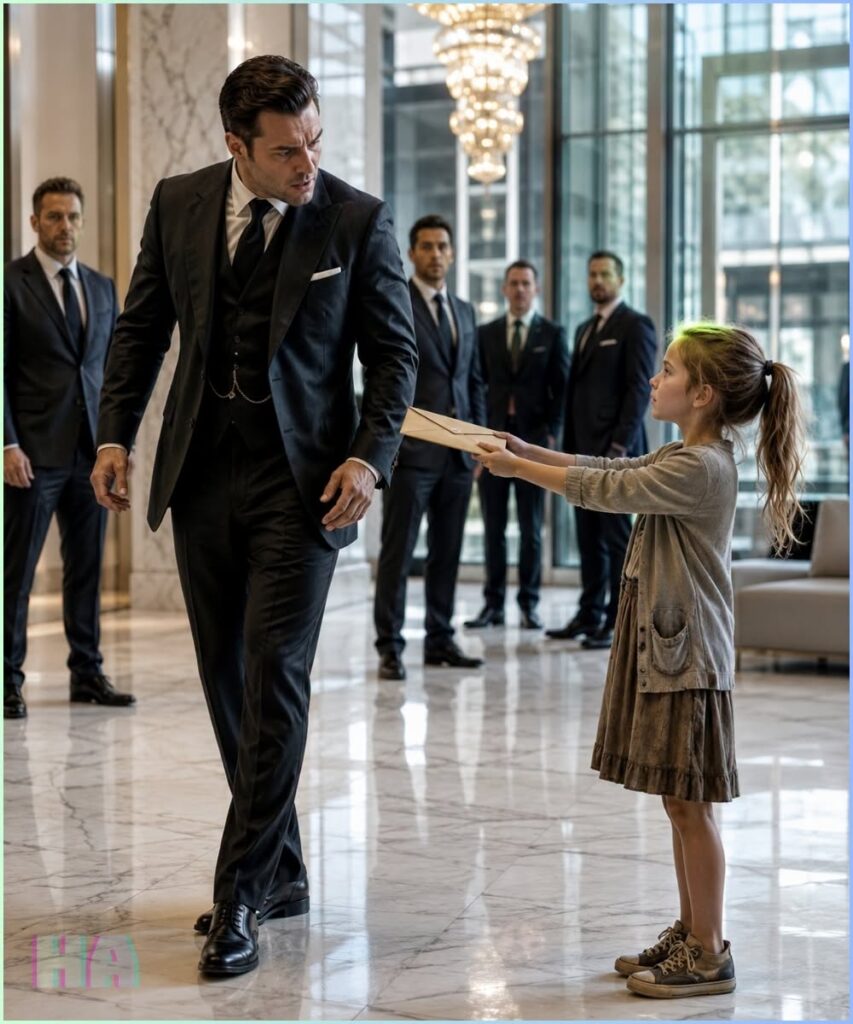
The Mafia Boss Thought the Poor Little Girl Was Chasing Him for Money Until She Returned the Envelope That Could Tear His Empire Apart
The black sedan had already reached the highway when six-year-old Emma Carter ran into the storm with ten thousand dollars pressed against her chest.
Her shoes were split at the toes. Her yellow raincoat had belonged to another child before it belonged to her, and one sleeve was shorter than the other. She could have hidden the envelope beneath it, gone home, and changed everything before sunrise. The money could have paid the overdue rent, bought medicine for her grandmother, replaced the car that coughed smoke every winter morning, and put food in the refrigerator for months.
No one inside Rosa’s Diner would have blamed her.
No one except Emma herself.
So she ran.
She raced through sheets of rain while the taillights of the luxury car faded into the darkness, waving the thick white envelope above her head and shouting until her small voice broke.
“Sir! You dropped this!”
When the sedan stopped, every person watching through the diner windows expected the feared man inside to send a driver back for his money.
Instead, Alessandro Moretti stepped into the rain himself.
And before that night was over, the most powerful crime boss in New York would hear seventeen innocent words that would begin tearing down the empire he had spent twenty years learning how to protect.
Three minutes earlier, Alessandro had been sitting alone in the rear booth of Rosa’s Diner, finishing black coffee he did not particularly want.
He had entered because the storm had made the highway almost invisible and because Luca Romano, his driver and oldest confidant, had advised him to wait ten minutes before crossing the bridge. Alessandro rarely changed plans for weather, but the envelope inside his coat contained ten thousand dollars intended for a business partner who considered lateness a greater insult than dishonesty. Arriving safely mattered more than arriving exactly on time.
Rosa’s was the kind of diner people noticed only when they desperately needed one. Its neon sign had lost the second half of the letter R. The vinyl seats had been repaired with silver tape. A paper snowflake still hung in the window even though Christmas had passed months earlier.
Yet the coffee was hot, the plates were clean, and no one stared when Alessandro entered with two broad-shouldered men behind him.
That last part impressed him.
People usually stared.
Some recognized him. Others merely recognized the effect he had on a room. Conversations softened. Shoulders tightened. Men looked toward doors. Women pulled their purses closer without knowing why.
At Rosa’s, an elderly woman behind the counter simply pointed toward an empty booth.
“Kitchen closes in twenty minutes,” she said. “Coffee’s fresh. Pie isn’t.”
Alessandro almost smiled.
“Coffee will do.”
A waitress brought it a moment later. She was perhaps thirty, with auburn hair pinned at the back of her head and exhaustion hidden beneath practiced efficiency. Her name tag said SOPHIA.
“Anything else?” she asked.
“No.”
Her eyes rested briefly on the two men near the entrance. She understood danger, Alessandro thought, but she did not feed it with fear. She nodded and walked away.
In the last booth sat a little girl with a coloring book, three broken crayons, and a plate holding half a grilled-cheese sandwich. Her clothes were clean but worn thin from too many washings. Every few minutes, Sophia passed the booth and touched the child’s shoulder or moved the plate closer to her.
Alessandro noticed because he noticed everything.
He had built his life on noticing what other people missed.
What he failed to notice was the envelope slipping from inside his coat when he stood.
He placed cash beneath the saucer, buttoned his overcoat, and walked through the storm to the sedan. Luca drove away before anyone inside the diner saw the white envelope lying beneath the edge of the table.
Emma saw it first.
She slid out of the booth and picked it up with both hands. It was thick enough to feel important, sealed with dark wax, and heavier than any letter she had ever held.
“Mom?”
Sophia was at the register helping Rosa count a drawer.
“What is it, sweetheart?”
“The man dropped this.”
Sophia looked toward the empty booth, then through the window at the sedan disappearing past the gas station.
“Put it on the counter. He may come back.”
Emma saw the money before she set it down. The flap had loosened when the envelope hit the floor, exposing the green edges of the bills.
Rosa stopped counting.
One trucker turned on his stool. Another man lowered his fork.
Sophia stared at the money for half a second, and in that half second every unpaid bill in her life seemed to rise around her.
The rent notice beneath the sugar jar at home.
The pharmacy receipt folded in her wallet.
The dialysis transportation charge she had not shown her mother.
The tuition statement from the nursing program she had left three years earlier.
Ten thousand dollars would not solve her life, but it would give the trouble room to breathe.
Emma looked up at her.
“Is it his?”
Sophia swallowed.
“Yes.”
“Then he needs it.”
Sophia’s fingers tightened around the counter. She looked through the rain again. The car was almost gone.
“Emma, wait.”
But Emma was already running.
The bell above the door rang wildly as she pushed through it. Rain hit her so hard that she stumbled from the curb. She recovered, hugged the envelope to her chest, and sprinted across the gravel shoulder.
“Sir!”
The sedan continued.
Emma ran faster.
“Sir, you dropped this!”
Luca heard her before Alessandro did.
“Boss.”
Alessandro looked up from his phone.
Luca glanced into the rearview mirror. “There’s a child behind us.”
Alessandro turned. Through the rain-blurred rear window, he saw the yellow raincoat and the small white object raised in one hand.
“Stop.”
The sedan braked.
Before Luca could leave the driver’s seat with an umbrella, Alessandro opened the rear door and stepped into the storm.
Emma reached him breathless. Mud streaked her stockings. Water ran down her forehead and trembled on her eyelashes. She held out the envelope with both hands.
“You dropped it.”
Alessandro stared at the seal.
He knew its weight. He knew the exact blue band around the bills. He knew there was enough money inside to buy everything visible on the child’s body a hundred times over.
He crouched so he would not tower above her.
“You opened it?”
“It opened when it fell.”
“And you saw what was inside?”
She nodded.
Alessandro removed two hundred-dollar bills and held them toward her.
“For bringing it back.”
Emma took one step away.
“No, thank you.”
“It is yours.”
“No, sir. It’s yours.”
The diner door flew open behind them. Sophia ran into the rain without a coat, her apron still tied around her waist.
“Emma!”
She reached her daughter in four strides and pulled her close. Her hands moved over the child’s forehead, shoulders, and arms, checking for injury before allowing herself to feel anger.
“You cannot run into a highway,” she said, breathless. “Do you understand me? Never. Not for anything.”
“But he dropped his money.”
“I know.”
Sophia looked at Alessandro. Recognition entered her face, not because she knew his name, but because she understood he was the kind of man whose belongings could bring danger.
“I’m sorry,” she said. “She should not have chased your car.”
Alessandro offered her the two bills.
“For the inconvenience.”
Sophia looked at them but did not reach out.
“She did what she believed was right. That is all.”
“This would help her.”
“She does not need to be paid for being honest.”
Rain ran from Alessandro’s hair into the collar of his coat. Men had refused his money before, but never because they considered it unnecessary. They refused when they wanted more, when they feared a trap, or when accepting would expose them.
Sophia’s refusal contained none of those calculations.
He returned the bills to the envelope and looked at Emma.
“You could have kept it,” he said quietly. “No one would have known.”
Emma leaned against her mother’s side. Her answer came with the certainty of something repeated many times at a kitchen table.
“My mom says money that isn’t yours doesn’t make you happy, no matter how much of it there is.”
The storm continued around them.
Alessandro did not move.
He had sat across from men who placed guns beside plates of pasta. He had listened to threats in three languages. He had survived betrayals, funerals, investigations, and wars that never reached the newspapers.
No one had ever silenced him with a sentence.
A six-year-old had done it in the rain.
Sophia lifted Emma into her arms.
“We should go inside.”
Alessandro nodded once. It was all he trusted himself to do.
He returned to the sedan, carrying the envelope beneath his coat.
Luca drove toward the bridge. For several miles, neither man spoke.
Finally, Luca glanced into the mirror.
“You want me to contact the diner?”
“Why?”
“Coffee?” she asked.
“Yes.”
Sophia was carrying eggs to an elderly man near the window. Her shoulders tightened when she saw Alessandro, then relaxed as she resumed working.
Emma sat in the last booth with her coloring book. Her hair had been washed and tied with a blue ribbon. When she noticed him, she smiled.
He nodded to her and took a table beside the window.
Sophia brought a menu.
“Whatever is simplest,” he said.
“Black coffee and toast.”
“With butter.”
She wrote the order.
“You do not need to come here because of what happened,” she said quietly. “We are fine.”
Alessandro met her eyes.
“I came because the coffee is better than the coffee at my house.”
She did not smile.
“Rosa will be pleased.”
He paid before the toast arrived and left a tip that was fair but not extravagant. When he departed, Emma waved with a pink crayon between her fingers.
In the sedan, Luca looked into the mirror.
“Where to?”
“Home.”
Luca waited.
Alessandro added, “We return next Tuesday.”
He came back the following week, and the week after that.
He became a regular slowly, as though he feared any sudden kindness would be mistaken for ownership. He sat at the same table, ordered the same coffee, and never remained longer than forty-five minutes.
Sophia treated him as she treated everyone else. She refilled his cup because she refilled every cup. She did not linger. She did not ask questions. She did not perform gratitude.
He respected her more each time.
One afternoon, when only three customers occupied the diner, Sophia set down his coffee with her left hand. Her right shoulder barely moved.
“Old injury?” he asked.
Her gaze sharpened.
“My shoulder?”
“You protect it when you carry more than one plate.”
“My husband and I were in a car accident years ago. It healed badly.”
“Does it hurt?”
“When it rains.”
Alessandro looked through the window. A drizzle misted the glass.
He considered offering a doctor, then remembered the rain, the money, and her refusal.
Instead, he said, “The coffee is good today.”
“It is the same coffee as yesterday.”
“Then it was good yesterday too.”
Her mouth almost curved.
A week later, he made the mistake of offering help.
“If your car needs repair,” he said, “or there is a bill that has become difficult, I could arrange—”
“Thank you, Mr. Moretti.”
She interrupted without hostility.
“I have work. I have my mother. I have my daughter. I have enough.”
He studied her.
There was no pride in her voice. Pride usually announced itself. Her refusal was quiet because it had been shaped long before he arrived.
“I understand,” he said.
He did not push again.
Later, Rosa approached while Sophia was in the kitchen. The older woman wiped the table beside Alessandro’s even though it was already clean.
“That girl hasn’t asked anyone for anything in three years,” Rosa said, addressing the salt shaker. “Not when her husband died. Not when her mother got sick. Not when the rent increased. She works. That’s all she knows.”
Alessandro looked toward the kitchen door.
“How did her husband die?”
“Bridge construction accident upstate. A support cable failed. He was thirty-one.”
“And her mother?”
“Kidneys. Dialysis three times a week.”
Rosa finally looked at him.
“Do not turn her into a project.”
“I have no intention of doing that.”
“Men with money always say that before they begin rearranging someone else’s life.”
Alessandro accepted the warning.
“Then tell me when I begin.”
Rosa nodded once.
“I will.”
The following Saturday, Sophia took a brief break and sat across from him. Emma was doing arithmetic in the next booth.
“Your daughter has your eyes,” Alessandro said.
Sophia smiled, and the difference between that smile and her professional expression startled him.
“Her father used to say that.”
She told him about Daniel Carter, the man she had married at twenty-two. Daniel had worked on bridges and believed every structure revealed the honesty of the person who built it. He had been killed when a contractor ignored warnings about a weakened cable.
After his death, Sophia discovered that his small life-insurance policy had been borrowed against to pay medical bills for her father. Her father died six months later. Eleanor’s kidneys failed the following winter.
Sophia had been studying nursing at a community college. She left during her third semester and began working full-time at Rosa’s.
“I intended to return after one semester,” she said. “Then one semester became three years.”
“Do you still want to finish?”
“I still have the textbooks under my bed.”
“Why not apply for assistance?”
“Because assistance is rarely just assistance.”
“Sometimes it is.”
“Not in my experience.”
She folded her hands on the table.
“I want Emma to see me standing on my own feet. What I earn may be small, but it is mine. It does not come with anyone’s hand around my wrist.”
Alessandro understood then that Emma’s sentence had not been childish innocence. It was inheritance. A moral line passed from mother to daughter through repetition, hardship, and example.
Emma appeared beside the table holding a plate.
“This is for you.”
It contained a slice of apple pie, the corner crust perfectly intact.
“The best piece,” she explained. “I saved it.”
Alessandro looked at the pie, then at her.
He had received watches, cars, properties, favors, loyalty, and envelopes thick with cash. He could not remember anyone saving him the best piece of anything simply because they had thought of him earlier in the day.
“Thank you, Emma.”
She seemed satisfied by the seriousness of his response.
After that, bringing him something became her ritual.
Sometimes it was pie. Sometimes it was a warm cookie. Once, when the pastry case was empty, she brought him buttered toast cut diagonally.
He accepted every offering as though it were precious.
He began asking about school.
Emma told him about Miss Ramirez, a gray cat that appeared outside the classroom, and Bella Thompson, who refused to share colored pencils. She also confessed that she did not understand multiplication.
“Seven times eight makes no sense,” she declared.
Alessandro arranged sugar packets in seven rows.
“Count eight packets in each row.”
Emma leaned over the table. As she counted, confusion gave way to discovery.
“Fifty-six,” she whispered.
“Exactly.”
“Can we do nine times six?”
They did.
Rosa watched from the counter. Sophia watched through the kitchen window.
That evening, after Alessandro left, Rosa said, “He no longer comes for the coffee.”
Sophia rinsed a plate.
“What does he come for?”
“You know.”
Sophia looked toward Emma, who had fallen asleep in the last booth with her cheek against an open coloring book.
“I know what men like him want.”
Rosa shook her head.
“No. You know what men who pretend to be like him want. I am not sure you know what that one wants.”
Sophia did not answer.
Three months after the storm, Marco Bellini noticed Alessandro smiling during a meeting.
“You seem different lately,” Marco said.
“Do I?”
“You have smiled twice this month. That exceeds your annual average.”
Alessandro gave him a measured look.
Marco laughed and closed the folder.
After he left, Alessandro remained in the study.
Warmth had become so unfamiliar that he had mistaken it for fatigue.
His estate contained thirty-two dining chairs and no family dinners. Paintings covered walls no one admired. A grand piano sat untouched because the woman who had once played it was dead.
Her name had been Isabella.
Alessandro had planned to marry her when he was twenty-seven. She died in a car accident three months before the wedding. He attended the funeral beside his father and did not cry because grief in the Moretti house had always been private, brief, and efficient.
After Isabella, Alessandro’s heart had narrowed around power.
Then Emma returned an envelope.
Now he found himself waiting for Tuesdays.
He stopped at an art store one evening and bought a tin of forty-eight colored pencils.
At the diner, he placed the tin beside Emma’s coloring book.
“I found these outside,” he said. “Someone must have dropped them.”
Emma opened the box. Her eyes widened at the rows of red, gold, blue, lavender, and green.
Then she looked up.
“Mr. Alessandro, I know you bought them.”
“Do you?”
“They still have the price sticker.”
Sophia laughed.
It was the first time Alessandro heard the sound without restraint. He laughed with her, and for a moment he was not a man people feared. He was simply a man caught in a poorly constructed lie by a six-year-old.
That night, he removed the ten-thousand-dollar envelope from his safe and placed it on his desk.
He finally admitted what had happened.
He had fallen in love with Sophia Carter.
Not in a dramatic instant, but through accumulation.
The way she pinned her hair with a pen when both hands were occupied.
The way she pulled out chairs for older customers before they asked.
The way she checked Emma’s coat zipper three times before allowing her outside.
The way she never made poverty look noble but refused to let it make her cruel.
He wanted to tell her.
He also wanted to help Eleanor receive better treatment, help Sophia return to nursing school, and give Emma a bedroom with walls she could cover in drawings.
Then the darker truth entered the room.
If Sophia stood beside him, she became a target.
If Emma called him family, she became leverage.
Alessandro had attended funerals for men who thought their enemies would respect wives and children. Their enemies never did.
So he made a decision.
He would love them silently.
He would continue drinking coffee at Rosa’s and helping Emma with arithmetic, but he would never pull them into his world.
For several weeks, he kept that promise.
Then he noticed the empty tables.
At first, he blamed the weather. But the diner grew quieter even on clear evenings. Familiar customers disappeared. Two electricians who once ate every Tuesday stopped coming. An elderly widower who ordered eggs every Sunday vanished from his corner table.
The food had not changed. The prices had not increased. Rosa’s coffee remained better than anything served at Alessandro’s estate.
One evening, Sophia set down his cup and the porcelain rattled against the saucer.
“Are you all right?” he asked.
“I’m tired.”
Her smile tried to close the subject.
Rosa watched her walk away with the expression of a mother who knew her daughter was carrying something alone.
Alessandro finished his coffee and returned to the sedan.
“Drive slowly around the neighborhood,” he told Luca. “Three blocks in each direction.”
The laundromat three doors away had closed after twenty-two years. The flower shop beside it was empty. Across the street, a grocery store had switched off its lights two hours early.
Three months earlier, those businesses had been open.
The arithmetic did not balance.
The next morning, Luca entered Alessandro’s private office at seven.
“The neighborhood around Rosa’s,” Alessandro said. “Find out who is pressuring the businesses.”
“Do you suspect someone from our side?”
“I suspect someone using our name.”
“How far do I go?”
“As far as the truth requires. No one else knows. Not Marco, not the captains, not the bookkeepers.”
Luca nodded.
For three weeks, he disappeared into Brooklyn.
He rented a narrow storefront and pretended to open a bakery. He placed bread in the window and flour on his coat. The deception became inconvenient when real customers began buying the rolls, but it provided an excuse to speak with every shop owner in the neighborhood.
Their stories matched.
Five thousand dollars a month.
Cash delivered on the first Wednesday.
Refusal brought broken windows, ruined deliveries, frightened customers, and threats painted across walls.
The collectors called themselves friends of the Moretti family.
Seven businesses had closed. Eleven more were near collapse.
When Luca returned, he carried recordings, photographs, financial records, and a list of five collectors.
Alessandro read the names.
“Who stands above them?”
Luca placed one folded sheet on the desk.
Alessandro opened it.
Marco Bellini.
For forty seconds, Alessandro did not speak.
He remembered Marco at his father’s deathbed holding a rosary. He remembered Marco taking a bullet in the thigh that had been intended for Alessandro. He remembered meals, weddings, baptisms, and late-night conversations.
“I called him brother,” Alessandro said.
Luca remained silent.
“And he used my name to enter the kitchens of decent people.”
“There is more.”
Luca opened another folder.
Inside were photographs of Rosa’s Diner.
A shattered window.
Red paint across the rear wall.
A note nailed to the door.
PAY OR NEXT TIME IT IS THE CHILD.
Alessandro’s face did not change, but his hands closed into fists.
“They have demanded five thousand a month for two years,” Luca said. “Sophia paid until three months ago. Eleanor’s treatment changed. There was no money left.”
Alessandro looked again at the threat.
“Since then?”
“Three broken windows. Two suppliers frightened away. Customers followed into the parking lot. A man waited outside Sophia’s apartment last week, but he left before approaching.”
The trembling coffee cup returned to Alessandro’s mind.
Sophia had known he was powerful. She had also believed accepting help from him would carry a price.
Even when danger followed her home, she refused to place Emma inside a debt she did not understand.
“She is not to know that we know,” Alessandro said.
Luca nodded.
“Place two men at the diner and two at the apartment. Men you would trust beside your own children. Marco’s people do not touch Sophia, Emma, Rosa, or Eleanor.”
“And if they try?”
Alessandro looked at the photograph of the nailed threat.
“They do not leave the block.”
After Luca departed, Alessandro opened the private safe.
On the bottom shelf lay a black leather notebook written by his father forty years earlier. Its pages contained the rules Vincenzo believed separated a family from a pack of animals.
Alessandro turned to Rule Seven.
No member takes from decent people. Not money, food, livelihood, or dignity. Anyone who does so under this name is finished. No exception.
Alessandro read it three times.
Then he called Luca back.
“I want every dollar traced,” he said. “Every collector, account, false company, and man who looked away. Build a file so complete that even Marco’s oldest friend cannot defend him.”
“Yes.”
“Find everyone inside our house who belongs to him.”
“Yes.”
“And keep Sophia and Emma alive without allowing them to feel watched.”
Luca rested one hand on the chair.
“I served your father for twenty-four years. I have served you for eighteen. I have never seen you this angry.”
“This is not anger.”
“What is it?”
“Shame.”
Luca’s expression softened.
“If there is a way for me to handle Marco so you do not have to end a man you called brother, tell me now.”
Alessandro closed the notebook.
“No. This is my house and my failure. I will close the wound.”
The investigation continued for three weeks.
Luca and two trusted financial men uncovered four shell companies, hidden accounts, false supplier contracts, and more than four million dollars stolen from small businesses.
They also found thirteen men inside the Moretti organization who had joined Marco.
Three had eaten at Vincenzo’s table.
One had held Alessandro at his christening.
Alessandro continued meeting Marco every Thursday. He listened to false reports, accepted coffee from a traitor, and signed harmless versions of documents Luca had already copied.
Marco suspected nothing.
At Rosa’s, two of Luca’s men occupied a booth near the door wearing construction jackets. Sophia assumed they were new customers.
For the first time in months, no windows broke.
One evening, she stood beside Alessandro’s table.
“Something changed,” she said.
“What?”
“No one has threatened us in three weeks. The suppliers returned. The men who waited in the parking lot disappeared.”
“Perhaps they found another target.”
Sophia studied him.
“You are not a good liar.”
“Emma has told me that.”
“I do not know what you did.”
“I have done nothing you need to repay.”
Her eyes narrowed.
“That sentence sounds carefully prepared.”
“It was.”
“Then I will not ask tonight.”
“Thank you.”
“But one day I will.”
“When that day comes, I will answer honestly.”
Alessandro watched her return to the counter. He knew she understood enough to be afraid, but not enough to know the danger had moved from the street into his own house.
He planned to tell her everything when Marco was secured.
He never received the chance.
One of the thirteen traitors discovered Luca’s investigation and warned Marco.
At eleven that night, Marco sat alone in his Staten Island home and considered escape. Four million dollars waited in hidden accounts. He could leave the country before dawn.
But leaving meant surrendering the empire he believed he deserved.
Instead, he contacted Vincent Duca, the aging head of a rival organization on Long Island.
Marco offered him the shadow network and promised the loyalty of forty men.
“All I need,” Marco said, “is Alessandro removed.”
Duca listened without expression.
“You believe forty of his seventy-two men belong to you?”
“They belong to me.”
“Then why is Moretti still alive?”
“Because he has spent his life preparing for enemies. He has never prepared for a brother.”
Duca agreed to help, but he demanded certainty.
“Alessandro will fight if cornered,” he said. “A man like that needs a reason to walk into the room unarmed.”
Marco smiled.
“He has one.”
He told Duca about the waitress and her daughter.
The following night, Sophia closed the diner early because Eleanor had developed a fever.
Emma was asleep in the last booth, one of Alessandro’s colored pencils curled in her fist. Sophia carried her to the car, covered her legs with a coat, and drove home.
At the apartment building, she left Emma sleeping in the locked car for less than two minutes while she went upstairs to check on Eleanor.
The apartment door stood slightly open.
The kitchen light was on.
Sophia entered and found two men waiting in the hall.
One covered her mouth. Another pressed a chemical-soaked cloth beneath her nose.
She fought until her knees failed.
Outside, a third man removed Emma from the car and carried her to a van.
Eleanor lay unconscious beside her armchair, drugged but breathing.
The operation took less than four minutes.
One of Luca’s guards noticed the van too late. He entered the apartment, found Eleanor, and called Luca.
Luca called Alessandro.
Alessandro was in his study reviewing the final report against Marco.
He listened without interrupting.
“Eleanor is alive,” Luca said. “Sophia and Emma are gone. There is a note.”
“Read it.”
“Warehouse Seven. Midnight. Alone.”
Alessandro closed his eyes.
For six months he had kept Sophia at a distance to protect her from his world.
That distance had failed.
“Take Eleanor to Dr. Falcone,” he said. “She does not wake alone.”
“What are your instructions?”
Alessandro opened a locked cabinet containing his father’s handgun.
“Gather every man we still trust. Half approach from the roofs. Half come from the water. No one enters until I give the signal.”
“You are not going alone.”
“I must appear to.”
“They will kill you.”
“They took a child because of me.”
“They took her because of Marco.”
“I gave Marco the power to do it.”
He loaded the weapon.
“This is my failure, Luca.”
At eleven fifty-three, Alessandro parked twenty yards from Warehouse Seven.
Wind came off the river with enough force to cut through his coat. Beneath his shirt, he wore a protective vest. A microphone had been sewn into his collar so Luca could hear every word.
The warehouse door opened before Alessandro reached it.
Inside, industrial lamps cast hard yellow circles across the concrete.
Sophia and Emma sat tied to metal chairs in the center of the room.
Emma’s face was wet with silent tears. Sophia had a bruise along her cheek and blood on one sleeve. She looked at Alessandro only once, and what he saw in her eyes was not accusation.
It was terror that he might die because she had been taken.
Marco stood between them holding a pistol.
Eight armed men occupied the floor and catwalks.
“You came,” Marco said.
“You knew I would.”
“I knew you better than you knew me.”
Alessandro stopped ten feet away.
“You stole from working families while sitting at my table.”
“I built what you were too sentimental to build.”
“You threatened a child.”
“I found the only thing that made you human.”
Marco gestured with the pistol.
“Your weapon.”
Alessandro removed his father’s handgun, lowered it to the floor, and kicked it forward.
Marco smiled.
“You thought your father’s rules made you strong. They made you weak.”
“No,” Alessandro said. “They are the only reason men followed us instead of merely fearing us.”
“Those men belong to me now.”
“Then why did you need a six-year-old tied to a chair?”
Marco’s smile vanished.
Through the microphone, Luca heard the change in his breathing.
Alessandro continued, buying seconds.
“You had money. Territory. My trust. Yet you still needed to threaten a waitress and a child to feel powerful.”
“I needed you in this room.”
“I am here. Release them.”
“You do not give orders anymore.”
Marco raised his pistol toward Alessandro’s chest.
That was the signal.
The skylight shattered.
Three lines dropped from the roof as Luca’s men descended. At the same instant, a side door burst inward from the river.
Gunfire thundered through the warehouse.
Alessandro moved toward Emma.
He tore the rope from her wrists and pulled her against his chest. A bullet struck his vest near the shoulder, knocking him sideways, but he stayed upright.
Sophia struggled against her restraints.
Alessandro reached her chair and cut the rope with a blade hidden inside his sleeve.
“Take Emma,” he said.
Sophia grabbed her daughter.
Luca reached them from behind a support column.
“Move!”
He guided Sophia toward the river exit.
Then Emma saw something on the floor.
A pink colored pencil had fallen from her pocket.
She twisted from Sophia’s arms.
“My pencil!”
“Emma, no!”
The child took one step back into the open.
On the upper catwalk, a gunman rose and aimed at her.
Alessandro saw him.
He crossed the distance before Sophia could scream.
He caught Emma against his chest and turned his body between her and the weapon.
Three shots rang out.
Two struck the protective vest.
The third entered above its edge.
Alessandro remained standing because Emma was still in his arms.
He carried her toward the door while blood spread beneath his shirt.
One step.
Then another.
By the fourth, his legs began to fail.
Sophia ran back.
“Give her to me.”
Alessandro placed Emma in her arms with extraordinary care.
Then he collapsed.
Sophia lowered him to the concrete and pressed both hands over the wound.
“Stay with me.”
Alessandro’s breathing came shallow.
“Emma?”
“She is safe.”
Emma knelt beside him and removed her cardigan. Sophia pressed it against the blood.
“Mr. Alessandro,” Emma sobbed. “You have to wake up.”
His eyes found hers.
“The cat,” he whispered.
“What?”
“The gray cat. You promised to draw it.”
“I will. I’ll make the tail curl all the way around. But you have to see it.”
The corner of his mouth lifted.
Then his eyes closed.
A private ambulance reached the warehouse within minutes. Dr. Henry Falcone, a surgeon who had known the Moretti family for decades, worked over Alessandro while the vehicle raced toward a secure medical center.
Sophia sat beside the stretcher, one hand on Alessandro’s wrist and the other around Emma.
Falcone noticed how she maintained pressure and monitored his breathing.
“You trained?”
“Three semesters of nursing.”
“You remember more than three semesters.”
“Is he going to live?”
Falcone looked at the monitor.
“He is alive now. That is the answer I can give.”
At the warehouse, Luca found Marco chained to a steel chair.
Several of Duca’s men had surrendered. Others had been wounded or killed during the fight. Luca’s teams moved through the city before dawn, detaining the thirteen traitors named in the investigation.
He ordered that none be executed.
Alessandro had not given that command.
Luca did not use words his boss had not spoken.
Marco remained silent until Luca placed Vincenzo’s black notebook on the table before him.
“You remember Rule Seven?” Luca asked.
Marco looked away.
“You ate in the old man’s home. You repeated his oath. Then you frightened widows, broke shop windows, and threatened a child.”
“I built millions.”
“You stole dollars from cash registers.”
“I built an empire.”
“You built a list of witnesses.”
Marco’s face changed for the first time.
Luca leaned closer.
“Alessandro is alive. When he wakes, your future will belong to him.”
Two days later, Alessandro opened his eyes.
Sophia was sleeping beside the bed with her cheek against the back of his hand. Emma occupied a chair on the other side, her fingers wrapped around his forearm.
Luca stood near the door.
Alessandro’s voice barely carried.
“Marco?”
“Secured.”
“The files?”
“Complete.”
“Give him to federal prosecutors. Everything. Extortion, fraud, conspiracy, kidnapping, all of it.”
Luca hesitated.
“That is not the old way.”
Alessandro looked toward Emma.
“We are a family, Luca. Not animals.”
“He tried to kill you.”
“A bullet would be quick. Marco believed prison was for weaker men. Let him spend the rest of his useful years waking behind a locked door.”
Luca nodded.
Marco Bellini was transferred to federal custody with financial records, recordings, photographs, witness statements, and evidence connecting him to years of extortion. He eventually received a sentence long enough to ensure he would be an old man before he saw the city again.
The protection racket collapsed within forty-eight hours.
From his hospital bed, Alessandro ordered every dollar returned to the neighborhood businesses, with interest taken from Marco’s hidden accounts.
Rosa received a plain envelope listing the amount stolen from her diner over two years. She sat behind the counter for a long time before opening it.
Inside was enough money to repair the windows, settle old debts, replace failing kitchen equipment, and keep the diner open.
At the bottom of the accounting sheet were nine words.
This was yours before it was ever taken from you.
Rosa understood who had written them.
She placed the note beneath the register and told no one.
Alessandro’s recovery was uncertain for six days.
Sophia and Emma remained at the hospital. Eleanor, having recovered from the sedative, arrived each afternoon in a wheelchair and spoke to Alessandro even when he could not answer.
She discussed the weather, the newspaper, and Emma’s schoolwork.
“You should wake up,” Eleanor told him one morning. “My daughter has spent years refusing help from every living person. If you make her sit beside this bed any longer, she may become impossible.”
Sophia looked up.
“Mother.”
“I am ill, not dishonest.”
Emma slept beside Alessandro every night.
Each morning, she folded his hand between both of hers as though praying.
On the third day, she looked at Sophia across the bed.
“Mr. Alessandro isn’t my father.”
“No, sweetheart.”
“But he did what Daddy would have done.”
Sophia’s eyes filled.
Emma lowered her voice.
“Is it wrong if I love him too?”
Sophia pulled her close.
“No. Love is not something you steal from one person when you give it to another.”
“Then do you love him?”
Sophia looked at the unconscious man.
“Yes.”
It was the first time she had said it aloud.
Before dawn on the sixth day, Alessandro opened his eyes again.
Sophia was asleep with her head beside his hand. Emma rested against the mattress on the other side.
He understood something with absolute clarity.
Silence had not protected them.
Distance had not protected them.
Fear had merely cost him months in which he might have told them the truth.
“Sophia.”
She woke before he completed her name.
Her hands went to his face, then to the call button.
Emma opened her eyes and smiled the smile she had been saving for six days.
Falcone entered, checked the monitor, the wound, and Alessandro’s pupils.
“He will recover,” the doctor said. “Slowly, painfully, and only if he obeys every instruction I give him.”
“I have never obeyed every instruction from anyone,” Alessandro murmured.
Falcone adjusted the IV.
“Then I will sedate you until obedience becomes natural.”
When the doctor left, Sophia sat beside the bed.
“I am sorry,” Alessandro said.
“For what?”
“For bringing this to your door.”
“No one brought me anywhere. Emma chose to return the envelope. I chose not to ask for help. You chose to protect us. Marco chose cruelty. We all arrived here through choices.”
“My world nearly killed you.”
“Your world also produced Luca, who saved my mother, and men who risked their lives for a child they had never met. Do not use one monster to excuse yourself from becoming a better man.”
He stared at her.
“You speak to everyone this way?”
“Only difficult patients.”
Emma climbed carefully onto the bed and placed her head on his uninjured shoulder.
“I drew the cat,” she said.
“Is the tail curled?”
“Three times.”
“Then I have something to live for.”
Sophia laughed through her tears.
Alessandro spent five weeks recovering.
During that time, he dismantled much of Marco’s hidden network and cut ties with the businesses that had depended upon threats. Several men objected. Alessandro gave them a choice between legitimate work and leaving the organization.
Some left.
More stayed than he expected.
Power built entirely on fear, he began to understand, had to keep proving itself through pain. Loyalty built on rules could survive silence.
He sold three warehouses connected to Marco’s operations and placed the proceeds in a neighborhood development fund administered by an independent attorney and a board of local business owners.
Rosa accepted a place on the board only after informing Alessandro that she would resign the first time he attempted to control her vote.
“I would expect nothing less,” he said.
Sophia returned to the diner while Alessandro recovered, but the danger around her had changed. Customers filled the booths again. Suppliers returned. The laundromat reopened under new ownership, and the grocery store repaired its awning.
Alessandro did not visit until he could walk with a cane.
On a Sunday afternoon, he entered Rosa’s beneath soft sunlight.
Thirty-two people occupied the diner. Shop owners filled the booths. Luca stood near the door. Falcone sat with a newspaper he was not reading. Eleanor waited beside the window beneath a blue shawl.
Rosa had invited everyone without explaining why.
Sophia carried clean glasses from the kitchen. When she saw Alessandro, she stopped.
He wore a plain dark suit. His steps were careful, but his shoulders were straight.
Emma rushed from the last booth, then remembered his wound and slowed before reaching him.
“You’re walking.”
“Falcone insists it is good for me.”
“He also says you are stubborn.”
“Falcone says many things.”
Sophia approached.
“You should be resting.”
“I have rested enough for several lifetimes.”
He looked around the crowded diner.
“Could we sit for a moment?”
They went to the last booth, the one where Emma had colored on the day he first returned. Sophia sat on one side. Emma climbed beside her.
Alessandro remained standing.
“I owe you the truth,” he said.
Sophia folded her hands.
“I know who you are now.”
“You know the public version.”
“I know enough.”
“Then you know I have done things I cannot make innocent by regretting them.”
“Yes.”
“I have spent my life building walls from power, fear, secrecy, and discipline. I believed those walls made a home because they kept enemies outside.”
He looked toward Emma.
“But no one ran to the door when I arrived. No one saved me the best piece of pie. No one waited at my table with a multiplication question.”
Emma smiled.
Alessandro returned his gaze to Sophia.
“You and your daughter taught me that a home is not where no one can reach you. It is where someone hopes you return.”
Sophia’s eyes filled, but she did not look away.
“I cannot promise that my past will disappear,” he continued. “I can promise that I will spend the rest of my life refusing to let it decide the man I become. I will never ask you to surrender your judgment, your work, or your independence. I will never make help feel like a hand around your wrist.”
He reached inside his coat.
“I also know that protecting you from a distance was partly cowardice. I feared losing you, so I nearly chose never to have you.”
He removed a small velvet box.
Emma gasped.
Alessandro lowered himself onto one knee with difficulty.
Sophia began crying before he opened the box.
“Sophia Carter, will you marry me?”
She covered her mouth.
He continued before she could answer.
“Not because you need rescue. You do not. Not because I believe money can repay what you and Emma gave me. It cannot. Marry me because I love the woman you are when no one is watching. Marry me because your daughter returned ten thousand dollars and somehow gave me back the conscience I had hidden. Marry me because I want to earn a place at your kitchen table for whatever years I have left.”
Sophia looked at Emma.
Emma whispered, “You can say yes.”
Sophia laughed through her tears.
Then she turned back to Alessandro.
“Yes.”
For one heartbeat, the diner remained silent.
Emma stood on the booth.
“My mom said yes!”
The room erupted.
Rosa struck the counter with both hands and shouted for everyone to stop crushing the napkin holders. Eleanor covered her face and cried. Luca turned toward the window, pretending to inspect the street until his expression was under control.
Alessandro placed the ring on Sophia’s finger.
Then Emma reached for him.
He lifted her carefully and held her against his chest, in the same way he had carried her from the warehouse, as though she were the most valuable thing his hands had ever touched.
Six months earlier, she had run into a storm to return an envelope.
Now sunlight filled the diner, the booths were crowded, and the man who once lived in a silent mansion finally had someone waiting for him to come home.
The original ten thousand dollars remained sealed.
Alessandro never spent it.
Years later, the envelope hung inside a glass frame in the hallway of the home he shared with Sophia and Emma. Beneath it was a small brass plate engraved with the words Emma had spoken in the rain.
Money that isn’t yours doesn’t make you happy, no matter how much of it there is.
Sophia eventually returned to nursing school. She graduated with honors and helped establish a community clinic beside Rosa’s Diner, where elderly patients could receive treatment without crossing the city by bus.
Eleanor became the clinic’s least cooperative patient and its most enthusiastic volunteer.
Rosa continued serving coffee until she was seventy-two, then transferred ownership of the diner to the cooks and waitresses who had kept it alive. She still occupied the corner stool every Sunday morning and corrected anyone who made the mistake of calling her retired.
Emma grew taller. Her clothes no longer came from donation boxes, but Sophia taught her that possessing more did not mean understanding more. She remained the child who returned what did not belong to her, though she eventually became skilled enough at arithmetic to stop using sugar packets.
As for Alessandro, he never became innocent.
Life did not offer that kind of easy transformation.
He lived with the consequences of the man he had been and spent years dismantling the most destructive parts of what he had inherited. Some people never forgave him. Others believed he changed only because he had finally found something he feared losing.
Perhaps both were true.
But every evening, when he entered the house, Emma came running.
Sophia looked up from whatever she was reading.
Someone waited for him.
And when he sat at the kitchen table beneath the framed envelope, he remembered the night a poor little girl had held ten thousand dollars in her hands and chosen to remain richer than every powerful man he had ever known.
THE END
