
The Billionaire Boss Boarded a Christmas Eve Flight Furious at the World Until His Ex-Wife Appeared With Twins Who Had His Eyes and a Hidden Letter Revealed Who Had Stolen Three Years From Them
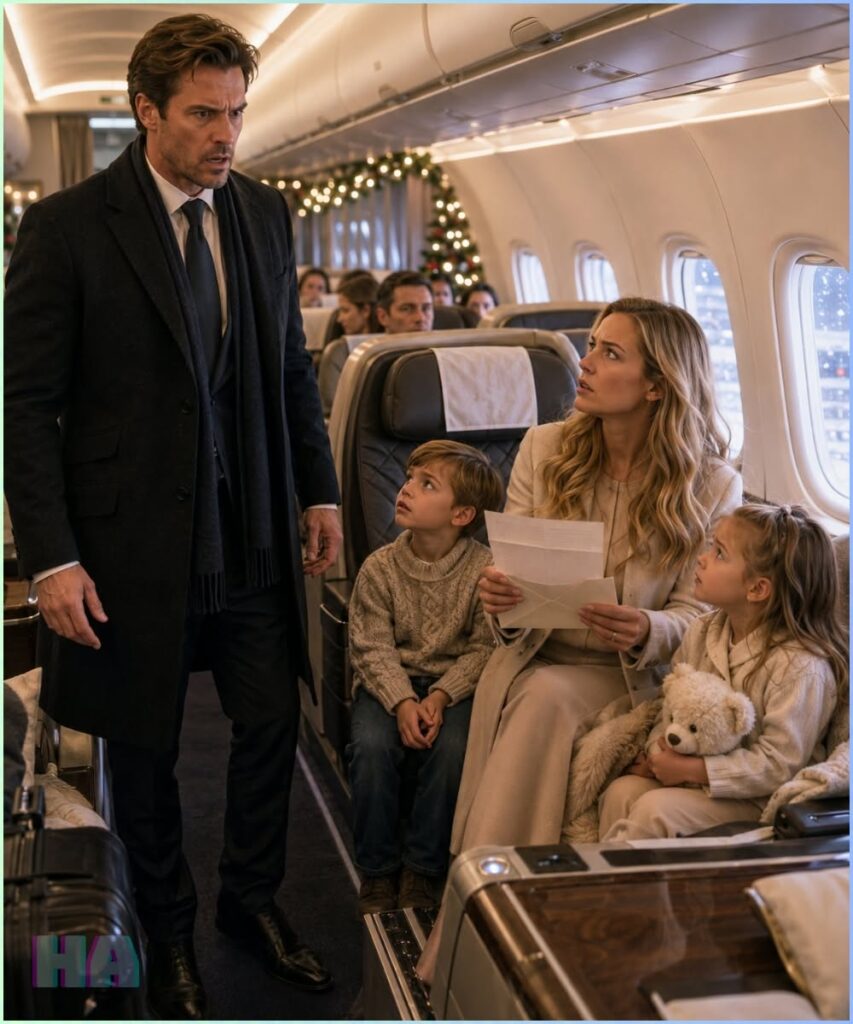
Damon Prescott was threatening to fire three executives when he saw the little boy pressing both hands against the airplane window.
The child could not have been more than two years old. Sandy-brown hair curled above his ears, and his small chin lifted with stubborn concentration as he searched the darkening runway for another plane. Beside him sat a little girl clutching a gray stuffed elephant. She had the same green eyes as the boy, the same serious crease between her eyebrows, and the same unmistakable dimple in her left cheek.
Damon’s dimple.
His voice died in the middle of a sentence.
“Mr. Prescott?” his chief operating officer asked through the phone. “Are you still there?”
Damon barely heard him.
The woman fastening the girl’s seat belt leaned forward, and a curtain of dark hair slipped over her shoulder. She tucked it behind one ear with a movement Damon had watched a thousand times in another life.
Cassandra.
His ex-wife.
The woman he had not seen in three years.
She raised her face, and their eyes met across twenty rows of passengers boarding a Christmas Eve flight from Seattle to Denver.
The color vanished from her cheeks.
The little boy turned from the window and said, “Mama, the angry man is staring at us.”
Damon lowered the phone.
The boy had his eyes.
The girl had his dimple.
And both children looked exactly old enough to destroy every explanation he had believed for the last three years.
“Mr. Prescott?” the voice on his phone repeated.
Damon ended the call without answering.
For the first time since building a company worth several billion dollars, the billionaire boss who could silence a boardroom with one look had no idea what to do next.
Cassandra Hayes had planned for nearly every disaster that could happen while traveling alone with twins.
She had packed medicine, snacks, extra clothes, coloring books, headphones, disinfecting wipes, two stuffed animals, three kinds of crackers, and enough diapers to survive an emergency landing in another state. She had worked fourteen extra night shifts in the neonatal intensive care unit to pay for the tickets, Christmas gifts, and a rental car she could barely afford.
She had not planned to meet the father of her children in first class.
“Cassie?” Damon said.
The old nickname reached her through the noise of the cabin, through the Christmas music playing from a flight attendant’s phone, through Luke’s questions and Violet’s nervous breathing.
Cassandra looked away.
“Mommy, do you know him?” Violet whispered.
“No, sweetheart.”
The lie came too quickly.
Damon heard it.
His expression changed from shock to something harder, but passengers crowded behind him, forcing him to move toward the front of the aircraft. He took his seat without looking away from Cassandra until the first-class curtain closed between them.
Only then did she breathe.
The elderly woman across the aisle watched her with gentle concern. “Honey, are you all right?”
“I’m fine.”
“You look like you’ve seen a ghost.”
Cassandra tightened her grip on the diaper bag. “Something like that.”
Outside, snow began drifting beneath the airport lights. Ground crews moved between planes in reflective coats while impatient passengers filled the cabin. Luke narrated everything he saw. Violet pressed closer to Cassandra, her elephant tucked beneath her chin.
Cassandra tried to focus on them, but her mind had already crossed three years and returned to a rain-soaked apartment in Seattle.
She and Damon had married young, convinced love would be enough to survive anything. For a while, it had. They shared a cramped apartment, secondhand furniture, unpaid bills, and dreams too large for their circumstances. Damon worked for a struggling software company. Cassandra finished nursing school and came home exhausted to find him waiting with burnt pancakes and cheap coffee.
Then Damon’s talent attracted powerful investors.
Opportunity turned into obsession. His workdays stretched from dawn until midnight. Dinners went cold. Weekends disappeared. Every conversation began with an apology and ended with another promise that things would calm down after one final deadline.
When Damon accepted a position in Seattle that required constant travel, Cassandra panicked. She had already felt like a widow inside their marriage. Moving farther from her family while Damon vanished into airports and boardrooms felt like surrendering the last piece of herself.
Their final argument had been cruel because both of them were terrified.
“You don’t want a wife,” she had shouted. “You want someone waiting in the background while you become important.”
“I’m doing this for us.”
“You’re doing it because nothing will ever be enough for you.”
“And what do you want me to do?” Damon had demanded. “Turn down the only chance I may ever have because you’re afraid?”
“I want you to choose me.”
“I already did. I married you.”
“That isn’t the same as staying.”
She had pulled off her wedding ring and thrown it across the room.
Damon had stared at the ring on the floor as if it were a bullet.
“If that’s what you think of me,” he had said quietly, “maybe there’s nothing left to save.”
He packed one bag and walked out.
Three days later, Cassandra saw two pink lines on a pregnancy test.
Two weeks after that, an ultrasound technician smiled and said, “There are two heartbeats.”
Cassandra had called Damon’s old office, but he was gone. She called the number he had given her before leaving, but it had been disconnected. She emailed every address she knew. She mailed a certified letter to the company where he had started working. The delivery confirmation arrived, but Damon never answered.
Then divorce papers came through an attorney.
She signed them while seven months pregnant.
Her pride told her he had received the letter and chosen silence. Her fear told her that forcing children into the life of a man who did not want them would create more pain than raising them alone.
She had repeated those explanations until they felt almost true.
Now Damon was twenty rows away, and the astonishment on his face had not looked like the expression of a man who had ignored a pregnancy announcement.
It had looked like the expression of a man who had never known.
The plane remained at the gate for forty minutes while crews deiced the wings. Damon sent no message and made no attempt to approach her, but Cassandra could feel his presence through the curtain. Every time a flight attendant passed, she expected a demand that she move to first class or surrender the children for an interrogation.
Instead, nothing happened.
That frightened her more.
When the plane finally accelerated down the runway, Luke squealed with delight. Violet closed her eyes and grabbed Cassandra’s hand.
“Clouds are dancing under us,” Cassandra whispered.
Violet opened one eye. “Are clouds nice?
Story
The Billionaire Boss Boarded a Christmas Eve Flight Furious at the World Until His Ex-Wife Appeared With Twins Who Had His Eyes and a Hidden Letter Revealed Who Had Stolen Three Years From Them
29
Jul
Jul
Luke pressed his nose against the window. “We’re higher than Daddy lives.”
Cassandra’s heart seized.
Luke had recently begun inventing a father from fragments of other families. His imaginary daddy lived in the sky, drove a fire truck, repaired broken toys, and sometimes visited the moon. Cassandra had never corrected him. She had told herself imagination was healthier than absence.
Twenty rows ahead, the real man had heard him.
The first hour passed with a fragile calm. Luke colored airplanes. Violet fell asleep against her elephant. Cassandra’s muscles remained tight enough to ache.
Then turbulence struck over the mountains.
The aircraft dropped without warning. Cups jumped from tray tables, and several passengers cried out. Violet woke screaming. Cassandra wrapped one arm around her while securing Luke with the other.
“It’s all right,” she said, forcing calm into her voice. “The clouds are just dancing harder.”
Another violent jolt opened an overhead compartment. A handbag fell into the aisle, scattering medication, a wallet, and wrapped Christmas gifts.
Damon left his seat before the flight attendant could stop him.
He steadied the elderly passenger beneath the open compartment, gathered her belongings, and secured the bin. His expensive suit jacket caught against a seat, but he did not appear to notice. He reassured the frightened woman, checked that she had not been injured, and waited until the turbulence eased before turning toward first class.
His gaze found Cassandra.
This time he did not look only at her.
He looked at Luke, who was laughing because the plane had “jumped.”
He looked at Violet, whose dark hair spread across Cassandra’s shoulder.
Damon gripped the seat beside him.
Cassandra watched the precise moment calculation became certainty.
His face seemed to break open without moving. Anger, grief, disbelief, and wonder passed through his eyes so quickly that she could barely separate them.
The seat belt sign turned off.
Damon walked toward row twenty-eight.
Passengers glanced up as he passed. Some recognized him. Damon Prescott had appeared on business magazine covers, technology podcasts, and television interviews. Three years earlier, he had been an ambitious employee with a failing marriage. Now he was the founder of Prescott Systems, a cybersecurity company valued at more than four billion dollars.
To Luke, however, he was only the angry man who had helped a lady pick up her purse.
“Hello,” Luke said brightly when Damon stopped beside their row. “Did you see the plane jump?”
“I did.” Damon’s voice sounded strained. “You were very brave.”
“I laughed.”
“I noticed.”
Violet hid behind her elephant.
Damon crouched carefully in the aisle. “And you must be Violet.”
Cassandra’s blood ran cold.
She had not said Violet’s name where he could hear it.
His eyes moved to the bracelet around the little girl’s wrist. Cassandra had ordered matching silver identification bands after Luke once wandered from a crowded playground.
Violet studied Damon. “How do you know me?”
Violet studied Damon. “How do you know me?”
“I read your bracelet.”
arrow_forward_iosRead more
“Oh.” She considered this explanation and held up her elephant. “This is Eleanor. She doesn’t like jumping planes.”
“That seems reasonable.”
Luke pointed to himself. “I’m Luke.”
Damon looked at the boy as though the name itself had wounded him.
“Luke,” he repeated. “That’s a good name.”
“I’m two and a half. Violet is two and a half too because we’re twins.”
Cassandra closed her eyes.
When she opened them, Damon was staring at her.
“June fifteenth?” he asked.
She swallowed. “Yes.”
His jaw tightened. “We need to talk.”
“Not here.”
“I have spent the last ten minutes realizing I have two children whose names I didn’t know. I think ‘here’ is the only place available.”
“Lower your voice.”
“I am trying.”
Luke stopped smiling. Violet’s thumb moved toward her mouth.
Cassandra saw their anxiety and shifted between them and Damon. “You’re frightening them.”
The accusation struck him immediately. His expression softened, and he moved back half a step.
“I’m sorry,” he told the children. “Your mother and I are surprised to see each other. That isn’t your fault.”
Luke leaned toward him. “Were you friends?”
Damon looked at Cassandra before answering.
“We were more than friends.”
“She was my wife.”
A hush seemed to fall around their row, although the cabin remained noisy.
Luke frowned. “Mama was married?”
“Yes,” Cassandra said gently. “A long time ago.”
“To him?”
“Yes.”
Violet lowered her elephant. “Are you our daddy?”
Damon stopped breathing.
Cassandra had imagined this conversation happening someday in a quiet room with children old enough to understand carefully chosen words. She had not imagined it at thirty thousand feet in front of strangers while the Rockies passed beneath them.
“Violet,” she began, but Damon spoke first.
“I think I am.”
“You think?” Luke asked.
Damon’s eyes filled with pain. “I only learned about you today.”
“Why?”
“That is something your mother and I need to understand.”
The flight attendant approached, alerted by the gathering attention. “Sir, you’ll need to return to your seat.”
Damon stood reluctantly.
He looked at Cassandra with controlled intensity. “You are not leaving the Denver airport until we talk.”
“You don’t get to order me around.”
“No, but I am asking you not to disappear with my children.”
“They are not possessions.”
“I know that.”
“Do you?”
His face hardened. “I have missed their birth, their first Christmas, their first words, their first steps, and every night they needed a father. You can hate me. You can punish me. But you do not get to decide that I am too late before I have even been given the truth.”
Cassandra flinched.
Damon saw it and seemed to regret the words, but the flight attendant touched his arm.
“Sir.”
He returned to first class.
The remaining hour felt endless. Luke asked questions Cassandra could not answer. Violet remained silent, watching her mother with solemn green eyes.
“Is Damon my real daddy?” Luke asked.
“Yes.”
“Does he know?”
“He does now.”
“Did he lose us?”
Cassandra looked toward the first-class curtain. “Maybe we all lost each other.”
The plane landed shortly after seven that evening.
Denver International Airport was crowded with families, rolling suitcases, winter coats, and children carrying presents. Christmas music echoed beneath the high ceiling. Beyond the windows, snow streaked sideways beneath the runway lights.
Cassandra moved slowly through the jet bridge, hoping Damon might be delayed.
He was waiting at the gate.
His carry-on rested beside him. His tie had been removed, and the top button of his shirt was open. He looked less like the polished billionaire from magazine covers and more like the exhausted young husband she remembered.
“I canceled my Christmas dinner,” he said.
“That was your decision.”
“My driver is downstairs. He can take you to your parents.”
“We have transportation.”
“No, you don’t.”
Cassandra stiffened. “You searched my reservation?”
“I heard you ask the rental counter on the plane’s Wi-Fi whether they could hold a car until morning. They said no.”
Heat rose in her face. She had planned to let the children sleep in an airport hotel lobby until the shuttle to her parents’ town began running at dawn. Damon knew she was struggling, and the knowledge felt humiliating.
“We’ll manage.”
“You have always managed,” he said. “That does not mean you should have had to do it alone.”
Luke tugged Damon’s coat. “Do you have a car?”
“I do.”
“Is it fast?”
“It can be, but tonight it will be safe.”
“Does it have snacks?”
Damon glanced at Cassandra. “It will in five minutes.”
Despite herself, Cassandra almost smiled.
Damon called his driver and requested two approved child seats, crackers, apple juice, wipes, and a stuffed elephant-sized seat belt. He made the absurd request without embarrassment. Within minutes, one of his assistants located the necessary supplies at an airport shop.
Money opened doors with insulting ease.
Yet when Violet became overwhelmed by the crowd, Damon did not offer to buy something. He crouched at a respectful distance and asked Eleanor whether she would like to ride in the warm car.
Violet whispered into the elephant’s ear.
“She says maybe.”
“Maybe is good enough.”
Cassandra’s parents lived in Pine Creek, a small town an hour south of Denver. During the drive, snow covered the highway in a thin silver sheet. Luke asked Damon forty-three questions. Damon answered every one.
Yes, airplanes could fly above storms.
No, he did not know whether reindeer preferred carrots or apples.
Yes, he had once burned pancakes so badly that the smoke alarm woke the neighbors.
Cassandra listened from the back seat beside Violet, remembering Sunday mornings in their old apartment.
When they reached her parents’ house, Robert and Margaret Hayes stood beneath the porch light. Her mother rushed toward the twins, laughing and crying at once. Her father took the bags and looked cautiously at the unfamiliar man beside the luxury SUV.
“Dad,” Cassandra said, “this is Damon Prescott.”
Robert’s expression changed.
He had never met Damon, but he knew the name of the man Cassandra had divorced and refused to discuss.
Damon extended his hand. “Mr. Hayes.”
Robert shook it once. “You picked an interesting night to reappear.”
“I did not know I was reappearing.”
Margaret’s attention moved from Damon to Luke and Violet. She saw the shared green eyes and understood before anyone explained.
“Oh, Cassie,” she whispered.
Cassandra’s composure cracked.
“I need you to keep the children tonight.”
“Of course.”
Luke wrapped both arms around Damon’s leg. “Are you coming inside?”
Damon looked startled by the contact.
“Not yet, buddy.”
“Why?”
“Your mother and I have some important things to talk about.”
“Grown-up things?”
“Yes.”
Luke considered this. “Come back tomorrow. Grandpa makes a snowman with a face.”
Damon swallowed. “I would like that.”
Violet approached more cautiously. “Eleanor says you can come if you don’t yell.”
Damon’s eyes shone. “I promise I won’t yell.”
The twins went inside with their grandparents.
Cassandra and Damon drove to a hotel near the highway. The bar was nearly empty, decorated with artificial garlands and white lights. A tired bartender polished glasses while an old Christmas movie played silently above the counter.
They chose a corner table.
For several minutes, neither spoke.
Damon placed both hands around a glass of untouched water. “Tell me everything.”
Cassandra stared at her coffee. “I found out I was pregnant three days after you left.”
His eyes closed briefly.
“I tried your number. It was disconnected. I called your old office, but they said you had already moved. I sent emails.”
“I changed accounts after the divorce.”
“I know.”
“Why didn’t you contact my attorney?”
“I did.”
Damon looked up sharply.
“I left two messages with the number listed on the papers,” Cassandra continued. “No one returned them. I mailed a certified letter to Prescott Systems when you incorporated. Someone signed for it.”
“What did the letter say?”
“That I was pregnant with twins. That regardless of what happened between us, you had a right to know. I included my phone number, my address, and the name of my doctor.”
Damon’s face went still.
“I never received it.”
“That’s what I’m beginning to believe.”
“You thought I did.”
“The delivery record showed it was accepted by your office. Six days later, I received a revised divorce agreement. There was a note from your attorney saying all further communication should go through legal representatives.”
“I never authorized that note.”
Cassandra studied him. “The papers included financial support.”
“I assumed you rejected it because you wanted nothing from me.”
“I did reject it. I did not want money in exchange for silence.”
“It wasn’t in exchange for silence. I thought I had destroyed our marriage and was trying to make sure you were secure.”
“Then why didn’t you call?”
“Because you threw your ring at me and told me you never wanted to see me again. Because every message from my legal team said you wanted the divorce completed without direct contact. Because I was a coward who convinced himself respecting your wishes was nobler than fighting for you.”
The truth settled between them.
They had not been separated by one person’s cruelty. They had been separated by pride, fear, and messages neither fully understood.
Damon reached for his phone.
“Who are you calling?”
“My chief of staff.”
“It’s Christmas Eve.”
“I no longer care.”
A woman answered on the second ring.
“Miranda, I need every archived record involving Cassandra Hayes, my divorce, or correspondence delivered to the company during the first six months after incorporation.”
There was a pause.
“Tonight,” Damon said. “I understand what day it is. This concerns my children.”
Another pause followed.
“Yes. Children.”
His voice nearly broke on the word.
He ended the call and looked at Cassandra. “I am going to find out what happened.”
“And if there is no conspiracy?” she asked. “If the letter was lost, or if someone made a mistake?”
“Then I still failed you.”
“You didn’t know.”
“I knew you well enough to understand that your anger was fear. I should have come back. I should have knocked on every door until you told me face-to-face that it was over.”
Cassandra felt tears gathering. “I should have tried harder too.”
“You were pregnant and alone.”
“I was also proud. When you didn’t answer, I decided it proved everything I feared about you. That was easier than risking another rejection.”
Damon reached across the table, then stopped before touching her.
“May I?”
She nodded.
His fingers closed around hers.
The contact was painfully familiar.
“I have spent three years building something enormous,” he said. “People call me visionary. They call me ruthless, brilliant, impossible. Last month a magazine described me as a man who never misses an opportunity.”
His thumb moved once across her knuckles.
“And tonight I discovered I missed the only two opportunities that mattered.”
Cassandra cried then, quietly and without dignity. Damon moved to the chair beside her and held her as he had years ago. For one dangerous moment, she wanted to believe love alone could repair everything.
Then his phone rang.
He released her reluctantly.
Miranda spoke fast enough that Cassandra could hear the urgency without understanding the words.
Damon’s expression changed.
“What do you mean the letter is in the restricted archive?”
He stood.
“Who placed it there?”
His face hardened into the expression that had made investors fear him.
“Send me the scan. Now.”
A document appeared on his screen.
Cassandra recognized the cream paper she had bought because she wanted the letter to feel personal instead of legal. Her handwriting crossed the first page.
Damon enlarged the image.
A digital intake label showed the letter had arrived at Prescott Systems on October fourth, three years earlier.
Beneath it was a routing note.
Founder not to receive. Personal matter resolved through counsel. G.M.
Damon read the initials twice.
“Who is G.M.?” Cassandra asked.
“Graham Mercer.”
The name was familiar even to her. Graham had been Damon’s first major investor, the older businessman who had transformed an obscure programmer into the public face of a billion-dollar company.
Damon scrolled through the archive.
There were copies of Cassandra’s emails. Telephone logs. Notes from his divorce attorney. Each had been redirected, filtered, or summarized before reaching him.
One internal message from Graham appeared beside the records.
Damon is emotionally unstable regarding his former wife. Direct contact threatens the Horizon financing. Keep this away from him until closing.
Cassandra felt cold.
“They knew.”
Damon stared at the screen as if someone had placed a weapon in his hands.
“They all knew.”
“Not everyone,” Miranda said through the speaker. “The archive permissions were limited to Mr. Mercer, the former general counsel, and two administrative accounts. I joined the company afterward. Damon, there’s more.”
A second document arrived.
It was an unsigned draft response to Cassandra’s pregnancy letter.
Ms. Hayes, Mr. Prescott has been informed and does not wish to participate in the pregnancy or future upbringing of the children. Any claim should be directed to counsel.
Cassandra covered her mouth.
“I never received that,” she whispered.
“They must have decided sending it created too much legal risk,” Miranda said. “But it was prepared.”
Damon looked as if he might be sick.
Graham had not merely concealed a letter. He had deliberately stolen the truth from both of them because Damon’s grief might have threatened a financing deal.
“Where is he?” Damon asked.
“At the Mercer Foundation dinner in Aspen.”
“Connect me.”
“Damon, perhaps you should speak with counsel first.”
“Connect me.”
Graham answered with irritation. “This had better be important.”
“You intercepted a letter from Cassandra.”
Silence followed.
Damon’s voice became quiet, which was more frightening than shouting.
“You knew she was pregnant.”
“Damon, listen to me.”
“You knew she was carrying my children.”
“You were days from closing Horizon. You had not slept. You were drinking. You told me the marriage was finished.”
“I told you I was heartbroken. I did not give you permission to erase my family.”
“The company would have died if you had abandoned the deal.”
“Then it should have died.”
Cassandra watched Damon’s hand tremble around the phone.
“You were not thinking clearly,” Graham said. “I protected your future.”
“You protected your investment.”
“I made you what you are.”
“No. You helped build a company. Then you decided the company owned my life.”
“Be reasonable. You are worth billions because I kept you focused.”
“I met my son and daughter on an airplane tonight. They are two and a half years old. My daughter asked whether I was her father, and I had to tell her I thought so because you decided I did not deserve to know she existed.”
Graham said nothing.
Damon’s next words were precise.
“Effective immediately, you are removed from every operational and advisory position at Prescott Systems. Your access is being terminated. An independent investigation will review every communication you concealed and every legal violation involved.”
“You cannot remove me. I control enough board votes to—”
“Not after the evidence reaches the board.”
“You will destroy your own company over this.”
Damon looked at Cassandra.
“No,” he said. “I am finally refusing to destroy my family for it.”
He ended the call.
The silence afterward felt enormous.
Cassandra expected satisfaction. Instead, she felt grief for the years no confrontation could restore.
Damon sat slowly.
“I am sorry.”
“You didn’t do it.”
“I created a world where someone believed hiding my children was protecting me. I made ambition so important that people around me treated love like a threat.”
“That does not make you responsible for his choice.”
“It makes me responsible for what I do next.”
The next morning, Damon arrived at the Hayes house carrying too many presents and no suit.
He wore jeans, winter boots, and a green sweater. Snow dusted his hair. The billionaire who commanded hundreds of employees stood on the porch looking terrified to meet two toddlers.
Cassandra opened the door.
“You came.”
“I promised.”
“That hasn’t always stopped you.”
“No.” He accepted the truth without defense. “But I want it to stop me from leaving now.”
Luke ran from the living room. “Daddy Damon!”
The combined title struck everyone silent.
Luke looked uncertain. “Can I call you that?”
Damon knelt, placing the presents aside.
“You may call me Damon, Daddy, Daddy Damon, or anything else that feels right. You do not have to decide today.”
Luke wrapped his arms around his neck. “Daddy Damon is good.”
Damon held him carefully at first, then with desperate tenderness.
Violet stood near the Christmas tree with Eleanor.
“I made you something,” she said.
She offered him a folded sheet of paper covered in green crayon. Four figures stood beneath a crooked tree. The tallest figure had unusually long arms. The two smallest figures held hands. Above them, Violet had drawn a blue airplane.
“Who is everyone?” Damon asked.
“That’s Mama. That’s Luke. That’s me. That’s you.”
Damon stared at the picture.
“Why are my arms so long?”
“So you can reach us.”
His composure failed.
He bowed his head, and Violet touched his hair with one small hand.
“Are you crying?”
“A little.”
“Because you’re sad?”
“Because I am happy and sad at the same time.”
Violet nodded as if she understood perfectly. “Mama does that too.”
Christmas unfolded without miracles. The twins opened presents, Robert ruined the first batch of cinnamon rolls, and Margaret quietly studied Damon through every interaction. Cassandra watched him sit on the floor, read the same picture book four times, and accept plastic tea from Violet with solemn gratitude.
After lunch, Luke asked the question they had all been avoiding.
“Why didn’t Daddy Damon live with us before?”
Damon looked at Cassandra.
She nodded.
“Because grown-ups made mistakes,” he said. “Your mother tried to tell me about you, but someone hid her message. I also made mistakes because I did not come back and ask questions myself.”
“Were we lost?” Luke asked.
“Yes.”
“Like my red truck?”
“Much more important than your red truck.”
“But you found us.”
Damon’s voice grew thick. “Yes.”
Violet climbed into Cassandra’s lap. “Are you staying forever?”
The room became still.
Damon did not offer a promise he had not earned.
“I am going to be your father forever,” he said. “But where I live and how our family works are things your mother and I need time to decide. I will visit. I will call. I will learn how to take care of you. And I will not disappear.”
“Even for work?” Luke asked.
Damon hesitated.
Cassandra saw the truth before he spoke. Work still owned more of him than he wanted to admit.
“Sometimes I will have to travel,” he said. “But I will always come back.”
That evening tested the promise sooner than anyone expected.
Damon’s phone began ringing during dinner. Prescott Systems faced a crisis involving a major international contract. Graham’s removal had frightened investors, and several board members demanded an emergency meeting.
Damon ignored the first call.
He ignored the second.
On the third, his shoulders tightened.
“You can answer,” Cassandra said.
“I said I would stay.”
“Staying while resenting every minute is not being present.”
“I don’t resent being here.”
“You’re staring at your phone as though the building is burning.”
“It might be.”
He stepped into the hallway and answered.
The call lasted twenty minutes. Then another arrived. By the time the twins were ready for bed, Damon was pacing in the living room, speaking in clipped phrases about voting rights, disclosure obligations, and market confidence.
Luke waited on the stairs holding a book.
“You said you would read the bear story.”
Damon covered the phone. “Five minutes, buddy.”
Luke sat on the bottom step.
Five minutes became fifteen.
Cassandra took the book. “Come on. I’ll read it.”
“No. Daddy said.”
The disappointment in his voice cut deeper than anger.
Damon heard it.
He ended the call.
“Luke, I’m sorry.”
Luke looked down at the book. “Work found you.”
The simple accusation silenced the room.
Damon sat beside him. “Yes.”
“Is work lost too?”
“No.”
“Then why does it keep looking?”
Cassandra saw Damon’s face change.
He had built his identity around being needed. Every emergency confirmed his importance. Every unanswered call felt like proof that the empire would collapse without him.
A two-year-old had reduced the illusion to one honest question.
Damon placed his phone on the table.
“Work keeps looking because I taught everyone to believe I would always answer.”
“Don’t answer,” Luke said.
“It isn’t always that easy.”
Luke leaned closer. “You can practice.”
Damon looked toward Cassandra.
“Your mother used to say that.”
“She says practice makes hard things easier.”
Damon lifted Luke into his arms. “Then I need a lot of practice.”
He read the bear story twice. Violet requested a third reading, but she fell asleep halfway through. Damon tucked the blanket around her and remained beside the twins after their breathing deepened.
Cassandra found him there twenty minutes later.
His phone buzzed silently in his pocket.
“You’re missing the board call,” she said.
“I know.”
“People may blame you.”
“They probably will.”
“The stock could fall.”
“Yes.”
“Are you afraid?”
He looked at the children.
“Terrified.”
Cassandra sat beside him. “What do you think will happen if the company struggles?”
“I’ll lose everything I built.”
“And then?”
“I’ll be the man who failed.”
“To whom?”
“To everyone.”
She waited.
Damon’s shoulders lowered.
“My father spent his life starting businesses that collapsed,” he said. “Every year he promised my mother the next idea would save us. We moved six times. Creditors came to the house. He died believing he was worthless because he never became successful.”
“You never told me that.”
“I was ashamed.”
“Of him?”
“Of being like him.”
Cassandra understood then. Damon had not chased wealth because he loved money more than family. He had chased it because poverty had taught him that a man who could not provide would eventually be abandoned.
His ambition was not confidence.
It was terror wearing an expensive suit.
“You are not your father,” she said.
“What if I am?”
“Then learn from what hurt you instead of spending your whole life running from it.”
Damon looked toward the twins. “What do I have to offer them without the company?”
“Time. Patience. Terrible pancakes. Airplane facts. A willingness to sit on the floor and drink imaginary tea.”
“That doesn’t feel like enough.”
“It is exactly what children remember.”
The following weeks were neither romantic nor easy.
A legal paternity test confirmed what no one doubted. Damon’s name was added to the twins’ records. Attorneys created a temporary parenting agreement, not because Cassandra wanted to punish him, but because love did not erase the need for stability.
Damon rented a modest house near Pine Creek instead of moving Cassandra and the children into one of his luxury properties. He hired a chief operating officer with real authority. He limited travel, blocked evenings on his calendar, and attended parenting classes without telling the instructor he was famous.
He learned that Luke hated peas but loved broccoli, that Violet needed the hallway light left on, and that both children demanded different voices for every character in a bedtime story.
He also failed.
He missed a pediatric appointment after a meeting ran long. He bought Violet an elaborate electronic doll when she wanted a five-dollar set of stickers. He attempted to solve Cassandra’s financial stress by depositing money into her account without asking, and she returned every dollar.
“I am trying to help,” he said.
“You are trying to control what makes you uncomfortable.”
“I don’t want you working double shifts.”
“Then ask what I need.”
“What do you need?”
“A partner, not a rescuer.”
The answer wounded him, but he listened.
Cassandra had failures of her own. She checked every diaper Damon changed. She corrected the way he cut sandwiches. She questioned every decision until he finally asked, “Do you believe I can learn, or are you waiting for me to prove that trusting me was a mistake?”
She realized she had spent three years surviving by controlling everything. Letting Damon become a father meant surrendering some of that control.
Trust, she discovered, was not a feeling.
It was repeated risk.
In February, the independent investigation into Graham Mercer became public. Prescott Systems’ share price dropped. Reporters surrounded Damon’s office and asked whether his personal scandal proved he lacked judgment.
Graham denied wrongdoing and claimed Cassandra’s letter had been withheld to protect Damon during a mental health crisis.
Damon could have settled quietly.
Instead, he stood before the board and accepted responsibility for building a culture that concentrated too much power in a few people.
“I will not defend what happened to my family,” he said. “And I will not pretend financial success excuses moral failure. We are restructuring this company so no employee, investor, or founder can hide behind authority the way Mr. Mercer did.”
The board demanded he return to full operational control until the crisis passed.
Damon refused.
“If this company can survive only when one frightened man works every hour of every day, then it is not a strong company. It is a dependency disguised as leadership.”
Several directors threatened to remove him.
He told them to vote.
They did not.
By spring, the company had stabilized under the new leadership team. Profits did not collapse. Employees made decisions without waiting for Damon’s approval. Problems were solved by people he had once refused to trust.
The world continued without his constant supervision.
To his surprise, that truth felt less like defeat than freedom.
On June fifteenth, Luke and Violet turned three.
They requested dinosaur pancakes, a backyard treasure hunt, yellow balloons, and a cake divided precisely in half because Luke wanted chocolate while Violet wanted strawberry.
At six thirty that morning, Damon’s phone rang.
A major acquisition in Shanghai was collapsing. Forty million dollars in development costs and hundreds of jobs might be lost unless he flew out immediately.
Cassandra found him in the kitchen with pancake batter on his shirt and his laptop open beside the stove.
“The investors want me there by tomorrow morning,” he said.
“And what do you want?”
He looked toward the ceiling, where the twins’ footsteps raced across their bedroom.
“Six months ago, I would already be in the car.”
“That isn’t what I asked.”
“I want to stay.”
“Then stay.”
“It could cost the company millions.”
“It might.”
“People could lose jobs.”
“Yes.”
Frustration crossed his face. “How can you sound so calm?”
“Because I am not making the decision for you.”
The twins ran into the kitchen wearing mismatched birthday clothes. Luke had chosen dress pants and a superhero shirt. Violet wore a silver tutu over striped leggings.
“Daddy, pancakes!” Luke shouted.
Damon looked from his children to the laptop.
The phone rang again.
He answered.
“Marcus, you are leading the negotiation.”
A startled voice responded through the speaker.
“You have full authority,” Damon continued. “Offer the revised terms we discussed. Do not promise anything beyond the approved limit. If they walk, we will protect the affected employees and pursue another partner.”
The voice argued.
Damon listened calmly.
“No. I am not flying to Shanghai today. My children are turning three.”
Another protest came through the phone.
“This is not a request for permission. It is a transfer of responsibility. You are capable, Marcus. I should have trusted you sooner.”
He ended the call and closed the laptop.
Luke climbed onto a chair. “Did work find you?”
“It did.”
“What did you say?”
“I said I was busy making pancakes.”
Luke nodded approvingly. “Good.”
Damon poured batter onto the griddle, but his hands trembled.
Cassandra touched his back. “You’re afraid.”
“I may have made a terrible business decision.”
“Perhaps.”
He gave her a startled look.
She smiled. “Choosing family does not mean pretending other choices have no cost.”
“What if the deal dies?”
“Then we face it together.”
“And if people call me irresponsible?”
“You decide whether they are right.”
He looked at the twins arguing over which dinosaur shape should be made first.
“I think I finally understand something,” he said. “There will always be a deal that claims it cannot wait. But children do not stay three until the market becomes convenient.”
He turned his phone face down.
The party lasted all day. Damon hunted for plastic dinosaur bones in the yard, wore a paper crown, and allowed Violet to paint one fingernail purple. He did not check his messages until both children had fallen asleep against him on the couch.
Marcus had sent a single update.
Negotiations completed. Investors accepted revised structure. No layoffs. Enjoy the birthday.
Damon read the message twice.
“They did it without me,” he said.
Cassandra sat beside him. “Does that disappoint you?”
“It should.”
“But?”
He looked down at Luke sleeping against his chest and Violet curled beneath his arm.
“It makes me proud.”
That evening, after the guests left, Cassandra found him on the porch.
The summer sky glowed above the mountains. Inside, the twins’ birthday balloons moved gently in the air conditioning.
“I love you,” Damon said.
She leaned against the railing. “I know.”
“I don’t mean as a memory. I don’t mean because you are the mother of my children. I love who you are now. The woman who survived what I did not know you were surviving. The nurse who holds dying babies and still comes home gentle. The mother who taught our children to trust the world even when the world disappointed her.”
Cassandra’s eyes filled.
“I love you too,” she said. “But loving you frightens me.”
“It should. I have given you reasons to be afraid.”
“What if this version of you disappears when the next crisis comes?”
“Then you tell me. And I listen. And I find my way back before pride steals another year.”
He did not produce a ring.
He did not promise perfection.
He offered his hand.
“Move into the house with me,” he said. “Not because it is easier. Not because the children want it. Move in because we are building something real, and I want to wake up every day and keep choosing it.”
Cassandra stared through the window at Luke and Violet.
Three years earlier, she had believed strength meant proving she needed no one. Damon had believed worth meant becoming indispensable to everyone.
Both ideas had left them lonely.
“All right,” she said. “But I keep my job.”
“I would never ask you to leave it.”
“We make decisions together.”
“Yes.”
“You do not buy solutions without asking.”
“I will struggle with that one.”
“You will practice.”
He smiled. “I have been told practice makes hard things easier.”
She took his hand.
They remarried the following Christmas in Cassandra’s parents’ backyard.
There were no reporters and no business leaders. Robert walked Cassandra through fresh snow beneath strings of white lights. Margaret cried before the ceremony began. Luke carried the rings in one mitten and a toy airplane in the other. Violet scattered flower petals with Eleanor tucked beneath her arm.
When the officiant asked Damon to speak his vows, he looked at Cassandra first and then at the children.
“I once thought love was proven by what I could build for someone,” he said. “A house, a fortune, a protected future. But you taught me that love is not what we build around people. It is the time we build with them.”
His voice trembled.
“I cannot return the mornings I missed or the nights you were alone. I can only promise that I will not waste the days we have left by treating them as less important than the work that can wait.”
Cassandra touched his face.
“I cannot promise I will never be afraid,” she said. “But I promise I will speak before fear becomes anger, ask before pride becomes silence, and stay at the table when walking away feels easier.”
Luke raised his hand.
“Can we do the kissing part now?”
Everyone laughed.
Damon kissed Cassandra while snow fell around them, and their children cheered.
Five years later, the Prescott kitchen was loud before sunrise.
Luke, now eight, was trying to prove syrup belonged on bacon. Violet was reorganizing her lunch by color. A baby monitor carried the sleepy sounds of their two-year-old brother, Noah, refusing to accept that morning had begun.
Damon stood at the stove making pancakes.
His phone rested on the counter beside him. It buzzed once.
He ignored it.
“Daddy,” Luke said, “what if it’s important?”
Damon flipped a pancake. “Your mother is important. You are important. Violet is important. Noah is important. Pancakes are currently important.”
“Business can wait?” Violet asked.
“Most of it.”
Cassandra entered the kitchen in hospital scrubs. Damon handed her coffee and kissed her forehead.
Prescott Systems had continued growing after he stepped away from daily management. Marcus became chief executive. Damon remained chairman, but he worked regular hours and traveled only when necessary.
With Cassandra, he established neonatal support centers in communities that lacked specialized care. Their foundation funded equipment, transportation, and training for hospitals across several states. Damon had finally discovered a way to use his success without allowing it to consume the people it was meant to serve.
There were still difficult days.
Cassandra missed family dinners when critically ill babies needed her. Damon occasionally slipped into old habits and answered emails during bedtime. They argued about schedules, money, discipline, and how many cereal boxes constituted an unreasonable breakfast selection.
But neither walked away.
They stayed.
They spoke.
They practiced.
That evening, after the children were asleep, Cassandra and Damon sat on the porch swing. The mountains darkened beneath a summer sky, and fireflies moved above the yard.
“Do you ever think about that flight?” Cassandra asked.
“Every Christmas Eve.”
“What would have happened if you had not looked back?”
“I would like to believe we would have found each other another way.”
“And if we hadn’t?”
Damon watched the upstairs window where a night-light glowed in the twins’ room.
“Then I would have spent my life believing I was successful while missing the only people who could have shown me what success meant.”
Cassandra rested her head on his shoulder.
“Do you regret firing Graham?”
“No.”
“Do you regret the years you gave the company?”
He considered the question.
“I regret believing those years mattered more than the people waiting for me at the end of them. But I cannot change who I was. I can only be grateful he did not get the rest of my life.”
Inside the house, a door opened.
Violet appeared in the porch light, holding the same gray elephant she had carried on the plane. Eleanor’s fur was worn thin, one ear had been repaired twice, and her embroidered eyes were fading.
“I had a bad dream,” Violet said.
Damon opened his arms.
She crossed the porch and climbed into his lap despite being almost too large. He wrapped a blanket around her and waited.
“In the dream, we were at the airport,” she whispered. “Mama and Luke got on the plane, but you couldn’t find us.”
Damon kissed her hair.
“I found you.”
“What if you lose us again?”
“I won’t.”
“How do you know?”
“Because finding someone is not one thing you do once.” He looked at Cassandra. “It is something you choose every day.”
Violet thought about that.
“Even when work calls?”
“Especially then.”
She rested her head against his chest.
Cassandra watched them beneath the porch light, father and daughter, no longer strangers separated by a hidden letter and three stolen years.
Damon had once believed that becoming a billionaire would prove he was not worthless.
Luke and Violet had taught him differently.
Worth was a little girl trusting him with her nightmares.
It was a boy waiting for pancakes while a phone rang unanswered.
It was a woman brave enough to forgive without forgetting, and a man humble enough to understand that forgiveness was not permission to stop changing.
Five years earlier, Damon Prescott had boarded a Christmas Eve flight furious because a business deal was collapsing.
He had believed losing the deal would be a disaster.
Then he saw his ex-wife holding two children with his eyes, and he learned that the greatest losses rarely appeared on financial statements.
They lived in missed birthdays, unread letters, silent bedrooms, and promises postponed until someday.
But he also learned that some stolen years did not have to become a stolen lifetime.
Sometimes love returned without warning, sitting in economy class with apple juice on its shirt and a stuffed elephant in its arms.
Sometimes a second chance did not ask whether someone deserved it.
It asked what they were willing to do after receiving it.
Damon tightened his arms around Violet while Cassandra leaned against him, and from inside the house came Luke’s sleepy voice asking why everyone was having a meeting without him.
Damon laughed.
“Come join us, buddy.”
Luke stepped onto the porch carrying another blanket. He squeezed between his parents, complained that Violet had taken the best spot, and then rested his head against Cassandra.
The four of them sat beneath the stars while the house behind them waited with Noah sleeping upstairs, breakfast dishes in the sink, school bags by the door, and another ordinary day approaching.
Damon’s phone buzzed inside.
No one moved to answer it.
For once, the billionaire boss was exactly where he needed to be.
THE END
