
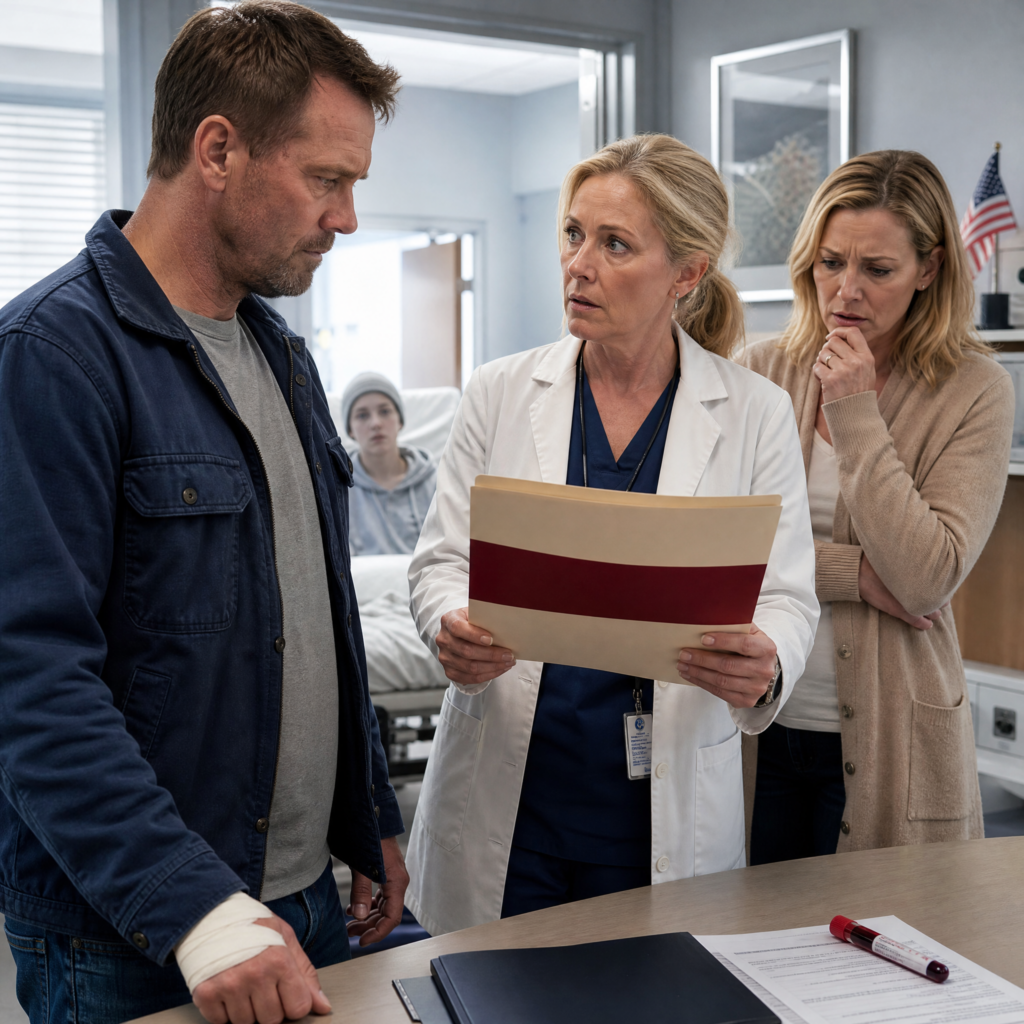
The oncologist looked at my blood test, asked for a second draw, then ran the results one more time. Across the hospital hallway, my ex-wife’s face went pale because she knew exactly what those numbers could reveal. I had come there to save my son from leukemia… but before anyone found a donor, the lie she built for three years had already started bleeding through the paperwork.
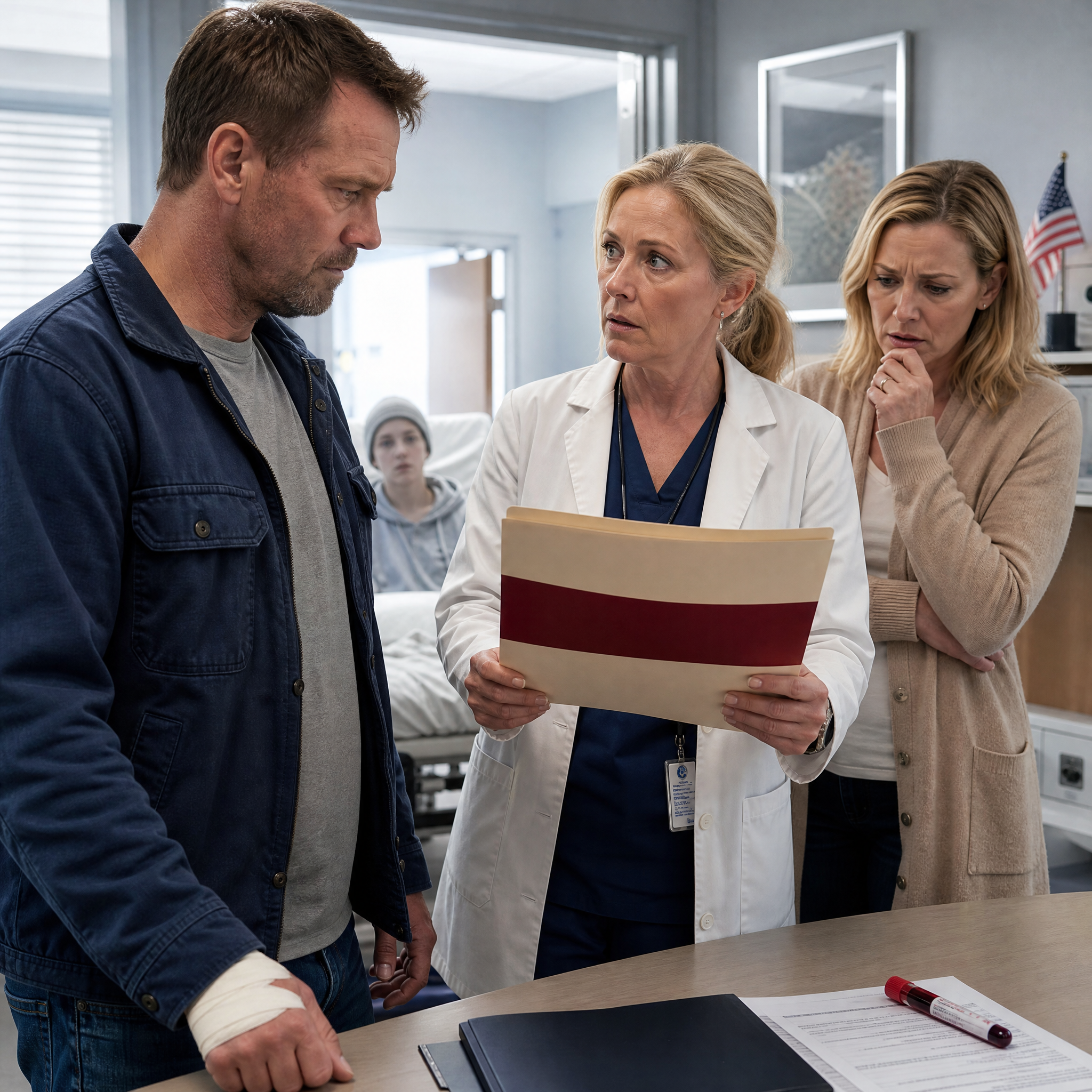
The oncologist read my blood test twice.
I watched her do it.
She stood on the other side of the glass wall in the transplant unit, her clipboard tucked close to her chest, staring at the report as if the numbers might rearrange themselves if she gave them another second. Then she turned to the nurse beside her and said something too quiet for me to hear.
A minute later, the nurse came back into the room with a fresh set of tubes.
“Mr. Keller,” she said gently, “Dr. Sorenson would like to draw one more sample, just to confirm.”
That was when I knew.
Not because I understood every marker on a transplant report. Not because I knew all the words doctors use when they are trying not to scare you.
I knew because my ex-wife, Marissa, was standing ten feet away in the hallway, white as the wall behind her.
My son Caleb was upstairs with leukemia in his blood and poison in his veins, waiting for a bone marrow donor who might not exist. I had come to that hospital because I was his father. Because fathers show up. Because when your child is running out of time, you do not stand around protecting secrets like they matter more than a life.
But Marissa knew what that second blood draw meant.
So did I.
When Dr. Sorenson finally asked to speak with me alone, she did it with the soft carefulness people use right before they change your life.
We sat in a small consultation room with a box of tissues on the table, two plastic chairs, and a muted television bolted high in the corner. Outside the door, carts rolled by. Nurses spoke in low voices. Somewhere down the hall, a monitor beeped steadily, like the hospital itself was counting seconds.
Dr. Sorenson folded her hands.
“Mr. Keller,” she said, “I need to talk to you about the test results.”
I could see the pity in her face. She thought she was about to tell me something that would break me.
So I saved her the trouble.
“I’m not his biological father,” I said. “That’s what the test shows, isn’t it?”
She went still.
“Yes,” she said after a moment. “That is what it shows. I’m very sorry.”
I looked down at my hands.
They were rough hands. Mechanic’s hands. Knuckles scarred from thirty years of engines, brake dust, winter air, and bolts that refused to move. They were not pretty hands. But they were the hands that had held Caleb the night he was born. They were the hands that had changed his diapers, tied his shoes, packed his lunch, checked his fever, fixed his bicycle, clapped from bleachers, and wiped tears off his face when he was still small enough to let me.
So I looked back at that doctor and said the six words that ended the lie.
“I know. They’re still my sons.”
Dr. Sorenson did not speak right away.
Whatever she had expected from me, it was not that.
I watched her face change. The sympathy was still there, but something else came in behind it. Understanding, maybe. Respect. She had thought she was sitting across from a man who had just discovered a betrayal. Instead, she was looking at a man who had known the truth for sixteen years and had still walked into that hospital willing to give marrow, blood, and anything else that could be taken from him if it meant his boy might live.
She leaned back slowly.
“They’re very lucky to have you,” she said.
I had not heard anything like that in three years.
For three years, I had been told I was unwanted.
For three years, I had been told my sons were ashamed of me.
For three years, I had been told to stay away, to let them move on, to accept that the boys I had raised no longer wanted my name, my calls, or my face in their lives.
And for three years, like a fool, I believed it.
I wish I could tell you I was smarter than that. I wish I could say I saw through Marissa’s lies right away, hired the best attorney in the county, and fought like hell.
But grief makes a man stupid.
Love does, too.
My name is Isaac Keller. I am forty-four years old, and I run a small auto repair shop outside Dayton, Ohio, in a low brick building with two service bays, a Pepsi machine that steals quarters, and a hand-painted sign my father made before he died.
Keller Auto Repair.
That sign has been there since I was nineteen.
I know brakes. I know engines. I know bad transmissions, bad starters, old pickup trucks that should have been retired ten years ago, and the look people get when you tell them the repair is going to cost more than they hoped.
I have never been rich. I have never owned a boat. I have never taken a vacation that required a passport. The nicest thing I ever bought new was a set of tires for Marissa’s SUV because she hated driving in snow.
But I had a good life once.
A small life, maybe.
But a good one.
I met Marissa when she was twenty-six and three months pregnant with twins.
Her car came in on the back of a tow truck on a Tuesday afternoon in late February. The driver said it had died outside a strip mall near the pharmacy. Marissa stood behind him in a gray coat that would not button right over her stomach, holding her purse with both hands like it was the last thing keeping her together.
I remember thinking she looked exhausted.
Not regular tired.
Not “long day at work” tired.
She looked like a person who had been carrying fear for so long her body had started to bend around it.
I told her we would take a look, and she nodded like she heard me from somewhere far away. Ten minutes later, I found her sitting in the waiting area under the calendar from the local credit union, crying silently into a napkin.
I asked if she wanted water.
That was all.
That was enough.
Sometimes people can hold themselves together in front of family, friends, bosses, and strangers in the grocery line. Then one ordinary kindness in the wrong moment knocks the door open.
Marissa started talking.
Not dramatically. Not all at once. Just in broken pieces.
She was pregnant.
Twins.
The man who got her pregnant had disappeared as soon as she told him. He had packed what little he owned, stopped answering calls, and left behind no forwarding address, no apology, no child support, not even the dignity of a hard conversation.
She was working the front desk at a dental office during the day and folding clothes at a department store three nights a week. She was behind on rent. Her mother was helping when she could, but her mother had her own bills. The car was the one thing she needed to keep both jobs, and now it was dead, too.
She kept apologizing for crying.
I kept telling her she did not have to.
I did not fall in love with her right there. Real life is not that tidy.
But something happened in me that afternoon.
I looked at that young woman in my shop, carrying two babies who had not asked for any of this, and I felt the shape of a decision before I had words for it.
The car needed a fuel pump.
She could not afford it.
I fixed it anyway.
I told her she could pay me later, and she looked at me like nobody had said later to her in a long time.
She came back two weeks after that with a plate of cookies wrapped in foil and twenty dollars in cash. She insisted I take it. I did. Then I asked if she wanted coffee.
Five months later, we got married at the county courthouse.
Marissa was eight months pregnant by then, round and uncomfortable and cranky in a way that made me love her more instead of less. She wore a blue maternity dress and white flats because heels were out of the question. My mother cried through the whole thing. The clerk who married us had a cough drop tucked in her cheek and a framed photo of her grandchildren on the desk.
When she asked if I took Marissa to be my wife, I said yes.
When I placed my hand on Marissa’s belly and felt one of the babies kick, I said yes again, silently, to both of them.
I knew they were not mine.
That matters.
I was never tricked. I was never confused. There was no later discovery, no hidden affair, no DNA test that tore open some truth I had not been ready to face.
I knew from the beginning.
Those boys were not biologically mine, and it did not matter.
When Caleb and Jonah were born six minutes apart, I was the first person to hold them.
Caleb came first, red-faced and furious, his tiny fists clenched like he had entered the world ready to argue. Jonah came second, quieter, blinking up at the delivery-room lights like he was deciding whether he approved of the place.
I cut both cords.
I counted fingers.
I held each one against my chest and whispered the same thing.
“Hey, buddy. I’m your dad.”
Not because blood said so.
Not because the law said so.
Because I did.
Fatherhood, I learned that day, is not always something that happens to you. Sometimes it is something you choose before anyone can ask it of you. Then you keep choosing it. When the baby has colic. When the toddler throws cereal across the kitchen. When the school calls. When the braces cost more than expected. When the teenager rolls his eyes. When your heart is tired and no one thanks you for staying.
I stayed.
For fifteen years, I stayed.
I taught Caleb how to ride a bike in the cracked parking lot behind my shop. He kept yelling, “Don’t let go,” and I kept lying, “I’m right here,” even after I had already released the seat. When he realized he was riding on his own, he laughed so hard he crashed into a stack of old tires.
Jonah was left-handed. I am not. Teaching him to throw a baseball was like trying to write backward in a mirror, but we figured it out. He had a funny little sidearm throw at first, and I spent whole evenings crouched in the backyard, catching balls until the porch light came on and Marissa called us in for dinner.
I coached Little League for four summers.
We never won a championship. Not even close. But I kept the cooler full of sports drinks, learned every kid’s name, and told them to shake hands whether they lost by one run or twenty.
I went to parent-teacher conferences with grease still under my fingernails.
I sat through school concerts where one hundred fifth graders played recorders badly enough to test a man’s faith.
I built a pinewood derby car with Jonah that looked fast and absolutely was not.
I helped Caleb make a volcano for science class, and we used too much baking soda, and red foam ran off the kitchen table onto the floor while Marissa stood there with a dish towel over her shoulder, trying not to laugh.
Those were ordinary years.
That is the part that hurts most.
People think betrayal announces itself with slamming doors and screaming matches. Sometimes it doesn’t. Sometimes betrayal comes after years of grocery lists, mortgage payments, church picnics, dentist appointments, and birthday candles. It grows quietly under the same roof where you keep the baby pictures.
For a long time, Marissa and I were happy.
At least, I thought we were.
We lived in a small ranch house with white gutters, a maple tree in the front yard, and a mailbox that leaned no matter how many times I fixed it. The boys shared a room until they were twelve and argued over whose side smelled worse. We had neighbors who waved from driveways. We ordered pizza on Fridays. We went to my mother’s for Thanksgiving, where everyone pretended to like her cranberry salad.
It was not fancy.
It was ours.
But somewhere around the boys’ middle-school years, Marissa started wanting a life that did not fit inside ours anymore.
She got a new job at a medical billing company in the city. She started dressing differently. Not badly. Just sharper. Blouses that needed dry cleaning. Shoes that clicked against the kitchen floor. She made new friends, people who talked about lake weekends, kitchen remodels, and which private high school was worth the tuition.
At first, I was proud of her.
She had worked hard. She deserved to feel good about herself. I told her that.
But slowly, I began to notice the way she looked at our house.
At my shop.
At me.
Not with anger.
Worse.
With embarrassment.
If one of her coworkers called while she was in the kitchen, her voice changed. She would step into the laundry room and close the door. When the shop had a slow month, she sighed over the bills like I had personally failed her. She stopped inviting me to work events. When I asked, she said, “You’d hate it anyway.”
Maybe I would have.
But I would have gone.
That is marriage, or at least I thought it was. You go to things you hate because the person you love wants you there.
Then came Ryan.
She said his name casually at first. Ryan from accounting. Ryan who knew a good contractor. Ryan who got everyone tickets to a charity gala downtown.
I never found proof of an affair before the divorce. Maybe it started before. Maybe it didn’t. I have stopped needing that answer. Sometimes the exact date of a betrayal matters less than the fact that somewhere along the line, your spouse began building a future without you and forgot to mention it.
One night after dinner, while the boys were downstairs playing video games, Marissa sat across from me at the kitchen table and said she wanted a divorce.
She said it calmly.
That almost made it worse.
I remember the refrigerator humming. I remember a stack of unpaid bills near her elbow. I remember Caleb laughing at something in the basement, the sound coming up through the vent.
I asked if there was someone else.
She looked away.
That was answer enough.
I did not beg.
I wanted to, but I didn’t.
I told her I loved her. I told her I thought our family was worth saving. I suggested counseling. She said she had already made up her mind.
“There’s no need to make this ugly,” she said.
People say that when they are already holding the knife.
I believed we would share custody. I believed we would be decent for the boys. I believed that whatever had happened between Marissa and me, we both loved Caleb and Jonah enough not to use them as weapons.
That was my mistake.
Marissa did not want shared custody.
She wanted full custody.
She wanted the house.
She wanted the boys in her new life, cleanly separated from the old one. And in that new life, there was no room for a mechanic ex-husband who smelled like motor oil and still drove the same truck he had owned for twelve years.
Her lawyer sent papers.
My lawyer, a tired man named Mr. Danvers who worked above a tax office, told me we could fight it.
“We have a strong case,” he said. “You raised them. You’re on the birth certificates. You’ve been their father from day one.”
He was right.
On paper, I had rights.
But Marissa had something stronger than paperwork.
She had the secret.
She knew I would do almost anything to keep Caleb and Jonah from learning, in the middle of a custody war, that I was not their biological father. Not because I was ashamed. Because I was afraid they would be hurt. I was afraid two fourteen-year-old boys would hear “not your real dad” from the wrong mouth, in the wrong room, and feel their whole childhood tilt under them.
I had spent their entire lives making sure they felt wanted.
I could not bear the thought of them hearing the truth as an accusation.
Marissa understood that.
One evening, after a meeting with the lawyers, she caught me in the parking lot. It was raining, and she stood under a black umbrella, looking neat and untouched while I got soaked.
“You can fight me,” she said. “But if this gets ugly, things will come out. The boys are old enough to understand.”
She did not have to say more.
I stared at her.
“You’d tell them like that?” I asked.
Her face tightened.
“I’m saying divorce brings things up.”
No.
She was saying she knew where to press.
And she pressed.
So I did the thing I have regretted more than anything in my life.
I backed down.
I told myself I was protecting the boys. I told myself I would still see them. I told myself that once the divorce settled, emotions would calm, and we could work out weekends, holidays, ball games, birthdays.
A man can talk himself into almost anything when he believes the sacrifice is for his children.
The divorce became final in September.
Marissa got primary custody.
I got scheduled visitation.
On paper.
Two weeks later, she sent me the text that hollowed me out.
The boys have talked about it. They don’t want to see you right now. They’re ashamed you’re their father. Please respect their wishes. It’s better for everyone if you let them go.
I read it sitting in my truck outside the shop.
It was late. The bays were closed. The vending machine inside buzzed through the wall. Rain tapped the windshield.
They’re ashamed you’re their father.
I read that line again and again until the words stopped looking like English.
I did not throw the phone.
I did not call her screaming.
I sat there with both hands on the steering wheel and stared through the windshield at the dark shop window, where my own reflection looked like somebody I used to know.
I believed her.
That is the hardest thing to admit.
I believed that Caleb and Jonah had chosen not to see me. I believed they were embarrassed by me. I believed fifteen years of packed lunches, bedtime stories, bike rides, ball games, emergency-room visits, bad jokes, and Christmas mornings had somehow weighed less than whatever Marissa had told them.
I was already broken enough to believe the worst.
So I stopped pushing.
At first, I called.
No answer.
I texted.
No reply.
I drove by the house twice and sat at the curb like a thief, too ashamed to walk to the door. Once, I saw the living-room curtains move. Nobody came out.
After a while, I told myself I was respecting their wishes.
I was not.
I was disappearing.
There is a difference.
For three years, I lived a smaller life than I knew a man could live.
I went to work. I fixed cars. I paid bills. I ate dinner standing over the sink more often than not. My mother invited me over on Sundays, and I went when I could not think of a good excuse, but I hated the pity in her eyes.
She asked about the boys until I asked her not to.
Their birthdays were the worst.
Caleb and Jonah were born on April 12. Every year, I bought two cards. I never mailed them. I wrote in them anyway.
Caleb, I hope you’re still drawing cars in the margins of your notebooks.
Jonah, I hope you’re still throwing left-handed.
I kept the cards in the top drawer of my desk at the shop, under invoices and old registration forms.
Once, about a year into the silence, I saw Jonah outside the hardware store.
He was taller. That was the first thing I noticed. Taller and thinner, wearing a hoodie and standing with three boys near the garden-center entrance. He turned, and for one second his eyes met mine across the parking lot.
My heart did something painful.
I lifted my hand.
Barely.
He looked away.
Not dramatically. Not cruelly. Just turned back to his friends like I was nobody.
I got into my truck and closed the door. Then I sat there until the automatic lights in the parking lot came on.
I thought that was proof.
Now I know it was not.
Now I know Jonah had been told a different lie. He had been told I left because I did not want them. He had been told I stopped calling. He had been told my silence was my choice.
That day in the parking lot, he was not rejecting me.
He was a fifteen-year-old boy seeing the father he thought had abandoned him and not knowing whether to be angry, ashamed, or hopeful.
But I did not know that then.
Then I only knew my son had looked away.
Three years passed like that.
Then Dana called.
Dana was Marissa’s younger sister, the only person in her family who had ever treated me like I was more than a temporary inconvenience. She had a loud laugh, a bad habit of saying exactly what she thought, and a soft spot for the boys that even Marissa could not manage to control.
I was replacing a water pump on a Chevy Silverado when my phone rang.
Unknown number.
I almost let it go.
I wiped my hand on a rag and answered.
“Isaac?”
I knew her voice immediately, though I had not heard it since the divorce.
“Dana?”
She was crying.
“I’m sorry,” she said. “I know I’m not supposed to call you, but I can’t not call you. It’s Caleb.”
Everything in me went quiet.
“What happened?”
“He has leukemia,” she said. “He’s really sick. They need a donor.”
I leaned against the truck because my knees were suddenly unreliable.
Leukemia.
The word did not fit with Caleb.
Caleb was supposed to be sixteen and annoyed by homework. He was supposed to be learning to drive, sleeping too late, eating everything in the refrigerator, and pretending he was too old to hug his father.
Not leukemia.
Dana told me what she knew in a rush. He had been diagnosed almost a year earlier. Acute lymphoblastic leukemia. He had gone through chemo. It worked at first. He reached remission. Everyone had hoped.
Then it came back.
Relapse.
That word changes everything.
The doctors wanted to do a bone marrow transplant, technically a stem cell transplant. First, they had to knock the leukemia down again. Then they would have a narrow window when Caleb’s body was ready, the disease quiet enough, the timing right.
But they needed a donor.
Jonah had been tested. He was not a match.
That surprised me until a transplant coordinator later explained it. Caleb and Jonah were fraternal twins, not identical. Genetically, they were like any other siblings. A brother or sister has the best odds, but even then, it is not guaranteed.
The registry had not found anyone close enough yet.
Time was running.
“Marissa didn’t want me to call you,” Dana said.
I believed that.
“She said it would upset everyone. But Isaac, I don’t care anymore. He’s your son. You should know.”
I was already reaching for my keys.
“I’m coming.”
Dana exhaled like she had been holding her breath for three years.
“You understand they may test you?”
“Yes.”
“And Isaac…”
She stopped.
I knew what she was trying to say.
“I know,” I said.
There was a long silence.
Then Dana whispered, “I’m sorry.”
I hung up, told my guys to close the shop, and drove to the hospital.
On the way, I understood exactly what I was doing.
I was not Caleb’s biological father. A transplant test would make that obvious to anyone trained to read it. Parent and child share certain genetic markers. A biological father is always at least a partial match in the basic structure, even if he is not close enough to donate.
I would not be.
Testing me would not simply rule me out as a donor.
It would expose the secret I had spent sixteen years protecting.
The secret I had surrendered custody to keep.
The secret Marissa had used to cut me out of my sons’ lives.
And still, I drove faster.
Because Caleb needed a donor.
Because I had marrow.
Because fatherhood is not a feeling you carry when it is convenient. It is what you do when the cost is high and nobody claps for you.
The children’s hospital sat near downtown, all glass and pale brick, with a valet stand out front and a row of tired parents standing near the parking garage with coffee cups, phone chargers, and the blank look of people living between updates. I parked crooked on the third level and ran.
Marissa was in the transplant-floor hallway when I came out of the elevator.
For a moment, neither of us moved.
She looked different. Thinner. More polished and more worn at the same time. Her hair was pulled back, and she wore a cream sweater I did not recognize. Her face changed the second she saw me.
Fear first.
Then anger.
She walked toward me quickly.
“What are you doing here?” she whispered.
“Our son needs a donor.”
Her mouth tightened.
“You can’t do this.”
“I can get tested.”
“Isaac, stop.”
“No.”
She glanced toward the nurses’ station, then lowered her voice even more.
“You don’t understand what this could do.”
I did not laugh, but something close to it moved through me. Not because anything was funny. Because after all these years, she still thought the most dangerous thing in that hospital was the truth.
I looked at her and said, “Caleb is sick. That’s what matters. Not you. Not me. Not what comes out. Caleb.”
For the first time in years, Marissa had nothing ready to say.
A nurse at the desk looked up.
“Can I help you?”
I turned away from my ex-wife.
“I’m Isaac Keller,” I said. “I’m Caleb Keller’s father. I’m here to be tested as a donor.”
Marissa closed her eyes.
Just for a second.
But I saw it.
They took me back to a small room with a vinyl chair, a sharps container on the wall, and a poster about handwashing. A nurse drew blood. She asked standard questions. Medical history. Medications. Travel. Illness.
I answered all of them.
Then I waited.
Hospitals make time feel cruel.
Minutes stretch. Hours disappear. You sit in hard chairs under fluorescent lights and watch families pass with coffee cups, blankets, balloons, bad news, good news, and the stunned look of people whose lives have been divided into before and after.
I thought about Caleb upstairs.
I wondered if he knew I was there.
I wondered if he wanted me gone.
That old text from Marissa still lived somewhere inside me like a splinter.
They’re ashamed you’re their father.
Even with Caleb sick, even after Dana’s call, I could not fully shake it.
Then Dr. Sorenson came.
She was in her fifties, with silver threaded through dark hair and the kind of calm that did not feel fake. She introduced herself as Caleb’s oncologist. Her handshake was firm but warm.
“Thank you for coming in,” she said.
“Of course.”
She explained tissue typing, donor matching, and the urgency of Caleb’s situation. She did not talk down to me, and I appreciated that. She told me the first test would come back quickly enough to see whether I was worth further evaluation.
Then she left.
When she returned the first time, she did not bring results.
She brought the nurse.
That was when they drew my blood again.
The second time, Dr. Sorenson herself came to the door.
“Mr. Keller,” she said, “could we speak privately?”
And there it was.
The consultation room.
The tissues.
The muted television.
The pity.
I told her I already knew.
But that was not the end.
In some ways, it was the beginning.
Because once the truth entered that hospital, it could no longer be shaped by Marissa’s fear.
Doctors do not care about family pride when a child needs a donor. They care about biology, records, possibilities, names, timelines, and whether someone can be found before the window closes.
Dr. Sorenson asked careful questions.
Was I aware I was not Caleb’s biological father?
Yes.
Had Caleb and Jonah been adopted by me formally?
No, though I was listed as father on their birth certificates and had raised them since birth.
Was their biological father known?
I looked at Marissa through the glass wall of that small room.
“That’s a question for their mother,” I said.
A meeting happened later that afternoon.
Not dramatic. Not loud.
Just a conference room, a medical team, Marissa, me, and facts laid gently but firmly on the table.
Marissa sat with her arms folded, staring at the polished surface.
The transplant coordinator asked for the biological father’s name.
Marissa hesitated.
Dr. Sorenson waited.
There is a kind of silence professional women use that is more powerful than shouting. Dr. Sorenson had it. She did not accuse. She did not soften the importance.
She simply waited, pen ready.
Finally, Marissa gave the name.
Derek Ames.
I had heard it once, sixteen years earlier, in my shop waiting room, when Marissa was pregnant and crying into a napkin. The man who had vanished. The man who had left two unborn sons behind like an unpaid bill.
“Do you know where he is?” the coordinator asked.
“No,” Marissa said.
“When was your last contact?”
“Before the twins were born.”
“Any family? Parents? Siblings?”
Marissa swallowed.
“I might know where his mother used to live.”
“Used to live” was not much.
But it was more than nothing.
The team wrote everything down. They asked about old addresses, possible relatives, social media, public records. They talked about emergency searches and registry updates. They talked about cord blood and alternative donor options. They talked about Caleb’s remission window like it was a door already starting to swing shut.
And in the middle of all that, Marissa’s story died.
Not with yelling.
Not with a courtroom confession.
With medical paperwork.
With a doctor saying, “Mr. Keller is not a biological match, but he has been Caleb’s legal and functional father since birth.”
Functional father.
It was such a clinical phrase.
And yet it was the truest thing anyone had said about me in years.
Marissa had told people I was someone to be ashamed of.
But in that room, the facts sat between us like witnesses.
I had married her when she was pregnant with another man’s children.
I had raised those boys.
I had kept her secret.
I had lost them rather than expose it.
And when Caleb got sick, I came running.
There is no way to make that shameful.
She tried to keep her face blank, but I saw the moment she understood. The truth had not destroyed me. It had revealed me.
That is what destroyed her.
Not because everyone hated her. Not because she was dragged into some public punishment. Real life rarely gives you that kind of clean satisfaction.
It destroyed the version of events she had built to survive her own choices.
The nurses knew. The doctors knew. Dana knew. Soon the boys would know.
Most of all, Marissa knew.
The lie could still be spoken, maybe, but it could no longer stand.
I saw Caleb two days later.
Dr. Sorenson said he wanted to see me.
I stood outside his room for almost a full minute before I could make myself go in.
There are things no parent should have to see.
Your child pale under hospital blankets.
Your child’s hair gone.
Your child’s body smaller than it should be.
Your child attached to tubes, monitors, pumps, and bags with labels you are afraid to read.
Caleb was fifteen, but sickness had made him look both younger and older. His face was thinner. His eyes were too large. A blue knit cap sat on his head, though the room was warm. There was a half-finished cup of ice chips on the bedside table and a stack of get-well cards taped to the wall.
He turned when I came in.
For one second, we just looked at each other.
The last time I had seen him up close, he had been fourteen, angry about something I no longer remembered, slamming a car door too hard in our driveway. Now he was in a hospital bed fighting for his life.
His chin started to tremble.
“Dad?”
I crossed the room.
I did not think. I did not ask if it was okay. I went to him, careful of the tubes, and put my arms around my son.
He grabbed the back of my shirt with both fists.
Not weakly.
Desperately.
And he cried into my chest.
I had spent three years believing my sons were ashamed of me. Three years believing all that love had been erased. But Caleb held on like a drowning boy who had found the dock.
“I thought you left,” he whispered.
I closed my eyes.
“No, buddy.”
His fingers tightened.
“Mom said you left.”
“I know.”
“She said you didn’t want us anymore.”
I wanted to hate her in that moment.
I really did.
But my son was in my arms, sick and shaking, and hatred would have taken up room he needed.
So I said the only thing that mattered.
“I never stopped wanting you. Not for one day.”
He cried harder.
So did I.
There are reunions people clap for in movies, the airport kind, the wedding kind, the soldier-coming-home kind. Ours was quieter. A sickroom. A plastic chair. A father bent over a hospital bed while machines kept rhythm beside us.
But to me, it felt like the world had been handed back.
Jonah came later that evening.
He stood in the doorway with his hands shoved into the pocket of his hoodie. He had grown taller than me. That annoyed me and broke my heart at the same time.
He looked from Caleb to me.
Then he said, “Is it true?”
Nobody asked what he meant.
Caleb wiped his face.
I stood up.
Jonah’s eyes were red, but he looked angry enough to hold himself together.
“Is it true you knew?” he asked. “About us?”
I nodded.
“Yeah.”
“Always?”
“From before you were born.”
His mouth twisted.
“And you still…”
He could not finish.
“I still loved you,” I said. “I still raised you. I still meant it every time I called you my sons.”
Jonah looked down.
His shoulders shook once.
Then he crossed the room and hit me in the chest with both arms, the way teenage boys hug when they are too big for it and need it too badly to care.
I held him with one arm and Caleb with the other as best I could.
For a few minutes, I had both my sons again.
That was the first miracle.
The second came from a stranger.
My test did not help Caleb. I was not a match. No surprise there.
The search for Derek Ames became urgent, but the man was hard to find. The address Marissa had for his mother led to an apartment where someone else had lived for seven years. Dana searched online. The hospital’s transplant team followed what leads they could. A social worker helped. Marissa made calls I could tell she hated making.
But Derek had spent sixteen years being gone, and he remained good at it.
The registry kept searching.
Every day, Caleb’s blood counts were checked. Every day, the doctors weighed options. Every day, I learned new fears.
I learned that remission could be fragile.
I learned that transplant preparation could be brutal.
I learned that parents in hospital hallways recognize each other without speaking.
I learned the sound of Marissa crying quietly in a family bathroom and how complicated pity can feel when you are still angry.
I stayed.
At first, I slept in chairs.
Then the nurses started bringing me blankets without asking.
I went to the shop in the mornings when I had to, then came back to the hospital. My two mechanics, Luis and Ray, kept the place running. Luis left sandwiches in the office fridge with my name written on the bag. Ray covered oil changes and lied to customers about why I was unavailable.
“Family emergency,” he told them.
That was true enough.
Caleb and I relearned each other in small pieces.
He told me about school. About how he liked biology before biology turned against him. About how he used to wonder if I drove past the house.
I told him I did.
He cried when I admitted it.
Jonah came to the shop on days when Caleb slept through treatment. The first time, he wandered around like a ghost of his younger self, touching the old tool chest, the soda machine, the dent in the office door from when he and Caleb had thrown a rubber ball indoors after being told not to.
“I thought you sold this place,” he said.
“Nope.”
“Mom said you might move.”
“I didn’t.”
He looked at me then, and I saw another piece of the lie break.
She had told each of us just enough to keep us apart.
To me, she said the boys were ashamed.
To them, she said I had chosen to leave.
Then she let silence do the rest.
That kind of lie is not loud. It is worse. It is architectural. It builds walls where doors used to be.
One Thursday afternoon, Jonah came into my office while I was sorting invoices and placed something on my desk.
It was a birthday card.
Still sealed.
My handwriting on the envelope.
I stared at it.
“How did you get this?”
He sat across from me.
“I found a box in Mom’s closet.”
My stomach turned.
He put another card down.
And another.
Six cards total.
Three birthdays.
Two boys.
All unopened.
“I thought you never sent anything,” Jonah said.
I could not speak for a moment.
“I didn’t think they’d reach you.”
“But you tried.”
I looked at the cards.
“I wrote them.”
He nodded, and his face changed in a way I will never forget. Not relief exactly. More like grief finding evidence it had been lied to.
“I hated you sometimes,” he said.
The words hurt, but I was glad he said them.
“You had reason to.”
“No,” he said quickly. “I didn’t.”
“You had the story you were given.”
He wiped his nose on his sleeve like he was eight instead of fifteen.
“I should’ve known.”
“You were a kid.”
“So were we just stupid?”
“No,” I said. “You were hurt. Hurt kids believe the adult who is still in the house.”
He looked toward the shop floor, where Ray was laughing at something Luis had said.
“Caleb asked if you would’ve come if Dana didn’t call.”
“Yes.”
“He knows that now.”
“I wish I’d known sooner.”
“Me too.”
That was all.
Sometimes the biggest repairs happen with very few words.
Then, two weeks after I walked into the hospital, Dr. Sorenson found us in Caleb’s room with news.
They had a match.
Not Derek.
Not anyone related.
A man on the national registry. Thirty-two years old. Somewhere in Oregon. He had joined years earlier during a college donor drive and barely remembered doing the cheek swab. When the registry contacted him, he said yes.
Just yes.
I had to sit down.
Caleb stared at Dr. Sorenson.
“So some random guy can save me?”
Dr. Sorenson smiled gently.
“That’s what we’re hoping.”
Caleb looked at me.
His eyes filled.
I put my hand on his shoulder.
“Sounds like a pretty good guy.”
He nodded.
“Yeah.”
The transplant process was not quick and it was not pretty.
First came more chemo. Stronger chemo. The kind meant to wipe out what was left of Caleb’s diseased marrow and make room for the donor cells. The doctors explained everything. They were honest but careful. Caleb listened like a boy trying to be brave enough for everyone else.
The transplant itself looked almost too simple.
A bag of cells.
An IV line.
No dramatic surgery. No operating room.
Just a quiet infusion in a hospital room while nurses watched closely and I sat beside the bed holding Caleb’s hand.
“This is it?” Jonah whispered.
“This is it,” Dr. Sorenson said.
Marissa stood on the other side of the bed.
For once, neither of us looked away from the same thing.
The donor’s cells entered Caleb’s body slowly, drop by drop.
A stranger’s gift.
A stranger’s choice.
I thought about that man in Oregon. I did not know his name. I did not know if he had a wife, kids, a dog, a messy apartment, student loans, a favorite diner, a mother who worried too much. I only knew that somewhere, a man who owed us nothing had said yes.
My son was alive because someone chose to show up.
That truth settled deep in me.
Blood had failed in every direction that mattered.
The biological father was gone.
The legal father was not a match.
The twin brother was not a match.
Then a stranger’s cells crossed a country and gave Caleb a chance.
The weeks after transplant were some of the hardest of my life.
Caleb had no immune system. Not really. Every visitor washed hands until skin cracked. Everyone wore masks. Fresh flowers were not allowed. Certain foods were banned. A fever could become an emergency. A cough could empty the room of color.
We lived by numbers.
White blood cells.
Platelets.
Hemoglobin.
Counts rising.
Counts falling.
Counts not moving when we prayed they would.
Some days, Caleb was almost himself. He joked with the nurses. He watched old car restoration videos with me on my phone. He complained about hospital food with the passion of an old man at a diner.
Other days, he barely spoke.
On those days, I sat in the chair by his bed and did what I had done when he was a baby with colic.
I stayed.
One night around two in the morning, he woke up sick and scared. The room was dim except for the blue light of the monitor. Marissa had gone home to shower. Jonah was asleep in the family lounge, curled awkwardly across two chairs.
Caleb turned his head toward me but did not open his eyes.
“Dad?”
“I’m here, bud.”
He swallowed.
“You’re not leaving?”
“No.”
“Even if it gets bad?”
I leaned forward.
“Especially if it gets bad.”
His breathing slowed.
A few minutes later, he fell back asleep.
I sat there in the dark, listening to the machines, and thought about those four hours when he and Jonah were newborns and screaming in our little living room. Marissa had been exhausted beyond words. I had taken one baby in each arm and walked circles until my legs ached. Around four in the morning, they both fell asleep on my chest, and I stood still because I was afraid to wake them.
That was the night fatherhood stopped being a decision and became my life.
Fifteen years later, in another dark room, Caleb said Dad, and meant me.
No blood test could touch that.
Marissa apologized near the end of Caleb’s hospital stay.
I was in the corridor near the vending machines, trying to decide between terrible coffee and worse coffee, when she came up beside me.
For a while, she said nothing.
Then she said, “Isaac.”
I turned.
She looked older than she had a month earlier. Not in her skin exactly. In the way she carried herself. Shame has weight when it finally lands.
“I’m sorry,” she said.
I waited.
She pressed her lips together.
“I told myself I was doing what was best for them.”
I looked at her.
“By telling them I left?”
Her eyes filled.
“I know.”
“By telling me they were ashamed of me?”
She looked down.
“I know.”
The vending machine hummed between us.
“I can’t explain it in a way that makes it right,” she said. “I wanted a clean life. I wanted to move on. I thought if you were still there, everything would be complicated forever.”
“They are your children,” I said. “They were always going to be complicated.”
A tear slipped down her face.
“When you showed up to get tested,” she said, “I realized what I had done.”
I did not say it was okay.
Because it was not.
I did not forgive her in that hallway, not in the way people mean when they want a neat ending tied with ribbon.
But I did understand something.
If I let hatred become the center of my life, Marissa would still be controlling the shape of my family. She had used silence to hurt us. I would not use bitterness to finish the job.
So I said, “The boys need both of us to stop lying.”
She nodded.
“They need you to let them love me,” I said. “And I’ll let them love you.”
She covered her mouth.
“I don’t deserve that.”
“This isn’t about what you deserve.”
That was the most honest thing I could have said.
It was never about Marissa.
It was about Caleb and Jonah.
It had always been about them.
Caleb came home in stages. Hospital first, then outpatient appointments, then careful weeks where every sniffle made us all tense. His recovery was slow. There were setbacks. There were scares. There were nights when I woke up and checked my phone just to make sure I had not missed a call.
But the donor cells took hold.
His new marrow began doing what marrow is supposed to do.
His counts rose.
Color came back into his face.
Fuzz grew on his head, soft as baby hair.
The first time he laughed hard enough to cough, everyone in the room froze, then laughed too.
By spring, he was strong enough to come by the shop.
He walked through the bay doors wearing a mask, a hoodie, and the grin of a boy who had spent too long being treated like glass.
Luis nearly cried and pretended he had gotten dust in his eye.
Ray gave him a clipboard and said, “You’re late for your shift.”
Caleb rolled his eyes.
“I almost died, Ray.”
Ray shrugged.
“Still not an excuse in this economy.”
Caleb laughed.
That laugh did more for me than any doctor’s report.
We went back to court in June.
Not for war.
For repair.
Marissa and I agreed to shared custody. Real custody. Legal, written, signed. The kind we should have had from the beginning. The judge looked over the agreement, asked the boys a few questions privately, and approved it.
Outside the courthouse, Jonah stood between us in the sunlight, taller than both his parents now, holding a paper cup of lemonade from a food truck.
“So what now?” he asked.
I looked at Marissa.
She looked at me.
“Now,” I said, “we do better.”
That was not a dramatic line.
It was a promise.
My house has their things in it again.
That may not sound like much unless you have lived in a house after your children are gone.
There are shoes by the door.
Hoodies on chairs.
Empty cereal boxes put back in the pantry by criminals who know exactly what they are doing.
Jonah’s baseball glove sits on the bench in the mudroom. Caleb leaves water glasses everywhere. The bathroom smells like teenage-boy shampoo. The laundry has become ridiculous.
It is beautiful.
Every bit of it.
Last month, Caleb asked me to teach him to drive.
I kept my face calm, like this was a normal request, like my heart had not just cracked open in the middle of the kitchen.
“Sure,” I said. “Saturday morning?”
He nodded.
We went to the parking lot behind my shop, the same one where I taught him to ride a bike. The asphalt still had the same cracks. The old tire stack was gone. The maple at the edge of the lot had gotten bigger.
Caleb sat in the driver’s seat of my truck, thin hands on the wheel, concentrating like he was piloting a plane.
“Brake,” I said.
“I am braking.”
“Brake more.”
“You’re nervous.”
“I am not nervous.”
“Dad.”
“Fine. I’m a little nervous.”
He smiled.
He drove careful circles around the lot. Too slow. Too stiff. Perfect.
At one point, he stopped near the back fence and looked over at me.
“Do you ever wish you didn’t know?” he asked.
I knew what he meant.
About the biology.
About the truth.
About the years we lost because of it.
“No,” I said.
He looked down at the steering wheel.
“Does it feel different now?”
“What?”
“Being my dad.”
I reached over and tapped his chest lightly with two fingers.
“Caleb, I was your dad when you were two minutes old. I was your dad when you threw up in my truck after the county fair. I was your dad when you broke your arm falling out of that tree I told you not to climb. I was your dad when we weren’t speaking. I was your dad in that hospital. I’m your dad right now.”
His eyes shone.
“The only thing that changed,” I said, “is now you know I chose it.”
He wiped his face quickly and pretended he hadn’t.
Then he put the truck in drive and nearly hit the curb.
So fatherhood continued.
Not in some perfect, shining way.
In the ordinary way.
Which is the best way.
There are still hard days. Caleb still has follow-ups. Every appointment brings a little fear with it. Jonah still gets angry sometimes about the lost years. Caleb does too. They love their mother, but their love is more complicated now. I do not interfere with that. I do not feed it. I do not clean it up for her either.
That is between them.
When they ask me hard questions, I answer carefully.
I do not lie.
I also do not punish them with the truth.
There is a difference.
Marissa and I communicate mostly by text now. Schedules. Appointments. School forms. Medication reminders. Who has which weekend. She is trying, in her way. Maybe guilt is part of it. Maybe love is. Most things in families are mixed.
I have stopped needing her to become the villain every time I tell the story.
She did wrong.
Deeply wrong.
But she is still their mother.
And I know what happens when one parent tries to turn a child against the other. I lived inside the damage. I will not become another version of it.
Sometimes people ask, when they hear pieces of what happened, whether I regret keeping the secret so long.
Yes.
And no.
I regret letting fear make decisions that love should have made.
I regret believing the truth would wound the boys more than lies would.
I regret underestimating them.
But I do not regret choosing them.
Never that.
For years, I thought the truth was: I am not their real father.
That was never the truth.
The truth was: two boys came into the world with one man already gone, and another man standing there with his arms open.
The truth was: I knew everything and stayed.
The truth was: they were wanted before they could earn it, before they could understand it, before they could even open their eyes.
That kind of truth does not destroy a child.
It gives him ground to stand on.
The donor who saved Caleb remains anonymous for now. Maybe someday, if both sides agree, we will know his name. Caleb talks about writing him a letter. He has started and stopped three times.
“What do you even say?” he asked me once.
We were at the kitchen table. His homework was pushed aside. Jonah was in the living room yelling at a basketball game on TV.
I thought about it.
“You say thank you,” I told him. “Then you live a life that makes it mean something.”
Caleb nodded.
He wrote that down.
I do not know what kind of man Caleb will become. I do not know what kind of man Jonah will become either. But I know they have learned something most people do not learn so young.
Blood matters in hospitals.
It matters in tests, charts, markers, and matches.
But love is built somewhere else.
Love is built in waiting rooms, parking lots, kitchens, courtrooms, and dark hospital rooms at two in the morning. It is built by the person who comes back. The person who stays. The person who tells the truth when lying would be easier. The person who signs up, eyes open, knowing it may cost him everything.
My son survived because a stranger chose to help him.
My sons came back to me because the truth finally outran a lie.
And I became their father not because of blood, but because sixteen years ago, in a county courthouse with a pregnant woman beside me and two unborn boys kicking beneath my hand, I made a promise.
I kept it when it was easy.
I kept it when it cost me my family.
I kept it when they hated me for reasons they did not understand.
I kept it when a doctor looked at my blood test and thought she was about to break my heart.
She couldn’t.
That heart had belonged to Caleb and Jonah from the first moment I held them.
It still does.
