
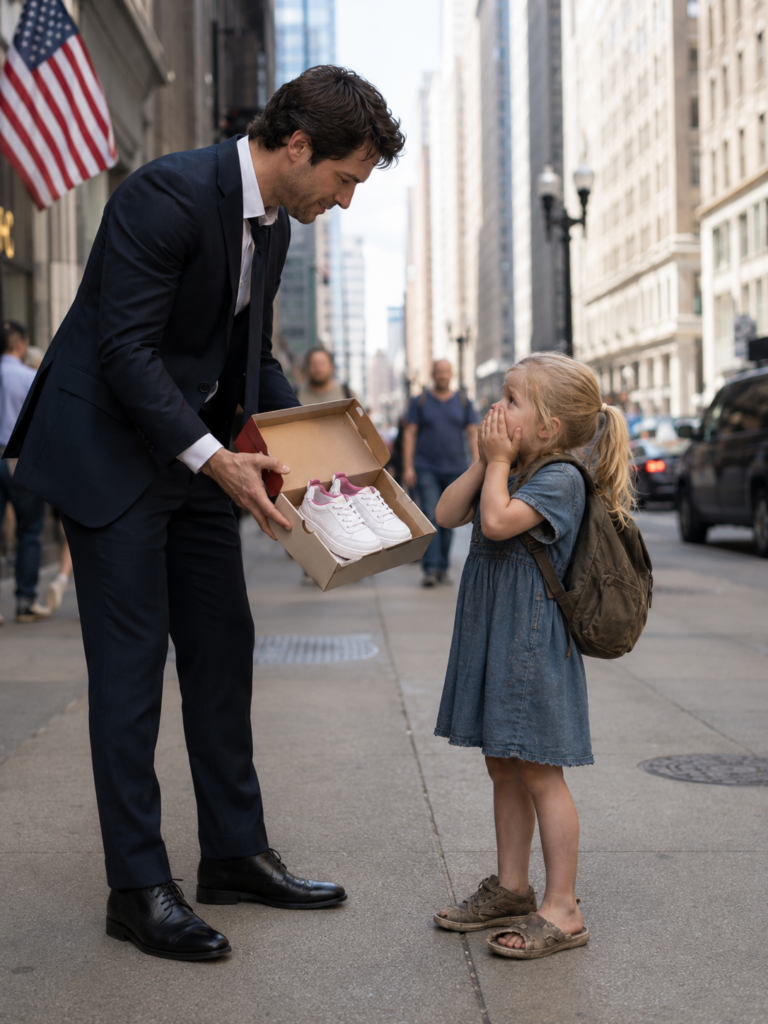
A little girl stopped me on a busy city sidewalk and asked for a pair of school shoes. The shoes cost me just $45. What I didn’t know was that her desperate promise to repay me one day would lead me to a dying secret, a struggling mother, and a truth powerful enough to change my life forever.
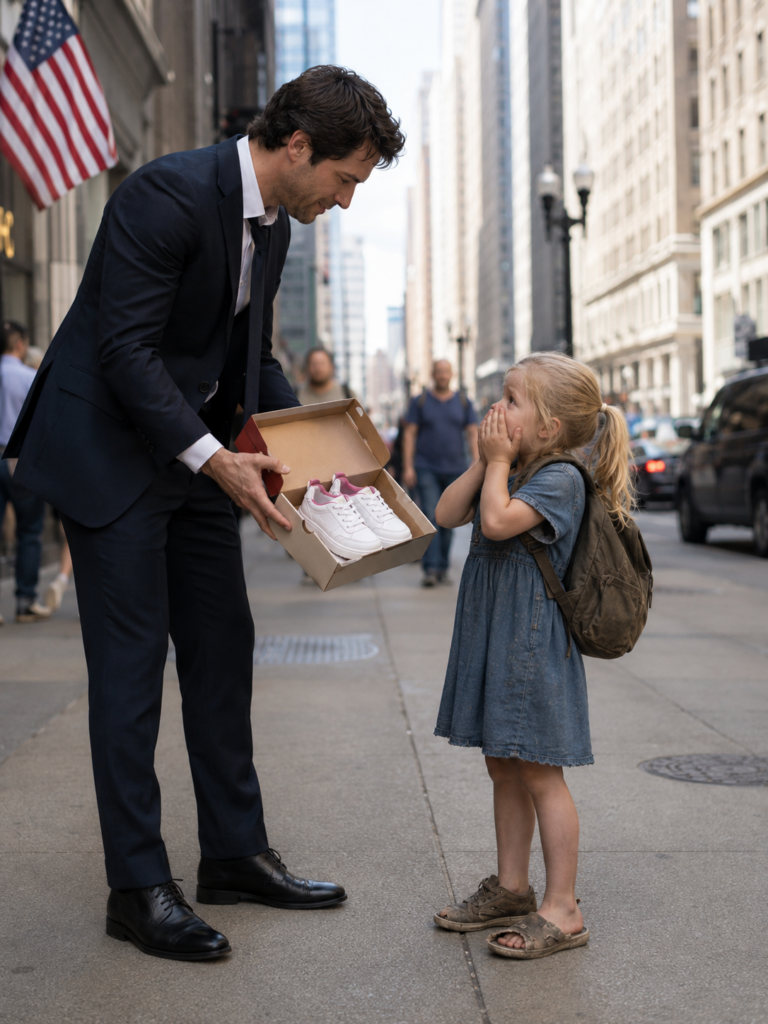
A little girl stopped me on a busy Chicago sidewalk and asked for a pair of school shoes, not money, not food, not sympathy—just shoes she could wear without other children laughing at her. They cost me forty-five dollars, less than I had spent that morning on coffee for a boardroom full of people who did not need it, but what I did not know was that her promise to pay me back one day would lead me to a hospital room, a dying mother, a secret buried in an old envelope, and a truth powerful enough to change everything I believed about success, family, and the kind of life a man is supposed to build.
My name is Michael Harrison, and before I met Sophie, people called me successful with the kind of confidence that made it sound settled.
I was forty-two years old. I owned a private investment firm in Chicago, three cars I rarely drove myself, a penthouse apartment with floor-to-ceiling windows, and a lake view that tourists would have stopped to photograph if they could have gotten past the lobby security desk.
My name appeared in business magazines beside phrases like “self-made,” “disciplined,” and “rising force in Midwest finance.” I sat on charity boards. I wrote checks big enough to make hospital administrators shake my hand with both of theirs. I knew how to buy a table at a gala, how to nod through speeches about community, how to smile when someone told me my late father would have been proud.
But most nights, I came home to silence.
Not peaceful silence.
Expensive silence.
The kind that hummed through climate-controlled rooms and bounced off marble countertops. The kind where the refrigerator sounded too loud, where the elevator ding outside my private foyer felt like the only sign another human being existed nearby.
I had built exactly the life people told me to want.
And somehow, I had built it around an empty chair.
That Thursday afternoon started like every other Thursday in my world.
A board meeting ran long. A senior partner argued about risk exposure. Someone from acquisitions presented a slide deck so polished and lifeless it might as well have been prepared by a machine. We discussed numbers large enough to feed whole neighborhoods, then moved on because we had another meeting scheduled at four.
By 3:30, I could feel a headache pressing behind my eyes.
My assistant, Rachel, stood near the glass door of my office with my coat over one arm and my phone in her hand.
“Your driver is downstairs,” she said.
I looked past her toward the city, toward the gray ribbon of street between office towers.
“Cancel him,” I said.
Rachel blinked. “For today?”
“For right now. I’m going to walk.”
“In those shoes?”
I looked down at my polished black Oxfords and gave her the first real smile I had managed all day.
“They’ll survive six blocks.”
Outside, Chicago was cold in that sharp early spring way, when the wind coming off the lake still carried winter in its teeth even though the tulips had started pushing up in the planters. Office workers moved in fast streams along the sidewalk, shoulders hunched, phones out, coffee cups in hand. A bus groaned at the curb. Somewhere nearby, a street musician played a saxophone under the rumble of the L.
I loosened my tie.
For a few minutes, I let myself be anonymous.
No driver. No assistant. No handshakes. No one calling me Mr. Harrison like my last name was a building they had to enter carefully.
Just a man walking through a city.
I had made it half a block past a drugstore and a sandwich shop when a small voice stopped me.
“Mister?”
I turned around with the automatic expression I had perfected over years of being approached downtown. Polite. Guarded. Ready to say, “Sorry, I can’t help,” before the request had fully formed.
Then I saw her.
She was a little girl, five or six at most, standing beside the brick wall of a closed tailor shop. Blonde pigtails. A faded blue dress with a small tear near the hem. A backpack with one strap repaired by what looked like silver duct tape. Her hands were clasped in front of her like she had practiced being brave and was trying not to forget how.
But it was her shoes that held me there.
They were pink once, maybe. The color had faded into a tired gray. The canvas had split along the sides, and the soles were peeling away as if the shoes themselves were trying to leave. One tiny toe peeked through a hole near the front.
That toe undid me.
Not the dress. Not the backpack. Not the nervous tremble in her mouth.
The toe.
Something about it was so small, so practical, so unfair.
“Can I help you?” I asked.
She swallowed.
Up close, I could see that her cheeks were flushed from the cold, and there was a smudge of dirt near her chin.
“My name is Sophie,” she said, as though beginning with her name might make the request more proper.
“Hello, Sophie.”
“I’m not supposed to talk to strangers.”
“That’s a good rule.”
She nodded seriously. “But you look like somebody’s dad.”
I almost laughed, but something in her face stopped me.
“I’m not,” I said quietly.
“Oh.” She looked down at her shoes. “Well, you look like you know where stores are.”
That time, I did laugh softly. “I know where a few stores are.”
She took a breath.
“Everyone laughs at me at school.”
Her voice did not break. That made it worse.
“I try to hide my feet under the desk, but when we line up for lunch, they see. And today, Liam Baker said my shoes look like they came from a trash can.”
Her little jaw tightened. She lifted one foot.
“My shoe hurts.”
I looked down the street, then back at her.
“Where is your mother?”
“At the hospital.”
That should have been the moment I asked more questions. A responsible adult would have asked where she lived, who was watching her, why she was alone downtown.
But her eyes were fixed on me with such clear, embarrassed hope that every practiced defense I owned fell uselessly to the ground.
There was a small shoe store across the street, the old-fashioned kind with children’s sneakers in the window and a bell above the door.
I pointed to it.
“Let’s fix that.”
Her eyes widened.
“Really?”
“Really.”
She did not move right away. “I don’t have money.”
“I figured.”
“I can pay you back later.”
“No need.”
Her face changed. Not relief. Not exactly.
Offense.
“My mom says promises matter.”
“I believe your mom is right.”
“Then I promise,” she said, chin lifting. “When I grow up, I’ll pay you back.”
People walked around us. A man bumped my shoulder and muttered something under his breath. A cab honked at the intersection. But for a moment, the whole city seemed to narrow down to a child in broken shoes and her fierce little promise.
“All right,” I said. “I accept.”
Inside the shoe store, warmth rushed around us. The place smelled like leather, cardboard boxes, and floor polish. An older salesman with silver hair looked up from behind the counter and smiled at Sophie the way some men smile at children only when they’ve had children of their own.
“Well now,” he said. “Looks like we’ve got important business.”
Sophie stood very straight.
“I need school shoes,” she said.
“Then school shoes you shall have.”
His name tag read Mr. Alvarez. He brought out the measuring device, the metal kind I remembered from childhood, and Sophie placed her foot on it as carefully as if it were a church step. While he measured, she kept glancing at me, making sure I had not disappeared.
“You can sit,” I told her.
“I don’t want to wrinkle anything.”
Mr. Alvarez looked at me over her head.
Something passed between us.
Not pity.
Recognition, maybe.
He brought out three pairs.
The first pinched. Sophie tried to pretend it did not, but her toes curled inside them.
“Tell the truth,” I said.
She looked guilty. “They pinch a little.”
“Then they’re not the ones.”
The second pair was sturdy but too heavy. She clomped across the store like a little astronaut, then shook her head.
The third pair was white with pale pink trim and two small stars near the heel. They were simple, practical, nothing fancy. But when Sophie slipped them on, her whole face changed.
She stood slowly.
Took one step.
Then another.
Then she looked up at me with wonder so pure it made something ache behind my ribs.
“It doesn’t hurt anymore,” she whispered.
Mr. Alvarez looked away fast, pretending to straighten a stack of boxes.
Sophie walked to the mirror, then turned sideways to admire the shoes from another angle. A laugh escaped her, small at first, then bigger. Soon she was doing careful laps around the store, not running exactly, because she was still trying to be polite, but close enough that her pigtails bounced.
That laugh filled the little shop.
And somehow, it filled something in me too.
“We’ll take them,” I said.
At the counter, the total came to forty-five dollars and some change. I gave Mr. Alvarez my card. He slid the box for the old shoes toward Sophie.
She stared at the worn-out pair, suddenly uncertain.
“You don’t have to keep them,” I said.
“My mom says not to throw things away if they can still be useful.”
“They hurt you.”
Sophie looked at them for another moment, then pushed the box gently back.
“Maybe they’re done being useful.”
Mr. Alvarez nodded as if she had said something wise.
Outside, the sun had broken through the clouds, flashing against office windows and car windshields. Sophie stood on the sidewalk and looked down at her new shoes as though they might vanish if she stopped paying attention.
“They’re beautiful,” she said.
“They suit you.”
She looked up at me.
“You’re a nice man.”
“I have my moments.”
She did not smile. She was studying me with a seriousness that belonged on a judge.
“When I grow up, I’ll pay you back.”
“You already said that.”
“I mean it more now.”
“I believe you.”
Then, before I could react, she wrapped her arms around my leg.
It was quick. Fierce. A child’s hug with no calculation in it.
“Thank you,” she said into my coat. “I have to go now.”
“Wait, Sophie. Where are you—”
But she had already pulled away.
She ran down the sidewalk, her new shoes flashing white in the afternoon sun.
“Sophie!”
She turned just long enough to wave, then disappeared around the corner near a bus stop.
I stood there like a fool, holding the receipt for a pair of children’s shoes.
The world had not changed.
The traffic was still loud. The wind was still cold. My phone was still full of messages from people who wanted decisions, signatures, money, or all three.
But the city felt different.
Brighter somehow.
Alive in a way it had not felt when I walked out of my office.
I was still looking in the direction Sophie had gone when my phone buzzed.
Unknown number.
I almost ignored it. My life was built on filtering unknowns. Unknown callers were usually wrong numbers, invitations, requests, or problems someone wanted to make mine.
Then I saw the attachment.
A photograph.
I opened it.
Sophie stood beside a hospital bed.
Her new shoes were visible at the bottom of the frame, bright against the dull hospital floor. She was holding the hand of a woman who looked too thin, too pale, too young to be lying under that many blankets. Clear oxygen tubing rested beneath the woman’s nose. One hand lay outside the sheet, fragile as paper.
The message beneath the photo read:
You helped my daughter today. She may not have told you this, but she was trying to buy shoes so she could visit me without being embarrassed.
I stopped breathing for a second.
A second message appeared.
Please don’t tell her I contacted you. She thinks I’m getting better.
Then a third.
The doctors say I may not have much time left.
I stared at the screen until the words blurred.
People flowed around me, annoyed by the man standing still in the middle of the sidewalk.
Another message came in.
My name is Emily Carter. I know this is strange. I got your number from the shoe store receipt Sophie tucked into her backpack. I should not have done that. But I saw your name, and I need to ask you something before it’s too late.
I typed, then deleted, then typed again.
What hospital?
The reply came almost instantly.
St. Mary’s. Room 614. Please come alone if you come. And please don’t tell Sophie why.
I looked up at the buildings around me, glass and steel rising into the Chicago sky. My whole day had been planned down to the minute. Calls. Dinner with a developer from New York. A review of quarterly projections at seven.
For once, I did not check my calendar.
I hailed a cab.
St. Mary’s Medical Center sat on a busy street near a row of old brick apartment buildings and a Catholic church with a faded sign advertising Friday fish fry. The lobby smelled like sanitizer, coffee, and carnations from the gift shop. Nurses moved with practiced urgency. Families sat in clusters under fluorescent lights, clutching paper cups and bad news.
I had donated to hospitals.
I had attended ribbon cuttings.
I had shaken hands beside plaques with my name on them.
But I had not sat in a real hospital waiting area in years. Not since my father died when I was twenty-three and my mother followed him less than two years later, quietly, as if grief had turned off the lights inside her one room at a time.
I found the elevator and pressed six.
The doors opened to a quieter floor.
Room 614 was at the end of the hall.
Sophie was sitting in a chair outside, swinging her feet. The new sneakers looked almost too clean against the scuffed floor.
She saw me and lit up.
“Nice man!”
I glanced toward the room.
“Hi, Sophie.”
“My mom is sleeping. The nurse said I have to let her rest.”
“Are you here by yourself?”
“My neighbor Mrs. Donnelly brought me. She went downstairs to call her son because he always talks too loud in hospitals.”
That sounded specific enough to be true.
Sophie hopped off the chair and held out one foot.
“They still don’t hurt.”
“That’s good.”
“I told my mom I got them because a nice man helped me. She cried, but she said it was happy crying.”
Through the half-open door, I could see the woman from the photograph lying in bed, turned slightly toward us. Her eyes were closed, but not fully. She was awake.
A nurse came down the hall and gave me the quick, assessing look hospital staff reserve for unfamiliar adults near children.
“I’m Michael Harrison,” I said. “Emily asked me to come.”
The nurse’s expression shifted. She nodded.
“Sophie, sweetheart, Mrs. Donnelly is by the vending machines. She bought you apple juice.”
Sophie looked torn between apple juice and suspicion.
“Will you be here when I come back?” she asked me.
“I’ll try.”
She narrowed her eyes. “Trying means maybe.”
I crouched slightly.
“I’ll be here.”
“Promise?”
The word landed differently now.
“I promise.”
She studied me one more second, then ran down the hall in her new shoes.
I stepped into room 614.
Emily Carter opened her eyes.
She was probably in her mid-thirties, but illness had blurred the number. Her hair was dark blond and thin around her temples. Her face carried the kind of beauty that had been worn down by pain, bills, and too many nights pretending fear was just fatigue.
“Mr. Harrison,” she whispered.
“Michael is fine.”
“Thank you for coming.”
I pulled the chair closer to her bed.
“You didn’t have to send the photo.”
“I did.”
Her voice was weak, but not uncertain.
“I needed you to know she was real.”
That sentence hit harder than it should have.
“You thought I wouldn’t believe you?”
“I’ve learned people with money are careful about stories.”
I looked down at my hands.
“She asked for shoes,” I said. “Not a story.”
“That sounds like Sophie.”
A faint smile crossed her face, then vanished under a wave of pain she tried to hide.
I had seen executives conceal panic during hostile negotiations with less discipline.
“You said you needed to ask me something,” I said.
Emily looked toward the door.
“Before I do, I need you to understand something. I’m not asking for money.”
“Most people say that right before asking for money.”
That made her smile again, just barely.
“I’m asking for time.”
I waited.
She took a breath, and the monitor beside her bed kept its steady rhythm.
“I have stage four cancer. It moved faster than they expected. I kept working as long as I could. Two jobs, then one, then none. I cleaned offices at night, did laundry for a hotel, whatever I could manage. Sophie thinks I’m tired because hospitals make people tired.”
Her eyes shone.
“She doesn’t know what dying means. Not really.”
My throat tightened.
“Does she have family?”
“No father in the picture. My parents are gone. I have an aunt in Ohio who sends Christmas cards but hasn’t answered my last three calls. Mrs. Donnelly watches Sophie when she can, but she’s seventy-six and has a heart condition.”
She turned her face toward me.
“And I cannot leave my daughter to chance.”
There it was.
The room seemed to shrink.
“Emily,” I said carefully, “you don’t know me.”
“I know.”
“You met me through a receipt.”
“I know.”
“You can’t be thinking—”
“I am not asking you to adopt my daughter.”
The words silenced me.
She reached toward the drawer beside her bed. Her hand trembled, so I stood and opened it for her.
Inside was a worn manila envelope with my name written across the front.
Not typed.
Written.
Michael Harrison.
The sight of it made my skin go cold.
“How do you have that?”
Emily closed her eyes for a moment, gathering strength.
“Because your mother gave it to mine.”
I stared at her.
“My mother died nineteen years ago.”
“I know.”
“No,” I said. “You don’t.”
Emily’s gaze did not move.
“My mother’s name was Rose Carter. She worked for your family when you were little.”
The name struck somewhere deep, behind locked doors I had not opened in years.
Rose.
Not Mrs. Carter.
Rose.
A woman in a yellow kitchen apron, humming while she stirred soup in my mother’s kitchen. A woman who smelled faintly of vanilla hand lotion. A woman who knew I liked the crust cut off toast when I was six but would never have admitted it at ten.
I sat down slowly.
“Rose was your mother?”
Emily nodded.
“She died eight years ago. Before she passed, she gave me that envelope and told me only to open it if I ever found myself with no other choice. I opened it three months ago.”
I looked at the envelope as if it might burn me.
“What’s inside?”
“Something your mother wanted you to have when you were ready.”
A bitter laugh left me before I could stop it.
“When I was ready? I’m forty-two.”
“Maybe that’s what she was afraid of.”
I looked at Emily sharply.
There was no cruelty in her face. Only exhaustion.
I opened the envelope.
Inside were three things.
A letter.
A photograph.
And a folded legal document yellowed slightly at the edges.
My hands went first to the photograph.
I knew the kitchen immediately.
The old house in Evanston. The one my parents sold when my father’s business began growing too fast for childhood to survive inside it.
In the photograph, my mother sat at the kitchen table, younger than I remembered her, smiling tiredly. Beside her stood Rose Carter holding a baby.
The baby was not me.
On the back, in my mother’s handwriting, were two words:
For Michael.
My mouth went dry.
I unfolded the letter.
My mother’s handwriting rose from the page like a ghost.
My dearest Michael,
If you are reading this, then Rose believed you were finally strong enough to hear the truth, or life has forced it open before any of us were ready.
There are things your father and I never told you. Not because you did not deserve the truth, but because grown people can be cowards when love, shame, and reputation become tangled together.
Years before you were born, your father and Rose were close. Too close. I knew. She knew I knew. Your father knew and pretended I did not.
I should have hated her. Some days I tried. But life is rarely as clean as pride wants it to be.
Rose became pregnant.
Your father panicked.
His family name mattered to him then more than his soul. He wanted the problem to disappear quietly. Rose refused to disappear, and I respected her for that more than I ever told her.
I could not save my marriage from the truth, but I could save a child from being punished for it.
The baby was named Emily.
I stopped reading.
The room tilted.
Emily watched me with eyes full of apology for a crime she had not committed.
“No,” I said.
It was not an argument. It was a reflex.
Emily looked toward the window.
“I said the same thing when I read it.”
I forced my eyes back to the letter.
Your father provided money for Rose for a while, then stopped when his attorneys warned him about exposure. I did what I could privately. Rose never asked for more than help with rent and diapers. She never threatened us. She never used the truth as a weapon.
I wanted to tell you when you were older. Your father forbade it. After he died, I still could not find the courage. I told myself I was protecting you. That was a lie. I was protecting the version of our family I wanted you to keep.
If Emily ever finds you, please do not punish her for our failures.
She is your sister.
I covered my mouth with my hand.
For years, I had thought I was alone.
No siblings. No cousins I spoke to. No real family left.
I had built my life like a fortress because there was no one left to invite inside.
And all that time, somewhere in the same city, my sister had been growing up with a mother who had once cut the crusts off my toast.
I looked at Emily.
“You knew before today?”
“Three months.”
“And you didn’t contact me?”
“I tried once.”
“What do you mean?”
She reached for her phone, tapped slowly, then turned the screen toward me.
An email.
To my corporate office.
Subject: Personal matter regarding your mother, Margaret Harrison.
I had never seen it.
“I sent it to your company’s general inquiry address,” she said. “I called twice. A woman told me messages like that had to go through proper channels.”
Rachel.
No, not Rachel. Legal screening. PR protocols. Layers of protection I had paid for and never questioned.
“I’m sorry,” I said.
Emily gave a small shrug.
“People like me get used to not making it through proper channels.”
The shame of that was quiet and sharp.
I looked at the legal document.
“What’s this?”
“My mother said your mother insisted on it. It’s not a claim against your estate or your company. Nothing like that.”
I unfolded it.
It was a trust document.
Small. Private. Created by my mother almost twenty years earlier. Beneficiary: Emily Rose Carter. Secondary beneficiary: any living child of Emily Rose Carter.
My mother had set aside money.
Not corporate money. Personal money.
Enough, invested properly, to have changed Emily’s life.
My eyes scanned the page until I found the trustee.
Harrison Family Office.
My own family office.
My breath went cold.
“This was never administered,” I said.
Emily’s voice was almost gentle.
“I know.”
“No. That’s impossible.”
But even as I said it, I knew it was not.
After my mother died, everything had gone through my father’s attorneys, then through advisors, then through the machine that became my life. Old accounts. Dormant files. Paperwork nobody wanted to examine too closely if it complicated the clean story of Harrison success.
“How much?” I asked.
Emily looked away.
“My mother said your mother started it with two hundred thousand dollars.”
I gripped the paper.
Two hundred thousand dollars.
With nearly two decades of growth, it could have paid rent, medical bills, school tuition. It could have given Emily choices. It could have kept Sophie from walking around Chicago in shoes that split open on the sidewalk.
A familiar anger rose in me, but there was nowhere clean to put it.
My father was dead.
My mother was dead.
Rose was dead.
The lawyers were retired or buried in Florida somewhere.
And Emily was lying in a hospital bed, apologizing with her eyes because my family’s silence had arrived at her door wearing a suit.
“I’ll fix it,” I said.
She closed her eyes.
“I didn’t bring you here for the money.”
“You should have.”
“I brought you here because Sophie is going to be alone.”
The sentence landed like a hand around my throat.
Outside the room, I heard Sophie laughing with someone near the nurses’ station.
Emily listened too, and her face broke with a love so fierce it seemed almost too large for her failing body.
“She thinks if she behaves, if she eats her vegetables, if she says her prayers, I’ll come home.”
I could not speak.
“I need someone to know her,” Emily said. “Not just manage money for her. Not just put her into a system and hope decent people find her. Someone who understands she hates peas but pretends not to because she thinks good children are easier to keep. Someone who knows she reads the same library book three times because she likes the part where the lost dog comes home. Someone who will tell her her mother loved her when she gets old enough to wonder why love wasn’t enough to stay.”
Her hand trembled on the blanket.
“I am asking you to be family.”
For most of my adult life, I had handled pressure well. Markets falling. Deals collapsing. Men threatening lawsuits with smiles on their faces. I could think clearly when other people panicked.
But in that hospital room, I was useless.
Because this was not a transaction.
This was not a problem I could solve by calling the right person and moving the right money.
A dying woman was handing me the truth of my own bloodline and asking whether I had enough humanity left to hold it.
“I don’t know how,” I said.
Emily looked at me for a long moment.
Then she smiled sadly.
“No one does at first.”
Sophie came back with apple juice and a packet of crackers.
She stopped at the doorway when she saw my face.
“Are you sad?” she asked.
I folded the papers carefully and slid them back into the envelope.
“A little.”
“Because hospitals are sad?”
“Yes.”
She nodded as if this confirmed something she had long suspected.
“They should paint them yellow.”
Emily laughed softly, then coughed. Sophie hurried to her bedside and took her hand.
“Mom, look. Mr. Nice Man came.”
“I see that.”
“He promised he’d stay.”
Emily looked at me.
I knew then that promises were going to matter in my life in a way they never had before.
“I did,” I said.
That evening, I canceled everything.
The dinner. The calls. The review.
Rachel sounded alarmed over the phone.
“Is everything all right?”
“No,” I said. “And I need you to find an old file.”
“What kind of file?”
“A trust created by my mother for Emily Rose Carter.”
There was a pause.
“I’m sorry. Who?”
“My sister.”
Silence.
For the first time in years, Rachel had no immediate response.
“Start with the family office archives,” I said. “Then call Bernstein & Cole. If anyone tells you it doesn’t exist, tell them I have a signed copy in my hand.”
“Michael—”
“And Rachel?”
“Yes?”
“Find out why her email never reached me.”
By the next morning, the machine I had built for profit began working for something else.
Attorneys were pulled into conference calls before breakfast. Records were requested. Old boxes were retrieved from storage in Oak Brook. A retired accountant was tracked down in Arizona. The family office director, Martin Kellerman, arrived at my office wearing the pale expression of a man who had spent the morning realizing a buried document had teeth.
I met him in the conference room alone.
He placed a folder on the table.
“We’re still reviewing,” he began.
“That’s not an answer.”
His mouth tightened.
“The trust existed. It was funded. It appears it was transferred into a holding account after your mother’s death pending beneficiary verification.”
“Pending for nineteen years?”
He adjusted his glasses.
“There were complications.”
“There was a child.”
“There was no formal acknowledgment by your father.”
“There was a signed trust by my mother.”
“Yes, but—”
“Martin.”
He stopped.
I had used that tone in acquisitions, but never with someone who had known my family before I was old enough to sign checks.
“Tell me the truth.”
He looked down.
“Your father instructed the office not to pursue distribution.”
The room went very quiet.
“After my mother died?”
“Yes.”
“And after my father died?”
“The matter remained dormant.”
“Dormant,” I repeated.
A word clean enough to hide a theft.
Martin’s face reddened. “No funds were taken by the office. The account continued accruing value. It simply was not distributed.”
“Simply.”
He had the sense not to continue.
“How much is in the account now?”
He slid a page toward me.
I looked at the number.
Seven hundred and eighty-three thousand dollars.
I thought of Sophie’s shoes.
Forty-five dollars.
I stood and walked to the window.
Below, people moved along the sidewalk, small and busy. Somewhere among them was a little girl who believed promises mattered because her mother had taught her that, even while the adults around her drowned in secrets.
“Transfer it,” I said.
“To Emily Carter?”
“To a properly structured guardianship and medical trust for Emily and Sophie. Today.”
“There may be tax considerations.”
“Then consider them quickly.”
“Michael, this could raise questions about your father.”
I turned.
For the first time, I understood how much of my life had been spent protecting dead people’s reputations while living people paid the bill.
“Good,” I said.
Martin looked at me.
“Let it raise questions.”
By Saturday, Emily’s hospital room had changed.
Not physically. The walls were still beige. The TV still hung too high in the corner. The same plastic water pitcher sat on the same rolling table.
But the air had shifted.
A social worker named Dana joined us. Then an estate attorney I trusted because she had never once smiled to soften bad news. Mrs. Donnelly came too, wearing a purple cardigan and carrying a tote bag full of Sophie’s coloring books. She eyed me with deep suspicion for the first fifteen minutes, which made me like her immediately.
“So you’re the rich man,” she said.
“I suppose.”
“Rich men make me nervous.”
“That’s fair.”
She looked me up and down.
“You know anything about children?”
“No.”
“Good. Means you won’t pretend.”
Emily laughed until she had to rest.
Over the next few days, we made plans no one should ever have to make.
Temporary guardianship.
Medical directives.
A trust for Sophie.
School arrangements.
Counseling.
Housing.
Practical things. Necessary things. Cruel things, because every signature admitted what love was not powerful enough to stop.
Sophie did not understand all of it.
She understood that I came every day.
She understood that I brought books from the hospital gift shop, though she told me after the second day that the books were “too babyish” and asked for one about horses instead.
She understood that I learned she liked grilled cheese cut into triangles, not squares.
She understood that when her mother slept, I sat outside the room with her and helped color pictures, even though I was terrible at staying inside the lines.
“You’re bad at purple,” she told me one afternoon.
“I didn’t know a person could be bad at a color.”
“You can.”
“Thank you for telling me.”
She leaned closer to my page.
“You made the horse look worried.”
“Maybe the horse has a board meeting later.”
“What’s a board meeting?”
“A room where adults sit around a table and make each other tired.”
“That sounds dumb.”
“It often is.”
She considered this.
“When I grow up, I’m not going to have board meetings.”
“What will you have?”
“Dogs.”
“Just dogs?”
“And pancakes.”
“That sounds better.”
She nodded. “You can come.”
The invitation was so casual, so generous, that I had to look away.
I started spending less time at the office.
At first, people treated it like an emergency, because in my world, absence always had to be justified by crisis. Rachel moved meetings. Partners whispered. Martin avoided my eyes. A few clients expressed concern.
I let them.
For the first time in my career, I did not rush to assure everyone that business would continue unaffected.
Business had been unaffected long enough.
One afternoon, Emily asked me to push her wheelchair to the hospital courtyard.
It was one of those small urban courtyards surrounded by brick walls, with a few benches, a leafless tree, and planters waiting for warmer weather. Sophie walked ahead in her white sneakers, stepping carefully along the cracks in the pavement as though they were balance beams.
Emily watched her.
“She looks lighter,” she said.
“She likes the shoes.”
“It’s not just the shoes.”
I stood behind the wheelchair, hands on the grips.
“She talks about you,” Emily said.
“What does she say?”
“That you’re funny but sad.”
I looked down.
“Children are rude.”
“They’re accurate.”
A pigeon landed near the planter. Sophie crouched and tried to talk to it.
Emily’s voice softened.
“I hated you for a little while.”
I did not answer.
“When I first opened your mother’s letter, I hated all of you. Your father for obvious reasons. Your mother for waiting too long. You because you got the name, the house, the education, the safety. I know that isn’t fair.”
“It sounds fair enough.”
“No.” She turned slightly. “You were a child too.”
I swallowed.
“My father wasn’t easy.”
“I know.”
That surprised me.
“My mother said he was charming in public and cold in private. She said your mother spent years trying to make a beautiful home out of a lonely marriage.”
That sounded like my mother.
Dinner parties. Fresh flowers. Perfect table settings. A sadness she wore so elegantly I mistook it for grace.
“I thought being successful would make me different from him,” I said.
Emily looked up at me.
“Did it?”
The question was not cruel.
That made it harder.
I looked toward Sophie.
“I don’t know.”
Emily nodded, as if honesty was enough for that moment.
“You can still choose.”
A week later, Emily worsened.
The decline was not dramatic like in movies. It was quieter. Meaner. She slept more. Ate less. Her voice thinned. Her hands, once restless, grew still on the blanket.
Sophie began to notice.
She stopped asking when they were going home.
She started climbing into bed beside her mother, careful not to disturb the tubes, and laying her head against Emily’s shoulder.
One evening, rain streaked the hospital window while the city lights blurred beyond the glass. Mrs. Donnelly had gone home to rest. Dana had left her card on the table. I stood near the door, unsure whether to stay or give them privacy.
Emily looked at Sophie.
“Baby, can you show Michael your reading book?”
Sophie frowned. “Now?”
“Please.”
Sophie slid off the bed and came to me reluctantly.
“Mom wants to talk grown-up,” she whispered.
“Sounds serious.”
“It usually means boring.”
I took her to the family lounge down the hall. She read two pages from a book about a dog who got lost in a thunderstorm, then stopped.
“Is my mom going to die?”
There are questions adults prepare to answer badly.
Then there are questions that strip all preparation away.
I closed the book.
“What did your mom tell you?”
“That her body is very tired.”
“That’s true.”
“People sleep when they’re tired.”
“Yes.”
“But sometimes they don’t wake up.”
Her eyes stayed on the book.
I remembered boardrooms where men lied with perfect confidence.
I could not lie to her.
“Sometimes,” I said.
Her mouth trembled.
“If she dies, where do I go?”
I took a breath that hurt.
“With people who love you.”
“Mrs. Donnelly is old.”
“She loves you.”
“You?”
The question was barely audible.
I looked at this child who had entered my life through a broken shoe and a promise, and I understood that there are doors a person walks through only once.
“Yes,” I said. “Me too.”
She stared at me.
“But you live in a tall building.”
“I do.”
“Kids can’t live in tall buildings.”
“Some do.”
“Do you have cereal?”
“I can buy cereal.”
“That’s not the same as having cereal.”
I almost smiled.
“You’re right. I’ll get cereal.”
“What kind?”
“What kind do you like?”
She wiped her eyes with the back of her hand.
“The kind with strawberries on the box. But not the fake strawberries inside. Those are weird.”
“Noted.”
She leaned against me then, not a full hug, just the weight of a child too tired to stand alone.
I put one arm around her shoulders.
At the end of the hall, a nurse walked by and pretended not to see me crying.
The next morning, Emily asked for the envelope again.
I handed it to her.
From inside, she took one more folded page I had not noticed before. It was newer than the others.
“This one is from me,” she said.
“For Sophie?”
“For you.”
I shook my head. “Emily—”
“Take it.”
I did.
“You don’t have to read it now.”
“I don’t want a goodbye letter.”
“Too bad.”
That sounded so much like Sophie that we both smiled.
Her breathing grew shallow.
“I need you to promise me something.”
“Anything.”
“No.” Her eyes sharpened. “Don’t say that unless you mean it. That’s how people like your father ruined lives. They made promises in rooms where no one could hold them accountable.”
I sat beside her bed.
“What do you need?”
“Don’t raise her out of guilt.”
The words pierced cleanly.
“Emily—”
“I mean it. Guilt gets tired. Guilt resents. Guilt keeps score. If you cannot love her freely, find someone who can and fund everything from a distance.”
I looked through the glass toward the hallway.
Sophie was showing a nurse her shoes.
“I don’t know what kind of father I’d be.”
“No one good ever does.”
“I’m afraid I’ll fail her.”
“You will.”
I looked back at her.
Emily’s mouth curved faintly.
“Not in the big ways, I hope. But you’ll forget things. Say the wrong thing. Buy the wrong cereal. Work too late. She’ll get mad. You’ll apologize. That’s family.”
Family.
The word no longer sounded like ancestry or photographs or names engraved on plaques.
It sounded like someone waiting outside a hospital room with apple juice.
“I promise,” I said. “Not from guilt.”
Emily searched my face.
Then she nodded.
“Good.”
That night, Sophie fell asleep in a chair beside the bed, her new shoes still on her feet. Emily watched her for a long time.
“She said she’d pay you back,” she whispered.
“She did.”
“She will, you know.”
“I know.”
Emily closed her eyes.
“Maybe not with money.”
In the early hours of Tuesday morning, Emily Carter died while her daughter slept with one hand tucked inside hers.
There is no graceful way to describe what follows.
Grief does not move like a scene in a movie. It comes in paperwork, phone calls, casseroles, missing toothbrushes, and a child asking at breakfast whether heaven has visiting hours.
Sophie did not scream when we told her.
She listened.
Then she asked if her mother had been scared.
Mrs. Donnelly began to cry.
I knelt in front of Sophie.
“I think she was sad to leave you,” I said. “But she knew you would be loved.”
Sophie looked at me with eyes too old for her face.
“By you?”
“Yes.”
She nodded once.
Then she walked into my arms and broke.
The funeral was held at the small Catholic church near the hospital, though Emily had not attended regularly. Mrs. Donnelly said Rose Carter had once gone there, and that seemed to matter.
I paid for everything quietly. Not because money could dignify death, but because poverty should not be allowed to humiliate grief.
The church basement ladies made coffee. Someone brought ham sandwiches. A neighbor arranged grocery-store flowers in glass vases. Mr. Alvarez from the shoe store came wearing a dark suit that did not quite fit, and he placed a small pink shoebox near the guest book.
Inside was a note for Sophie.
For when these get too small.
At the service, Sophie sat between me and Mrs. Donnelly. Her feet did not touch the floor. She held a folded drawing in her lap: a picture of herself, her mother, and a worried purple horse.
When it was over, people approached me with cautious eyes.
Some had read the obituary and seen my name listed under “survived by her brother, Michael Harrison.” Some recognized me from business pages. Some simply wondered why a man in a tailored black suit was holding the hand of a little girl from a third-floor walk-up on Ashland Avenue.
I let them wonder.
For once, I did not owe the room an explanation.
Two weeks later, Sophie moved into my apartment.
The first night, she stood in the foyer holding a small suitcase and looked around at the white walls, the marble floor, the enormous windows.
“It’s too quiet,” she said.
“Yes.”
“Do you have neighbors?”
“Technically.”
“Do they know you?”
“No.”
“That’s weird.”
“It is.”
She walked into the kitchen and opened a cabinet.
“No cereal.”
“I ordered groceries.”
She looked at me as if I had failed a basic citizenship test.
“You can’t order cereal for later. Morning is when cereal happens.”
So at 8:15 that night, Michael Harrison, CEO, investor, and alleged rising force in Midwest finance, stood in a neighborhood grocery store holding three boxes of strawberry cereal while Sophie explained the difference between good marshmallows and suspicious marshmallows.
The cashier recognized me.
Or thought she did.
She kept glancing at my suit and Sophie’s serious face.
“Big decision?” the cashier asked.
“Very,” Sophie said. “He’s new.”
The cashier laughed.
I did not explain that she meant new at being a person.
The apartment changed quickly after that.
Not beautifully.
Honestly.
A pink toothbrush appeared beside my black one. Library books stacked up on the coffee table. A night-light glowed in the hallway. The refrigerator gained magnets shaped like animals. My spotless living room acquired a basket of stuffed toys, three crayons under the sofa, and one mysterious sticky patch near the dining table that no amount of cleaning fully solved.
Rachel came by one Saturday with documents and found me assembling a small bookshelf while Sophie sat cross-legged on the floor reading instructions upside down.
“You look terrible,” Rachel said.
“I’ve been informed I’m bad at purple and shelves.”
Sophie looked up.
“He is.”
Rachel smiled in a way I had never seen at the office.
“Hi, Sophie. I’m Rachel.”
“Are you his boss?”
“I wish.”
Sophie considered this. “Someone should be.”
Rachel looked at me.
“She’s not wrong.”
The legal process took months.
Guardianship hearings. Home visits. Background checks. Court dates in rooms with worn wooden benches and vending machines humming outside. I learned that love can be real and still require notarized forms. I learned that judges do not care how rich you are if your paperwork is incomplete. I learned that children’s socks disappear in dryers at a rate no financial model can explain.
I also learned how people look at a man like me when he enters family court with a child like Sophie.
Some saw generosity.
Some saw scandal.
A few saw opportunity.
Reporters called after a business columnist caught a whisper of the story. I refused interviews. A nonprofit asked if I wanted to “share my journey” at a fundraising luncheon. I declined. Martin suggested a controlled statement might protect the Harrison reputation.
I told him the Harrison reputation had received enough protection.
The hardest part was not the court.
It was bedtime.
In the daytime, Sophie could be bright, bossy, funny, stubborn. She corrected my grocery choices. She made friends with the doorman. She insisted the apartment needed “regular people curtains.” She asked questions constantly.
At night, grief found her.
She would lie in bed under a blanket printed with horses and stare at the ceiling.
“What if I forget her voice?” she asked once.
I had been sitting in the chair near her door, reading emails I no longer cared about.
I closed the laptop.
“We won’t let that happen.”
“How?”
So I found every voicemail Emily had left. Every video Mrs. Donnelly had on her old phone. Every photograph tucked into boxes. We made a memory drawer in Sophie’s room: Emily’s scarf, her library card, a recipe for chicken soup, a birthday candle shaped like a number five, the hospital bracelet she had worn the day Sophie was born.
Some nights, Sophie opened the drawer and touched each item.
Some nights, she ignored it completely.
I learned not to force grief into a lesson.
One Sunday, we visited Emily’s grave.
Sophie wore the white sneakers.
They were scuffed now. Real shoes. Lived-in shoes. She stood in the grass and told her mother about school, about cereal, about how I still folded shirts wrong.
Then she placed a small drawing against the headstone.
It showed three people holding hands.
Her mother had wings.
I had very large ears.
“I don’t think my ears are that big,” I said.
Sophie patted my arm.
“They’re listening ears.”
I had no answer to that.
A year after I met her, Sophie turned seven.
We held a birthday party in a park near Lincoln Park Zoo. Not a gala. Not a ballroom. Not a catered event with silent auction cards.
A real birthday party.
Paper plates. Cupcakes. Children running in circles for no clear reason. Mrs. Donnelly sitting under a tree like a queen, directing adults with a paper fan. Mr. Alvarez came with a gift wrapped in shoe-store paper. Rachel brought a kite that immediately got stuck in a tree.
I watched Sophie laugh with frosting on her nose and felt the strange ache of happiness arriving where pain had made room for it.
Near the end of the party, she ran over to me holding a small envelope.
“For you.”
“What’s this?”
“Open it.”
Inside was a drawing.
A pair of shoes.
Underneath, in careful letters, she had written:
I paid you back.
I looked at her.
“With a drawing?”
“No.” She rolled her eyes. “With being your family.”
The park blurred.
Sophie suddenly looked worried.
“Is that okay?”
I crouched in front of her.
For most of my life, I had believed payment meant equal exchange. Debt settled. Balance restored. The world made clean by numbers.
But a child with frosting on her face had just explained what no boardroom ever could.
Some gifts cannot be repaid with money because money was never the point.
“Yes,” I said, my voice rough. “That is more than okay.”
She threw her arms around my neck.
This time, I was ready.
Years have passed since that Thursday on the sidewalk.
The company still exists. The penthouse does not.
We moved to a house in Evanston with a small yard, creaky stairs, and neighbors who know too much, which Sophie says is the point of neighbors. There is cereal in the pantry at all times. There are regular people curtains in every room. There is a dent in the kitchen table from a science project involving vinegar, baking soda, and poor judgment.
On the wall near the back door hangs a framed photograph.
Not one from a magazine.
Not one from a gala.
It is a slightly blurry picture Mrs. Donnelly took outside the courthouse the day the guardianship became permanent. Sophie is grinning with two missing teeth. I am holding a folder of legal papers in one hand and her backpack in the other. She is wearing sneakers with pink trim.
Below the photo is the receipt from the shoe store.
Forty-five dollars and some change.
People still sometimes call me successful.
I understand the word differently now.
Success is not an apartment with no fingerprints on the windows.
It is a child shouting from upstairs that she cannot find her other shoe, even though it is somehow in the refrigerator.
It is knowing which cereal matters.
It is showing up at parent-teacher conferences with coffee on your tie.
It is sitting in a school auditorium beside Mrs. Donnelly while Sophie plays a tree in the spring musical and waves at us like she has just won an Oscar.
It is telling the truth when the truth is hard, and staying when staying is harder.
A few months ago, Sophie asked me about the day we met.
She is old enough now to understand more of the story. Not all of it. Some truths wait until a child has stronger shoulders. But enough.
We were in the kitchen. Rain tapped against the windows. She was doing homework at the table, one foot tucked under her leg.
“Did you only help me because you felt sorry for me?” she asked.
I put down the dish towel.
“No.”
“Then why?”
I thought about the man I had been that afternoon. Tired. Empty. Rich in every measurable way and poor in the only one that mattered.
“Because you asked for what you needed,” I said. “And I think part of me had forgotten people were allowed to do that.”
She considered this.
“Mom said promises matter.”
“She was right.”
“You promised her?”
“Yes.”
“That you’d take care of me?”
“Yes.”
She looked down at her homework.
Then she said, very softly, “You did.”
Two words.
No applause.
No headline.
No number attached.
Just two words from the child who once promised to repay me.
I had spent half my life trying to build something that would outlast me. Towers. Funds. Deals. A name people would remember.
But the truth is, the only thing I ever built that mattered began with a pair of forty-five-dollar shoes and a little girl brave enough to stop a stranger on a cold Chicago sidewalk.
She thought I saved her from being laughed at.
She never understood.
Not then.
She was the one who saved me.
