
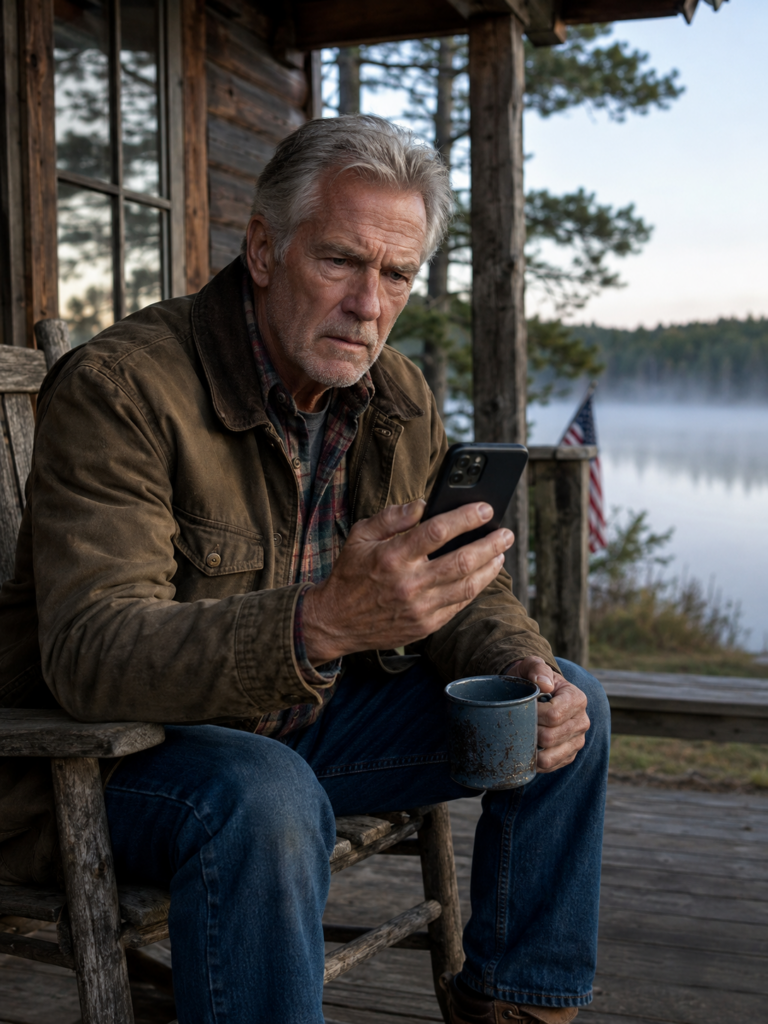
My sons thought they had already stolen my cabin. They had the papers ready, the realtor waiting, and a quiet little plan to push me out of the Wisconsin lake house I built with my own hands. But when my oldest son called and gave me thirty days to leave, I asked him one simple question—and the confidence in his voice disappeared.
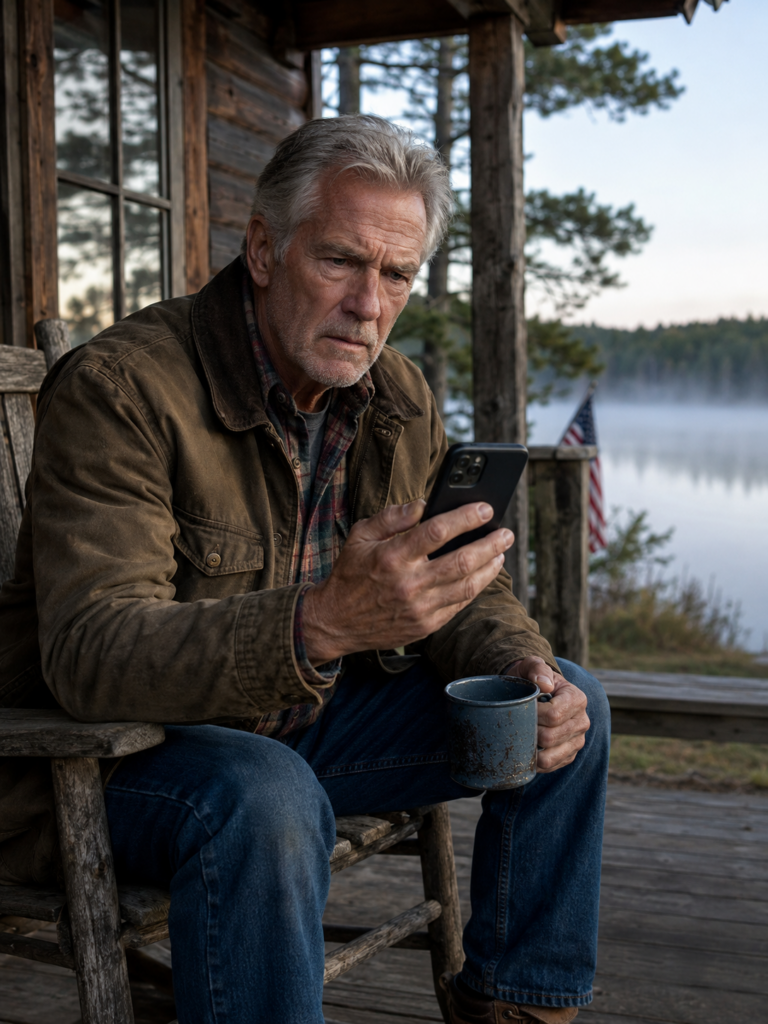
The morning my sons tried to sell my life out from under me, the lake was so still it looked like even God had stopped to listen.
Fog lay low over the water in pale silver ribbons, wrapping itself around the pine trees, the old wooden dock, and the little red mailbox at the end of the gravel drive. The porch boards groaned beneath my boots when I shifted in the chair. I knew every sound that cabin made. I knew which step complained in November, which window whistled when the north wind came hard across the water, and which floorboard in the kitchen still dipped because Brad had dropped a toolbox on it when he was nine and insisted he had not.
My coffee steamed in a chipped blue mug.
Renee had bought that mug at a flea market outside Wausau thirty years earlier. She said it matched my eyes, though by then my eyes were already turning more gray than blue. After she died, I kept using it because some habits are less about usefulness and more about keeping a hand on the past.
That cabin was never fancy. It had pine walls darkened by woodsmoke, a kitchen table scarred by homework, fishing hooks, birthday candles, and one bad attempt at homemade taffy. The screen door slapped too loud. The bathroom faucet needed a careful twist. The old couch sagged in the middle, but Renee had loved it because both boys could fall asleep on it sideways after swimming all afternoon.
To some people, it might have looked like a piece of lakefront property.
To me, it was the place where my wife laughed, got sick, got brave, and spent her last good summer wrapped in a quilt on the dock, watching sunlight turn the water gold.
Then my phone buzzed.
Brad.
My oldest son’s name lit up the screen, bright and cold.
I let it ring three times.
A father knows things. He knows when a child is sick before the thermometer says so. He knows when a lie is forming before it reaches the mouth. And sometimes, if he has lived long enough and lost enough, he knows betrayal is coming before the first word is spoken.
I answered anyway.
“Morning, son.”
There was a pause.
Not long.
Just long enough to hurt.
“Dad,” Brad said.
His voice was stiff. Formal. Polished in that way he used when he wanted something to sound reasonable before he did something cruel.
“We’ve made a decision.”
I looked out across the foggy water.
“We?”
“Me and Tim.”
That name landed harder than I expected.
Tim was my younger boy. The soft one. The one who cried when a fish swallowed a hook too deep. The one who used to sneak Renee’s oatmeal cookies before church and confess by lunchtime because guilt sat on him like a wet coat.
Brad had always been different. Sharp. Ambitious. Restless. Even as a boy, he hated waiting, hated losing, hated being told no. He was not bad. Not then. Just hungry for more than the world seemed willing to hand him.
But Tim?
Tim was supposed to remember.
Brad cleared his throat.
“We’re listing the cabin.”
I did not move.
The fog kept drifting.
“You need to be out of the Kerr property by the end of the month,” he said.
For a moment, the whole world went silent.
No birds.
No wind.
No small lap of water against the dock.
Just my son’s voice telling me I had thirty days to leave the place where I had buried half my heart.
I tightened my hand around the mug.
“My name is on that deed,” I said.
Brad sighed like I was a delay at a bank counter.
“Dad, don’t make this difficult.”
Difficult.
That is the word people use when they want you to surrender quietly.
“We’ve already talked to Mark Benson,” Brad continued. “He thinks the market is perfect. Lakefront property is moving fast. Cash buyers. No inspections. No drawn-out nonsense.”
I stared at the old railing in front of me. I had sanded that railing myself in 1998 after Brad carved his initials into it with a pocketknife and then blamed a raccoon.
“You talked to Mark,” I said.
“Yes.”
“About my cabin.”
“Our cabin,” Brad corrected.
There it was.
Not loud.
Not vulgar.
Just that one little word, dressed up in entitlement.
“Our.”
He kept going, and the more he talked, the less he sounded like my son and the more he sounded like a man trying to sell me something I already owned.
“You’re seventy-one. You’re alone too much. Maintenance is expensive. Taxes are only going up. Honestly, Dad, it doesn’t make sense to hang on to an asset just because of memories.”
An asset.
I looked down at the porch boards.
That cabin was not an asset.
It was Brad at nine, carrying a coffee can full of nails and asking if he could hammer “for real this time.”
It was Tim at six, asleep on a pile of drop cloths because he had promised to help all day and lasted twelve minutes.
It was Renee sitting on an unfinished beam, laughing so hard she nearly fell over because I had measured a window frame wrong and refused to admit it.
“Civil engineer, my foot,” she had said, tossing me the tape measure. “Jack Kerr, if stubbornness were lumber, we’d have two cabins by now.”
I could still hear her.
“Is Tim there?” I asked.
Another pause.
“He agrees.”
“Put him on.”
Muffled movement followed. A palm over the phone. Two low voices. Brad’s sharp. Tim’s uncertain.
Then Tim came on.
“Hey, Dad.”
“Timothy.”
He inhaled sharply. He hated when I used his full name. It made him twelve again.
“Is this your decision?” I asked.
Silence.
“Dad, I think Brad’s just trying to—”
“That is not what I asked.”
He swallowed. I could hear it.
“We talked about it,” he said.
“Did you hire the realtor?”
“No.”
“Did you tell Brad to call me with a deadline?”
“No.”
“But you agreed.”
The silence that followed was worse than any argument.
Then Tim whispered, “I didn’t stop him.”
There it was.
The second knife.
I set my coffee down carefully on the porch rail because if I held it any longer, I might throw it into the lake.
“Put your brother back on.”
Brad returned quickly, as if he had been waiting to regain control.
“Dad, listen. We’re doing this with or without you.”
I leaned back.
The porch chair creaked beneath me.
For the first time that morning, I smiled.
Not because anything was funny.
Because Brad had finally said the quiet part out loud.
“Brad,” I said, “which cabin do you think I’m calling you from right now?”
He went silent.
Not annoyed silent.
Not impatient silent.
Afraid silent.
“What?” he said.
“Which cabin?”
“The Kerr cabin,” he answered slowly. “Where else would you be?”
I looked out at the water. The fog was beginning to lift, and sunlight spread across the lake in long white streaks.
It was beautiful.
It was unfamiliar to anyone who had only visited Kerr Lake.
“No,” I said. “That is what you assumed.”
“Dad,” Brad said, and for the first time his voice cracked, “what are you talking about?”
I stood and walked to the porch railing.
Across the water, a loon cried once.
“This isn’t Kerr Lake.”
Nobody spoke.
Then Tim said, very softly, “Brad…”
I could almost see them standing together somewhere in Brad’s big suburban kitchen outside Madison. Brad in his pressed shirt, pacing near the island. Tim probably hunched over with one hand on his forehead. They had planned for my anger. They had planned for pleading. They had planned for an old widower too sentimental to fight.
They had not planned for me being somewhere else.
“You boys always did mistake quiet for weakness,” I said.
Brad recovered first. He always did.
“What game are you playing?”
“The same one you started,” I replied. “Only I read the rules.”
Three weeks earlier, I had received a plain white envelope from the county recorder’s office.
At first, I almost tossed it onto the stack with the pharmacy receipts, property tax notices, and Medicare mailers that seemed to multiply on my kitchen counter. But something about the return address made my stomach tighten.
I opened it standing beside the sink.
Inside was a copy of a quitclaim deed transfer request related to the Kerr Lake property.
My signature was on it.
Except I had not signed it.
The signature looked like mine if you did not know me. It had the same slant, the same uneven pressure. But Renee used to say my J curled like a fishing hook because I “signed like a man who expected the paper to fight back.”
On that document, the J was straight as a nail.
I stood there for a long time with the paper in my hand while the refrigerator hummed and the old clock over the stove ticked too loudly.
Brad had power of attorney for my medical decisions.
Medical only.
That had been Renee’s idea after my small stroke seven years earlier. Nothing dramatic. Just a numb hand, a night in the hospital, and a doctor with tired eyes telling me not to be heroic about warning signs. Brad worked in finance. He understood forms. It made sense at the time.
But medical power of attorney did not give him the right to touch my real estate.
It did not give him the right to speak for me at a title office.
It did not give him the right to move my life around as if I had already died.
I called the county recorder’s office. A woman named Linda answered. She had the kind of voice that sounded like she had been dealing with people’s panic for thirty years and had learned not to absorb it.
“Mr. Kerr,” she said, after I explained. “I’m going to put a temporary fraud alert on this parcel right now.”
The word fraud went through me like cold water.
“Has anything been transferred?” I asked.
“Not yet,” she said. “But someone is trying to start a sale process. There’s also been a request for certified copies.”
“Who made the request?”
She hesitated.
“I can’t say much over the phone. But you should speak with a real estate attorney. Today.”
I hung up and sat at the kitchen table, the same table where my boys had once eaten grilled cheese sandwiches cut diagonally because Renee believed triangles tasted better.
For ten minutes, I did nothing.
Then Mark Benson called.
Mark was a realtor in town, though to me he would always be the skinny boy from high school with bad brakes and worse judgment. In 1987, I pulled him from a ditch after he wrapped his truck around a birch tree during the first ice storm of the season. He had never forgotten it.
“Jack,” he said, voice careful, “I need to ask you something.”
“Go on.”
“Are you selling the cabin?”
I closed my eyes.
“No.”
He let out a slow breath.
“That’s what I thought.”
“My sons spoke to you?”
“Brad did most of the talking,” Mark said. “Tim was there, but he barely said a word.”
That hurt more than I wanted it to.
“What did Brad say?”
Mark hesitated again.
“Jack, he said you were getting confused. He said you had agreed to sell but might get emotional if anyone called you directly. He said the family was trying to help you transition into assisted living before winter.”
I looked around my kitchen.
The woodstove.
Renee’s potholders.
My boots by the door.
The framed photo of the boys in life jackets, sunburned and grinning.
Assisted living.
They had not just planned to sell the cabin.
They had planned to make me sound incapable of objecting.
I thanked Mark for calling. Then I drove into town, parked outside a strip mall between a dental office and a tax preparer, and met a lawyer named Ellen Price, who had silver hair, square glasses, and the calm expression of a woman who enjoyed making bullies regret paperwork.
She read everything twice.
Then she looked over the top of her glasses and said, “Mr. Kerr, whoever filed this either thinks you’re helpless or thinks no one will check.”
“Maybe both.”
“Do you want to confront your sons?”
I looked out her office window at the American flag snapping above the credit union across the street.
“No,” I said. “Not yet.”
Ellen nodded slowly.
“Good. Confrontation gives people time to clean up their lies.”
That was when I stopped feeling old.
That was when I started feeling dangerous.
Over the next ten days, the pieces came together.
Mark forwarded emails.
Linda at the recorder’s office flagged the parcel.
Ellen contacted the title insurance company because Renee, practical to the bone, had insisted years earlier that we carry enhanced title protection after one of her church friends nearly lost a farm to forged paperwork.
Brad had mocked that policy once at Thanksgiving.
“Mom, you insure against things that actually happen,” he had said.
Renee had smiled sweetly over the mashed potatoes.
“Someday, Bradley, you’ll learn that what actually happens is usually the thing nobody wanted to discuss at dinner.”
I had forgotten that line.
The insurance company had not.
They opened an investigation. Quietly. No drama. No threats. Just emails, certified letters, copies, signatures, notaries, dates. The boring machinery of law, which is only boring until someone has tried to steal from you.
Two days later, Ellen called me.
“Jack,” she said, “I need you to sit down.”
“I am sitting.”
“Your sons are pushing fast. Brad has scheduled a walk-through with what he thinks is a private buyer.”
“Who is it?”
“Not a buyer.”
I looked at Renee’s photo on the mantel.
Ellen said, “He’s an investigator.”
That should have been enough.
But Renee had left more.
The night after Ellen’s call, I could not sleep. Wind rattled the kitchen windows, and every room felt too full of ghosts. Around two in the morning, I went to the small closet beneath the stairs looking for an old file box.
Instead, I found Renee’s metal lockbox.
I had seen it before, years ago, shoved behind Christmas ornaments and tax returns. I had assumed it held old insurance papers, maybe her mother’s jewelry, maybe letters too private for me.
The key was taped beneath the bottom.
Of course it was.
Renee had never trusted obvious hiding places.
Inside were neat folders labeled in her handwriting.
Kerr deed.
Insurance.
Trust.
Haven.
I stared at the last word.
Haven.
My hands went cold.
Renee had bought a small piece of land before we were married, using money from her grandmother. She called it “our escape plan” when we were young, laughing as if we were spies instead of two broke kids trying to afford a used station wagon. I knew about the land, or thought I did. Some northern acreage. Nothing much. A place we never visited because life got full, then fuller, then hard.
But inside the folder was a deed.
Haven Lake.
Ten acres.
A cabin.
Paid in full.
My wife had owned a second cabin for nearly fifty years, and she had never once corrected me when I forgot about it.
Beneath the deed was a letter.
My dearest Jack,
If you are reading this, then one of two things has happened. Either I am gone and you are finally cleaning closets like I begged you to do, or one of our boys has forgotten who built his childhood.
I sat down on the closet floor.
The house creaked around me.
Her handwriting nearly broke me. Renee’s letters always leaned slightly uphill, as if even her words refused to lie down.
I kept reading.
I hope I am wrong. I have prayed to be wrong. But I watched the boys grow into men, and I saw what money did to them in different ways. Brad learned to count everything. Tim learned to avoid pain by letting stronger people choose for him.
That sentence cut deep because it was true.
Brad had grown into a man who measured success in square footage, account balances, and the kind of dinner reservations where nobody says the prices out loud. Tim had grown into a man who apologized often but rarely stood between a wrong thing and the person doing it.
Renee had seen them clearly.
A mother usually does.
The letter went on to explain what she had done.
Years earlier, after her diagnosis, she had placed the Kerr Lake cabin into a family trust with a special provision. I had full use of the property for the rest of my life. No one could remove me. No one could force a sale. If any heir attempted to sell, transfer, leverage, or interfere with the property against my wishes, the cabin would leave the family entirely.
It would become the Renee Kerr Memorial Retreat.
A nonprofit sanctuary for widows, veterans, and families who needed a quiet week by the water after loss had hollowed them out.
I read that paragraph three times.
Then I laughed.
Then I cried so hard I had to put the papers down.
My wife had protected me from beyond the grave.
Not with rage.
Not with revenge.
With paperwork.
Which, if you knew Renee, was exactly her style.
She had been a church secretary for twenty-one years. She could organize a potluck for ninety people with one legal pad and a look. She knew who brought the Costco sheet cake, who forgot the plastic forks, who needed a ride to the pharmacy, and who was smiling too brightly because their marriage was falling apart.
People underestimated her because she was kind.
That was their mistake.
Kindness is not weakness.
Sometimes kindness is simply power with manners.
The next morning, I packed a duffel bag, locked the Kerr cabin, and drove four hours north to Haven Lake.
The road was narrower than I expected. Past farm fields, closed bait shops, a Lutheran church with a faded sign, and a diner advertising Friday fish fry. The final mile was gravel, pine, and quiet.
The Haven cabin was smaller than Kerr. One bedroom. A stone fireplace. A porch facing water so clear I could see the rocks beneath the surface.
Inside, it smelled faintly of cedar and dust.
On the kitchen counter sat an old guest book.
Only one page had been written on.
Renee’s handwriting.
Jack will grumble about the road. Then he will love the porch.
I laughed until my chest hurt.
Then I made coffee and waited.
That was where I was sitting when Brad called to tell me I had thirty days to leave Kerr Lake.
He thought he was evicting an old man from his only refuge.
He did not know Renee had left me a second one.
He did not know the investigator was already moving.
He did not know Mark Benson had forwarded every email.
And he did not know I had read his message to Mark that said:
Once Dad is out, we move fast before he changes his mind.
Or the second one:
Tim won’t be a problem. He caves when pressured.
That one hurt most.
Because Brad had not only betrayed me.
He had understood his brother’s weakness and planned around it.
On the phone, Brad’s breathing changed.
“Dad,” he said carefully, “I think you’re confused.”
There it was.
The oldest trick.
When an old man refuses to be fooled, call him confused.
“I’m clear as morning,” I said.
“Where are you?”
“Haven Lake.”
Tim made a sound like the air had been knocked out of him.
Brad snapped, “There is no Haven Lake cabin.”
“No,” I said. “There is no Haven Lake cabin for you.”
I heard movement on their end. A chair scraping. Brad muttering something sharp under his breath.
“What did you do?” he demanded.
I turned and looked through the cabin window behind me. On the kitchen table lay Renee’s letter, the trust papers, and the printed emails Brad had sent Mark.
“I did what your mother asked me to do,” I said.
Brad went quiet.
“Don’t bring Mom into this.”
I laughed once, bitterly.
“You brought her into it the moment you called her home an asset.”
Tim whispered, “Dad, I didn’t know about the forged papers.”
“I believe that,” I said.
Brad immediately shouted, “Tim, shut up.”
And that was when the last piece fell into place.
Brad had been leading.
Tim had been following.
Both had failed me.
But only one had picked up the knife.
“Brad,” I said, “Mark Benson is meeting your buyer at Kerr cabin this afternoon, correct?”
No answer.
“The tall man in the gray coat?”
Still nothing.
“He isn’t a buyer.”
Tim gasped.
“What?” Brad said.
“He’s a fraud investigator,” I told him. “And the woman with him is from the district attorney’s office.”
The silence on the phone became enormous.
Then Brad exploded.
“You set us up?”
“No,” I said calmly. “You walked into the house carrying matches. I simply opened the curtains.”
For the first time in his life, Brad had no answer.
I heard him breathing. Fast. Uneven.
Then another sound came through the phone.
A doorbell.
Brad muttered something.
Tim whispered, “Oh my God.”
The doorbell rang again.
“Are you expecting someone?” I asked.
No one answered.
Then came a firm knock.
A man’s voice, muffled but clear, said, “Bradley Kerr? We need to speak with you about a forged property transfer.”
Tim began crying.
Not loudly.
Just one broken breath after another.
Brad whispered, “Dad, please.”
That word hit me harder than all his threats.
Because for one terrible second, he sounded like the boy with the coffee can full of nails. My boy. My firstborn. The one who used to run down the dock shouting, “Watch me, Dad!” before jumping into water so cold it stole his breath.
But love is not blindness.
And forgiveness is not surrender.
“You should answer the door,” I said.
“Dad, I can fix this.”
“You should have said that before you tried to erase me.”
The phone rustled. Brad must have lowered it because I heard voices blur together. Official. Frightened. Angry.
Tim kept saying, “I didn’t sign anything. I didn’t sign anything.”
Then the line went dead.
I stood there for a long time with the phone in my hand.
The sun had fully risen over Haven Lake. The fog was gone. The water was bright, almost white with morning light.
I thought I would feel victorious.
Instead, I felt old.
People imagine justice as a clean feeling.
It is not.
Justice can feel like standing in a warm room with wet clothes on. You know you are no longer drowning, but you are still cold to the bone.
That afternoon, I drove back to Kerr Lake.
The closer I got, the heavier my hands felt on the steering wheel. I passed the grocery store where Renee used to buy peaches in August, the pharmacy where everyone still asked how I was doing, and the diner where Tim once spilled chocolate milk into my lap and cried harder than I did.
Small towns remember everything.
Sometimes that is comfort.
Sometimes it is a sentence.
The gravel road to the cabin looked the same as always. Pine needles scattered across the ruts. The red mailbox leaned a little to the left. Renee had painted it that cheerful color because, she said, every lonely road deserved one brave thing.
Two black SUVs were parked outside when I pulled in.
Mark Benson stood near the porch with his arms folded, looking older than he had that morning.
Brad sat on the front step.
His wrists were free, but his face looked ruined.
Tim stood down by the dock, bent forward with his hands on his knees, crying like a man who had finally run out of excuses.
A woman in a dark coat introduced herself from the district attorney’s office. The investigator stood beside her with a folder tucked under his arm.
They spoke carefully, respectfully.
Attempted title fraud.
Forged authorization.
Financial exploitation of an elderly parent.
Possible charges.
Brad had done most of it.
Tim had known about the plan to sell but not the forged transfer request. His silence still mattered, the investigator said, but there was a difference between cowardice and criminal intent.
That should have comforted me.
It did not.
When officials talk about your children in legal language, something inside you folds in half.
Brad did not look at me while they explained. His jaw was tight. His face had that hard, offended expression people wear when consequences arrive before they have prepared a speech.
Tim looked at me too much.
That was worse.
By late afternoon, the officials left with their folders, their business cards, and Brad’s promise to appear for questioning with counsel.
Mark lingered.
“I’m sorry, Jack,” he said.
I looked at him.
“Did you know?”
His eyes filled with shame.
“I knew something felt wrong. That’s why I called. But I should have called sooner.”
I nodded.
That was all I had to give him.
After he drove away, the three of us remained at the cabin.
My sons and me.
The house behind us.
The lake in front of us.
Renee everywhere.
Tim came up from the dock first.
“Dad,” he said, his voice raw. “I’m sorry. I am so sorry.”
I looked at him for a long time.
He was forty-two years old, but all I could see was the boy who used to bring injured birds home in shoeboxes and beg Renee to save them.
“Your mother knew,” I said.
His face twisted.
“What?”
“She knew one of you would come for the cabin someday.”
Tim shook his head.
“No. Mom wouldn’t think that.”
“She hoped she was wrong.”
Brad barked a humorless laugh from the porch.
“This is insane.”
I turned toward him.
He stood slowly, brushing dirt from his pants as if the porch itself had insulted him.
“You’re acting like we were stealing from you,” he said. “We were trying to make a practical decision.”
I stared at him.
“You forged my name.”
“I didn’t forge anything,” he snapped.
“Someone did.”
His eyes flickered.
A small thing.
Enough.
“Brad,” Tim said weakly.
Brad turned on him. “Don’t start.”
Tim flinched.
I had seen that flinch before. Not from fists. Brad had never been that kind of cruel. His cruelty was cleaner. A look. A sentence. A reminder of who was smarter, richer, faster, braver.
Tim had spent years shrinking around his brother.
And I had let myself call it personality.
“Enough,” I said.
Both of them looked at me.
I reached into my coat and took out Renee’s letter.
The paper trembled slightly in my hand. I hated that. I hated that my age showed up in little betrayals of the body, even when my heart was steady.
I handed the letter to Tim.
“Read it.”
He took it with both hands.
Brad stepped off the porch.
“What is that?”
“Your mother’s words.”
“I said don’t bring Mom into this.”
“No,” I said. “You don’t get to use her memory as decoration and then complain when her wishes enter the room.”
Brad’s mouth tightened.
Tim began reading.
At first, his eyes moved quickly. Then slower. Then he stopped breathing the way people do when the truth has reached the place excuses cannot follow.
Halfway down the first page, he sat on the dock.
By the final paragraph, tears were dripping from his chin onto the paper.
Brad stood several feet away, arms crossed, pretending not to care. But he kept looking at the letter the way a hungry man watches a locked pantry.
Tim looked up at me.
“Dad,” he whispered. “What is this?”
I took the letter back and unfolded the final amendment Renee had attached.
“She did more than protect my right to stay here,” I said.
The wind moved across the lake, rattling dry leaves along the shore.
“She protected the cabin from all of us.”
Brad’s eyes narrowed.
“What does that mean?”
“It means your mother placed Kerr Lake into a conservation trust with a charitable transfer clause. If any heir attempted to force a sale, falsify authority, pressure me out, or treat this cabin as an asset against my wishes, the property would transfer out of the family.”
Tim pressed his hand over his mouth.
Brad stared at me.
“You’re bluffing.”
I held up the notarized amendment.
“No.”
His face hardened.
“Fine. So who gets it? Some lawyer?”
“No.”
“Then who?”
I looked back at the cabin.
The windows reflected the lake. The porch sagged a little on the east side. A stack of firewood leaned under the tarp where I had left it. Everything looked ordinary, and that was what nearly broke me.
So much of life-changing grief happens in ordinary places.
“The cabin becomes the Renee Kerr Memorial Retreat,” I said. “A nonprofit sanctuary. Widows. Veterans. Families recovering from loss. People who need a week of quiet when life has taken too much.”
Tim began crying again.
Brad’s face went red.
“You mean none of us gets it?”
“No,” I said.
“That’s ridiculous.”
“Maybe.”
“You can’t just give away family property.”
“I didn’t.”
I tapped the paper.
“Your mother did.”
Brad looked at the cabin, then at me, then at Tim.
His voice dropped.
“What about him?”
Tim looked up.
Brad pointed at his brother.
“He went along with it. He sat right there with me at Mark’s office. He knew we were trying to sell. Why does he get to stand there crying like some victim?”
“He doesn’t,” I said.
Tim lowered his head.
“He failed me too.”
The words landed hard. I saw Tim absorb them.
Good.
Some pain is necessary. Not to punish, but to wake a man up.
“But Tim did not forge my name,” I said. “He did not tell people I was confused. He did not try to make a legal record that turned me into a problem to be managed.”
Brad’s jaw flexed.
“You always gave him softer landings.”
“No,” I said quietly. “Your mother did.”
He blinked.
I turned to the second page.
“There’s more.”
Tim looked frightened.
Brad looked suspicious.
I read Renee’s words aloud.
If the retreat is ever activated, I ask that Timothy Kerr be offered the chance to serve as its first local steward, under Jack’s supervision and only if Jack believes he is worthy. I do not choose Tim because he is stronger than Brad. I choose him because he knows what weakness feels like, and a man who understands weakness may still learn mercy.
Tim covered his face.
Brad stared at me as if I had slapped him.
“She chose him?”
“No,” I said. “She gave him a chance.”
Brad laughed sharply.
“After what he did?”
“Yes,” I said. “And now he has to live with what he did.”
Tim looked up at me, wrecked.
“I don’t deserve that.”
“No,” I said. “You don’t.”
He nodded as if the words hurt and helped at the same time.
“That’s why you’ll have to earn it.”
Brad turned away, dragging both hands through his hair.
“This is unbelievable. All of it. She writes some sentimental letter and suddenly I’m the villain.”
I looked at him.
“You made yourself the villain when you decided I was easier to move than to love.”
For once, Brad did not answer.
The sun had started to lower behind the pines. The lake turned the color of old pennies. Somewhere down the road, a dog barked twice, then stopped.
That should have been the end.
But Renee had left one final door unopened.
A car pulled into the gravel drive.
Not official.
Not black.
An old green Subaru with rust above the wheel wells and a plastic rosary hanging from the mirror.
An elderly woman stepped out slowly.
She wore a navy coat and carried a brown envelope against her chest. Her silver hair was pinned beneath a wool hat, and though I had never seen her in my life, something about the tilt of her head made my breath catch.
Brad frowned.
“Who is that?”
The woman looked at him first.
Then at Tim.
Then at me.
Her eyes filled before she spoke.
“My name is Margaret Hale,” she said. “Renee was my sister.”
The world seemed to shift beneath my feet.
Renee had told me she had a sister who died when they were teenagers.
Not often. Renee did not speak much about her family. Her father had been a hard man, meaner in private than he was in public, the kind who wore a tie to church and made his house afraid of footsteps. Her mother had disappeared into silence long before she disappeared into the ground.
Renee had built her adult life by closing the door on her childhood.
I respected that.
But now an old woman with Renee’s eyes was standing in my driveway.
“My wife’s sister died,” I said.
Margaret shook her head.
“No, Jack. She ran.”
My throat tightened.
“What?”
Margaret walked closer.
“Renee helped me leave. I was seventeen. Our father found out I was pregnant and promised he would send me somewhere I’d never come back from. Renee got me out instead.”
Brad’s face changed.
Not much.
But enough.
Margaret looked at him.
Her hand tightened around the envelope.
“I didn’t come here to hurt you,” she said.
Brad’s voice was barely audible.
“Why are you looking at me?”
Margaret closed her eyes for a moment.
Then she opened the envelope and removed a yellowed birth certificate, a court order, and a folded letter.
She handed them to me first.
My hands shook as I read.
The child had been born forty-three years ago.
Mother: Margaret Elaine Hale.
Adoptive guardian: Renee Kerr.
Child’s adopted name: Bradley James Kerr.
The paper blurred in front of me.
For a moment, I was not on the porch.
I was in a hospital room forty-three years earlier, holding a bundled baby with a furious red face while Renee watched me with tears in her eyes.
“His mother couldn’t keep him,” she had told me then. “But he needs a home, Jack.”
I had asked only one question.
“Is he ours?”
Renee had said, “If we love him right.”
And I had.
God help me, I had.
I never asked enough questions. Maybe because I trusted Renee. Maybe because I wanted to be a father so badly that the details felt smaller than the miracle.
Brad took one step backward.
“No,” he whispered.
Margaret’s face crumpled.
“I’m sorry.”
“No.”
“Bradley—”
“No.”
His voice cracked on that second one.
Not like a businessman.
Not like a man who had threatened his father over property.
Like a boy.
Margaret reached toward him, then stopped herself.
“Renee raised you because I couldn’t keep you safe. Your grandfather was violent. I had no money, no husband, no way out. Renee and Jack gave you a life.”
Brad turned to me.
“You knew?”
I could barely speak.
“I knew you were adopted. I didn’t know she was your mother.”
His eyes searched my face, desperate for a lie.
There was none.
“Renee made me promise not to chase the past unless it came looking for us,” Margaret said. “She wanted you to grow up without that fear hanging over you.”
Brad laughed once, hollow and broken.
“So what? The cabin was some test?”
Margaret’s tears slipped down her cheeks.
“Yes,” she said softly. “In a way.”
No one moved.
Even the lake seemed to hold still.
“Renee believed family was not blood,” Margaret said. “She believed it was care. Stewardship. Gratitude. The way you hold what was handed to you.”
Brad looked at the cabin.
The anger in his face flickered, then drained, leaving something worse behind.
Shame.
Not public embarrassment.
Real shame.
The kind that finds a man alone inside himself.
“You were loved,” Margaret told him. “That is the part you must not twist. Renee loved you. Jack loved you. You were never secondhand. You were never charity.”
Brad sat down on the porch step as if his legs had stopped working.
For a long time, he said nothing.
Tim stood slowly and walked halfway toward him, then stopped.
He had always stopped halfway.
This time, I saw him notice it too.
Brad looked up at me.
For the first time all day, there was no polish in his voice.
“No wonder she didn’t trust me with it.”
I sat beside him on the step.
My knees protested, but I ignored them.
“Your mother trusted you with plenty,” I said. “She trusted you with Christmas lights, boat keys, Tim’s lunch money, and my best hammer, which you lost in 1996 and still haven’t confessed.”
A broken sound came out of him.
Almost a laugh.
Almost a sob.
“She loved you, Brad.”
He stared at the gravel.
“I was going to sell her house.”
“Yes.”
His face twisted.
“I called it an asset.”
“Yes.”
He pressed the heels of his hands into his eyes.
I did not touch him.
Not yet.
Some men need a minute to understand that no one is coming to rescue them from the truth.
The next weeks were not neat.
Stories like this never end as cleanly as people want them to.
Brad hired an attorney. He cooperated after being told the evidence was not something he could charm his way around. Because the forged document had not completed a transfer, and because I refused to request the harshest possible path, the case settled into probation, restitution for legal costs, community service, and a permanent record he would have to explain.
Some people thought I was too merciful.
Others thought I was too hard.
Small towns enjoy moral certainty when the suffering belongs to someone else.
I stopped explaining myself.
Tim came to see me every Saturday.
At first, he came with apologies. Too many of them. He apologized on the porch, in the kitchen, by the woodpile, while carrying groceries from his truck. Finally, one morning, I handed him an axe and pointed to the split logs.
“Apologies don’t stack firewood,” I said.
So he worked.
He fixed the dock board that had been soft for two years. He cleaned Renee’s old flower beds. He replaced the mailbox post and painted it the same brave red. He sat with veterans from the county hall when the retreat board came to inspect the property. He listened more than he spoke.
That was new.
Brad stayed away longer.
I did not chase him.
That was new too.
A father spends the first half of life running toward his children every time they stumble. If he is lucky, he lives long enough to learn that some falls must be felt all the way down.
The Renee Kerr Memorial Retreat opened the following spring.
Not with a ribbon cutting.
Renee would have hated that.
We held a small lunch after church instead. Ham sandwiches. Potato salad. Lemon bars. Bad coffee in paper cups. Margaret came and sat beside me at the picnic table, her hands folded, watching Brad from across the yard.
He had come late.
He stood near the red mailbox in a plain jacket, looking unsure in a place where he had once acted like an owner.
Tim saw him first.
For a second, neither brother moved.
Then Tim walked over.
Not halfway.
All the way.
I could not hear what he said.
Brad nodded once.
Then he covered his face.
Tim put a hand on his shoulder.
It was awkward.
Imperfect.
A beginning, not a miracle.
But at seventy-one, I have learned to respect beginnings.
That afternoon, the first family arrived for a weekend at the retreat. A young widow from Eau Claire with two little boys who climbed out of the minivan clutching stuffed animals and looking at the lake like it might ask something from them.
Their mother looked exhausted in the way grief makes a person exhausted, right down to the bones.
Tim carried their bags inside.
Brad stood near the porch, uncertain.
Then the younger boy dropped a small backpack, and Brad bent to pick it up.
The boy looked at him and asked, “Do fish live here?”
Brad swallowed.
Then he said, “Yes. But they’re tricky. You need patience.”
I turned away before either of my sons could see my face.
Renee would have smiled at that.
By sunset, the widow was sitting on the dock with a blanket around her shoulders. Her boys were inside eating macaroni and cheese at the scarred kitchen table where my sons had once done the same. The cabin windows glowed warm against the blue evening.
For the first time since Renee died, the place did not feel empty.
It felt useful.
Later, after everyone left for the night, I sat alone on the porch with the chipped blue mug in my hands.
Tim had gone home.
Brad had too.
Margaret was staying at a motel in town, though she had promised to come for breakfast at the diner. She said there were things about Renee I deserved to know. I told her there were things about Brad she deserved to hear.
The lake was quiet.
Not still like that morning of betrayal.
Quiet like something finally at rest.
I thought about ownership.
How strange it is that we spend our lives signing papers, recording deeds, paying taxes, drawing lines around land, saying mine and ours and yours. Then time comes along and proves we never owned any of it the way we thought.
We are caretakers.
Of homes.
Of names.
Of each other.
Of the stories our dead trusted us to finish.
Brad lost the cabin.
Tim lost the comfort of pretending silence was innocence.
I lost the last illusion that love alone can keep children grateful.
But Renee, wise Renee, gave us something harder and better than inheritance.
She gave us a mirror.
And when my sons finally looked into it, one saw greed, one saw cowardice, and both saw the woman who had loved them enough to protect them from becoming worse.
The Kerr cabin no longer belongs to our family.
That is what the deed says now.
But sometimes, on Saturday mornings, I still sit on that porch while Tim checks the gutters and Brad teaches some grieving child how to hold a fishing rod without hooking his own sleeve.
And when the wind moves through the pine trees just right, I can almost hear Renee behind me.
Not laughing this time.
Just saying, in that calm church-secretary voice of hers, the one no committee ever survived:
“Well, Jack. At least they’re finally learning.”
I lift my chipped blue mug toward the lake.
Because she was right.
The cabin was never the inheritance.
The inheritance was love.
And love, if it is real, does not always hand people what they want.
Sometimes it takes everything they were fighting over and turns it into something holy enough to save strangers.
Sometimes it locks the door on greed.
Sometimes it opens the door for grief.
And sometimes, long after a person is gone, her final act of love is not leaving a house to her family.
It is teaching her family how to become worthy of one.
