
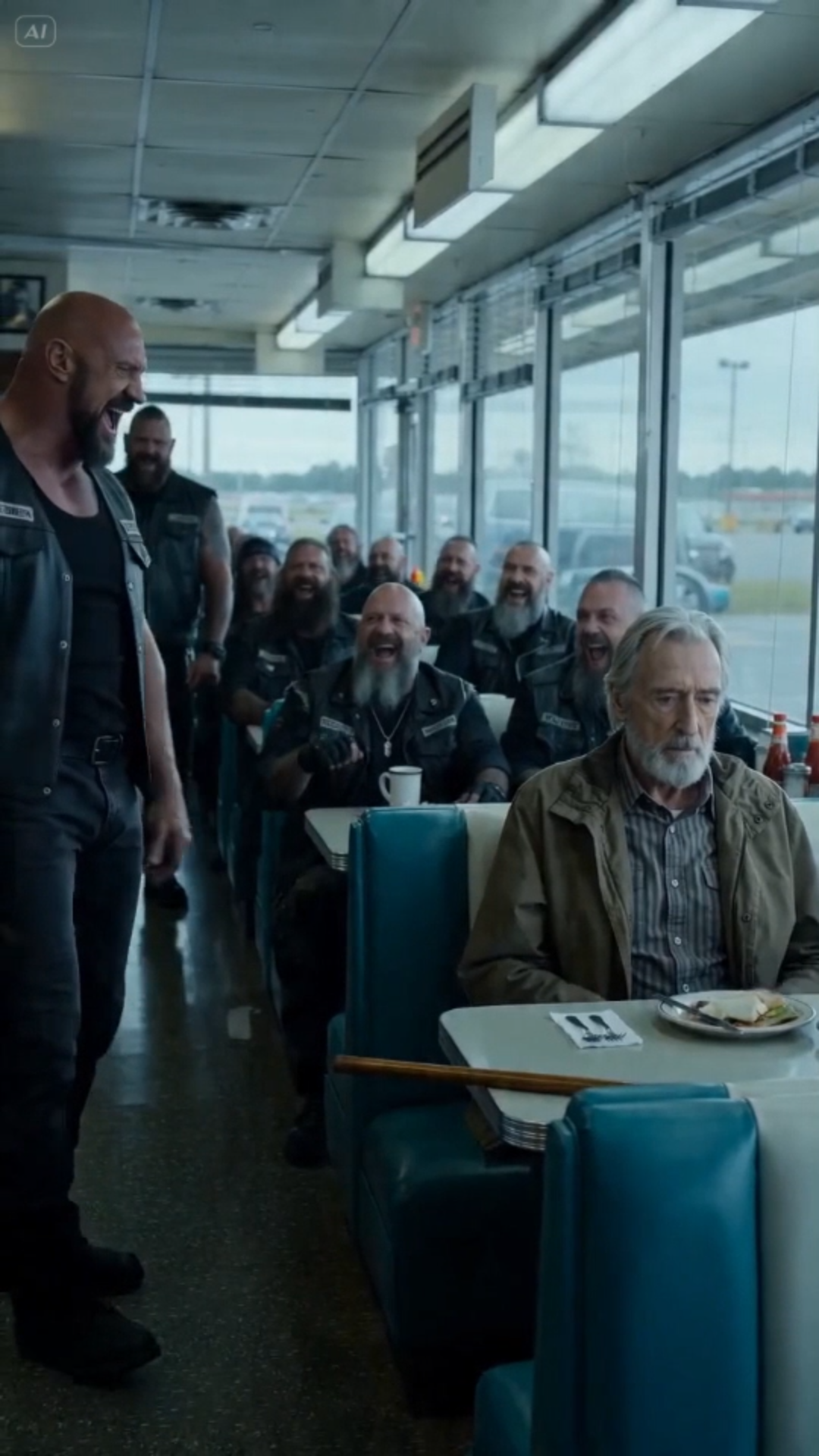
Walter Kane chose the booth by the window because he wanted Rex Dalton to see what was coming.
Not yet.
Not in the first minute.
Not while the coffee machine hissed behind the counter and the old ceiling lights buzzed softly above the teal leather booths.
But soon.
Very soon.
The diner looked almost exactly the way Walter remembered it.
Same white tables.
Same cracked sugar dispensers.
Same big front window facing the parking lot.
Same smell of coffee, fried eggs, and old grease that never quite left the walls.
Only the people had changed.
And not for the better.
Walter sat alone, his wooden cane resting across his knees.
He was seventy-two, silver-haired, silver-bearded, and thin in the way old men became when life had taken more from them than it gave back.
His dark khaki-brown jacket was worn at the elbows.
His striped button shirt was buttoned wrong at the collar.
To most people, he looked like a tired old man who had walked in for coffee and quiet.
That was exactly what he wanted them to think.
Across the diner, Rex Dalton laughed too loudly.
He sat with six bikers in black leather, taking up two booths like they owned the place.
Rex was huge.
Bald.
Bearded.
Heavy through the shoulders.
The kind of man who did not need to raise his voice to make a room uncomfortable, but always did anyway.
His gang laughed when he laughed.
Stopped when he stopped.
Looked where he looked.
And right now, Rex was looking at Walter.
“Who’s grandpa?” one of the bikers muttered.
Another one chuckled.
Walter did not turn his head.
He looked out the window at the empty parking lot, where cold daylight spread across the asphalt.
A waitress named Marlene stood behind the counter, pretending to wipe the same clean spot again and again.
Her hand trembled.
Walter noticed.
He noticed everything.
The broken lock on the front door.
The fresh scratch on the register drawer.
The dent in the napkin holder.
The unpaid bills stacked beside the pie case.
And the way every customer kept their eyes low whenever Rex Dalton shifted in his seat.
This was not a diner anymore.
It was a room being held hostage by fear.
Walter had seen places like this before.
In small towns.
In courtrooms.
In war zones.
The walls changed.
The method stayed the same.
Find people who feel alone.
Stand over them.
Laugh until they learn silence.
Rex pushed himself up from the booth.
The diner quieted before he even crossed the floor.
His boots hit the tile slowly.
Loudly.
One step at a time.
Walter kept one hand on his cane.
Rex stopped beside the booth and looked down at him.
“You lost, old man?”
Walter finally looked up.
His eyes were pale, calm, and cold.
“No.”
Rex smiled.
“You sure? This doesn’t look like your kind of place.”
Walter glanced around the diner.
“I knew it before you did.”
The smile left Rex’s face for half a second.
Then it came back sharper.
“You got a mouth on you.”
Walter said nothing.
Rex looked at the cane.
Then, with a sudden movement, he snatched it out of Walter’s hands.
Marlene gasped.
The bikers behind Rex burst into laughter.
Rex lifted the cane like a prize.
“Careful,” Walter said quietly.
Rex laughed.
“Or what?”
Then he slammed the cane hard onto the tabletop.
The crack of wood against Formica exploded through the diner.
Coffee cups jumped.
A child at the far end flinched into his mother’s side.
Walter’s shoulders jerked once.
Only once.
Then his face became still again.
Rex leaned close.
“What are you gonna do, old man? Limp at me?”
The gang roared.
Walter looked at the cane in Rex’s hand.
Not angry.
Not afraid.
Almost sad.
“That cane has been through better men than you,” Walter said.
Rex’s smile twisted.
“Then it can survive me.”
He walked a few steps away, still holding the cane, swinging it lazily as if it belonged to him.
The bikers clapped and laughed.
One of them slapped the table.
Another called out, “Make him dance, Rex!”
Marlene’s eyes filled with tears, but she did not move.
Nobody moved.
That was what Rex had trained them to do.
Walter reached slowly into his jacket.
Rex turned back.
“What, old man?”
Walter took out a smartphone.
The laughter thinned.
Rex lifted his chin.
“Calling the nursing home?”
Walter raised the phone to his ear.
His voice was soft.
Controlled.
Absolute.
“It’s me,” he said. “Bring ’em.”
Then he ended the call.
Rex stared at him.
For the first time, confusion touched his face.
Then he laughed again, louder than before.
“You hear that, boys? Grandpa’s got reinforcements.”
The bikers laughed with him, but not as hard this time.
Walter placed the phone on the table and folded his hands.
He did not ask for the cane back.
He did not look at Rex.
He looked out the window.
Rex followed his gaze.
The parking lot was still empty.
For about ten seconds.
Then the first black SUV turned in from the road.
Fast.
Clean.
Silent until the brakes caught.
Then another SUV came behind it.
And another.
And another.
A convoy of black SUVs rolled into the diner parking lot and stopped in a perfect line outside the big front window.
Headlights swept across the glass.
The diner went dead quiet.
No laughter.
No forks.
No coffee cups.
Just engines rumbling outside like thunder waiting to happen.
Rex’s hand tightened around Walter’s cane.
One of the bikers whispered, “Who the hell is that?”
Walter did not answer.
Doors opened.
Men stepped out.
Not bikers.
Not police.
Not thugs.
They wore dark suits and long coats.
Some were old.
Some were young.
All of them moved with discipline.
No shouting.
No weapons.
No wasted motion.
A tall Black man with a gray beard stepped from the lead SUV.
Beside him came a woman in a navy coat carrying a leather folder.
Behind them, two men held cameras.
Another carried a stack of documents.
Rex’s face hardened.
He pointed the cane toward the window.
“You think I’m scared of suits?”
Walter finally looked at him.
“No,” he said. “I think you’re scared of witnesses.”
The front door opened.
Cold air entered first.
Then the tall man in the gray beard walked in.
His eyes swept the diner, landed on Rex, then on the cane in his hand.
His jaw tightened.
“Walter,” he said, “you all right?”
Walter nodded once.
“Sit tight, Isaiah.”
Rex blinked.
Isaiah.
The name meant something to him.
He had seen it before.
On old photographs hanging in the clubhouse his gang had taken over.
Isaiah Brooks.
One of the original riders.
But that was impossible.
Isaiah Brooks was supposed to be dead.
Or gone.
Or too old to matter.
The woman in the navy coat stepped beside him.
“Mr. Dalton,” she said, “my name is Claire Hensley. I’m counsel for the Kane Foundation and legal representative for Marlene’s Diner.”
Rex barked a laugh.
“This place doesn’t have a lawyer.”
Marlene, from behind the counter, whispered, “It does now.”
Rex turned toward her.
“What did you say?”
Walter’s voice cut through the room.
“She said it does now.”
Rex glared at him.
“You don’t know what you just stepped into.”
Walter’s expression did not change.
“I stepped into my wife’s diner.”
That sentence hit the room harder than the cane had.
Marlene covered her mouth.
The bikers looked at one another.
Rex frowned.
“What?”
Walter slowly stood.
He was not tall.
Not anymore.
But the room changed when he rose.
“My wife, Ruth Kane, bought this diner in 1978 with money she saved waiting tables on double shifts,” Walter said. “She fed truckers who couldn’t pay. Veterans who had nowhere else to go. Kids whose parents forgot dinner.”
His eyes moved across the teal booths.
“She said every town needed one room where a person could sit down without being judged.”
Walter looked at Rex.
“And then men like you walked in and turned it into a place people were afraid to enter.”
Rex’s nostrils flared.
“You don’t own anything here.”
Claire opened the leather folder.
“Actually, he does.”
She laid documents on the counter.
“The property was transferred into the Ruth Kane Community Trust after Mrs. Kane’s death. Mr. Walter Kane is the trust’s controlling trustee. Marlene has been operating under a protected lease. Any attempt to force her to sell or vacate is illegal.”
Marlene began crying silently.
Rex looked from Claire to Walter.
Then he laughed again, but there was no confidence in it.
“You brought paperwork? That’s your big move?”
Isaiah Brooks stepped closer.
“No, Rex. He brought us.”
Rex stared at him.
“You’re not Isaiah Brooks.”
Isaiah reached into his coat and took out an old black-and-silver patch sealed in plastic.
The same patch Rex wore on his vest.
But older.
Cleaner.
Original.
“Black Ridge Riders,” Isaiah said. “Founded 1976. Walter Kane. Isaiah Brooks. Tommy Vale. Marcus Reed. Samuel Ortiz.”
The bikers behind Rex stopped moving.
One of them looked down at the patch on his own vest.
Isaiah’s voice hardened.
“We founded it to protect widows, veterans, and working people after the war. Not to threaten diner owners. Not to break windows. Not to collect cash from local businesses.”
Walter’s gaze moved to Rex’s vest.
“You’re wearing a promise you never earned.”
Rex’s face turned red.
“My father built this club.”
Walter’s eyes softened for one brief second.
“No, Rex. Your father was saved by this club.”
That silenced him.
Walter took a slow breath.
“Cal Dalton came home angry. Drunk. Broken. Your mother begged us to help him. We did. We got him work. We kept him out of jail twice. We stood beside him when nobody else would.”
His voice dropped.
“And then he sold our name to men who wanted to frighten this town.”
Rex’s grip tightened on the cane.
“My father was a king.”
“No,” Walter said. “Your father was a warning.”
Rex raised the cane slightly.
Isaiah stepped forward.
Walter lifted one hand.
Isaiah stopped.
Walter looked directly at Rex.
“You have been collecting money from Marlene for sixteen months. You and your men threatened the bakery, the gas station, the barbershop, and the church thrift store. You vandalized cars. You broke windows. You told people the police would not help them because half the county owed favors to the Daltons.”
Rex smiled.
“You got proof?”
Walter tapped the smartphone on the table.
“You gave it to me.”
Rex’s smile vanished.
Walter continued.
“Every word since you touched my cane has been recorded. Every threat. Every laugh. Every witness in this room. And outside, my team has signed statements from nine business owners, three former riders, and your bookkeeper.”
One of Rex’s bikers stood.
“Bookkeeper?”
Claire looked at him.
“Yes. The one you stopped paying.”
The biker slowly sat back down.
Rex looked toward the door.
Two county sheriff’s cruisers pulled into the parking lot behind the SUVs.
His face changed.
Not fear yet.
Calculation.
He leaned down toward Walter.
“You think old stories and signatures can bury me?”
Walter looked at the cane.
“No. I think your arrogance can.”
Rex followed his gaze.
Only then did he notice the small brass plate near the cane’s handle.
He turned it slightly.
The words were worn but readable.
Ruth Kane.
For the ones who still need a seat.
Rex stared at it.
Walter’s voice became quieter.
“My wife held that cane the last year she was alive. Cancer took her balance, but never her dignity. She sat in this booth and served coffee until her hands shook too badly to lift the pot.”
He stepped closer.
“And you slammed her name on a table to make men laugh.”
For the first time, Rex had no answer.
The sheriff entered with two deputies.
No guns drawn.
No drama.
Just authority.
“Rex Dalton,” the sheriff said, “you need to come outside with us.”
Rex spun toward him.
“You’re making a mistake.”
The sheriff’s face was grim.
“I made that mistake for too long already.”
Rex looked around at his gang.
“Do something.”
Nobody moved.
Because every man in that diner had felt the ground shift.
Rex was no longer the strongest man in the room.
He was just the loudest man who had finally run out of noise.
Isaiah stepped forward and held out his hand.
“The cane.”
Rex hesitated.
Then, slowly, he placed Walter’s cane into Isaiah’s hand.
Isaiah returned it to Walter.
Walter ran his thumb over Ruth’s brass plate.
His eyes closed for one second.
Then opened again.
Rex was escorted outside.
The bikers were questioned one by one.
Two tried to leave.
They did not get far.
By nightfall, the diner parking lot was filled with sheriff’s cruisers, black SUVs, local news vans, and people from town who had waited years to see Rex Dalton without control.
The investigation widened quickly.
Rex had not been acting alone.
His intimidation had helped a development company buy properties at half their value along the highway.
The company planned to tear down the diner, the bakery, the gas station, and a row of old houses to build a luxury roadside complex no one in town could afford.
The threats were not random.
They were strategy.
Rex scared people.
The developers appeared with offers.
The county ignored complaints.
And the money moved quietly.
Until Walter Kane returned.
For years, Walter had stayed away because Ruth’s death had hollowed him out.
He had left the diner in Marlene’s care and disappeared into a quiet house outside Nashville, answering letters, writing checks, and pretending grief was the same thing as peace.
Then Marlene sent him a message.
Not asking for money.
Not asking for help.
Just one sentence.
Ruth would be ashamed of what this place has become.
Walter read it five times.
Then he called Isaiah.
Then Claire.
Then every old Black Ridge Rider who still remembered what the patch was supposed to mean.
And finally, he walked into the diner alone.
Because he wanted Rex to show the town exactly who he was.
Rex Dalton was charged with extortion, criminal intimidation, vandalism, conspiracy, and coercion.
The development executives were indicted three months later.
So was a county zoning official who had buried complaints for years.
Several biker gang members took plea deals and testified.
The Black Ridge Riders were dissolved by court order, then rebuilt under a nonprofit charter by the original members and younger veterans who wanted no part of Rex’s corruption.
No more protection money.
No more threats.
No more leather vests used as weapons.
Six months later, Marlene’s Diner reopened after a full restoration.
The teal booths were repaired.
The window was replaced.
The door lock was fixed.
The old neon sign outside glowed again.
And on the wall behind the counter hung a framed photograph of Ruth Kane, smiling with a coffee pot in her hand.
Below it was her sentence.
For the ones who still need a seat.
Walter sat in the same booth by the window on opening day.
His cane rested beside him.
This time, nobody took it.
Marlene poured him coffee and smiled through tears.
“You saved this place,” she said.
Walter looked around at the crowded diner.
Veterans.
Nurses.
Truck drivers.
Families.
Former business owners who had almost lost everything.
“No,” he said. “Ruth did. I just came back late.”
Outside the window, the black SUVs were gone.
In their place were pickup trucks, family cars, motorcycles, and old sedans packed into the lot.
People had come from three counties to eat breakfast in a diner that had refused to be bullied out of existence.
A little boy at the next table pointed at Walter’s cane.
“Is that magic?”
His mother tried to hush him.
Walter smiled.
“No,” he said. “It just remembers things.”
The boy frowned.
“What kind of things?”
Walter looked at the brass plate.
Then at the diner.
Then at the road beyond the glass, where men like Rex Dalton had once thought fear could buy anything.
“The truth,” Walter said.
A year later, Rex Dalton stood before a judge and finally heard the word he had made others fear.
Sentenced.
Marlene watched from the front row.
So did Isaiah.
So did Walter.
Rex did not look big in the courtroom.
Without the booth behind him, the gang around him, and fear doing half his work, he looked like what he was.
A cruel man who mistook silence for weakness.
After the hearing, a reporter asked Walter why he had walked in alone that day.
Walter leaned on his cane and looked toward the courthouse steps.
“Because bullies always reveal themselves when they think nobody important is watching.”
The reporter asked, “And were you important?”
Walter smiled faintly.
“No,” he said. “But the people in that diner were.”
Then he walked away, slow but steady, the cane tapping once against the pavement.
Not as a sign of weakness.
As a warning.
Some men carry power in badges.
Some carry it in money.
