
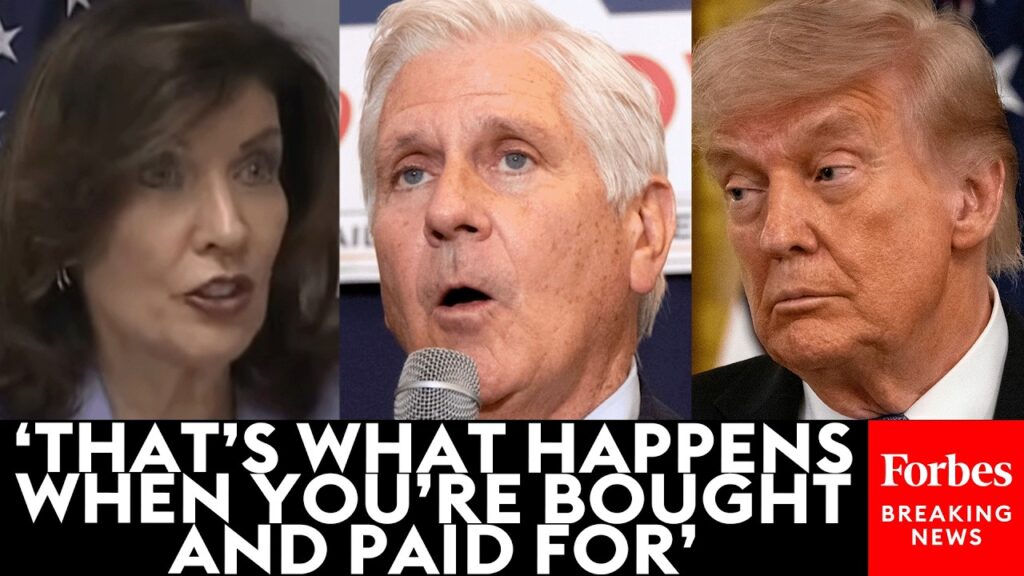
In a dramatic political confrontation, New York Governor Kathy Hochul has fiercely criticized Republican candidate Bruce Blakeman for allegedly seeking “marching orders“ from former President Donald Trump. This fiery exchange underscores a growing divide in the Empire State as Hochul calls attention to the implications of relying on party politics over the needs of New Yorkers.
During a recent media appearance, Hochul did not hold back her disdain, branding Blakeman’s trip to Trump’s residence as nothing short of a desperate plea for direction amidst a struggling campaign. “That’s just precious, isn’t it?“ she scoffed, indicating that she sees Blakeman’s actions as emblematic of a larger issue within the state’s political landscape.
Hochul’s comments come amid heightened tensions as both candidates gear up for the gubernatorial election. With New Yorkers facing mounting challenges—including skyrocketing gas prices and ongoing debates over education funding—Hochul argues that candidates should be focused on local issues rather than relying on the influence of national figures like Trump.
“He’s got to find out what Donald Trump wants him to do in the state of New York,“ Hochul asserted. This accusation suggests that Blakeman lacks the independence needed to lead effectively and may prioritize Trump’s agenda over the pressing needs of his constituents.
The governor’s remarks not only question Blakeman’s leadership but also invite voters to scrutinize the implications of a governor beholden to a party leader thousands of miles away. Hochul emphasized her commitment to fighting for New Yorkers, contrasting her approach to Blakeman’s reliance on the former president’s political capital.
As Hochul continues her campaign, she underscores the importance of local governance that addresses the specific concerns of constituents. During the interview, she highlighted challenges such as the soaring energy prices in Long Island, where gas prices have recently exceeded $5.50 a gallon, linking these issues back to the ineffectiveness of Blakeman’s proposed solutions.
“People want to know how candidates plan to directly tackle their everyday struggles,“ Hochul stated, positioning her campaign as one rooted in community needs rather than national party loyalty. By focusing on local issues and highlighting the ramifications of partisan politics, Hochul hopes to gain the support of undecided voters who prioritize pragmatism over partisan affiliation.
Blakeman’s camp has yet to respond effectively to these direct accusations, leaving voters to speculate on his ability to campaign independently of Trump’s influence. The apparent crux of the election will hinge on the candidates’ abilities to articulate their visions for New York while navigating the shadow of Trump, a figure whose impact looms large in today’s Republican politics.
As the gubernatorial election approaches, Hochul’s sharp words create a stark contrast between her approach and that of her opponents. The governor’s insistence on local engagement blends with a broader critique of a political system increasingly driven by national figures rather than nuanced state-specific solutions.
Voters across New York find themselves at a crucial crossroads, where their decision could shape the future direction of the state. The discourse surrounding Hochul and Blakeman illustrates not only the challenges of the upcoming election but also a larger conversation regarding accountability and the interests of the general populace.
In this heated political environment, the stakes have never been higher. Hochul’s fervent defense of New Yorkers, matched with her criticism of Trump-aligned candidates, formulates an urgent call to action, pushing voters to examine the implications of their choices in the coming election cycle.
As campaign strategies unfold, it remains to be seen whether Hochul’s fiery rhetoric will resonate with the electorate. However, her approach signals a determined effort to reclaim state politics from the clutches of national party influence, urging citizens to take an active role in shaping their local government.
The political landscape in New York is unraveling in real-time, illustrating that issues of everyday life, from energy costs to education, are at the forefront of this campaign. The question now looms: will New Yorkers rally behind a representative who prioritizes their needs, or will they choose a candidate swayed by distant political influences?
As the battle lines are drawn, one thing is certain: the conversation about New York’s political future is heating up, fueled by bold claims and urgent challenges. As Hochul throws down the gauntlet, eyes across the state are watching closely to see how this rivalry unfolds in the weeks to come. The next steps in this political showdown could redefine New York’s governance for years to come.
