
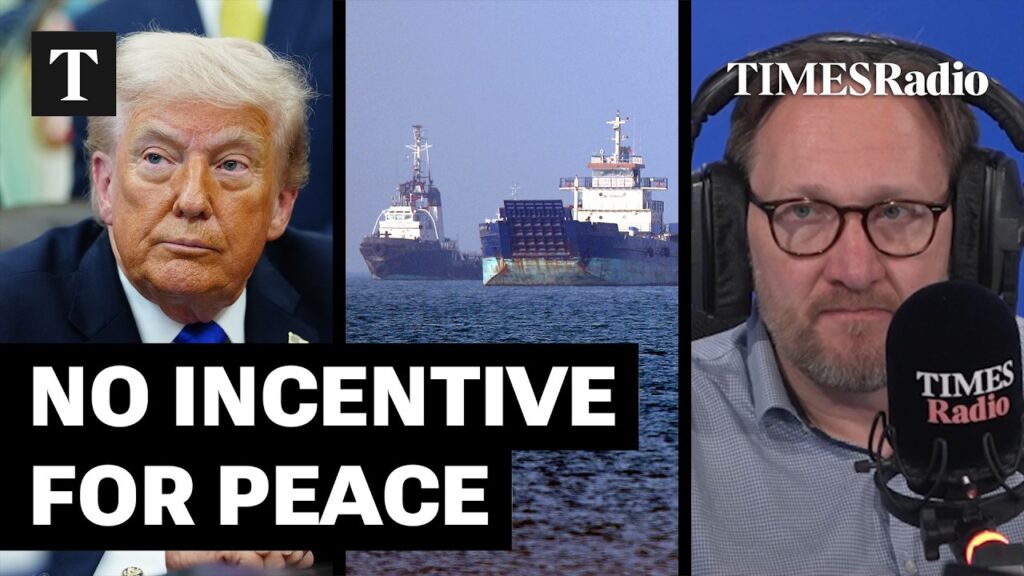
Tensions continue to escalate in the Strait of Hormuz as both Iran and the United States engage in a precarious standoff, each convinced of their tactical superiority. While President Trump boasts of America’s dominance, the reality on the ground reveals a potential for miscalculations spiraling out of control, heightening fears of wider conflict.
In an urgent press briefing, President Trump described the ongoing military engagements as a “skirmish,” asserting the U.S. was winning decisively against Iran, which he claims has no credible capabilities left. But behind the bravado lies a complex and dangerous game where both sides are posturing for strength, aware the other believes it is prevailing.
The situation in the Strait of Hormuz is especially dire, where U.S. naval forces are actively patrolling to protect commercial shipping lanes. Secretary of Defense Pete Hegseth articulated a vision of a “red, white, and blue dome” over the strait intended to deter Iranian operations. However, the psychological implications of crossing through this militarized zone remain unsettling for many commercial vessels, which may hesitate to navigate under the constant threat of hostilities.
Analysts reveal that while the U.S. military maintains upper hand capabilities on paper, the asymmetrical nature of warfare employed by Iran complicates matters. Iran continues to wield tactics of harassment, including threats of drone attacks and deploying mines in these critical shipping lanes. Such maneuvers keep U.S. forces on high alert, as the return of full-scale conflict would likely result in devastating consequences for both nations and their regional allies.
Moreover, the Iranian regime appears to be incentivized by its domestic political dynamics. Feeling insulated from internal dissent due to their authoritarian governance structure, Iranian leadership continues to project strength despite crippling economic sanctions. Their ability to suppress dissent allows them the latitude to engage in military posturing, further complicating any path towards de-escalation and peace.
Despite military successes claimed by the U.S., the environment in the Strait of Hormuz is anything but stable. The presence of increased American ground forces signals a preparation for potential escalations while also projecting power to deter Iranian aggression. The fear of wider conflict looms as both nations test one another’s resolve without crossing the precipice into open war.
Both President Trump and military officials have framed the U.S. effort as an essential response to Iranian provocations, which they deem necessary for maintaining global oil supply routes. However, the longer the stand-off continues, the more likely a miscalculation could trigger a significant and unintended military confrontation, raising alarms in Washington and across allied capitals.
The recent engagements signal a troubling reality – both sides, firmly entrenching themselves into their respective narratives of victory, have little incentive to engage in meaningful dialogue or negotiations. Each believes it has the upper hand, creating a feedback loop that diminishes the chances for a successful de-escalation.
International communities watch closely, understanding that the stakes involve not just regional players, but global economic implications as well. The Strait of Hormuz is crucial for oil transport to major markets, and any disruption could have ripple effects throughout the world economy, potentially leading to soaring prices and economic instability beyond the immediate conflict zone.
In this high-stakes game, strategic naval maneuvers, and military posturing serve as visible reminders of the thin line separating peace from escalated confrontation. Experts argue that without a third-party mediator to facilitate discussions, both parties remain trapped in a cycle of conflict perception and military readiness that jeopardizes any chance of a diplomatic resolution.
As the situation evolves, every interaction carries the potential to spark a confrontation, with high-ranking officials from both sides exchanging warnings and rhetoric that only escalate tensions further. The message must be clear; diplomacy must prevail if we are to avoid the catastrophic costs associated with a war that neither Iran nor the U.S. can truly afford.
The U.S. stands resolute in its commitment to protect maritime routes but recognizes that deterrence can only stretch so far. For Iran, political survival in the face of crippling sanctions and military posturing demands a show of strength, further jeopardizing any chance of diplomatic success. As both nations negotiate this dangerous landscape, the world watches closely, with the potential for the situation to unravel towards chaos ever-present.
In this volatile climate, the risk of missteps looms large. As reports circulate of aggressive encounters on the waves, both Washington and Tehran must recalibrate their strategies to ensure that the delicate balance of power does not tip into open conflict. Without immediate diplomatic engagement, the risk of escalation remains disturbingly high, placing both nations, and the world, on a precarious precipice.
In a world where every miscalculation could lead to significantly dire consequences, the narrative of victory espoused by both parties serves only to cloud the judgment necessary for strategic decisions. The need for a sustainable, peaceful resolution has never been more urgent, but as tensions at the Strait of Hormuz continue to rise, the path toward that resolution seems increasingly fraught with danger.
