
Chapter 1
He didn’t slam the door.
He didn’t raise his voice.
That was what made it unforgettable.
The moment my husband chose to leave us arrived wrapped in ordinary silence—an afternoon so quiet it felt almost rehearsed.
The fridge hummed softly.
Pale autumn light stretched across the kitchen floor like nothing in the world was about to break.
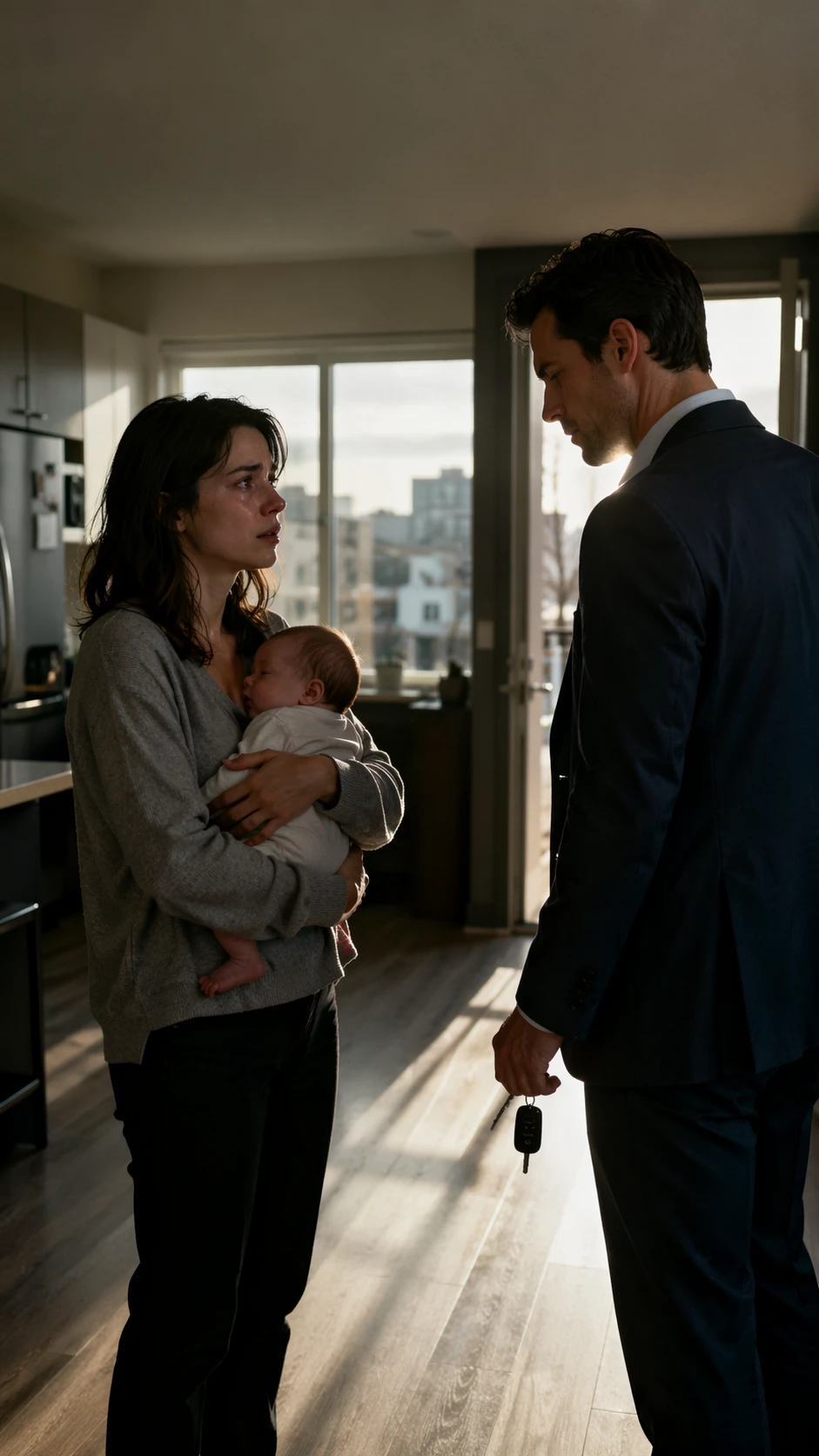
He stood in front of me, car keys resting in his palm, as if he were heading out for groceries—not walking away from his family.
Our son was only three months old.
He slept against my chest, warm and fragile, completely unaware that his future had just been rewritten.
The neurologist’s words still pulsed in my head like a warning I couldn’t silence—motor delays, years of therapy, a life that would demand patience measured in decades, not milestones.
My husband, Warren Pierce, didn’t ask a single question.
Not one.
He didn’t step closer.
Didn’t look at the crib.
“I’m not doing this,” he said, his voice flat, stripped of emotion.
“I’m not signing my life over to something like this.”
No anger.
No hesitation.
Just a clean, surgical decision—like love had terms and conditions, and our son had already violated them.
That silence hurt more than any scream ever could.
Within days, his world reshaped itself.
Photos appeared online—smiling dinners, a new woman, carefully curated laughter that looked effortless.
Meanwhile, mine collapsed into hospital visits, paperwork, and nights so long they blurred into mornings.
The divorce was quick.
Precise.
Handled by lawyers who spoke gently while dismantling everything I thought was permanent.
I remember standing in a courthouse hallway, a diaper bag digging into my shoulder, medical files clutched in my hand.
I watched Warren sign the final documents like he was closing a deal—not erasing himself from his child’s life.
And right there, under fluorescent lights that made everything feel colder than it was, I made a promise.
I would not break.
Because someone in my arms needed me whole.
Life after that didn’t come with dramatic music or heroic turning points.
It came quietly—one exhausting day after another.
Early therapy sessions.
Late nights stretching tiny muscles on the living room floor.
Endless meetings where professionals smiled politely while lowering expectations for my son.
I took every job I could find.
Eventually, I found my way into operations at a nonprofit in Seattle focused on accessibility.
That was where I learned something important.
Systems can be changed.
People’s assumptions… rarely.
My son grew.
And somewhere along the way, I gave him a new name—Adrian Rowe.
He would carry mine.
Only mine.
He walked unevenly, a cane becoming part of him by his teenage years.
But his mind… his mind was sharper than anything the world expected from him.
He didn’t follow trends.
Didn’t care about fitting in.
He studied.
Law books stacked high on the kitchen table, pages marked and worn under the glow of a dim lamp.
Sometimes I would stand there, watching him, unsure whether to feel proud or afraid of how intensely he focused.
“You don’t need to prove anything to anyone,” I told him once, softly.
He didn’t look up.
“I’m not proving anything,” he said.
“I’m getting ready.”
For what, I almost asked.
But something in his tone stopped me.
Because for the first time…
I realized he wasn’t catching up to the world.
He was preparing to face it.
Chapter 2
By sixteen, **Adrian could quote disability law the way other boys quoted song lyrics**.
He knew case names, precedent, loopholes, and the exact places where powerful men liked to hide behind polished language.
He also knew pain.
Not only the kind in his legs after long days, but the quieter kind—the kind that came from watching doors close before he even reached them.
One rainy evening in Seattle, I came home and found him sitting with a cardboard box I had never seen before.
Old envelopes were spread across the table like evidence.
“Where did you get those?” I asked.
He looked up slowly.
“From the front desk downstairs.
Someone had them delivered years ago, but the address was incomplete.
They were finally forwarded.”
The handwriting on the top envelope made my stomach clench.
**Eleanor Pierce.**
Warren’s mother.
She had been the only one in that family who ever looked ashamed.
At the courthouse, eighteen years earlier, she had stood at the far end of the hallway, pale and silent, while her son signed his family away.
My hands shook as Adrian opened the first letter.
Inside was an apology.
Not vague.
Not elegant.
**Brutally honest.**
_I failed you both by raising a man who thinks weakness is contagious._
_I do not ask forgiveness._
_I only ask that one day Adrian know someone on that side of his blood saw his worth._
There were dozens more.
Birthday letters she had written but never sent.
Articles about accessibility reform.
Notes about scholarships, legal programs, internship contacts.
And at the bottom of the box was a cream folder stamped with the name of a Portland law firm.
Adrian opened it carefully.
His face changed.
“What is it?” I whispered.
He slid the page toward me.
It was a notice from Eleanor’s attorneys.
**She had died three weeks earlier.**
And in her will, she had named Adrian Rowe—identified by his birth records as Adrian Pierce—her direct beneficiary for a private trust.
I stared at the paper for so long the words blurred.
“Why would she do this?” I asked.
Adrian’s jaw tightened.
“Maybe because she knew exactly what he did.”
He folded the letter once.
Then again.
And for the first time in years, I saw something colder than anger in his eyes.
Not revenge.
**Purpose.**
Chapter 3
The lawyers in Portland expected a grieving grandson.
What they got instead was **a young man with a cane, a calm voice, and a legal mind so precise it made senior partners sit up straighter**.
Eleanor had not left Adrian money alone.
She had left him information.
Pierce Urban Mobility—Warren’s gleaming company, the one magazines praised for “visionary civic leadership”—had a carefully hidden structure.
Eleanor still owned the controlling shares.
Warren had been running the empire, but **he had never truly owned it**.
And in a codicil added two years before her death, Eleanor had done something almost unimaginable:
she transferred those controlling shares to Adrian upon his eighteenth birthday, through a trust activated only if Adrian chose to accept.
I thought Adrian would refuse.
I thought he would tear the papers in half and walk away from every poisoned thing tied to the Pierce name.
Instead, he sat with the firm’s senior counsel, Gabriel Stone, and asked for a copy of every board agreement, every voting clause, every succession right.
“You’re reading this like a litigator,” Stone said quietly.
Adrian didn’t smile.
“I intend to be one.”
By then he was already deep into an accelerated legal fellowship—an impossible path he had earned through scholarships, brutal work, and sheer defiance.
He studied during train rides, in waiting rooms, at breakfast, at midnight.
**He treated law like other people treated oxygen.**
Weeks later, Stone called again.
“There’s a gala in Portland,” he said.
“Pierce Urban Mobility is unveiling a new accessibility initiative.
Warren will be center stage.
The board expects a ceremonial announcement.”
Adrian’s fingers tightened around his phone.
“And?”
“And Eleanor included one final instruction,” Stone said.
“If the transfer is ever to be executed, it must be read publicly, in the presence of the board, on the night of first announcement after your eighteenth birthday.”
I felt the air leave my lungs when Adrian told me.
“No,” I said immediately.
“You don’t owe him a confrontation.”
He looked at me with unbearable gentleness.
“This isn’t for him.”
“Then for who?”
His answer came without hesitation.
**“For the woman who carried me when he wouldn’t.”**
I turned away because my eyes had filled too fast.
But behind me, I heard the quiet scrape of his cane as he stood.
“I’m not going there to ask for anything, Mom,” he said.
“I’m going there to take the truth out of hiding.”
Chapter 4
The ballroom looked like the kind of place built to flatter bad men.
Gold light.
Crystal chandeliers.
Champagne laughter bouncing off marble like money itself made echoes.
Warren Pierce stood at the center of it all, older now, silver at the temples, one hand resting easily on a donor’s shoulder as he laughed.
His tuxedo was flawless.
His smile was practiced.
And when he turned, scanning the room, **his eyes moved past us without recognition**.
That hurt more than I expected.
I had imagined shock.
A flinch.
Some ghost of memory.
Instead, there was nothing.
Adrian noticed.
I saw it in the tiny stillness of his face.
Then the emcee welcomed “the next generation of legal advocates in accessibility justice,” and Adrian rose.
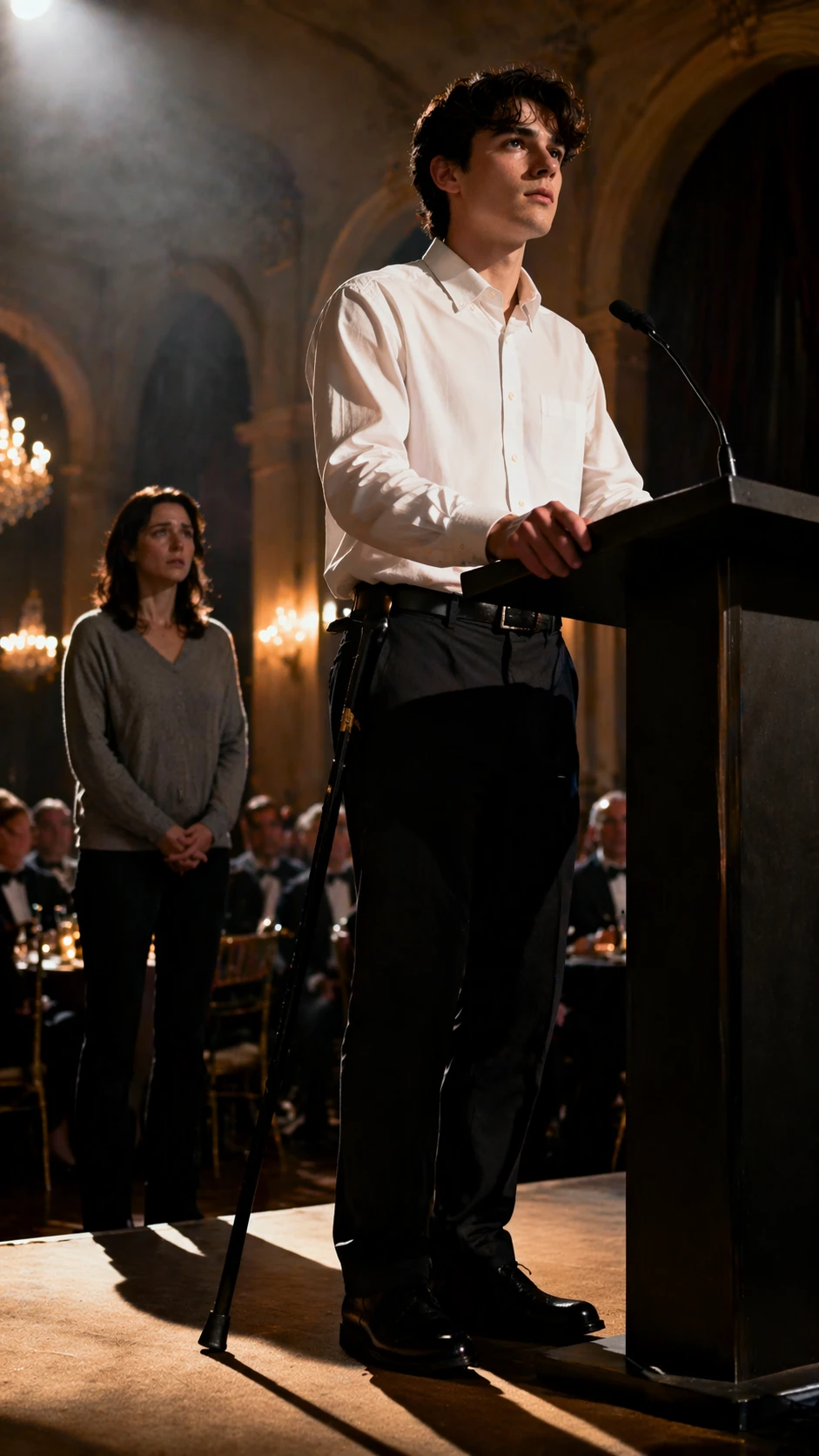
A murmur moved through the room as he stepped onto the stage with his cane.
Young.
Composed.
Impossible to ignore.
He reached the podium and adjusted the microphone.
“My name is Adrian Rowe,” he began.
His voice was low, clear, controlled.
“And eighteen years ago, a man decided a disabled infant was too expensive to love.”
The room went silent.
He did not rush.
He let every word land exactly where it needed to.
“He left without shouting.
Without grief.
Without even the courage to look at the crib.”
Across the ballroom, Warren’s smile disappeared.
Adrian lifted his eyes.
“His name,” he said, “is **Warren Pierce**.”
It felt as if the entire room stopped breathing.
I saw heads turn.
Wineglasses freeze halfway to lips.
A woman at table three actually whispered, “My God.”
Warren rose so fast his chair struck the floor.
“This is inappropriate,” he snapped.
“This is some kind of stunt—”
“No,” Adrian said, still calm.
“**A stunt is building a public brand on compassion you never had in private.**”
The silence turned electric.
Adrian spoke of a mother carrying therapy bags up apartment stairs.
Of nights on living room floors.
Of schools that underestimated.
Of a child who learned early that dignity was often something the world made disabled people fight to keep.
Then he looked directly at Warren.
“You abandoned me before I could form memory,” he said.
“But your absence had shape.
It had paperwork.
It had signatures.”
Warren’s face had gone gray.
“You have no idea what you’re talking about.”
Adrian opened a folder.
“I do.
I have the divorce filings.
The relinquishment documents.
The medical correspondence.
And I have your mother’s letters.”
That landed like a blade.
For the first time, Warren looked afraid.
Chapter 5
You could feel the room shifting.
Not just emotionally.
Socially.
Legally.
Board members were whispering to one another now.
Phones were out.
The press table near the back had stopped pretending this was a charity event.
Adrian turned one page.
“Eleanor Pierce wrote that she was ashamed of the man her son had become,” he said.
“She wrote that a legacy built without decency was just architecture around rot.”
A sharp breath moved through the crowd.
Warren took a step toward the stage.
“You will stop this now.”
Gabriel Stone rose from the front row.
“No, Mr. Pierce,” he said evenly.
“**He won’t.**”
Three more attorneys stood with him.
That was the moment Warren understood this had not been improvised.
This had been prepared.
Documented.
Timed.
Adrian’s voice never wavered.
“Tonight was meant to announce a new expansion in your company’s accessibility division.
A tribute to your leadership.
A celebration of your name.”
He let the words hang there.
Then he delivered the sentence that cracked the room open.
“**But Warren Pierce has never owned this company.**”
The board chair closed her eyes.
Adrian continued.
“Pierce Urban Mobility remained under Eleanor Pierce’s controlling shares until her death.
Under the binding transfer executed in her final codicil, those shares passed to her grandson upon his eighteenth birthday.”
Warren laughed then—a hard, desperate sound.
“That’s impossible.”
“It’s already done,” Stone said.
Adrian lifted the final document.
“As of 7:42 tonight, ratified by the board and witnessed by counsel, control has transferred.”
His fingers rested lightly on the paper.
“Not to the son you wanted.
To the one you discarded.”
Warren looked like a man watching the floor vanish beneath him.
Then Adrian leaned slightly closer to the microphone.
“And I’m not finished.”
My heart slammed once against my ribs.
Because I knew that voice.
It was the voice he used when every piece was already in place.
“The accessibility initiative unveiled tonight will move forward,” he said.
“But not under your name.
Effective immediately, Pierce Urban Mobility will be restructured into the **Rowe Center for Accessible Justice and Design**.”
The applause did not start all at once.
It began with one person.
Then another.
Then a wave.
Warren stared at the audience as if they had betrayed him.
But the true ending had not arrived yet.
Because Adrian looked down at him and said the one thing I never saw coming.
“She also left one more sealed instruction,” he said.
“One addressed to you.”
Chapter 6
A staff member carried the envelope across the ballroom with shaking hands.
Warren snatched it, tore it open, and unfolded the letter from his dead mother.
He read the first line.
Then the second.
And all the color left his face.
“What does it say?” someone called.
Warren said nothing.
So Adrian answered.
“It says Eleanor Pierce arranged a DNA confirmation before her death,” he said.
“It was attached to the trust for legal certainty.”
A strange confusion rippled through the room.
I felt it too.
Because I already knew Adrian was Warren’s son.
I had lived every brutal second of that truth.
Then Adrian spoke again.
“**The test confirmed that Warren Pierce is not my biological father.**”
For one suspended second, reality split.
I actually gripped the edge of my chair to stay upright.
Warren’s head jerked toward me.
His mouth opened.
Closed.
Opened again.
“No,” he said hoarsely.
“No, that’s not—”
But memory hit me like shattered glass.
The hospital.
The dates.
A conversation I had buried because life after abandonment had demanded survival, not reflection.
A blood test the doctors had once requested after Adrian was born because a medication reaction didn’t align with Warren’s chart.
Warren had refused follow-up testing.
We had never finished the process.
My breath came ragged.
Adrian looked at me then—not accusing, not cold.
Only heartbreakingly steady.
“I found the incomplete file in Eleanor’s records,” he said softly.
“She had it confirmed after she learned about it.
She kept it sealed because she didn’t want to hurt you unless it became necessary.”
The room was utterly still.
Warren’s voice cracked.
“Then none of this is mine.
Not him.
Not the company—”
“No,” Adrian said.
And then came the final blow.
“**But you still signed away a child you believed was yours because he was disabled.**”
There it was.
The truth beneath every excuse.
Beneath blood.
Beneath law.
Beneath inheritance.
He had not failed biology.
**He had failed character.**
Warren swayed where he stood.
For a horrifying moment, I thought he might collapse.
No one moved to catch him.
Adrian’s voice softened, and somehow that was worse.
“You spent eighteen years thinking your great shame would be that the son you abandoned came back stronger than you,” he said.
“But that isn’t your shame.”
He rested one hand on the podium.
“Your shame is that **he didn’t even have to be yours for you to owe him love.**”
I put a hand over my mouth.
Tears burned hot and fast down my face.
Around us, people were crying.
Not politely.
Not discreetly.
Openly.
The board chair stood.
“Mr. Pierce,” she said, her tone formal and final, “security will escort you out.”
He turned once more—first toward Adrian, then toward me.
There was something in his eyes I had once wanted desperately to see.
Regret.
Real regret.
But eighteen years too late is just another form of absence.
He opened his mouth as if to say my name.
I looked away.
On stage, Adrian straightened, tall despite the cane, the chandeliers catching in his dark hair.
**For the first time in that room, Warren Pierce looked small.**
The applause rose again.
Louder this time.
Not for scandal.
Not for revenge.
For truth.
Adrian looked at me across all that gold light and all those years.
And when he smiled, it was not triumphant.
It was free.
Later, after the ballroom emptied and the reporters were held back by staff, I found him alone backstage, sitting in a folding chair with the envelope box beside him.
I knelt in front of him.
“Why didn’t you tell me sooner?” I whispered.
He swallowed hard.
“Because I didn’t want you to think your life with me was built on a mistake.”
I took his face in both hands.
“Listen to me,” I said.
“**You were never the mistake.
He was.**”
His composure broke then.
Only for a moment.
Only enough for me to see the little boy under the lawyer, under the fighter, under the man he had become.
I pulled him into my arms.
And in that backstage silence, with the last of the gala music fading through the walls, I understood something that made my chest ache with relief.
Warren had lost everything he thought mattered that night.
His name.
His company.
His mask.
But Adrian had gained something far greater.
Not revenge.
**Inheritance of truth.
Freedom from blood.
And a future built, at last, by the love that stayed.**
