
Chapter 1
The morning should have smelled like coffee and rain-washed pavement.
Instead, it smelled like humiliation.
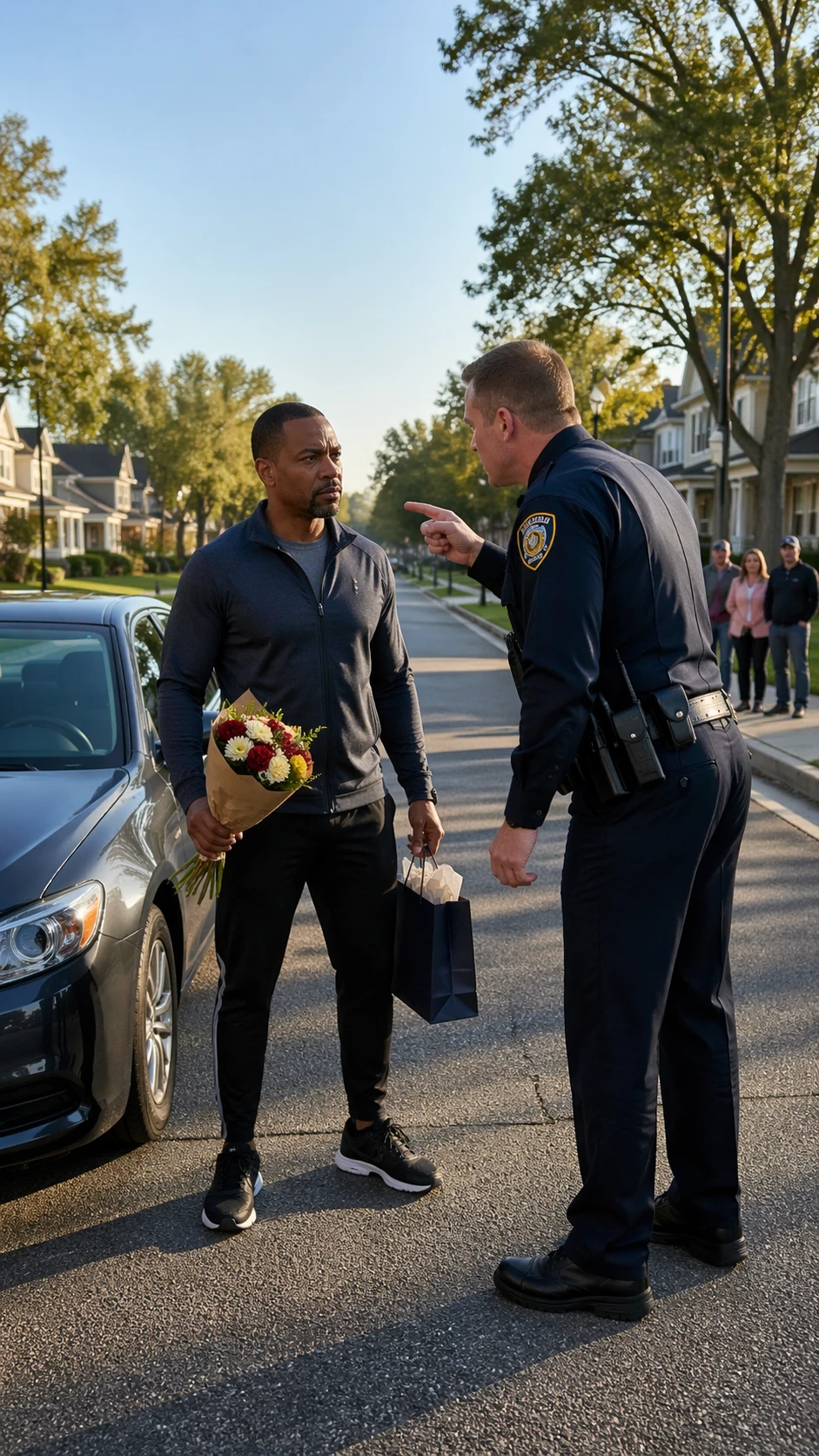
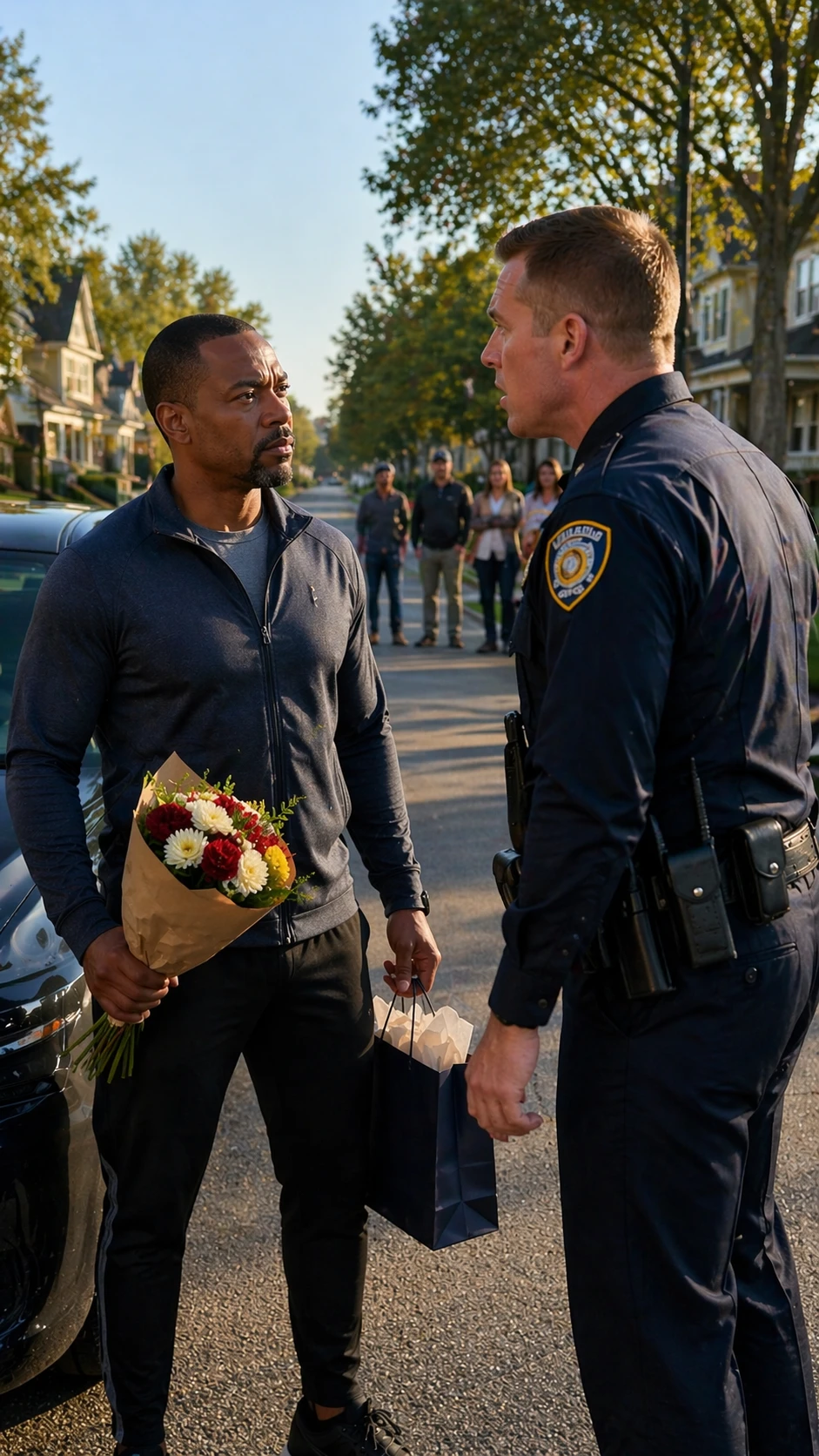
Dr. Jonathan Williams stood beside his Honda Accord with a bouquet in one hand and a navy gift bag in the other.
The flowers were for his daughter, Emma, who had just signed the lease on her first apartment.
He had planned to tease her about finally learning how to cook something besides instant noodles.
He had planned to hug her, carry in the boxes she still had not unpacked, and leave before her cat decided his shoelaces were prey.
A simple Saturday.
A father’s errand.
Then officer Derek Sullivan stepped out of his patrol car and turned it into something else.
“You better get your black ass out of this neighborhood before I make you regret it.”
The words landed hard.
Cold. Deliberate. Public.
Jonathan froze for half a heartbeat.
Not because he was afraid.
Because he recognized the tone.
The tone of a man who had already decided the story.
Already chosen the villain.
“I’m visiting my daughter,” Jonathan said quietly.
He kept his voice even, almost gentle.
Sullivan moved closer.
His hand hovered near his belt.
“I don’t care what lie you’ve got ready.”
“People like you don’t live here.”
The quiet street seemed to lean in.
A curtain twitched in a nearby window.
Jonathan glanced once at the apartment building.
Third floor. Emma’s unit.
He could already imagine her inside, still laughing at some video, unaware that twenty feet below her window, a stranger in a badge was trying to erase her father’s dignity.
He drew a slow breath.
The kind of breath that kept anger from becoming disaster.
“Officer, I belong exactly where I’m standing.”
Sullivan barked a humorless laugh.
“Hands where I can see them. Now.”
Jonathan lifted them carefully, flowers trembling only slightly.
The gift bag rustled against his wrist.
A police cruiser idled at the curb.
Its dash cam watched everything.
And maybe, Jonathan thought, that would matter later.
Chapter 2
Richmond woke slowly around them.
A dog barked behind a fence.
Somewhere farther down the block, a lawn sprinkler clicked in precise little arcs.
But here, in the widening ring of attention around the cruiser, something ugly had already bloomed.
Derek Sullivan had worn the badge for nine years.
Long enough to learn procedure.
Long enough to learn power.
Not long enough to learn restraint.
His file sat inside a gray cabinet at headquarters, thick with complaints and excuses.
Each incident explained away.
Each bruise on the truth softened by phrases like misunderstanding, officer discretion, insufficient evidence.
Last winter, Marcus Thompson had been handcuffed beside his BMW for two hours because Sullivan found it suspicious that a Black man could afford leather seats and a custom watch.
In March, four Black teenagers volunteering outside the community center were detained because Sullivan decided their laughter sounded like criminal intent.
And each time, the city had flinched.
Then looked away.
Jonathan knew pieces of that history.
He had heard the reports, read the summaries, seen how often harm arrived wearing the mask of policy.
That was why Monday’s calendar included a police reform forum.
May you like

That was why he had spent the past year fighting a battle half the city called necessary and the other half called betrayal.
But Derek Sullivan did not recognize the man in front of him.
He saw no mayor. No physician. No father.
Only skin.
Sweat.
Casual clothes.
An old Honda.
“What apartment?” Sullivan snapped.
“Three-twelve.”
“My daughter Emma lives there.”
“Name on the lease?”
“Emma Williams.”
Sullivan’s eyes narrowed, as if even the surname offended him.
Jonathan saw it then—the officer wasn’t investigating.
He was performing.
For the neighbors.
For himself.
For the old, poisonous fantasy that some people had to prove they were human before they could be left alone.
Two pedestrians had stopped across the street.
A woman in pink scrubs stood clutching her purse.
A man walking his golden retriever slowed until the leash went slack.
Jonathan met their eyes only once.
He saw pity there.
And that cut deeper than Sullivan’s words.
Chapter 3
“Turn around,” Sullivan ordered.
Jonathan looked at him steadily.
“For what reason?”
That was the wrong question.
Sullivan’s jaw clenched.
His face hardened into something almost eager.
“For obstruction.”
“For making me repeat myself.”
Jonathan felt the pulse beating in his throat.
Not panic.
Memory.
He remembered being twelve years old and watching his father, a high school principal, stopped on the shoulder of a Georgia road by a trooper who had called him boy.
He remembered the hand on the holster.
The silent prayer in his mother’s eyes from the passenger seat.
He remembered promising himself that if he ever had power, he would use it to make sure nobody else had to survive that kind of small, official cruelty.
And now here he was.
Standing in his own city.
Living inside the very thing he had sworn to fight.
From above, a window slid open.
“Dad?”
Emma.
Jonathan looked up.
She stood on the third-floor balcony in oversized pajamas, hair tied in a crooked knot, one hand braced on the railing.
Her face changed the moment she saw the officer.
The bouquet in his hand.
The patrol car.
“Dad, what’s happening?”
Sullivan glanced up sharply.
Something in his posture shifted.
Not guilt.
Annoyance.
“Ma’am, stay where you are,” he called.
“This is police business.”
Emma’s voice cracked like glass.
“He’s my father!”
The words rang across the street.
The two bystanders went still.
The woman in scrubs put a hand over her mouth.
For one dangerous second, Sullivan looked uncertain.
Then pride shoved uncertainty aside.
“That doesn’t prove anything,” he snapped.
“People say a lot of things.”
Emma stared at him in disbelief.
Jonathan wished, with sudden painful force, that she were anywhere else.
He had spent his career protecting residents from budget cuts, predatory landlords, crumbling schools, flooded roads.
None of it felt as urgent as protecting his daughter from this moment.
“I’m asking you one more time,” Jonathan said.
His voice was calm, but steel ran beneath it now.
“De-escalate.”
Sullivan stepped forward instead.
Chapter 4
The flowers slipped from Jonathan’s hand and hit the pavement.
White petals scattered across the asphalt like torn surrender flags.
Emma gasped.
A car slowed at the end of the block and stopped.
Sullivan reached for Jonathan’s wrist.
Not a full grab. Not yet.
A test.
Jonathan took one step back.
Measured. Nonthreatening.
But Sullivan had already committed himself.
“You think you can ignore me because you know somebody?”
Jonathan almost laughed at the bitter irony.
Know somebody.
He knew the police chief.
The city council.
The governor.
He knew the names of mothers whose sons had been stopped, searched, humiliated, and then told to go home grateful nothing worse had happened.
He knew the cost of silence.
The price of delay.
And suddenly he understood that this moment was no longer private.
It had become evidence.
Evidence of what happened when a culture trained certain men to confuse prejudice with instinct.
Evidence of what happened when every warning sign was filed, stamped, buried.
The dash cam kept recording.
The witnesses kept watching.
Jonathan straightened.
The street fell quiet in that strange way public shame sometimes creates.
Even the dog behind the fence had gone silent.
Sullivan pointed at him again.
“This is your last warning.”
Jonathan looked directly into his eyes.
“No,” he said softly.
“It’s yours.”
Something flickered across Sullivan’s face.
Confusion first.
Then anger at being confused.
He reached for his cuffs.
Emma ran down the building stairs so hard the front door banged against the brick.
“Stop!” she screamed.
She crossed the sidewalk barefoot, breathless, phone already in her hand.
She moved toward her father, but Jonathan lifted one palm to stop her.
That hurt him more than anything.
Seeing fear swallow her face.
“Stay back, Emma,” he said.
“It’s okay.”
It was not okay.
But fathers lied about that all the time.
Sullivan turned to her.
“Put that phone away.”
“No,” she shot back.
“I’m recording this.”
By now, three more neighbors had gathered.
One man muttered, “Jesus Christ.”
Another whispered, “That’s Dr. Williams.”
Not loudly.
But loud enough.
Sullivan heard it.
Jonathan saw it in the sudden tightening of his mouth.
Recognition was beginning.
Not complete.
Just a shape.
A tremor.
The first crack in certainty.
Chapter 5
Jonathan did not rush the moment.
He had spent years in hospital corridors delivering impossible news to families.
He had learned that the truth changed rooms most powerfully when it arrived without shouting.
He bent once, slowly, and picked up the bouquet.
One stem had snapped.
Emma stood three feet away, shaking.
The phone in her hand trembled so hard the image must have been blurring.
“Dad…”
Her voice was small.
A child’s voice, though she was twenty-four.
Jonathan looked at her and felt rage move through him like fire under glass.
Not the wild rage that lunged.
The disciplined kind.
The kind that built consequences brick by brick.
He faced Sullivan again.
“My name is Dr. Jonathan Williams.”
Sullivan said nothing.
His eyes sharpened.
“I am a resident of this city.”
“I am a taxpayer in this city.”
Still nothing.
But the officer’s shoulders had changed.
Jonathan took one careful step forward.
Not enough to threaten.
Enough to claim space.
“I was elected to serve this city.”
“I have spent fifteen years walking these streets so the people who live here know I do not hide from them.”
The bystanders were no longer uncertain now.
The man with the dog whispered a curse under his breath.
Emma lowered the phone by an inch.
Not because she was less afraid.
Because she was beginning to understand exactly what was happening.
Sullivan swallowed once.
A tiny, involuntary motion.
Jonathan saw the color drain from his face.
Saw the entire architecture of arrogance begin to wobble.
Then Jonathan said it.
Quiet.
Clean.
Final.
“I’m the mayor of this city.”
It was as if the block itself stopped breathing.
Sullivan’s hand fell away from the cuffs.
His mouth opened.
Closed.
Opened again.
Emma covered her lips with one hand, eyes filling instantly.
Not from relief alone.
From the horror of how close it had come.
How easily it could have been worse if Jonathan had been anyone else.
The officer stared at him.
Really stared, for the first time.
And Jonathan could see the exact second recognition fully arrived.
Not just of the man.
Of the catastrophe.
Chapter 6
For three long seconds, nobody spoke.
Then Sullivan did the one thing Jonathan least expected.
He laughed.
A thin, broken sound.
Too sharp to be embarrassment.
Too empty to be disbelief.
“Nice try,” Sullivan said.
But there was no force behind it now.
No conviction.
Only panic wearing the costume of contempt.
Jonathan’s eyes narrowed.
Emma looked stunned.
The neighbors exchanged glances.
The woman in pink scrubs whispered, “Oh my God.”
Sullivan took a step back and reached for the radio at his shoulder.
His voice came out clipped, fast.
“Dispatch, run ID on Jonathan Williams.”
He paused.
“Possible impersonation.”
That single word hit harder than everything before it.
Impersonation.
Jonathan felt something inside him go cold.
Not because the accusation was clever.
Because it was desperate.
Because when some men are finally cornered by truth, they do not surrender.
They burn the ground beneath everyone.
Emma stared at Sullivan as if he had become something inhuman.
“You cannot be serious.”
“I said stay back,” he barked, but the old force was gone.
His hand shook at the radio.
Static crackled.
Then dispatch answered.
A pause followed.
Longer than any of them expected.
Jonathan heard his own heartbeat.
He heard the leaves moving overhead.
He heard Emma trying not to cry.
And then the dispatcher’s voice came through.
Clear. Unmistakable.
Carried by the open radio to everyone standing there.
“Unit 14, be advised… that is Mayor Jonathan Williams.”
Silence.
Not ordinary silence.
A crushing, holy kind of silence.
Sullivan went white.
The neighbors stared.
Emma let out a ragged breath that sounded almost like pain.
Jonathan thought that was the end.
The unmasking.
The collapse.
It wasn’t.
