

Chapter 1
The insult did not echo.
It landed.
Heavy.
Precise.
Meant to wound.
“Pack your ghetto belongings and get out.
You’re fired, girl.”
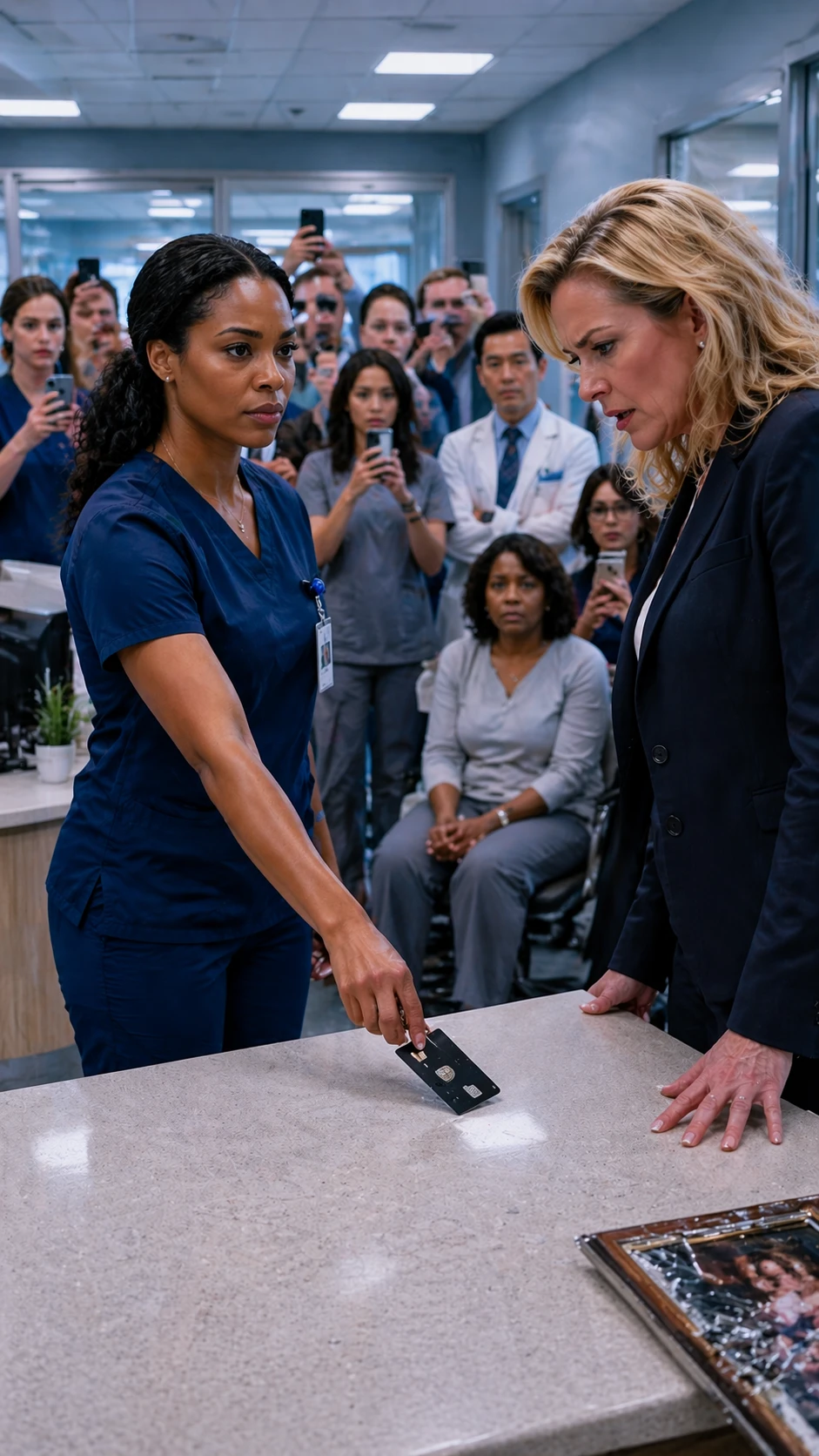
Karen Matthews swept her manicured hand across the nurses’ station desk.
Family photos, pens, a coffee mug, prescription glasses, and a leather notebook scattered like debris after an explosion.
A frame struck the tile.
Glass cracked.
The sound turned heads faster than the shouting.
Amara Johnson looked down.
Her daughter’s medical school graduation photo slid beneath Karen’s designer heel.
The heel pressed down.
The glass gave way with a brittle snap.
“Security’s coming,” Karen announced.
Her voice rang through St. Catherine’s ICU like a performance.
Twelve staff members stared.
Three patient families in the waiting area fell silent.
Someone lifted a phone.
Amara knelt without a word.
Her navy scrubs were wrinkled from a sixteen-hour shift.
Her shoulders ached.
Her fingers trembled only once as she reached for the broken frame.
Inside the photograph, her daughter was smiling in cap and gown.
Proud.
Radiant.
The future itself.
Karen folded her arms.
“What are you waiting for?
An apology?
You should be grateful I’m letting you leave quietly.”
Amara picked up her glasses.
Then the keys.
A platinum card on the ring flashed under fluorescent light.
No one noticed.
No one noticed a lot of things about Amara Johnson.
They did not notice her stillness.
They did not notice the way she watched and remembered.
They did not notice how little humiliation frightened people who had already survived harder things.
That morning, before she put on scrubs, she had been in a tailored suit at the top floor boardroom.
Reviewing acquisitions.
Approving new trauma equipment.
Studying a stack of revenue reports with her name on the final authorization line.
But now she was on the floor.
In front of everyone.
Like Karen had planned.
Maria Gonzalez, the charge nurse, stared in disbelief from her computer station.
Then quietly tilted her phone and went live.
“Y’all need to see this,” she whispered.
“This is racism happening at St. Catherine’s right now.”
The viewer count began to climb.
Amara stood.
Slowly.
One hand holding the broken photo frame.
Karen smiled as if the room belonged to her.
It did not.
Not really.
But for one poisonous moment, it felt like it did.
Chapter 2
Twenty minutes earlier, the ICU had smelled like antiseptic, stale coffee, and exhaustion.
Amara arrived at 2:45 p.m.
As always.
Fifteen minutes early.
She had gone straight to the station and opened patient charts.
Bed nine needed a medication review.
Bed twelve’s blood pressure trend worried her.
She was halfway through her notes when Karen approached with that familiar walk.
May you like


Fast.
Sharp.
A woman who enjoyed being seen before she spoke.
“I don’t care about your so-called experience,” Karen declared.
Her voice was already too loud.
Amara looked up.
“Is there a problem?”
Karen planted both hands on the desk.
“This is a prestigious hospital, not some community clinic.”
Conversations nearby slowed.
“Patients complain about your urban attitude,” Karen continued.
“And frankly, I’m tired of cleaning up the damage.”
Dr. Patterson, standing nearby with lab reports in hand, shifted uncomfortably.
But he said nothing.
Neither did the respiratory therapist.
Nor the unit clerk.
Nor the intern pretending not to listen.
Silence was so often the first accomplice.
Amara’s face revealed almost nothing.
Only her eyes changed.
“What specific incident are you referring to?”
Her tone was calm.
Karen laughed.
“Oh, don’t do that.”
“Don’t get academic with me.”
Then came the sentence that made even Maria flinch.
“This is about fit.
Cultural fit.”
Amara reached into her pocket and drew out her leather notebook.
Gold initials.
AJ.
She began to write.
Karen frowned.
“Are you threatening me?”
“Please state your full name and title for the record,” Amara said quietly.
Karen’s smile widened.
“Honey, I’m Karen Matthews.
Nursing supervisor.
Level four.
Fifteen years here.”
She leaned in.
“And you?”
“What do you have?
Six months?”
Amara glanced up.
The corner of her mouth moved almost invisibly.
“Long enough,” she said.
Karen mistook that answer for weakness.
That was her second mistake.
The first had been underestimating the woman in scrubs.
The third was yet to come.
Chapter 3
Back in the present, Karen gestured toward the waiting area as though presenting evidence to an invisible jury.
“Look around,” she said.
“No one here is confused except you.”
A murmur spread.
Mrs. Carter, whose grandson had been treated in the ICU for complications after surgery, stood slowly from her chair.
Her eyes narrowed.
She had watched Amara work through the night.
She had watched her comfort terrified parents.
She had watched her move from patient to patient with the steady authority of someone who carried storms inside and never let them touch the sick.
“That nurse saved my grandson’s life,” Mrs. Carter said.
Karen did not even turn.
“This is an administrative matter, ma’am.”
Maria’s livestream comments were exploding.
Fire her for what?
Record everything.
Who is that supervisor?
This is evil.
Amara set the broken frame carefully on the desk.
Then she opened her notebook again.
“Karen Matthews,” she said, writing.
“Nursing supervisor, level four.”
Karen rolled her eyes.
Amara continued, “Termination declared publicly.
Discriminatory language used in front of staff and patient families.
Property damage witnessed.
Security requested without documented cause.”
The room changed.
Not loudly.
Not all at once.
But people began to look at Amara differently.
Not because they understood.
Not yet.
But because humiliation had failed to make her small.
Security finally arrived.
Two officers in gray uniforms.
Karen straightened instantly.
“Escort her out.
Immediately.”
Neither officer moved.
They knew Amara.
Everyone in administration knew Amara.
Not by face, perhaps.
But by instruction.
By email.
By authority that traveled through confidential channels.
One officer glanced at the card clipped behind her ID badge, then at Karen.
His face lost color.
“Ma’am,” he said carefully, looking at Amara, “is there a problem?”
Karen snapped her head toward him.
“Yes.
The problem is insubordination.”
Amara reached into her pocket.
The room inhaled.
She removed a slim black card and placed it on the desk between them.
No flourish.
No smile.
Just precision.
“I think,” she said softly, “before anyone escorts anyone anywhere, you should read the name on that.”
Karen scoffed.
Then she looked down.
Her expression did not change at first.
Only her pupils.
Then her mouth parted.
Then her hand actually shook.
The card read:
Amara Johnson
Majority Owner and Acting Chair
St. Catherine Health System
Karen’s face drained white.
The livestream hit ten thousand viewers.
No one in the ICU moved.
It felt less like silence now.
More like impact.
Chapter 4
Karen looked from the card to Amara, then back again, as if reality might rearrange itself if she stared hard enough.
“That’s not possible,” she whispered.
Amara met her eyes.
“It is,” she said.
Karen laughed, but the sound was broken.
“No.
No, you’re lying.”
“Am I?”
Amara reached for her badge and unclipped the secondary credential hidden behind the standard nurse ID.
A gold-edged executive pass dropped into view.
Maria gasped.
Dr. Patterson nearly dropped his charts.
Karen’s voice turned desperate.
“Why would the owner be working bedside in the ICU?”
Amara did not answer immediately.
Because grief deserved space.
Because truth, when timed correctly, hit harder than rage.
Finally she said, “Because five years ago, my husband died in a hospital that had all the right slogans and none of the right eyes on the floor.”
Every person listening froze deeper.
“He didn’t die because no one cared,” Amara continued.
“He died because the people in power stopped seeing the people in beds as human.”
Her voice did not crack.
That made it worse.
“I bought controlling interest in St. Catherine’s two years later.”
“I kept my name off the walls.
I kept my face out of the brochures.”
Karen stared at her like she was seeing a ghost.
“I wanted truth.”
“Not reports.
Not polished meetings.
Truth.”
Amara stepped closer.
“So I worked where lies can’t hide.
Night shifts.
Double shifts.
Holiday weekends.
ICU.
ER.
Pediatrics.
Anywhere fear strips people down to what they really are.”
She looked around the unit.
“I have spent eleven months watching this hospital from the floor.”
“I have watched miracles here.”
“I have also watched cruelty dressed as leadership.”
Karen’s chin trembled.
“This is insane.”
“No,” Amara said.
“This is an audit.”
The words tore through the room.
Karen reached for the desk for balance.
“This is entrapment.”
Amara’s eyes sharpened.
“No.
Entrapment would be forcing you to become what you already are.”
A nurse in the back covered her mouth.
Mrs. Carter whispered, “Lord.”
Maria kept filming.
Thousands watched Karen unravel in real time.
Then Karen did something no one expected.
She pointed at Maria.
“Turn that off now!”
Maria lifted her chin.
“No.”
For the first time that afternoon, Karen looked truly afraid.
Chapter 5
Within twelve minutes, the board liaison, legal counsel, and chief compliance officer were on the unit.
Karen kept trying to speak.
Every sentence came out thinner than the last.
“There’s been a misunderstanding.”
“She deceived everyone.”
“This is not standard procedure.”
“No,” Amara said.
“It isn’t.”
The lawyer, a silver-haired woman named Elise Monroe, stood beside Amara with a tablet in hand.
“Ms. Matthews, pending immediate investigation, your access has been suspended.”
Karen blinked.
“You can’t do this over one argument.”
Amara’s gaze never left hers.
“This isn’t over one argument.”
She nodded once toward Elise.
Elise turned the tablet around.
On the screen were complaints.
Dozens.
Anonymous nurse reports.
Exit interviews.
Patient family testimonies.
Disciplinary patterns.
Shift assignments targeting Black staff and immigrant nurses.
Promotions blocked without explanation.
Incidents buried.
Karen looked like someone had reached inside her chest and removed structure.
Maria whispered, “Oh my God.”
Amara stepped forward.
“I knew there was rot.”
“I did not know how deep it went.”
Karen’s lips parted.
“You investigated me?”
“I investigated the culture.”
“You built yourself at the center of it.”
The compliance officer spoke next.
“We also reviewed financial irregularities connected to staffing budgets.”
Karen jerked her head up.
“What?”
“Ghost scheduling.
Inflated vendor approvals.
Signature routing through your office.”
Karen’s face twisted.
“That’s absurd.”
“It would be,” Amara replied, “if I hadn’t spent last night reading the numbers myself.”
The room seemed to tilt.
Karen tried one last move.
She pointed at Amara with shaking fingers.
“You think people will worship you because you came in here dressed like staff?
This is theater.”
At that, something flashed in Amara’s face.
Pain.
Old and deep.
“I didn’t wear scrubs for theater,” she said quietly.
“I wore them because the sick do not care who owns the building.”
“They care who answers when they are scared.”
That silenced everyone.
Even Karen.
Especially Karen.
Mrs. Carter began to clap.
One soft clap.
Then another.
Maria joined in.
Then Dr. Patterson.
Then two nurses.
Then the waiting area.
It was not loud.
It was not triumphant.
It sounded like recognition.
Long overdue.
Karen began to cry.
Not from remorse.
From collapse.
Security finally stepped forward.
This time, they were not there for Amara.
Chapter 6
The story should have ended there.
With Karen escorted out.
With the livestream viral.
With staff stunned and justice served in one unforgettable afternoon.
But the true ending was waiting upstairs.
That evening, after statements were taken and legal teams settled into conference rooms, Amara changed out of her scrubs and carried the broken photo frame to the executive floor.
She did not replace the glass.
She set the frame on her desk and sat in the dark as the city burned gold outside the windows.
Her daughter’s smiling face stared back at her.
You did it, baby.
Not because you won.
Because you endured.
A soft knock sounded at the door.
Elise stepped in.
“There’s something you need to see.”
Amara expected updated documents.
Or press alerts.
Or another complaint tied to Karen’s department.
Instead Elise handed her a thin envelope marked with the hospital seal.
“No return signature,” Elise said.
“It was delivered to legal archives eight months ago.
Delayed indexing.
We found it during the compliance pull.”
Amara opened it.
Inside was a single letter.
Her breath stopped.
She knew the handwriting.
Even after five years.
Even after death.
It was her husband’s.
Her hands shook as she read.
If you are reading this, it means what I feared was true.
If St. Catherine failed me, don’t burn it down.
Take it.
Fix it from the inside.
There’s one more thing you were never told.
Amara stood so fast her chair rolled backward.
At the bottom of the page was a name.
Karen Matthews.
And beneath it:
She wasn’t just present the night I died.
She tried to save me.
Someone above her stopped her.
Trust her only after you know the whole truth.
Amara stared at the words.
The room went cold.
Everything from the ICU replayed in reverse.
Karen’s panic.
Not arrogance at first, but fear.
The financial irregularities.
The buried complaints.
The desperation when the owner was revealed.
Not just a woman protecting power.
A woman terrified of what would surface if anyone dug too deep.
Amara turned to Elise.
“Bring her back.”
Elise froze.
“What?”
“Now.”
Thirty minutes later, Karen sat across from Amara in a private conference room, eyes swollen, wrists free but guarded by silence.
Amara slid the letter across the table.
Karen read three lines and broke.
Not neatly.
Not quietly.
She shattered.
“I tried to stop them,” Karen whispered.
“The ventilator order was changed from above.
I filed objections.
I was told if I kept talking, I’d lose everything.”
“Who?” Amara asked.
Karen looked up, horror flooding her face.
“The man who helped you buy the hospital.”
The room disappeared around Amara.
“No,” she said.
Karen nodded, sobbing now.
“Your husband’s death helped tank the valuation.
That’s how the deal became possible.
He orchestrated both.”
Amara’s mind raced to one face.
One trusted adviser.
One man who had stood beside her through the acquisition, through every board meeting, through every promise of reform.
Chief Executive Officer Daniel Mercer.
Her closest ally.
The architect of her rise.
And, if Karen was telling the truth, the reason her husband never came home.
Amara felt the world split.
Not because Karen had humiliated her.
Not because she owned the hospital.
Because the enemy had never been the woman in front of her.
It had been the man who helped place the crown on her head.
Outside the conference room, footsteps approached.
Measured.
Confident.
Mercer’s voice sounded through the glass.
“Amara?
I hear legal found something urgent.”
Karen went pale.
Amara folded the letter once.
Then twice.
And rose.
Her grief returned in full.
Sharp as the day she lost him.
But now it had direction.
She looked at Karen.
Then at the door.
Then at the ghost of the life that had been stolen from her.
When Daniel Mercer opened that door, he smiled.
He had no idea the woman standing before him finally knew who had really owned the night her husband died.
