
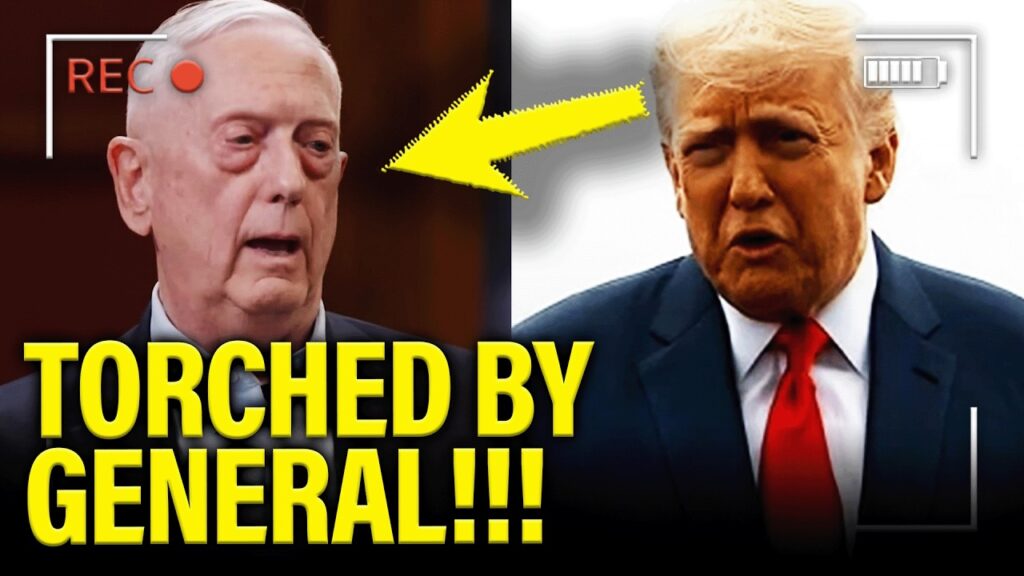
In a bombshell interview that has sent shockwaves through Washington, retired four-star General James Mattis, once Donald Trump’s own Defense Secretary, has unleashed a blistering critique of the former president’s chaotic handling of the Iran conflict. Mattis, drawing on his vast military experience, declares Trump’s strategy utterly devoid of coherence, warning that it has shattered U.S. alliances and could take 8 to 12 years to mend amid escalating global tensions.
This extraordinary rebuke from a decorated leader who served at the highest levels exposes the depths of Trump’s failures in foreign policy. Mattis, who resigned in protest during Trump’s first term, minced no words on PBS’s Firing Line, labeling the Iran regime as unyielding and Trump’s approach as a reckless gamble that ignores the need for strong international partnerships. His comments come as Trump ramps up inflammatory rhetoric against NATO and cozies up to adversaries like Russia.
Mattis’s perspective is rooted in decades of firsthand expertise in the Middle East, making his words all the more damning. He commanded forces in the Persian Gulf War, Afghanistan, and Iraq, and led U.S. Central Command, giving him unparalleled insight into the region’s complexities. In the interview, he bluntly stated that the Iranian regime is “very unlikely to fall,“ emphasizing its brutal grip on power and willingness to fight to the end.
The general’s frustration boils over as he describes Trump’s isolationist tactics as self-sabotage. “America is becoming predatory and unreliable,“ Mattis said, pointing to Trump’s attacks on NATO allies and erratic decisions that erode trust. This comes at a perilous time, with Trump deploying thousands of troops to the region, yet offering no clear endgame, leaving military experts and the public alike questioning the path forward.
Mattis didn’t hold back on the human cost, recalling how allies like Denmark stood with the U.S. after 9/11, only to face Trump’s tariffs and disdain now. He warned that without rebuilding these relationships, any effort in Iran is doomed. “We’re fighting a limited war, but for them, it’s total war,“ he explained, highlighting the regime’s survival instincts against Trump’s muddled “excursion.“
The interview reveals a stark divide between Trump’s bravado and the grim realities on the ground. Mattis, who has studied authoritarian regimes, noted that Iran’s leaders will murder their own to stay in power, making regime change a fantasy. He criticized Trump’s shifting goals—from unconditional surrender to vague promises—as confusing and unachievable, potentially prolonging the conflict indefinitely.
As tensions mount, Mattis’s call for strategic clarity resonates like a warning siren. He urged a return to America’s strengths, including its economy and alliances, rather than solo adventurism that plays into the hands of rivals like Russia and China. Trump’s decisions, Mattis implied, are strengthening these foes, with eased sanctions on Russian oil benefiting adversaries at the expense of global stability.
The general’s memoir echoes in his words: “Nations with allies thrive; those without them die.“ Yet Trump’s actions have left the U.S. isolated, forcing a reevaluation of how to confront Iran without reliable partners. Mattis’s assessment paints a picture of a world order in peril, where Trump’s unpredictability has turned former friends into skeptics.
This isn’t just political theater; it’s a crisis unfolding in real time. Mattis, who resigned in late 2018 over policy disagreements, has now gone public with what insiders have whispered for years. His interview on PBS is a masterclass in leadership, contrasting sharply with Trump’s impulsive style and raising alarms about future conflicts.
Experts are already dissecting Mattis’s remarks, with foreign policy analysts warning that the damage to NATO could embolden Iran and its proxies. Trump’s recent posts deriding the alliance as a “paper tiger“ only fuel the fire, as Mattis points out the strategic folly of alienating key partners while demanding more from them.
In one pivotal clip, Mattis addressed the path to rebuilding trust: “It departs on a horse at a gallop and comes back at a slow walk.“ He estimated 8 to 12 years of consistent effort to restore America’s standing, a timeline that underscores the long shadow of Trump’s decisions. This isn’t hyperbole; it’s a sobering forecast from a man who has seen the worst of war.
The Iranian regime, Mattis explained, is a product of history, tracing back to the 1979 revolution that reshaped the Middle East. He cautioned that recent military actions, while setting back Iran’s nuclear program and proxies, haven’t altered the fundamental dynamics. “We’re going to have to deal with it,“ he said, rejecting any notion of walking away.
Trump’s defenders may dismiss this as sour grapes, but Mattis’s record speaks for itself. As a four-star general, he led with precision and purpose, qualities he finds absent in Trump’s Iran policy. The former president’s flip-flopping—from troop surges to sudden withdrawals—has created a vacuum that adversaries are eager to exploit.
This breaking story forces a national reckoning. As Mattis put it, “We’ve treated them poorly,“ referring to allies, and now the bill is coming due. The U.S. faces a “darn difficult problem“ in Iran, one that demands unity and strategy, not division and bluster.
In the broader context, Mattis’s interview highlights the risks of leadership without foresight. China’s gains and Russia’s resurgence, he noted, are direct outcomes of America’s missteps. This isn’t just about Iran; it’s about the global balance of power teetering on the edge.
Viewers of the PBS segment were left with a clear message: Trump’s approach is not only failing but accelerating decline. Mattis’s unfiltered analysis, delivered with the authority of experience, serves as a wake-up call for policymakers and the public alike.
The fallout from this interview could reshape debates on foreign policy, especially as elections loom. Mattis’s words carry the weight of history, urging a return to principled engagement before it’s too late. In a world of uncertainty, his voice cuts through the noise, demanding attention and action.
This urgent revelation from General Mattis isn’t fading; it’s igniting conversations across capitals. The former Defense Secretary’s critique exposes the fragility of current strategies, calling for immediate course corrections to avert deeper crises. As tensions escalate, his insights could prove pivotal in steering the U.S. back from the brink.
Mattis’s emphasis on clear objectives resonates profoundly. In warfare, as in life, purpose and planning are non-negotiable, yet Trump’s “murky“ intent leaves forces 𝓮𝔁𝓹𝓸𝓼𝓮𝓭. This disconnect, Mattis warns, invites disaster, echoing lessons from past conflicts that cost lives and treasure.
The interview’s final clips drive home the point: Iran’s regime is entrenched, and half-measures won’t suffice. Mattis’s call for a “good strategy“ as an “appetite suppressant to war“ is a masterstroke of wisdom, contrasting sharply with Trump’s appetite for conflict without end.
In summary, General James Mattis has thrown down the gauntlet, challenging the narrative of Trump’s so-called strength. His words, born of battlefield experience, paint a vivid picture of peril and possibility, urging America to reclaim its role as a reliable global leader before irreparable damage sets in. This story isn’t over; it’s just beginning, and the world is watching.
