
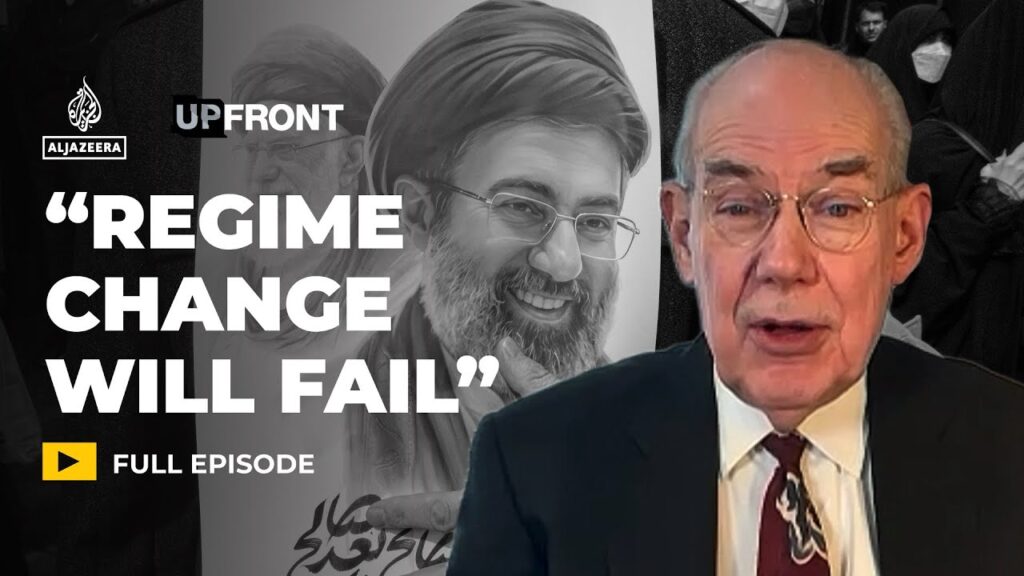
Renowned political scientist John Mearsheimer argues that the United States, currently engaged in a major military conflict with Iran under the Trump administration, faces dim prospects for strategic success. In a detailed analysis, Mearsheimer contends that Washington was effectively drawn into the war by Israel and its influential lobby, despite the campaign running counter to core American national interests.
Israel’s Role and Lobby Influence Mearsheimer highlights Israel’s long-standing push for confrontation with Iran, particularly under Prime Minister Benjamin Netanyahu, who has framed Tehran as an existential threat due to its nuclear program and support for proxy groups like Hezbollah, Hamas, and the Houthis. He describes the Israel lobby as the most powerful in U.S. history, capable of shaping American foreign policy in ways that diverge from U.S. priorities—citing examples from support for Israeli actions in Gaza, past involvement in Iraq, and pressure on Iran policy. While acknowledging shared U.S.-Israel goals in preventing Iranian nuclear weapons, Mearsheimer insists that a direct military attack on Iran serves Israeli rather than American interests, as Iran poses no direct threat to the United States.
U.S. Objectives and Strategic Flaws The primary American aim, according to Mearsheimer, is regime change in Tehran: to install a government that halts nuclear enrichment, dismantles ballistic missile programs, and ends support for regional militias. He criticizes the administration’s shifting rationales—alternating between nuclear prevention, missile threats, proxy attacks, and broader security concerns—as incoherent. Air power alone, he argues, cannot force regime change; historical cases (e.g., Iraq, Afghanistan, Libya, Serbia) show that sustained punishment campaigns fail without a ground invasion, which remains politically untenable given public opposition and lessons from past “forever wars.”
Military and Public Support Realities Mearsheimer notes that only about 20% of Americans supported the war at its outset on February 28, 2026—an unprecedented low for a U.S.-initiated conflict. He cites warnings from military leaders, including Joint Chiefs Chairman Gen. Kaine, about depleted munitions stocks insufficient for prolonged engagement, drawing parallels to Ukraine aid challenges and potential future Taiwan scenarios. Trump’s campaign promises to avoid endless wars clash with his current claims of unlimited U.S. weaponry, creating credibility gaps.
Predicted Outcomes and Global Ramifications Mearsheimer predicts the U.S. will not “win” in any meaningful sense. Regime change is unattainable without boots on the ground, and prolonged bombing risks accelerating Iran’s nuclear breakout. Post-conflict U.S.-Israel relations may fray if goals remain unmet, with Israel potentially escalating independently. Globally, the war benefits adversaries: Russia gains from elevated oil prices (weakening sanctions and reducing U.S. leverage in Ukraine), while China projects stability and expands Middle East influence amid perceived American overreach.
Counterarguments and Broader Context Critics of Mearsheimer’s view argue that Israel’s influence is overstated, pointing to longstanding U.S. strategic interests in Middle East dominance, oil security, and countering Iranian expansionism—factors predating the modern Israel lobby. Nonetheless, Mearsheimer maintains that the current escalation exemplifies how powerful domestic lobbies can pull the U.S. into conflicts misaligned with its own security and economic priorities.
As the conflict enters its third week with no clear off-ramp, the analysis underscores deep skepticism about achieving decisive victory through air strikes alone and highlights the risks of mission creep in an already divided domestic landscape.
